

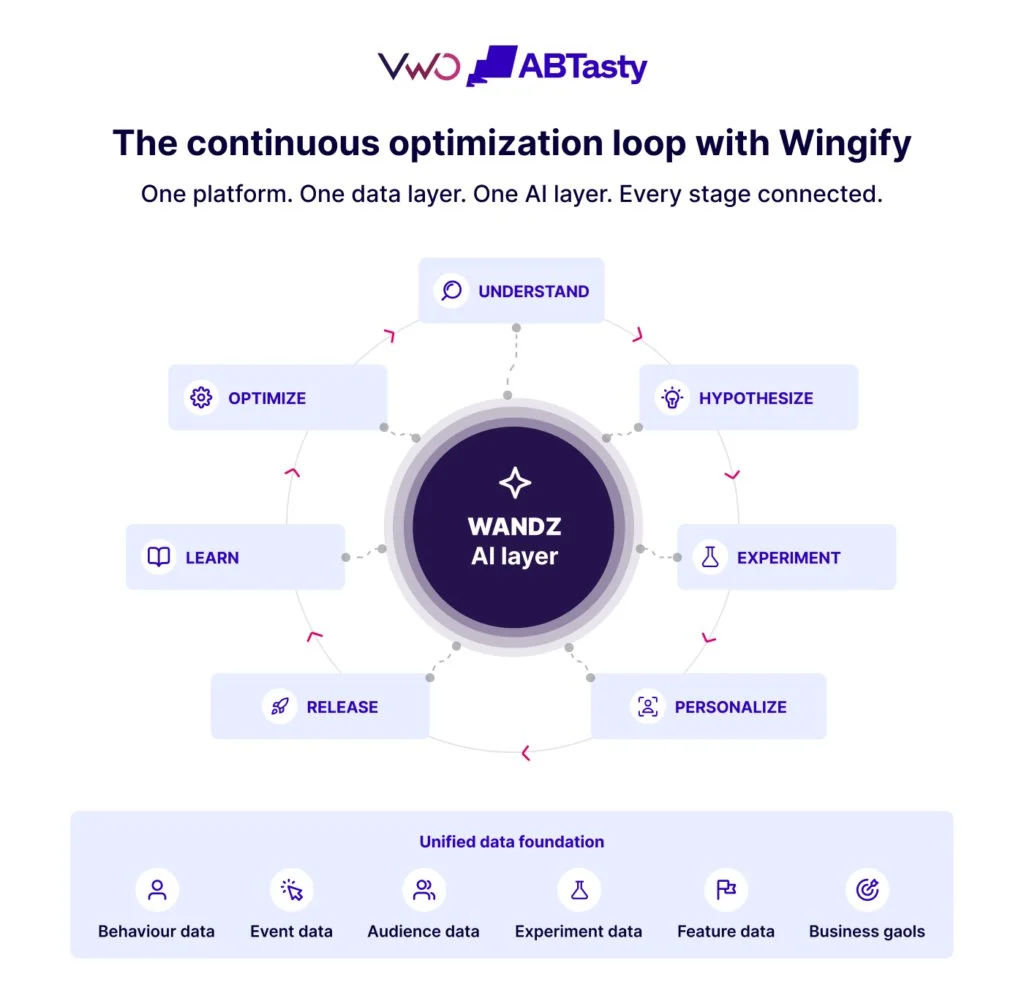
Wingify has officially launched its integrated Digital Experience Optimization (DXO) suite, a comprehensive platform that brings together the industry-leading capabilities of AB Tasty and VWO under a single operational umbrella. This move, following the 2026 merger of the two entities, aims to address the persistent "coordination problem" that has long plagued digital marketing and product teams. By uniting personalization, experimentation, feature management, customer insights, and artificial intelligence into a singular ecosystem, Wingify intends to eliminate the friction caused by disconnected point solutions and fragmented data silos.
The launch marks a significant shift in the digital experience landscape. For years, organizations have struggled with a "data gap"—a systemic disconnect between the collection of user information and the ability to execute confident, data-driven actions. While most enterprise teams possess an abundance of data, the ability to tie specific experiments back to revenue or accurately target audiences across multiple tools has remained elusive. Wingify’s new suite is designed to serve as a shared, complete view of the customer, allowing cross-functional teams to act from a unified interface without the need for manual data reconciliation or translation layers.
The Structural Challenge of Disconnected Martech Stacks
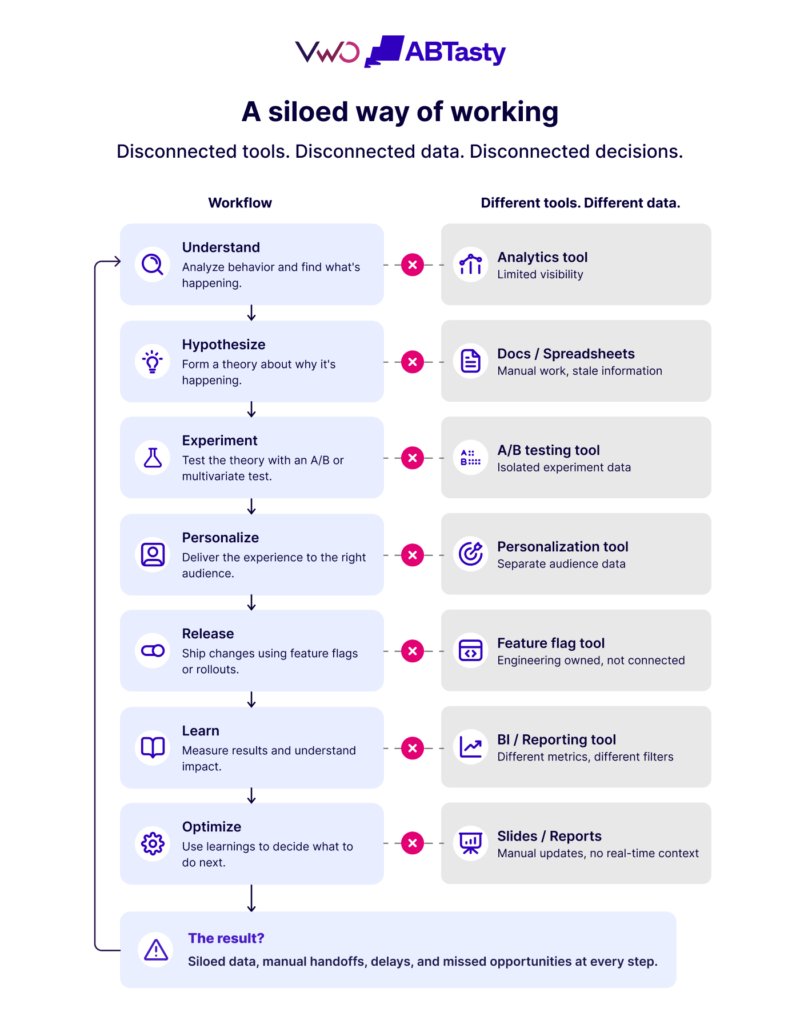
The modern digital optimization strategy is often a patchwork of specialized tools. While "best-of-breed" solutions offer deep functionality in specific niches, they frequently fail to communicate with one another. This lack of integration creates several critical bottlenecks that Wingify’s unified suite seeks to resolve.
One of the primary issues identified by Wingify leadership is that data which does not "travel" inevitably slows down decision-making. In a fragmented stack, a customer insight discovered in an analytics tool must be manually moved to an experimentation platform, then to a personalization engine, and finally to a feature management tool for rollout. Each of these handoffs introduces the risk of interpretation errors and significant time delays. By the time a hypothesis is tested and deployed, the market conditions or user behaviors that prompted the idea may have already shifted.
Furthermore, audience definitions often drift apart when managed across separate platforms. A segment defined as "returning customers who abandoned a cart" might be calculated differently in an analytics tool versus a personalization suite due to differing tracking methodologies or data refresh rates. This discrepancy leads to conflicting reports, where experimentation metrics do not align with overall business analytics, forcing teams to spend more time reconciling spreadsheets than optimizing the user experience.
A Unified Architecture for Continuous Improvement
Wingify’s DXO suite is built on the philosophy that connection, rather than just individual capability, drives business outcomes. The platform is structured around a continuous loop of "Understand, Hypothesize, Experiment, Personalize, Release, and Learn."
In this model, the output of one stage automatically becomes the input for the next. For instance, a heatmap generated within the suite might reveal a point of friction in the checkout process. This insight is immediately available to the experimentation module to form a hypothesis. Once a winning variant is identified through A/B testing, it can be instantly converted into a personalized experience for the specific segment that showed the highest engagement. Finally, the feature management component allows for a progressive rollout of the change, ensuring stability through kill switches and gradual exposure.
This unbroken chain is supported by the legacy strengths of both constituent brands. VWO contributes over a decade of expertise in behavioral insights and rigorous experimentation, while AB Tasty provides advanced capabilities in AI-driven targeting and enterprise-grade personalization.
The Integration of Wandz: Contextual AI in DXO
A central pillar of the new Wingify suite is "Wandz," an embedded AI engine that serves as the intelligence layer across all modules. Unlike general-purpose AI tools that require users to manually input context through prompts, Wandz is woven directly into the platform’s workflows. It possesses native visibility into live experiments, audience segments, rollout histories, and campaign performance.
The integration of Wandz represents an evolution of AB Tasty’s "Evi" and VWO’s "Copilot" AI assistants. By merging these technologies, Wingify has created a system capable of:
- Automated Hypothesis Generation: Analyzing user behavior data to suggest high-impact testing opportunities.
- Dynamic Audience Building: Using machine learning to identify micro-segments that are most likely to respond to specific personalized interventions.
- Configuration Review: Auditing experiment setups to ensure statistical validity and prevent technical conflicts before a test goes live.
- Predictive Interpretation: Surfacing the "why" behind experimental results, allowing teams to understand the underlying drivers of user behavior rather than just the raw numbers.
By removing the "round trip" required to consult external AI tools, Wandz significantly reduces the time between insight and action, allowing teams to scale their optimization efforts without a linear increase in headcount.
Feature Management and Governance
Recognizing the increasing overlap between marketing and engineering, Wingify has placed a heavy emphasis on feature management. The suite includes robust tools for feature flags, progressive rollouts, and "kill switches." This allows product teams to deploy code more frequently and with less risk, as new features can be toggled on or off for specific user segments without requiring a full redeployment of the application.
From a governance perspective, the unified platform provides a centralized permission model. For large enterprises operating across multiple regions and brands, this simplifies the management of security protocols and audit trails. Rather than maintaining separate compliance standards for five different tools, organizations can manage their entire digital optimization surface through a single administrative interface. This is particularly relevant for maintaining compliance with global data privacy regulations such as GDPR and CCPA, as user consent and data handling are managed through a unified data layer.
Chronology and Market Context
The formation of the Wingify DXO suite is the culmination of a multi-year strategic roadmap.
- Early 2010s: VWO and AB Tasty emerge as early leaders in the A/B testing and CRO (Conversion Rate Optimization) space, respectively focusing on ease-of-use and enterprise personalization.
- 2020-2024: Both companies aggressively expand their offerings. VWO integrates full-stack experimentation and insights, while AB Tasty acquires technologies to bolster its AI and server-side capabilities.
- 2026: The formal merger is announced, creating Wingify as the overarching entity. The companies begin the process of technical integration.
- Present: The launch of the unified Wingify DXO suite, marking the transition from two separate product lines to a single, integrated experience.
Industry analysts suggest that this consolidation is a response to a broader trend in the software-as-a-service (SaaS) market. As organizations look to reduce "vendor fatigue" and optimize their software spend, there is a growing preference for integrated platforms over fragmented point solutions. Wingify’s move positions it as a direct competitor to large-scale marketing clouds offered by providers like Adobe and Optimizely, but with a specific focus on the agility required for digital experience optimization.
Official Perspectives and Future Outlook
While current users of AB Tasty and VWO will continue to see their existing products supported, Wingify has confirmed that these products are being gradually folded into the unified Wingify experience. The transition is designed to be seamless, allowing teams to adopt the new integrated features at their own pace.
The business case for a unified suite rests on the principle of compounding improvements. When the barriers between data and action are removed, the frequency of experimentation increases. In a competitive digital landscape, the ability to learn and adapt faster than the competition is a primary driver of long-term growth.
As the digital economy continues to evolve, Wingify’s leadership anticipates that AI will play an even larger role in automating the "tedious" aspects of optimization—such as data cleaning and basic segmentation—allowing human teams to focus on high-level strategy and creative problem-solving. The launch of the Wingify DXO suite is a foundational step toward that automated, data-fluent future, providing the infrastructure necessary for organizations to finally bridge the gap between having data and knowing exactly what to do with it.







