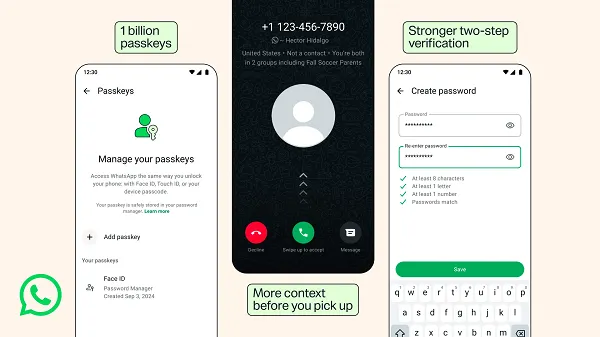
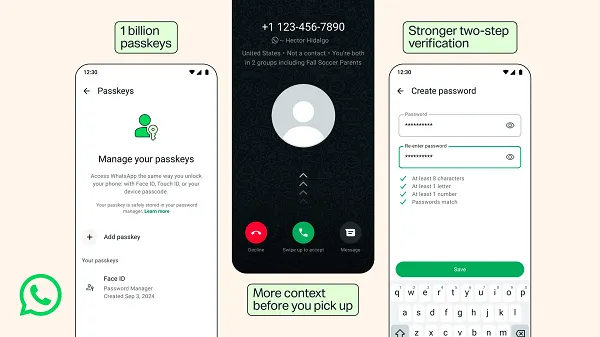
WhatsApp, the world’s leading instant messaging platform with over two billion users, is significantly upgrading its account security protocols by rolling out several critical enhancements. These include the ability for users to add multiple passkeys to a single account across both Android and iOS devices, expanding its two-step verification (2SV) system to support longer, alphanumeric passwords, and introducing more detailed caller information to help users identify and avoid potential scams. These updates underscore WhatsApp’s ongoing commitment to user privacy and security, addressing evolving cyber threats and aiming to provide a more robust defense against account takeovers and social engineering tactics.
The core of these new security measures lies in strengthening the foundational elements of account access and verification. Passkeys, initially introduced by WhatsApp in 2023, have already seen widespread adoption, with the company reporting over one billion users having created a passkey. This innovative authentication method offers a more secure and convenient alternative to traditional passwords, leveraging biometric authentication (fingerprint, facial recognition) or device PINs to verify identity without the need for complex, memorized strings of characters. The ability to now associate multiple passkeys with a single WhatsApp account significantly enhances redundancy and user flexibility. For instance, a user might register a passkey from their primary smartphone, a secondary tablet, and perhaps a work device, ensuring seamless and secure access even if one device is lost or inaccessible. This multi-device support aligns with broader industry trends towards universal second-factor (U2F) and FIDO Alliance standards, which aim to eliminate the vulnerabilities associated with traditional passwords. Passkeys are inherently phishing-resistant, as the authentication process involves a cryptographic key stored securely on the user’s device, making it virtually impossible for attackers to intercept credentials through fake websites or deceptive prompts. The previous limitation of a single passkey could pose a challenge if that specific device was unavailable, but the new multi-passkey functionality mitigates this risk, offering greater resilience in account recovery and daily access.
Alongside the enhanced passkey system, WhatsApp is revolutionizing its two-step verification (2SV) process. Historically, WhatsApp’s 2SV relied on a six-digit PIN, a system that, while providing an additional layer of security beyond the initial SMS verification, still presented inherent vulnerabilities. Short, numeric PINs are susceptible to brute-force attacks, especially if users opt for common, easily guessable sequences like "123456" or birthdates. Recognising this weakness, WhatsApp is now expanding its 2SV to accommodate full alphanumeric passwords, including special characters. This shift dramatically increases the entropy and complexity of the verification code, making it exponentially harder for malicious actors to crack. As WhatsApp itself highlighted, for users still employing simple PINs like "123456," this update serves as a critical prompt to upgrade to a more robust password. The transition from a fixed-length numeric PIN to a variable-length alphanumeric password with special characters aligns WhatsApp’s 2SV with best practices in modern cybersecurity, where password strength is directly correlated with length and character diversity. This enhancement is particularly crucial given the prevalence of SIM swap attacks and other methods used to intercept SMS-based one-time passcodes, where a strong 2SV password acts as a vital last line of defense against account compromise.
Beyond account access, WhatsApp is also addressing the pervasive issue of scam calls and unsolicited communications by introducing more context to its call display feature. On Android devices, users will now see additional information about non-contact callers, such as the country of origin for the incoming number and whether they share any common groups with the caller. This seemingly minor update carries significant implications for user safety. Scam calls, often originating from international numbers or disguised as legitimate contacts, have become a sophisticated vector for fraud, identity theft, and malware distribution. By providing immediate contextual clues, WhatsApp empowers users to make more informed decisions about whether to answer an unfamiliar call. A call from an unknown international number with no shared groups, for instance, could immediately raise a red flag, prompting the user to decline or exercise extreme caution. This feature complements WhatsApp’s existing "Silence Unknown Callers" setting, offering an additional layer of discernment before a call is even accepted. It is a proactive step to combat social engineering tactics, which often rely on urgency and lack of information to trick victims into divulging sensitive data or taking harmful actions.
Chronology of WhatsApp’s Security Evolution
WhatsApp’s journey to bolster user security has been a continuous process, evolving significantly over the past decade to meet the demands of a rapidly changing digital landscape and increasingly sophisticated cyber threats.
- 2014: WhatsApp is acquired by Meta (then Facebook), leading to increased scrutiny over its security practices.
- 2016: A landmark year, WhatsApp rolls out end-to-end encryption (E2EE) by default for all messages, calls, photos, videos, and files across all its platforms. This implementation, powered by the Open Whisper Systems’ Signal Protocol, ensures that only the sender and recipient can read messages, not even WhatsApp itself. This move positioned WhatsApp as a leader in privacy-focused messaging.
- 2017: Two-step verification (2SV) is introduced. Initially, this feature allowed users to protect their account with a six-digit PIN, which would be required when re-registering their phone number with WhatsApp. This added an essential layer of security against SIM swap attacks and unauthorized account access.
- 2018-2022: WhatsApp introduces a series of incremental security and privacy features, including:
- Group Privacy Settings: Allowing users to control who can add them to groups.
- Disappearing Messages: Enabling messages to automatically delete after a set period.
- View Once: Allowing photos and videos to be viewed only once before disappearing.
- Backup Encryption: Option to encrypt chat backups stored in Google Drive or iCloud.
- Chat Lock: A feature to password-protect individual chats, hiding them from the main chat list.
- Silence Unknown Callers: Automatically silencing calls from numbers not in the user’s contacts.
- 2023: WhatsApp integrates passkey support, offering a passwordless and phishing-resistant authentication method using biometrics or device PINs for account login and recovery. This marked a significant step towards modern authentication standards.
- Current Rollout (Late 2023/Early 2024): The latest wave of updates, detailed in this article, includes multi-passkey support, expanded alphanumeric passwords for 2SV, and enhanced call display information for non-contacts. These features build upon the existing security infrastructure, providing deeper layers of protection.
This chronology illustrates a clear pattern: WhatsApp consistently responds to user feedback and emerging security challenges by integrating advanced cryptographic techniques and user-centric security controls, solidifying its position as a secure communication platform.
Broader Industry Context and Supporting Data
The enhancements by WhatsApp are not isolated but reflect a broader industry-wide push towards more robust, user-friendly security measures in response to a escalating threat landscape. Cybercrime continues to grow at an alarming rate, with reports consistently highlighting the increasing sophistication of phishing, malware, and social engineering attacks. According to the Identity Theft Resource Center (ITRC), data compromises affected hundreds of millions of individuals annually, often leading to credential stuffing and account takeovers. A significant percentage of these breaches are attributable to weak or reused passwords.
The shift towards passkeys, championed by the FIDO Alliance and major tech players like Google, Apple, and Microsoft, represents a pivotal moment in the battle against password-related vulnerabilities. Passkeys are based on public-key cryptography, where a unique cryptographic key pair is generated for each account. The private key remains securely on the user’s device, while the public key is registered with the service provider. This eliminates the need for users to remember complex passwords, reduces the risk of phishing, and provides a more seamless login experience through biometrics or device PINs. The adoption of passkeys by over a billion WhatsApp users in a relatively short period underscores the readiness of the general public to embrace more secure, passwordless authentication methods when presented with a simple user experience.
Similarly, the upgrade to alphanumeric 2SV passwords for WhatsApp is a direct response to the inadequacy of simple PINs in the face of modern cracking techniques. While any password can theoretically be cracked given enough time and computational power, increasing the length and character set dramatically increases the time and resources required, rendering brute-force attacks impractical for most attackers. A six-digit numeric PIN has only 1 million possible combinations (10^6), which can be guessed relatively quickly. An alphanumeric password of similar length, including special characters, could have trillions of combinations, and longer passwords make the task exponentially harder. This aligns with recommendations from cybersecurity agencies worldwide, which advocate for strong, unique passwords combined with multi-factor authentication.
The focus on combating scam calls is also timely. Voice phishing (vishing) and scam calls exploiting messaging platforms have seen a surge, particularly during times of global crises or widespread online activity. Scammers often leverage publicly available information or stolen data to make their calls appear legitimate, tricking individuals into revealing personal information or performing actions that compromise their accounts. The ability to see the country of origin and shared group context for unknown callers directly addresses these social engineering tactics, providing users with vital information to assess risk before engaging. This proactive approach helps users avoid falling victim to sophisticated schemes that might otherwise bypass traditional spam filters.
Official Responses and Inferred Statements
While the official statements from WhatsApp on these specific updates are concise, they implicitly convey a strong commitment to user safety and privacy. The direct quote, "If you’ve been using ‘123456,’ this is your sign to upgrade," is a clear and urgent call to action, demonstrating WhatsApp’s awareness of common user security pitfalls and its role in educating its user base.
The company’s blog post further elaborates on the rationale behind the 2SV upgrade: "Two-step verification is an extra protection layer that helps prevent someone from taking over your account, even if they get hold of your one-time passcode. Until now it was a six-digit PIN, we’ve now upgraded it to a full password: longer, alphanumeric, and even with special ch@racters to make it harder to guess." This statement emphasizes the preventative nature of the feature and the deliberate design choice to enhance complexity.

Regarding the call display feature, WhatsApp stated, "On Android, you’ll now see more information about a non-contact caller, like whether the number is from a different country and if you have any groups in common." This highlights a user-centric approach, providing actionable intelligence to empower users in their decision-making process when faced with potentially unwanted or malicious calls.
Collectively, these statements, though brief, infer a broader strategic objective from Meta, WhatsApp’s parent company. This objective includes:
- Proactive Security Development: Continuously anticipating and addressing emerging threats rather than merely reacting to them.
- User Empowerment: Providing users with tools and information to manage their own security effectively.
- Privacy by Design: Integrating security and privacy considerations into the core development of features.
- Industry Leadership: Setting high standards for security in the messaging space, particularly given WhatsApp’s immense global reach.
These updates can be seen as part of Meta’s larger investment in cybersecurity, not just for WhatsApp but across its entire ecosystem of applications, aiming to build trust and ensure the safety of its vast global user base.
Broader Impact and Implications
The combined impact of these security updates for WhatsApp’s two billion users is substantial, fostering a more secure and trustworthy communication environment.
- Enhanced Account Resilience: The multi-passkey support significantly reduces the risk of being locked out of an account due to a lost or damaged device, improving user experience and reducing reliance on less secure recovery methods. The move to stronger 2SV passwords creates a much more formidable barrier against account takeovers, even if an attacker manages to obtain a user’s initial login credentials. This is particularly crucial for users in regions prone to cybercrime or political unrest, where secure communication is paramount.
- Reduced Vulnerability to Social Engineering: The enhanced call display feature directly tackles the growing menace of scam calls. By providing immediate context, WhatsApp is helping users develop a "scam sense" before they even engage with a potential threat. This can lead to a tangible reduction in successful phishing, vishing, and identity theft attempts originating from the platform.
- Improved User Confidence: In an era where data breaches and privacy concerns are constantly in the headlines, consistent security enhancements like these can significantly boost user confidence in WhatsApp as a reliable and secure platform for personal and professional communication. This trust is vital for maintaining and expanding its massive user base.
- Setting Industry Benchmarks: As a market leader, WhatsApp’s adoption of advanced security features often influences other messaging applications. These updates could encourage competitors to similarly enhance their security offerings, ultimately benefiting the broader digital ecosystem.
- Challenges and Adoption: While the technical improvements are clear, the success of these features also hinges on user adoption. Educating users, particularly those less tech-savvy, about the benefits of creating multiple passkeys and upgrading their 2SV passwords will be crucial. WhatsApp’s "this is your sign to upgrade" message is a good start, but sustained awareness campaigns may be necessary to maximize the impact of these security layers. The balance between enhanced security and user convenience remains a perpetual challenge, and WhatsApp’s implementation appears to strike a reasonable equilibrium.
In conclusion, WhatsApp’s latest security updates represent a comprehensive and strategic reinforcement of its platform against the backdrop of an ever-evolving cyber threat landscape. By embracing modern authentication standards like multi-passkey support, strengthening critical verification layers with alphanumeric 2SV, and empowering users with more information to combat scams, WhatsApp is not only protecting its vast user base but also reaffirming its commitment to being a secure and private communication service. These advancements are critical for maintaining user trust and ensuring the platform remains a safe digital space in an increasingly interconnected world.