Raul Delapena Setiawan
From the nascent stages of the internet, website developers recognized the inherent need to guide users and search engine crawlers through the digital landscape. Early iterations of websites often featured comprehensive lists of links, acting as navigational anchors to a site’s core sections. These could be found in the often-overlooked footer of a webpage or presented on dedicated, standalone pages, and were commonly referred to as "sitemaps." This fundamental concept of providing a structured overview of a website’s content has evolved significantly, particularly with the advent of search engine optimization (SEO) as a critical component of online visibility.
The landscape of sitemaps underwent a seismic shift in 2005 when Google introduced a groundbreaking innovation: the XML sitemap. This new format leveraged the Extensible Markup Language (XML), a powerful text-based data storage standard developed in the 1990s. Site owners were empowered to submit these XML sitemaps directly to Google, a process that would later become streamlined through the now-ubiquitous Google Search Console. The primary objective behind this development was to equip search engines with a more efficient and comprehensive method for discovering and indexing all the pages within a website. This marked a significant departure from earlier methods, which relied more heavily on traditional link-following mechanisms.
As the digital ecosystem matured, the industry began to differentiate these two distinct types of sitemaps. The original, human-readable navigation aids were retrospectively termed "HTML sitemaps," while the more technical, machine-readable files became known as "XML sitemaps." Despite their shared nomenclature and overarching purpose – to improve site discoverability – a persistent confusion often arises among website owners regarding their distinct functionalities and benefits. For e-commerce businesses, understanding this difference is not merely an academic exercise but a critical factor in optimizing their online presence and driving organic traffic. This guide aims to demystify these two essential tools, providing e-commerce owners with a clear roadmap to leveraging them effectively.
Unpacking the Core Differences: Discoverability and Indexation
The fundamental divergence between HTML and XML sitemaps lies in their primary audience and operational mechanism. XML sitemaps are meticulously engineered to enhance discoverability for search engine bots. By providing search engines with a direct, structured list of URLs, they allow crawlers to locate and identify pages on a site without necessarily needing to navigate through the website’s front-end interface. This bypass mechanism is invaluable for ensuring that search engines are aware of every single page, regardless of its internal linking structure or prominence within the site’s navigation.
However, the mere discovery of a page via an XML sitemap does not guarantee its indexing. The decision by search engine bots to crawl and subsequently index these discovered pages is a complex interplay of numerous factors. These include a site’s "crawl budget," which dictates how many pages a search engine will allocate resources to crawl; the site’s overall authority and reputation; the relevance and originality of the content; the depth and comprehensiveness of the internal linking strategy; and the presence of authoritative external backlinks. In essence, an XML sitemap acts as an invitation, but the search engine’s decision to accept and process that invitation is based on a broader assessment of the website’s quality and relevance.
Conversely, HTML sitemaps operate on a different principle. They are not designed as a direct conduit for search engine bots to bypass user navigation. Instead, crawlers must actively land on the website itself to access an HTML sitemap, typically by following internal links that lead to this dedicated page. This means that an HTML sitemap’s discoverability by search engines is intrinsically linked to the site’s internal linking structure.
The impact of HTML sitemaps on search engine optimization remains a subject of ongoing discussion among SEO professionals. However, practical experience suggests that they can indeed contribute to improved indexing. By clearly outlining internal links to every page, an HTML sitemap can offer search engines a comprehensive view of the site’s architecture. When strategically placed, such as in the website’s footer, HTML sitemaps can effectively distribute "internal link equity" across the listed pages. This distribution can be particularly beneficial in mitigating the dreaded "Crawled, currently not indexed" status within Google Search Console, indicating pages that have been discovered but not yet added to the search engine’s index. This offers a valuable layer of redundancy and a fallback mechanism for pages that might otherwise be overlooked.
The Strategic Synergy: Leveraging Both HTML and XML Sitemaps
The consensus among SEO experts and practitioners is that the most effective approach for e-commerce businesses is to utilize both HTML and XML sitemaps in tandem. This dual strategy significantly enhances a website’s ability to be discovered, crawled, and indexed by search engines, especially for larger and more complex sites with a vast number of product pages and categories.
However, it is crucial to understand that neither sitemap serves as a substitute for a well-designed website hierarchy. The ultimate organic search visibility of a website is contingent upon a fast, logically structured, and robustly interlinked site. A natural website hierarchy that intuitively prioritizes important pages remains the cornerstone of effective SEO. Sitemaps are powerful tools to support this foundation, not to replace it.
In certain scenarios, such as during a significant website restructuring or when awaiting the finalization of internal linking strategies, the temporary implementation of an HTML sitemap can be a prudent recommendation. This can help bridge any potential gaps in discoverability during the transition phase. However, it is essential to reiterate that an HTML sitemap should never be considered a permanent replacement for a well-executed internal linking strategy.
Recent insights from Google have further underscored the value of HTML sitemaps, even from a search engine’s perspective. In a discussion on the "Search Off the Record" podcast, Google’s John Mueller, who has historically expressed a degree of skepticism regarding the SEO impact of HTML sitemaps, acknowledged their potential benefits. Mueller noted that HTML sitemaps "would help crawling because from this place we can find all the links," highlighting their utility in providing a centralized point for link discovery. This statement suggests a growing recognition within Google of the role HTML sitemaps can play in the crawling process.
Construction and Maintenance: Dynamic XML vs. Static HTML
The construction and maintenance of XML and HTML sitemaps exhibit distinct characteristics that align with their respective purposes.

XML sitemaps are inherently dynamic. They are designed to be continuously updated to reflect the most current state of a website. This includes the addition of new pages, the introduction of new products in an e-commerce context, or any modifications to existing content. An XML sitemap should ideally enumerate every URL that a site owner wishes to have indexed by search engines. This ensures that any new content or product listings are promptly communicated to search engines.
In contrast, HTML sitemaps are typically static in nature. They usually focus on presenting the most important pages and categories of a website. This approach aligns with their primary role as a navigational aid for human users.
During the aforementioned podcast episode, John Mueller further elaborated on the differing construction principles, particularly in the context of e-commerce. He stated, "If you have an e-commerce site, you wouldn’t list all of your products in an HTML sitemap file. You would list the categories so people can go to the right place, then pick out the product individually." This illustrates a key strategic difference: XML sitemaps are comprehensive inventories of all indexable URLs, while HTML sitemaps serve as curated directories of high-level navigational pathways.
The creation of XML sitemaps is often automated. Most modern content management systems (CMS) and e-commerce platforms have built-in functionalities that generate and update XML sitemaps automatically. Website owners are typically advised to consult the documentation of their specific CMS or platform to locate the URL(s) of their XML sitemap. Once identified, this sitemap should be submitted to search engine submission tools such as Google Search Console and Bing Webmaster Tools. This submission process is critical for ensuring that search engines are actively monitoring the sitemap for changes and new content.
To ensure the efficacy and accuracy of XML sitemaps, specialized web crawler tools can be employed. Software like Screaming Frog’s SEO Spider is invaluable for auditing XML sitemaps. These tools can meticulously examine the sitemap for critical issues such as broken links (404 errors), URLs that have been intentionally excluded from indexing (noindexed URLs), and other potential glitches that could hinder search engine crawling and indexing. Proactive identification and resolution of these issues are paramount for maintaining optimal search engine performance.
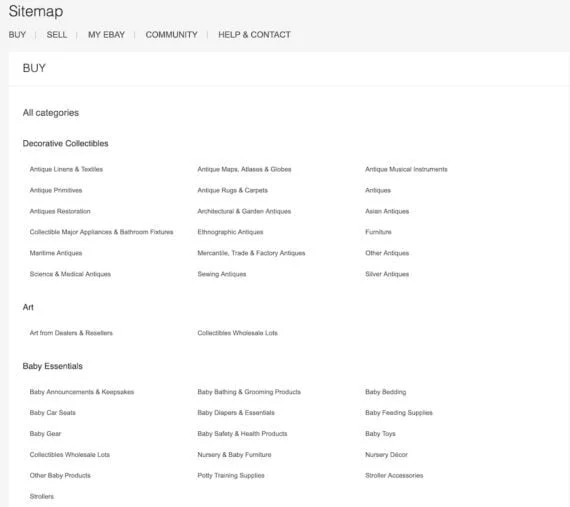
HTML sitemaps, on the other hand, are built with both human users and search engine crawlers in mind. Their construction is guided by the website owner’s strategic prioritization of pages. A prime example of an effective HTML sitemap in action can be observed on eBay’s website. eBay’s HTML sitemap provides a clear and organized pathway to its main categories and subcategories. The intended audience for such a sitemap is primarily human users who are actively searching for specific types of products, seeking assistance, or looking for community discussions.
The structure of eBay’s HTML sitemap, as depicted in accompanying visual representations, showcases a hierarchical arrangement. It typically begins with broad top-level links such as "Buy," "Sell," "My eBay," "Community," and "Help & Contact." Beneath these, a dedicated "Buy" section might meticulously list categories like "Decorative Collectibles," "Art," and "Baby Essentials," each further broken down into granular subcategory links presented in a visually accessible multi-column format. This detailed organization facilitates intuitive browsing and empowers users to efficiently navigate to their desired sections of the vast e-commerce platform. This approach underscores the HTML sitemap’s role as a navigational blueprint, guiding users through the complexities of a large online marketplace.
Broader Implications for E-commerce Growth
The strategic implementation of both HTML and XML sitemaps carries significant implications for the growth and success of e-commerce businesses. In an increasingly competitive online marketplace, maximizing organic search visibility is paramount.
XML sitemaps, by ensuring that search engines are aware of every product and category page, directly contribute to a more comprehensive index. This increased visibility means that a wider range of product searches can potentially surface the e-commerce site’s offerings. For businesses with extensive product catalogs, the ability to quickly communicate new product additions or updates to search engines via an XML sitemap can significantly reduce the time lag between a product going live and its potential appearance in search results. This can translate into faster sales cycles and improved inventory turnover.
HTML sitemaps, while primarily serving human users, also indirectly benefit SEO. By providing a clear, navigable structure, they enhance user experience. Search engines increasingly prioritize user experience signals, such as dwell time and bounce rate. A well-organized HTML sitemap can lead to lower bounce rates as users can quickly find what they are looking for, and increased dwell times as they explore different sections of the site. Furthermore, as mentioned earlier, the internal linking provided by HTML sitemaps can distribute link equity, strengthening the authority of individual pages and categories within the eyes of search engines.
The insights from Google’s John Mueller reinforce the idea that search engines are continuously evolving their understanding of how websites are structured and how users interact with them. This suggests that maintaining both robust technical SEO practices (XML sitemaps) and user-centric design principles (HTML sitemaps) is a prudent long-term strategy.
For e-commerce owners, the actionable takeaway is to view sitemaps not as a mere technical requirement but as an integral part of their digital marketing toolkit. Regularly reviewing and updating both types of sitemaps, ensuring their accuracy, and submitting them to the appropriate search engine tools are ongoing tasks that yield substantial returns in terms of online visibility and potential customer acquisition. By understanding and effectively utilizing the distinct yet complementary strengths of HTML and XML sitemaps, e-commerce businesses can build a more discoverable, navigable, and ultimately, more successful online presence.


 Asep Darmawan

 Nana Muazin