

Over the past few months, a notable shift has been observed in how artificial intelligence (AI) search platforms surface information, particularly for B2B insights. Researchers and marketers alike are discovering that alongside established giants like Gartner and McKinsey, and peer-reviewed academic papers, AI engines are increasingly citing content from individual professionals on LinkedIn. This phenomenon, where personal LinkedIn articles and posts by solopreneurs and experts without massive followings gain visibility in AI-generated answers, has sparked considerable interest. It suggests a burgeoning opportunity for Answer Engine Optimization (AEO), particularly for independent professionals who traditionally struggle to compete with large enterprises in conventional search engine rankings.
The emergence of AI as a primary research tool for B2B buyers signifies a pivotal moment in digital marketing. With 73% of B2B buyers now reportedly leveraging AI tools in their research, according to Loginix, the landscape for lead generation and brand visibility is rapidly evolving. This dramatic shift underscores the necessity for businesses, especially solopreneurs, to adapt their digital strategies to align with how AI models source and present information. The traditional focus on Search Engine Optimization (SEO) for organic search results is now complemented, and in some contexts, overshadowed, by the demands of AEO – optimizing content to be directly answerable by AI systems.
The Rise of Answer Engine Optimization (AEO)
Answer Engine Optimization (AEO) represents the next frontier in digital visibility, extending beyond the familiar realm of traditional SEO. While SEO focuses on ranking web pages in response to user queries on platforms like Google, AEO targets the conversational interfaces of AI models such as ChatGPT, Perplexity, Gemini, and Google AI Mode. These AI tools aim to provide direct, synthesized answers to complex questions, often citing their sources within the response. For content creators, the goal of AEO is to have their content recognized and referenced by these AI systems as authoritative answers.
![Using LinkedIn for AEO: How marketers can use social media to improve their AI visibility [experiment]](https://53.fs1.hubspotusercontent-na1.net/hubfs/53/AEO-for-LinkedIn-piece-1-20260826-6108454.webp)
This evolution is driven by the increasing sophistication of large language models (LLMs) and their integration into daily search functions. Users are no longer just looking for links; they seek immediate, curated information. Consequently, AI platforms scour vast datasets, including web pages, academic journals, news articles, and professional social media platforms, to construct their answers. The inclusion of platforms like LinkedIn in these source lists is a testament to the AI’s ability to discern credible, professional insights from individual contributors, not just institutional giants.
LinkedIn’s Emerging Role in AI Search
For years, LinkedIn has been the preeminent professional networking site, but its role in the AI search ecosystem is expanding. Unlike broad internet searches that can be cluttered with varying levels of authority, LinkedIn offers a curated environment where professionals share expertise, thought leadership, and industry insights. This inherent professional context makes LinkedIn a valuable, structured data source for AI models looking for expert opinions, case studies, and practical advice.
Recent studies and observations corroborate this trend. Data suggests that AI models, particularly Google AI Mode and Gemini, tend to cite LinkedIn more frequently than some of their peers. This preference can be attributed to several factors: the platform’s focus on professional content, the verified identities of its users, and the structured nature of profiles and articles, which makes it easier for AI to extract and attribute information. For solopreneurs, this presents an unprecedented opportunity. In traditional search, competing with well-established agencies and large corporations for top rankings is an uphill battle. However, AI’s capacity to surface niche expertise from individual profiles and articles on LinkedIn can level the playing field, making individual contributions more discoverable.
A Solopreneur’s Strategic Experiment: Leveraging LinkedIn for AEO
![Using LinkedIn for AEO: How marketers can use social media to improve their AI visibility [experiment]](https://no-cache.hubspot.com/cta/default/53/9dd5e54b-fbef-4dd0-bc44-1689feb1ea18.png)
Recognizing this shifting dynamic, one solopreneur embarked on a focused experiment to test the efficacy of LinkedIn for AEO. The objective was clear: to determine if strategic content creation and profile optimization on LinkedIn could significantly boost visibility for a specific service area within AI search results. The solopreneur, a marketing professional, aimed to increase their discoverability for "case study writer," a service they sought to grow but had not extensively marketed previously.
The experiment was predicated on the understanding that while referrals, industry groups, and traditional LinkedIn engagement had been reliable lead sources, the growing reliance of B2B buyers on AI tools necessitated a proactive AEO strategy. The initiative sought to quantify the impact of targeted LinkedIn activity on AI citations and overall brand visibility.
Methodology: A Three-Week Deep Dive
The experiment followed a structured, three-week methodology designed to establish a baseline, implement optimization strategies, and monitor progress.
-
Establishing a Baseline with HubSpot AEO: The first step involved assessing the solopreneur’s current AI visibility. Utilizing HubSpot AEO, a specialized tool for monitoring AI search performance, the solopreneur inputted their brand details, domain, services, and ideal customer profile (ICP). Competitors in the "case study writer" niche were also identified. A series of prompts, both branded (e.g., "Can you recommend a case study writer for X industry?") and unbranded (e.g., "What are best practices for writing a case study?"), were brainstormed and then run across leading AI platforms including ChatGPT, Perplexity, and Gemini. The initial results revealed a meager 0.11% visibility rate across these prompts, indicating significant room for improvement.
![Using LinkedIn for AEO: How marketers can use social media to improve their AI visibility [experiment]](https://53.fs1.hubspotusercontent-na1.net/hub/53/hubfs/Frank%20H/AEO-for-LinkedIn-piece-2-20260826-896145.webp?width=1999&height=1085&name=AEO-for-LinkedIn-piece-2-20260826-896145.webp)
-
Profile Optimization for AI Readability: Before creating new content, the solopreneur meticulously reviewed and optimized their LinkedIn profile. The primary goal was to clearly signal expertise in "case study writing" to AI readers. This involved prominently featuring the service area in the headline, "About" section, experience descriptions, and skills endorsements. The rationale was that a well-defined and keyword-rich profile would enhance the AI’s ability to categorize and recommend the individual as an authoritative source in their niche. AI algorithms are designed to understand context and relevance, and a consistent, optimized profile acts as a strong signal of expertise.
-
Targeted Content Creation on LinkedIn: The core of the experiment involved publishing fresh, targeted content. Drawing inspiration from HubSpot AEO’s topic suggestions, the solopreneur crafted two long-form LinkedIn articles and two shorter posts, all centered on "case study best practices" and lessons learned from direct experience. Crucially, this content was entirely human-written, emphasizing a unique point of view (POV) and authentic expertise – a critical differentiator in an increasingly AI-generated content landscape. Each article included a cover image, a clear structure, and a professional bio, ensuring completeness and credibility. Active engagement with comments further demonstrated expertise and fostered community. This content strategy aimed to provide rich, authoritative answers that AI models could readily process and cite. The deliberate focus on specific keywords and practical insights was intended to make the content highly relevant to the identified AI prompts.
-
Consistent Monitoring and Manual Verification: Throughout the three-week period, progress was diligently monitored. Weekly checks of the HubSpot AEO dashboard tracked changes in citation metrics. Additionally, manual searches were conducted in incognito mode across ChatGPT, Perplexity, and Google AI Mode. This dual approach allowed for both quantitative data tracking and qualitative observation of how AI responses evolved and whether the solopreneur’s content began to appear in the results. The manual checks provided firsthand insight into the nuances of AI answer generation and source attribution.
Key Findings and Outcomes
While the experiment’s three-week duration was relatively short for significant AEO shifts, it yielded several valuable insights and demonstrable results.
![Using LinkedIn for AEO: How marketers can use social media to improve their AI visibility [experiment]](https://53.fs1.hubspotusercontent-na1.net/hubfs/53/AEO-for-LinkedIn-piece-2-20260826-896145.webp)
-
Modest Gains in AI Visibility: For the first two weeks, the citation numbers remained static. However, by the third week, movement was observed. The solopreneur’s brand visibility rate on Gemini increased to 0.95%, a significant jump from the baseline, though visibility on ChatGPT and Perplexity remained largely flat. More broadly, brand mention citations and owned domain citations against competitors saw an increase from 2% to 5.3%. This suggests that some AI models are quicker to integrate new, relevant LinkedIn content into their knowledge bases. The differing rates of adoption across platforms highlight the varying algorithms and indexing schedules of different AI search tools.
-
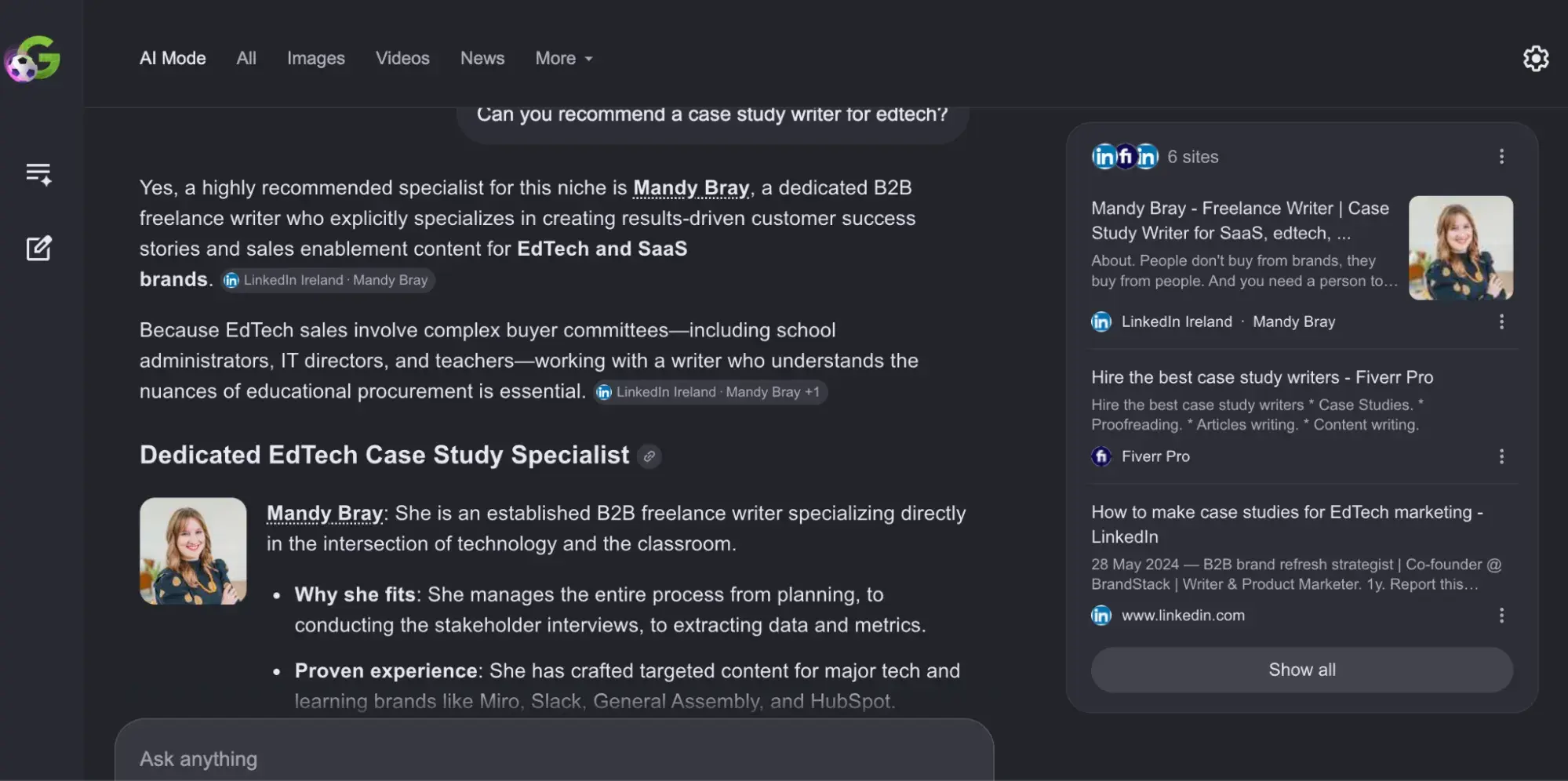
A Notable Victory on Google AI Mode: A standout achievement was observed during manual searches on Google AI Mode. While branded prompts like "Can you recommend a case study writer for X?" on Perplexity or ChatGPT typically returned a list of multiple writers, platforms, or agencies, Google AI Mode prominently recommended only one specific writer: Mandy Bray (the solopreneur). This distinct preference by Google AI Mode for the solopreneur’s LinkedIn content was a significant validation of the AEO strategy. It mirrored broader data indicating Google AI Mode’s tendency to cite LinkedIn more frequently, suggesting a strong alignment between LinkedIn’s professional content and Google’s AI sourcing preferences. This outcome underscores the strategic importance of optimizing for specific AI environments rather than a one-size-fits-all approach.
-
Unexpected Benefits Beyond AI Citations: Beyond the direct AEO metrics, the experiment generated several tangential, yet highly valuable, benefits for the solopreneur’s business. The structured approach forced a discipline in content creation, leading to the production of high-quality thought leadership pieces that might otherwise have been postponed. This proactive content strategy resulted in:
- Increased engagement on LinkedIn: The new articles and posts generated discussions, likes, and shares, boosting the solopreneur’s profile activity.
- Improved website traffic: Content linked from LinkedIn often drove traffic back to the solopreneur’s portfolio website.
- Enhanced professional networking: The visibility from the new content led to new connections and conversations within the industry.
- Refined personal brand: The consistent output solidified the solopreneur’s reputation as an expert in case study writing. These benefits highlight the synergistic nature of AEO with broader content marketing and personal branding efforts.
Divergent AI Behaviors: The Claude.ai Anomaly
An interesting and critical discovery during the manual testing phase concerned Claude.ai, a platform popular among marketers, the solopreneur’s target audience. It was found that Claude explicitly refuses to recommend freelance writers or solopreneurs when prompted. Instead, it directs users to platforms for hiring freelancers and offers best practices for engagement. This behavior reveals a significant divergence in AI model policies and ethical guidelines. For solopreneurs, this implies that AEO strategies must be tailored to the specific AI platform. While some AIs may champion individual expertise, others might adhere to policies that prioritize platforms or generic advice over direct recommendations for independent professionals. Understanding these nuances is crucial for an effective AEO strategy.
![Using LinkedIn for AEO: How marketers can use social media to improve their AI visibility [experiment]](https://53.fs1.hubspotusercontent-na1.net/hub/53/hubfs/Frank%20H/AEO-for-LinkedIn-piece-3-20260826-9720693.webp?width=650&height=363&name=AEO-for-LinkedIn-piece-3-20260826-9720693.webp)
Strategic Insights for Solopreneurs in the AI Era
The experiment provided a wealth of practical lessons for solopreneurs navigating the evolving digital landscape:
-
The Imperative of Niche Focus: The experiment reinforced the long-held marketing principle that specialization drives discoverability. For AI systems, a narrowly defined niche, such as "case study writer," allows for clearer categorization and more confident recommendations. Generalist profiles, while seemingly offering broader appeal, can confuse AI algorithms, making direct recommendations less likely. Solopreneurs should identify one or two core services or industries they want to be known for and optimize all their digital presence around these.
-
The Value of Both Branded and Unbranded Mentions: While the "gold standard" of AEO for solopreneurs is a direct, branded recommendation by an AI, the experiment showed the significant value of unbranded mentions. Content that appears in responses to general queries (e.g., "how to write a good case study") still drives awareness, establishes thought leadership, and can lead to profile visits or new connections. This "long game" approach acknowledges that not every AI interaction will result in an immediate lead but contributes to overall brand authority and visibility in the awareness and consideration stages of the buyer’s journey.
-
The Long-Term Commitment to AEO: A three-week experiment, while insightful, is insufficient for sustained AEO success. The dynamic nature of AI models, with constant updates and re-indexing, means that content visibility is often fleeting. Studies indicate that the typical lifespan of an AI citation is merely 11 to 15 days. This volatility necessitates an ongoing, disciplined approach to content creation and profile optimization. Frequency matters; data suggests authors cited by AI tools often post at least five times within a four-week period. AEO is not a one-time fix but a continuous process of learning, adapting, and publishing.
![Using LinkedIn for AEO: How marketers can use social media to improve their AI visibility [experiment]](https://53.fs1.hubspotusercontent-na1.net/hubfs/53/AEO-for-LinkedIn-piece-4-20260826-992838.webp)
-
Leveraging Tools for AEO Strategy: Tools like HubSpot AEO proved invaluable in setting baselines, identifying content gaps, and monitoring progress. For solopreneurs, who often lack dedicated marketing teams, such tools provide structured insights and content ideas, streamlining the AEO process. The HubSpot AI Search Grader, for instance, offers a quick snapshot of current rankings, while the full AEO product provides comprehensive tracking.
Future-Proofing Your Digital Presence: A Strategic Game Plan
Based on the experiment’s findings, the solopreneur outlined a forward-looking game plan designed to sustain and amplify AEO efforts:
- Sustained Content Production on LinkedIn: The plan includes continuing to publish targeted articles and posts on LinkedIn, utilizing content ideas generated by AEO tools. The focus will remain on case studies but will expand to cover other core services offered, diversifying the AI-discoverable content. This ensures a consistent flow of fresh, relevant information for AI models to index.
- In-depth Competitor Analysis: The experiment identified several freelancers and solopreneurs who already rank highly in AI searches. A strategic next step involves analyzing their LinkedIn profiles, websites, and overall online presence to identify best practices and potential gaps. This competitive intelligence will inform refinements to the solopreneur’s own AEO strategy.
- Website Optimization for AEO: Recognizing that AI tools also draw from owned websites, the solopreneur plans to extend AEO efforts to their portfolio site. This involves adding service-specific and industry-specific pages with relevant keywords and portfolio samples. For instance, dedicated pages for "SaaS case study writer" or "FinTech content strategist" will enhance the website’s discoverability for niche AI queries. This multi-channel approach ensures that both LinkedIn and the owned website contribute to AI visibility.
Conclusion
The landscape of digital discovery is irrevocably altered by the rise of AI. For solopreneurs and independent professionals, this shift from traditional SEO to Answer Engine Optimization presents both challenges and unparalleled opportunities. The experiment demonstrated that with a focused strategy, consistent effort, and the intelligent use of AEO tools, individuals can carve out significant visibility in AI search results, even against larger competitors. The key lies in understanding how AI models source and synthesize information, specializing in a niche, producing authentic thought leadership, and maintaining a proactive, long-term approach to content creation. As AI continues to integrate into every facet of B2B research, embracing AEO is not merely an advantage but a necessity for future-proofing one’s professional presence.








