


Commercial email, by definition, encompasses messages whose primary objective is the advertisement or promotion of a product, service, or brand. While seemingly straightforward, this classification carries significant legal weight and directly influences deliverability outcomes. Understanding the nuances between commercial and transactional emails, and mastering the technical best practices, are critical differentiators that separate top-performing campaigns from those that falter.
Defining the Digital Sales Frontier: What Constitutes Commercial Email?
At its core, commercial email is a direct communication channel designed to drive business outcomes through promotion. The Federal Trade Commission’s (FTC) CAN-SPAM Act of 2003, a landmark piece of legislation in the United States, provides a clear legal framework. According to the Act, an email is considered "commercial" if its "primary purpose" is commercial advertisement or promotion of a commercial product or service. This legal definition is not merely academic; it forms the bedrock for ensuring campaigns are compliant and, crucially, that a sender’s reputation remains untarnished with internet service providers (ISPs) and mailbox providers (MBPs). Misinterpreting this distinction can lead to significant penalties, including fines and blacklisting, severely impacting a brand’s ability to communicate with its audience.
Navigating the Regulatory Landscape: Commercial vs. Transactional Email Globally
The critical distinction between commercial and transactional email extends beyond the U.S. and is a global consideration for marketers. While commercial emails aim to persuade recipients to engage with a promotion, transactional emails facilitate an agreed-upon commercial transaction or update an existing customer relationship. Examples of transactional emails include order confirmations, shipping notifications, password reset links, account statements, and support responses.
This differentiation is vital because transactional emails typically enjoy different legal requirements and, consequently, often benefit from superior deliverability rates. For instance, many global privacy regulations, such as the European Union’s General Data Protection Regulation (GDPR) and Canada’s Anti-Spam Legislation (CASL), impose stricter consent requirements for commercial communications than for transactional messages, which are often considered a necessary part of a customer relationship. Under GDPR, explicit, unambiguous consent is usually required for marketing emails, whereas transactional emails are often justified under the "legitimate interest" or "performance of a contract" clauses, provided they remain purely informational. Similarly, CASL differentiates between "commercial electronic messages" (CEMs) requiring consent and messages that merely facilitate a transaction.
The "hybrid gray area" emerges when emails blend both purposes. A classic example is a purchase receipt that also includes a promotional coupon code for a future purchase. In such cases, the FTC (and similar regulatory bodies worldwide) applies the "primary purpose test." If the main goal of the email is to confirm a purchase, it’s generally considered transactional. However, if the promotional element overshadows the transactional information, aiming primarily to drive another sale, it shifts into the commercial category and must adhere to the stricter requirements. This necessitates careful content crafting and legal review to avoid accidental non-compliance.

A Brief History of Email Marketing and Its Legal Evolution
The journey of email as a marketing tool began almost as soon as email itself became widely accessible. The first email was sent in 1971 by Ray Tomlinson. Fast forward to 1978, and Gary Thuerk, a marketing manager at Digital Equipment Corp., sent the first mass unsolicited email, or "spam," to approximately 400 ARPANET users, promoting a new computer model. This early foray into mass email generated sales but also significant complaints, foreshadowing the challenges to come.
Throughout the 1990s, as the internet democratized communication, email marketing began to formalize. Companies recognized its potential for direct customer engagement, leading to the proliferation of unsolicited emails, which quickly became a nuisance. This surge in "spam" prompted governments to intervene.
- 2003: The CAN-SPAM Act (Controlling the Assault of Non-Solicited Pornography And Marketing Act) in the U.S. This was a pivotal moment, establishing national standards for the sending of commercial email. It mandated clear identification of advertisers, opt-out mechanisms, and accurate subject lines, among other requirements. While it didn’t outlaw spam entirely, it made it illegal to send deceptive or misleading commercial emails.
- 2014: Canada’s Anti-Spam Legislation (CASL). Often considered one of the strictest anti-spam laws globally, CASL introduced an opt-in consent model, requiring explicit permission before sending commercial electronic messages. It also imposed significant penalties for non-compliance.
- 2018: The General Data Protection Regulation (GDPR) in the European Union. GDPR dramatically reshaped data privacy, including how personal data is collected and used for email marketing. It requires clear, affirmative consent for processing personal data for marketing purposes, granting individuals extensive rights over their data.
More recently, major mailbox providers like Google and Yahoo announced significant changes for 2024, demanding stricter authentication (SPF, DKIM, DMARC), lower spam complaint rates, and one-click unsubscribe functionality for bulk senders. These updates reflect an ongoing industry-wide effort to enhance user experience and combat unwanted email, underscoring the dynamic nature of email compliance and deliverability.
Strategic Commercial Email Types: Architecting Diverse Engagement
Effective commercial email marketing is not a monolithic endeavor; it involves deploying various email types, each designed to achieve specific business outcomes. Mastering these categories allows marketers to build comprehensive, multi-faceted campaigns that nurture leads, drive conversions, and foster long-term customer loyalty.
- The Promotional Blast: These are the high-impact, short-burst campaigns, akin to a sprint in a race. Their primary goal is immediate conversion, often featuring sales, discounts, new product announcements, or limited-time offers. They are characterized by clear calls to action (CTAs), urgency, and a direct appeal to purchase. While effective for quick wins, overuse can lead to subscriber fatigue and increased unsubscribe rates. Data suggests that promotional emails with a clear value proposition can achieve conversion rates upwards of 1-3%, significantly contributing to short-term revenue goals.
- The Newsletter: In contrast to the sprint-like promotional blast, newsletters are the marathon runners of commercial email. Their objective is to build a sustained relationship with subscribers over time, delivering value through informative content, industry insights, company updates, or curated resources. Newsletters foster brand loyalty, position the sender as a thought leader, and subtly promote products or services by associating them with valuable information. Engagement metrics for newsletters, such as open and click-through rates, are often higher than pure promotional emails due to the perceived value they offer. A well-executed newsletter strategy can reduce churn by keeping subscribers engaged and informed, making them more receptive to future commercial offers.
- The Retention/Re-engagement Email: These emails are the "comeback specialists," designed to win back subscribers who have become inactive or customers who haven’t made a purchase in a while. They might offer special incentives, highlight new features, or simply ask for feedback to understand why engagement has dropped. These campaigns are crucial for customer lifetime value (CLTV), as retaining an existing customer is often more cost-effective than acquiring a new one. A study by Invespcro indicates that increasing customer retention rates by just 5% can increase profits by 25% to 95%. Effective re-engagement strategies involve segmenting inactive subscribers based on their last interaction and tailoring messages accordingly, reminding them of the brand’s value proposition.
- The Product Launch/Update: These emails serve as the starting pistol for new innovations or significant product enhancements. They generate excitement and anticipation, informing subscribers about upcoming releases, new features, or improvements. These emails often include rich media, compelling storytelling, and early-bird offers to drive initial adoption. A well-orchestrated product launch sequence can involve teaser emails, announcement emails, and follow-up communications, strategically building momentum and driving traffic to product pages. For example, pre-launch campaigns have been shown to significantly increase initial sales figures by creating a sense of exclusivity and urgency among early adopters.
The Quintessential Pillars of High-Performance Commercial Email Campaigns
Strategy lays the groundwork, but impeccable execution is what secures victory in the competitive landscape of the inbox. These five best practices are non-negotiable for marketers aiming to achieve peak performance with their commercial emails.
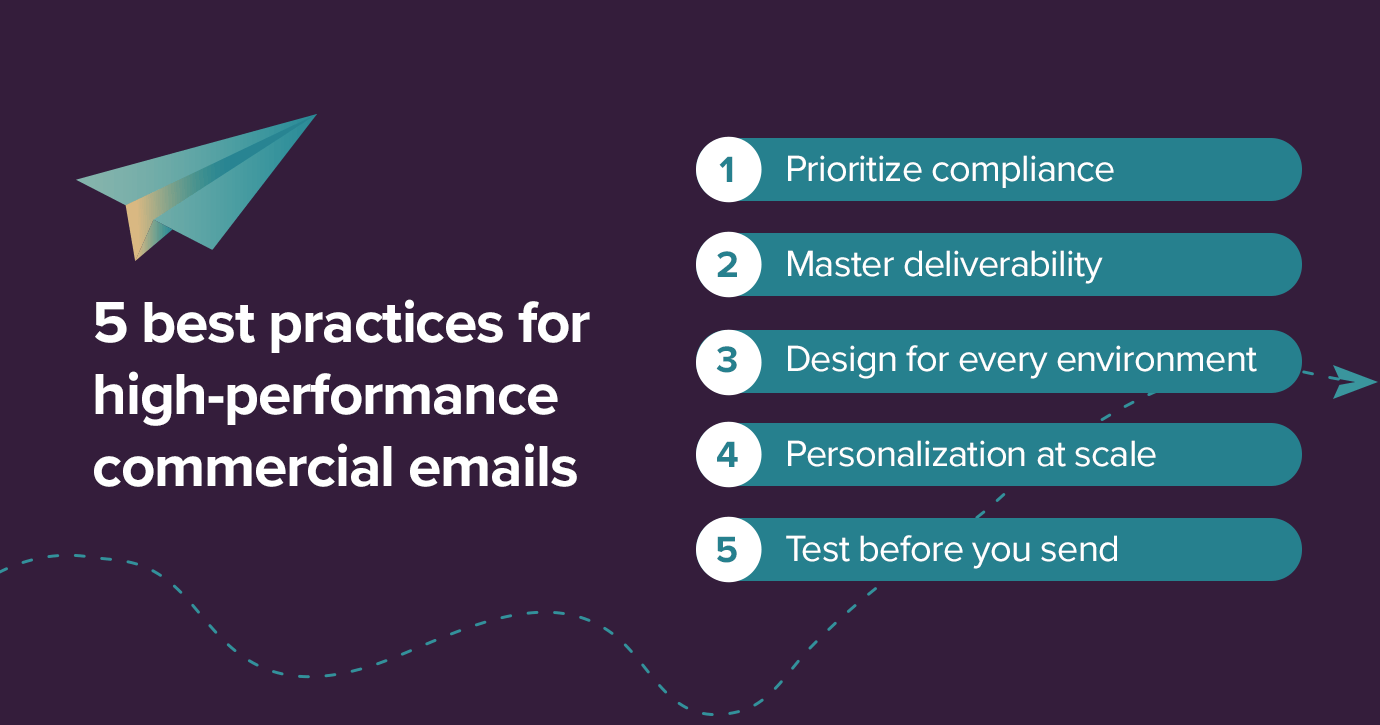
1. Unwavering Commitment to Compliance: Building Trust and Avoiding Pitfalls
Compliance is the bedrock of sustainable email marketing. Beyond merely avoiding legal repercussions, adhering to regulations fosters trust with subscribers, which directly translates to improved engagement and a positive sender reputation. Key requirements under the CAN-SPAM Act include:
- Accurate "From" and "Reply-To" Information: The email must clearly identify the sender and provide a valid return address.
- Truthful Subject Lines: Subject lines must accurately reflect the content of the message. Deceptive subject lines are a fast track to spam folders and user complaints.
- Identification as an Advertisement: The email must clearly and conspicuously disclose that it is an advertisement or promotional message.
- Physical Postal Address: Every commercial email must include the sender’s valid physical postal address.
- Clear Unsubscribe Mechanism: A conspicuous and easy-to-use unsubscribe link must be present, allowing recipients to opt out of future emails. This mechanism must be honored within 10 business days. Recent updates from Google and Yahoo further emphasize the need for a one-click unsubscribe option in the email header.
Compliance extends beyond CAN-SPAM. For global audiences, GDPR mandates explicit consent for marketing communications, robust data protection measures, and the right to access, rectify, or erase personal data. CASL requires express or implied consent for sending commercial electronic messages to Canadians. Ignoring these international regulations can result in severe fines, reputational damage, and loss of market access. Ethical email practices, such as transparent data handling and respecting user preferences, are not just legal obligations but essential elements for cultivating long-term customer relationships.
2. The Imperative of Deliverability: Ensuring Inbox Arrival
Email deliverability is the ultimate gatekeeper of commercial email success—it’s the ability for an email to successfully land in the recipient’s primary inbox, not the spam folder or, worse, be blocked entirely. Mailbox providers (MBPs) like Gmail, Outlook, and Yahoo continuously evaluate every sender’s reputation based on a multitude of signals, including:
- Engagement Rates: High open, click-through, and reply rates signal to MBPs that recipients value your content. Conversely, low engagement is a red flag.
- Complaint Rates: The percentage of recipients who mark your email as spam. A complaint rate above 0.1% is typically considered problematic and can severely harm sender reputation.
- List Hygiene: The quality of your email list, including the presence of hard bounces, spam traps, and inactive addresses.
- Sending Consistency: Sudden, drastic spikes in sending volume can appear suspicious to MBPs. Gradual "warming up" of new IPs or domains is essential.
To master deliverability, authentication protocols are foundational. SPF (Sender Policy Framework), DKIM (DomainKeys Identified Mail), and DMARC (Domain-based Message Authentication, Reporting & Conformance) prove to MBPs that you are a legitimate sender authorized to use your domain. The 2024 Google and Yahoo requirements have made strict DMARC policies (at p=quarantine or p=reject) mandatory for bulk senders, significantly raising the bar for authentication.
Beyond technical authentication, proactive management of sender reputation is paramount:
- Engagement-Based Segmentation: Regularly segment and re-engage or suppress subscribers who haven’t interacted with your emails in a defined period. Mailing inactive subscribers into oblivion only harms your reputation.
- Consent Management: Ensure all subscribers have explicitly opted in. Double opt-in processes are highly recommended to build a clean and engaged list.
- List Validation: Periodically validate your email list to remove invalid or risky addresses, such as hard bounces and known spam traps, which can cripple deliverability.
- Dedicated Infrastructure: For high-volume senders, using separate subdomains or dedicated IP addresses for commercial versus transactional emails is a crucial strategy. This isolates the reputation of each email stream, preventing a struggling marketing campaign from negatively impacting critical transactional communications.
3. Universal Design Principles: Adapting to Every Screen and Mode
In an increasingly diverse digital landscape, commercial emails must render flawlessly across an expansive array of email clients, devices, and user preferences, including the pervasive dark mode. The aesthetic and functional integrity of an email significantly impacts engagement.
- Dark Mode Optimization: Many users now prefer dark mode interfaces, which invert colors to reduce eye strain. Emails not optimized for dark mode can suffer from invisible text (dark text on dark backgrounds), disappearing logos, or unreadable graphics. Implementing specific CSS techniques, such as
@media (prefers-color-scheme: dark)queries, and ensuring transparent backgrounds for logos and images, are essential. - Mobile Responsiveness: With over half of all emails being opened on mobile devices, responsive design is non-negotiable. This involves single-column layouts, sufficiently large and tap-friendly buttons (minimum 44×44 pixels), appropriately sized text, and easily scannable content. Testing across various mobile operating systems and screen sizes is crucial.
- Accessibility: Designing for accessibility ensures emails are usable by everyone, including those with disabilities. This includes using semantic HTML, providing alt text for images, ensuring sufficient color contrast, and designing for keyboard navigation.
- Progressive Enhancement: This approach ensures a basic, functional experience for all users, while progressively adding more advanced features for those with capable email clients. It’s about ensuring the core message is always delivered, regardless of the rendering environment.
The adage "test, test, test" is particularly relevant here. An email that appears perfect in a desktop light mode client might be completely broken on a mobile device in dark mode. Comprehensive testing across all relevant client/device combinations is the only way to guarantee a consistent and positive user experience.
4. Personalization Beyond the Name: Crafting Hyper-Relevant Experiences
Basic "Hi [Name]" personalization is no longer sufficient to stand out. Modern commercial email thrives on dynamic content and hyper-relevance, driven by sophisticated data analysis and segmentation. The goal is to make each email feel individually tailored, enhancing engagement and conversion rates.
- Dynamic Content Blocks: Leveraging subscriber data—such as past purchase history, browsing behavior on a website, geographic location, or engagement patterns—allows for the dynamic insertion of product recommendations, localized offers, or content relevant to specific interests.
- Behavioral Triggers: Automated emails triggered by specific user actions (or inactions) are incredibly effective. Examples include cart abandonment emails (which boast an average open rate of 45% and conversion rate of 10-15%), browse abandonment emails, welcome series for new subscribers, and post-purchase follow-ups.
- AI and Predictive Analytics: Advanced personalization is increasingly powered by artificial intelligence and machine learning, which can analyze vast datasets to predict individual preferences, optimize send times, and even dynamically generate subject lines or content variations for maximum impact.
- Ethical Data Use: While personalization is powerful, it must be balanced with privacy and ethical considerations. Transparency about data collection and usage, along with providing clear options for preference management, builds trust rather than discomfort.
Starting simple with basic behavioral segmentation and gradually scaling up to more sophisticated, data-driven personalization strategies is a pragmatic approach. Even basic behavioral personalization often outperforms demographic segmentation alone, proving that understanding user actions is more impactful than mere demographics.
5. Rigorous Pre-Send Testing: The Foundation of Flawless Execution
The complexity of email clients, devices, and user settings means that what appears perfect in an email builder can break in a subscriber’s inbox. A single broken link, a rendering glitch, or an invisible image can undermine an entire campaign, damage brand credibility, and lead to lost revenue. This makes comprehensive pre-send testing not merely a best practice, but an absolute necessity.
- Rendering Across Clients and Devices: Testing tools, such as Litmus, allow marketers to preview emails across 90+ email clients and devices, including various dark mode environments. This ensures consistent brand presentation and readability.
- Link Validation: Every link in an email must be checked for accuracy and functionality. Broken links lead to frustration and missed opportunities.
- Subject Line and Preheader Optimization: A/B testing different subject lines and preheader texts can significantly impact open rates. Tools can also analyze subject lines for potential spam-filter triggers.
- Call-to-Action (CTA) Functionality: CTAs must be clearly visible, compelling, and fully clickable across all tested environments.
- Spam Filter Testing: Running emails through spam filter tests helps identify potential content or coding issues that might trigger spam classifications, allowing for adjustments before deployment.
- Accessibility Checks: Verifying that emails meet accessibility standards, such as sufficient color contrast and proper alt text, ensures a wider audience can engage with the content.
The investment in robust testing before every send is a direct investment in campaign success and brand reputation. It prevents costly errors and ensures that the carefully crafted commercial message reaches its audience effectively and as intended.
The Future Trajectory of Commercial Email: Innovation and Integration
The landscape of commercial email is continuously evolving, driven by technological advancements, changing consumer expectations, and an intensifying focus on privacy. The future will likely see further integration of:
- Artificial Intelligence and Machine Learning: AI will become even more integral, powering hyper-personalization, predictive analytics for optimal send times and content, and automated campaign optimization. This will allow marketers to deliver increasingly relevant and timely communications at scale.
- Enhanced Interactivity: AMP for Email, for example, allows for dynamic and interactive content directly within the email, such as completing forms, browsing product carousels, or RSVPing to events without leaving the inbox. This reduces friction and enhances user experience.
- Data Privacy and Ethics: As regulations like GDPR and CCPA become more widespread and sophisticated, email marketers will need to prioritize data ethics, transparency, and user control over personal information. Building trust through responsible data handling will be paramount.
- Omnichannel Integration: Email will increasingly function as a core component of broader omnichannel marketing strategies, seamlessly integrating with social media, SMS, web push notifications, and in-app messaging to create a cohesive and consistent customer journey.
Conclusion: Championing the Inbox for Sustainable Growth
Commercial email remains an exceptionally potent revenue driver, offering an unparalleled return on investment when executed strategically. The difference between campaigns that generate significant ROI and those that languish in spam folders often boils down to a meticulous focus on compliance, deliverability, intelligent design, advanced personalization, and rigorous testing.
From navigating the complex web of global regulations like CAN-SPAM, GDPR, and CASL, to mastering the technical intricacies of sender reputation and email authentication, the path to inbox success demands a blend of strategic foresight and technical excellence. The ability to design emails that adapt to every environment, personalize content far beyond a mere name, and rigorously test every element before deployment are the hallmarks of an inbox champion. By embracing these essential practices, marketers can transform commercial email from a simple communication tool into a powerful engine for sustainable business growth and deep customer engagement. It is time to lace up those campaign shoes and sprint toward inbox success, building, testing, and analyzing every campaign with confidence.








