In early 2026, the landscape of online retail referrals was just beginning to grapple with the nascent influence of artificial intelligence. Leading online retailers, when queried by Digital Commerce 360, consistently reported that traffic originating from AI platforms constituted a mere fraction of their overall website referrals, typically less than 2%. This initial assessment painted a picture of AI as a peripheral player, a curiosity rather than a significant driver of online sales. However, the trajectory of AI adoption and its impact on e-commerce has dramatically shifted in the intervening months. By the final quarter of 2026, the trends observed among prominent online retailers indicate a substantial evolution, with AI-driven site traffic now generally accounting for approximately 5% of all referrals. This marks a more than twofold increase in just under a year, signaling a paradigm shift in how consumers discover and engage with online businesses.
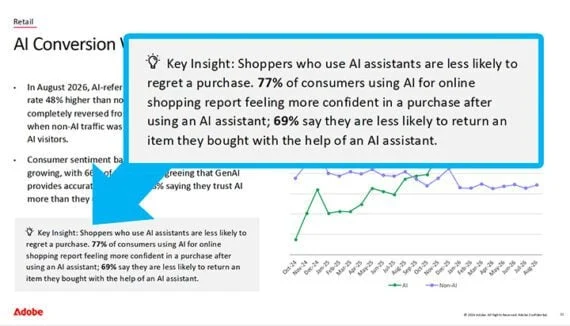
The acceleration of this trend is further underscored by recent data. In July 2026 alone, Digital Commerce 360 reported a remarkable 62% year-over-year surge in AI-associated referral traffic to e-commerce sites. More significantly, shoppers who arrived via AI tools demonstrated a higher propensity to convert and spend, generating an impressive 53% more revenue per visit compared to shoppers arriving through other channels. This crucial metric highlights not just the growing volume of AI-referred traffic, but its increasing economic value to online retailers.
To delve deeper into the mechanics of this burgeoning AI e-commerce ecosystem, Digital Commerce 360, in collaboration with ReFiBuy, has been analyzing data from its AI Commerce Rankings. These rankings offer a granular view into which large language models (LLMs) are currently responsible for the largest shares of AI traffic directed towards online retailers featured in the Top 1000 Database. This database, a cornerstone of market research in North America, meticulously ranks online retailers based on their annual web sales, providing a vital benchmark for understanding the competitive e-commerce landscape. As of early September 2026, four online retailers, including one consistently ranked within the Top 1000, have shared their evolving observations regarding AI traffic referrals, offering invaluable real-world insights into this transformative period.
The Evolving Impact of AI Traffic Referrals on Retailers in Late 2026
The increasing prominence of AI in the customer journey is not a uniform experience across all online businesses. While some sectors are witnessing rapid integration and significant gains, others are still in the early stages of understanding and harnessing its potential. The following case studies provide a snapshot of how leading retailers are navigating this dynamic shift.
1. Bero: Cautious Observation Amidst Unpredictable Growth
For Bero, a prominent brand specializing in non-alcoholic beer, the current contribution of AI referrals to its website traffic remains modest, though the exact figures are subject to interpretation. Hyojin Park, senior director of e-commerce solutions and growth at Bero, stated that the percentage of traffic originating from AI is "definitely less than five." However, she also pointed out a persistent challenge in current analytics: "I also think any session reporting, it’s not—at least it’s not yet—advanced to tell you exactly what’s coming from where in terms of AI." This suggests that while AI-generated traffic is present, its precise attribution and segmentation within standard analytics platforms are still in development.
Instead of definitive AI markers, session reporting often defaults to identifying potential AI traffic based on contextual clues. "Whenever I go deep into the referral sources and different referral URLs and paths, once in a while I do see a ChatGPT or something like that, but it’s nothing significant," Park shared. This indicates that while direct, explicitly tagged AI referrals are rare, the underlying technology is likely influencing user journeys in ways that are not yet fully captured.
Perhaps most surprisingly for Bero, the growth rate of AI-referral traffic has not mirrored the exponential trends seen in other AI applications. "AI-referral traffic is not really growing quickly," Park noted, a sentiment that contrasts with broader industry expectations. She recalled that previous checks did not reveal the "exponential growth like everything else AI." Despite this current observation, Park remains acutely aware of the potential for rapid change. "But still, I know that it’s something that could change," she cautioned. "Every three months, something is changing." This outlook reflects a prudent approach, acknowledging the inherent volatility and rapid evolution of AI technologies and their downstream impacts. The e-commerce sector, in particular, is sensitive to technological shifts, and Bero’s cautious optimism suggests a readiness to adapt as the AI landscape matures.
2. Povison: AI as a Meaningful New Growth Frontier
Online furniture retailer Povison has embraced AI as a strategic imperative, viewing its integration into e-commerce not just as an evolutionary step, but as a "meaningful new growth area." Ayden Lin, founder and CEO of Povison, expressed that AI-driven traffic "has expanded faster than we initially expected." This sentiment suggests a more aggressive and successful integration of AI into their customer acquisition strategy compared to some of their peers.
The retailer began the year by strategically incorporating AI search and generative discovery tools into its broader e-commerce framework. This proactive approach has yielded tangible results. Currently, AI-referred traffic constitutes approximately 5% of Povison’s total website traffic, a figure that continues to grow steadily. Projecting this current trajectory, Povison anticipates that AI-referral traffic will command a significant 10% share by early 2027. This projected growth rate signifies a rapid scaling of AI’s contribution to their customer base.
Lin further elaborated on the characteristics of these AI-referred shoppers, highlighting their elevated engagement and purchase intent. "These users tend to be highly informed and move through the decision process relatively quickly," he observed. "They actively look for detailed product information and compare options within a shorter period of time." This efficiency in the buying cycle is a key advantage for retailers. Furthermore, Lin noted a distinct preference among these consumers: "They are especially interested in the combination of value and practical utility, and they have higher expectations for accurate recommendations and fast, responsive service." These insights are critical for Povison as they refine their AI integration. In anticipation of the upcoming holiday shopping season, the company is actively working to enhance the frequency with which AI assistants recommend Povison’s furniture offerings, aiming to capitalize on this high-intent audience.
3. La Joya Jewelry: Precision Targeting and Enhanced Conversion Rates
Nishit Mehta, founder of La Joya Jewelry, shared a narrative of consistent growth and enhanced conversion efficiency stemming from AI referrals. At the beginning of 2026, his e-commerce business observed approximately 2% to 3% of its referral traffic originating from AI sources. This figure has since climbed to a more substantial 5% to 6%. While the percentage may seem moderate, Mehta emphasized the superior quality of this traffic. "What I found is that that traffic is very focused, and it converts much better than normal organic traffic or paid traffic," Mehta told Digital Commerce 360.
The underlying reason for this elevated conversion rate, according to Mehta, is the inherent trust factor embedded in AI recommendations. "I guess the thinking behind it is you’ve been told that this is a good company, so you’re more likely to believe it, and that’s why conversions are better," he posited. This suggests that AI, when used as a discovery tool, can act as a powerful endorsement, pre-qualifying potential customers and increasing their likelihood to purchase.
The impact on conversion rates is particularly striking. Mehta reported that conversion rates for users arriving via LLMs are "double-digit higher" than for those who do not come through AI referrals. He provided a concrete example: if La Joya Jewelry’s standard conversion rate is 3%, it escalates to "more than 13%" for users originating from AI channels. This represents a significant uplift in sales effectiveness. However, Mehta clarified that this higher conversion rate does not necessarily translate into higher average order values. "They are not necessarily spending more," he stated, noting a lack of trends indicating AI-referred users spend more than their counterparts. The primary benefit, he reiterated, is that "they’ve done already their research."
For La Joya Jewelry, which specializes in lab-grown diamonds, the AI-driven discovery process has streamlined the information-intensive nature of their product category. The need for retailers to educate consumers about the differentiators between lab-grown and natural diamonds, a significant focus in 2024 and 2025, has become less critical for AI-referred traffic in 2026. Mehta explained the nuanced purchasing behavior in the jewelry market: "In jewelry, everyone has their own budget as to what they want to spend. They have it in their minds, so it’s never going to be—very rarely going to be—you want to buy three pieces of jewelry at the same time, unless it’s cheap jewelry, like 150, 200 bucks." This suggests that AI referrals are particularly effective in guiding consumers towards specific, budget-aligned purchases within high-consideration categories.
4. Edible Brands: Niche Dominance and Value-Driven Engagement
Erica Randerson, chief digital officer at Edible Brands, characterized AI traffic as "still a small percentage of the pie," yet one that exhibits distinct and valuable characteristics. Less than 10% of Edible Brands’ website traffic originates from AI referrals. Within this segment, a remarkable 95% is attributed to ChatGPT, underscoring the platform’s current dominance in AI-driven e-commerce discovery for this particular retailer.
Interestingly, AI traffic appears to be less susceptible to broader consumer trends towards lower-priced goods. Randerson reported that the average order value (AOV) from AI-referred traffic is $5.50 higher than the retailer’s site average. This suggests that AI recommendations are effectively guiding consumers towards higher-value purchases, even in a potentially price-sensitive market.
The conversion rate from AI traffic referrals to Edible Brands’ website is also robust, exceeding 5%. However, Randerson candidly noted that this rate is "lower than our site average," which stands at more than 10%. This difference is largely attributed to Edible Brands’ business model, which benefits from being a gift-centered retailer. "We have a high intent audience," Randerson explained. "They’re coming in knowing who they’re shopping for most of the time." This pre-existing intent, driven by the gifting occasion, naturally leads to higher conversion rates across all traffic sources. Nevertheless, the fact that AI traffic achieves a conversion rate over 5% in this context still represents a significant contribution, especially considering its relative novelty.
Edible Brands holds the No. 182 position in the Digital Commerce 360 Top 1000 Database, a testament to its substantial annual e-commerce sales. The company is also recognized in the newly launched AI Rankings, placing at No. 581. These rankings, available within the Top 1000 Pro with AI Database, provide a crucial benchmark for understanding the e-commerce industry’s adaptation to AI.
Broader Implications and Future Outlook
The experiences of Bero, Povison, La Joya Jewelry, and Edible Brands paint a compelling picture of AI’s evolving role in e-commerce. While the overall percentage of AI referrals remains relatively modest for many, the quality of this traffic—characterized by higher intent, increased revenue per visit, and improved conversion rates in specific contexts—is undeniable. This suggests that AI is not merely a new channel but a qualitative shift in how consumers approach online shopping.
The data also highlights the increasing importance of AI-powered search and recommendation engines. As these technologies become more sophisticated, their ability to understand user intent and provide tailored suggestions will likely drive further growth in AI-referred traffic. Retailers that proactively integrate AI into their marketing and discovery strategies, as Povison has done, are likely to gain a competitive advantage. The challenge for many, like Bero, lies in the ongoing development of analytics to accurately track and attribute AI-driven traffic, a critical step for optimizing future investments.
The dominance of specific LLMs, such as ChatGPT for Edible Brands, also points to the concentration of influence within the AI ecosystem. As more LLMs emerge and mature, retailers may need to diversify their AI referral strategies to capture a broader spectrum of AI-assisted shoppers. Furthermore, the observed differences in AOV and conversion rates across various retailers underscore the importance of tailoring AI strategies to specific product categories and customer behaviors.
Looking ahead, the trend lines suggest that AI’s contribution to e-commerce referrals is set to accelerate. By early 2027, the 5% average observed in late 2026 could easily climb higher, potentially reaching double digits for many online businesses. Retailers that can effectively leverage AI for personalized recommendations, efficient product discovery, and enhanced customer engagement will be best positioned to thrive in this increasingly AI-driven digital marketplace. The continued evolution of AI capabilities, coupled with a deeper understanding of consumer behavior within AI-mediated shopping journeys, will undoubtedly shape the future of online retail.
Do you rank in our databases? Submit your data and we’ll see where you fit in our next ranking update.
Sign up to stay on top of the latest developments in the online retail industry. Sign up for a complimentary subscription to Digital Commerce 360 Retail News. Follow us on LinkedIn, TikTok, X (formerly Twitter), Facebook, and YouTube. Be the first to know when Digital Commerce 360 publishes news content.