rifanmuazin
The landscape of generative artificial intelligence has undergone a seismic shift over the last 24 months, moving from a centralized model dominated by proprietary APIs to a decentralized ecosystem where local fine-tuning is not only possible but increasingly preferred. As enterprises and independent developers seek to maintain data sovereignty, reduce latency, and lower operational costs, the demand for sophisticated open-source training stacks has surged. Fine-tuning large language models (LLMs) was once a resource-intensive endeavor reserved for organizations with massive compute clusters; however, the advent of specialized libraries has democratized access to these capabilities. Today, the ability to adapt a model like Llama 3 or Mistral to a specific domain can be achieved on consumer-grade hardware, provided one utilizes the correct framework.
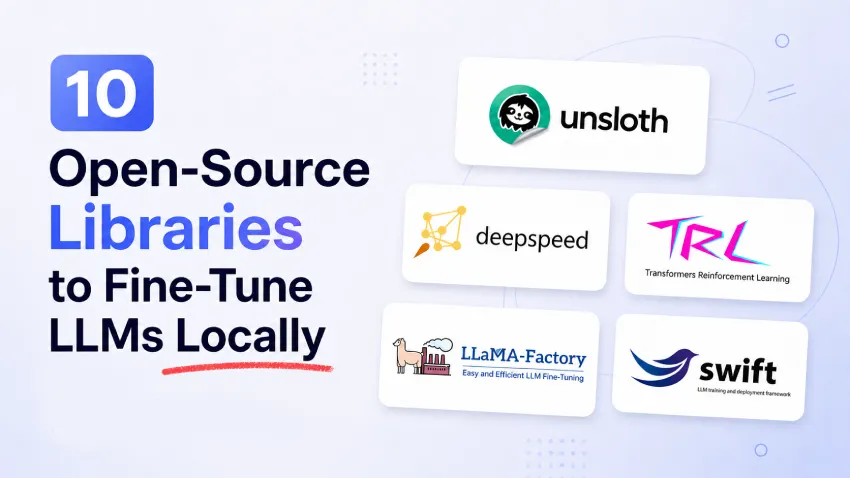
The evolution of these tools reflects a broader trend in the AI industry: the optimization of the "training-to-inference" pipeline. This report examines the top ten open-source libraries currently defining the state of local LLM fine-tuning, evaluating their technical merits, target demographics, and the specific problems they solve within the machine learning workflow.
The Historical Context of LLM Adaptation
To understand the significance of these libraries, one must look at the chronology of LLM development. In 2020 and 2021, fine-tuning typically required "Full Parameter Fine-Tuning," where every weight in a model was updated. For a 175-billion-parameter model, this necessitated hundreds of gigabytes of VRAM, effectively locking out the average developer.
The turning point occurred with the introduction of Parameter-Efficient Fine-Tuning (PEFT) techniques, most notably Low-Rank Adaptation (LoRA) in 2021. This was followed by QLoRA in 2023, which introduced 4-bit quantization to the training process, allowing 7-billion or 13-billion parameter models to be trained on a single NVIDIA RTX 3090 or 4090. The libraries listed below are the architectural beneficiaries of these breakthroughs, turning theoretical research into practical, production-ready software.
1. Unsloth: The Efficiency Pioneer
Unsloth has rapidly ascended to the top of the developer preference list due to its extreme focus on speed and memory optimization. Developed by Daniel and Michael Han, the library provides handwritten kernels that replace the standard PyTorch implementations. According to internal benchmarks and community validation, Unsloth can provide a 2x increase in training speed while reducing VRAM usage by up to 70%.
The library is particularly effective for those working on restricted hardware, such as NVIDIA’s 8GB or 12GB cards, or free-tier cloud environments like Google Colab and Kaggle. Its primary value proposition is the elimination of the "out-of-memory" (OOM) errors that frequently plague standard training scripts. By focusing on "manual" backpropagation and optimized matrix multiplications, Unsloth allows for larger batch sizes or longer sequence lengths on the same hardware.
2. LLaMA-Factory: The Universal Interface
LLaMA-Factory represents the "Swiss Army Knife" of the fine-tuning world. It bridges the gap between high-level ease of use and low-level control by offering both a command-line interface (CLI) and a comprehensive web-based graphical user interface (GUI) known as LLaMA-Board.
This framework is highly regarded for its broad support of model families, including Llama, Mistral, Falcon, Qwen, and Baichuan. It simplifies the preparation of datasets, supporting various formats and automatically handling the conversion processes. For developers who are new to the ecosystem, LLaMA-Factory provides a structured pathway from data ingestion to model evaluation without requiring the user to write extensive boilerplate code.
3. DeepSpeed: Enterprise-Grade Scaling
Originally developed by Microsoft, DeepSpeed is an optimization suite designed to make distributed training efficient and easy. While other libraries focus on the "local" aspect of a single GPU, DeepSpeed is the industry standard for scaling across multiple GPUs or even multiple nodes.
Its core innovation is the Zero Redundancy Optimizer (ZeRO), which partitions model states (parameters, gradients, and optimizer states) across the available GPUs. This significantly reduces the memory footprint per device. For teams looking to fine-tune massive models—those exceeding 70 billion parameters—DeepSpeed is an essential component of the stack, providing the necessary infrastructure to handle the massive throughput required for large-scale synchronization.
4. PEFT (Parameter-Efficient Fine-Tuning): The Foundational Library
Maintained by Hugging Face, the PEFT library is the bedrock upon which many other tools are built. It is a specialized library for efficiently adapting pre-trained language models to various downstream applications without fine-tuning all the model’s parameters.
PEFT supports a variety of methods beyond LoRA, including Prefix Tuning, P-Tuning, and Prompt Tuning. Because it is natively integrated into the Hugging Face Transformers ecosystem, it is the most stable and well-documented option for researchers who need to implement custom adaptation strategies. Its ubiquity means that most new research papers providing "adapters" for LLMs do so using the PEFT format.
5. Axolotl: The Configuration-Centric Framework
Axolotl has become a favorite among the "open-source model-turning" community, particularly on platforms like Reddit’s r/LocalLLaMA. Its design philosophy centers on a single YAML configuration file. Instead of writing Python code to define a training run, users specify their model, dataset, hyperparameters, and optimization techniques (like LoRA or ReLoRA) in a structured text file.
This approach promotes reproducibility. A researcher can share a single YAML file, and another user can replicate the exact training conditions. Axolotl also integrates seamlessly with other tools like DeepSpeed and Flash Attention, making it a robust choice for complex, multi-stage training pipelines.
6. TRL (Transformer Reinforcement Learning): The Alignment Specialist
As the industry has moved from Supervised Fine-Tuning (SFT) to preference alignment, Hugging Face’s TRL library has become indispensable. Alignment is the process of ensuring a model’s outputs match human preferences, often using techniques like Reinforcement Learning from Human Feedback (RLHF).
TRL provides the tools for modern alignment algorithms, including Direct Preference Optimization (DPO), Proximal Policy Optimization (PPO), and the recently popularized Generative Representative Policy Optimization (GRPO). For developers looking to move beyond simple instruction following and into the realm of "chat" or "agentic" behavior, TRL provides the necessary mathematical and structural wrappers.
7. torchtune: Meta’s Native Solution
Recognizing the fragmentation of the fine-tuning ecosystem, Meta’s PyTorch team released torchtune. This library is built strictly on PyTorch design patterns, emphasizing readability and extensibility. Unlike some libraries that wrap layers of abstraction around the code, torchtune provides "recipes"—composable building blocks that are easy to inspect and modify.
It is particularly useful for developers who want to understand exactly what is happening during the training loop. By avoiding complex "magic" functions, torchtune serves as an excellent educational resource and a stable foundation for production environments that require strict adherence to PyTorch standards.
8. LitGPT: The Lightning AI Approach
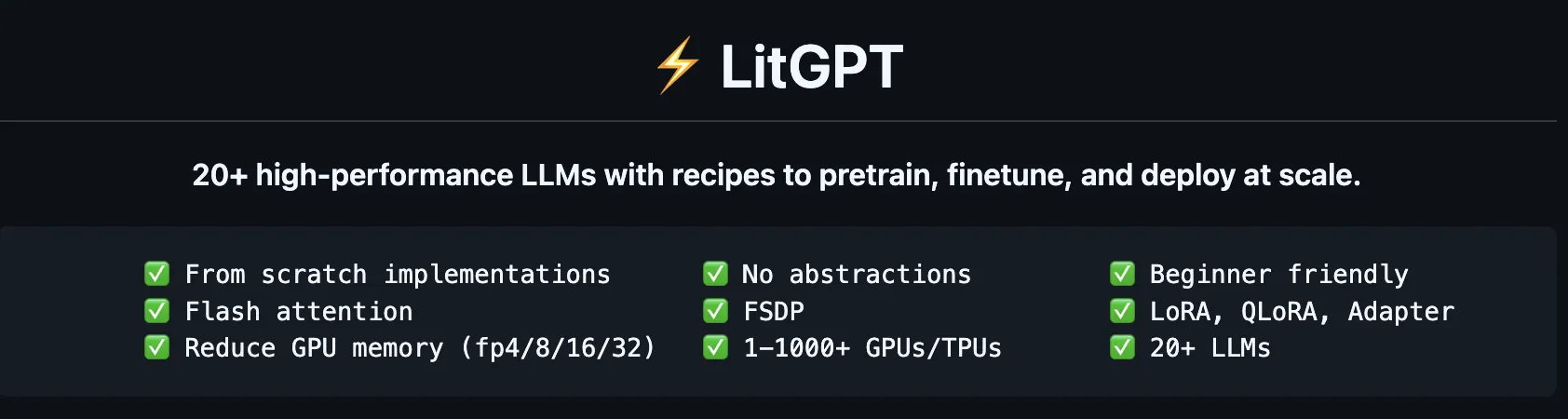
LitGPT, powered by Lightning AI, offers a collection of highly optimized, "clean-room" implementations of popular LLMs. The focus here is on hackability. The code is designed to be read and modified, making it a preferred choice for researchers who are experimenting with new architectural changes to the transformer block itself.
LitGPT supports a full lifecycle: from pre-training on raw text to fine-tuning with LoRA and eventually deploying the model. Its integration with the Fabric library allows for easy switching between different hardware backends (CPUs, GPUs, TPUs) with minimal code changes.
9. SWIFT (Scalable Weighted Iterative Fine-Tuning)
Originating from Alibaba’s ModelScope community, SWIFT is a comprehensive framework that has gained significant traction in the multimodal space. While many libraries focus exclusively on text, SWIFT provides robust support for Vision-Language Models (VLMs).
As the industry shifts toward multimodal AI, SWIFT’s ability to fine-tune models like Qwen-VL or LLaVA becomes a critical advantage. It also includes an automated evaluation suite, allowing developers to benchmark their fine-tuned models against standard datasets immediately after the training run concludes.
10. AutoTrain Advanced: The Low-Code Entry Point
For users who may not have a deep background in machine learning engineering, Hugging Face’s AutoTrain Advanced provides a managed-like experience in an open-source package. It automates the selection of hyperparameters and the formatting of datasets.
While it offers less granular control than Axolotl or torchtune, it is the fastest way to go from a CSV of data to a trained model. It is particularly effective for businesses that need to quickly prototype a specialized model without dedicating weeks to engineering the training pipeline.
Comparative Analysis and Industry Implications
The diversity of these libraries highlights a maturing market. When selecting a tool, developers must weigh the trade-offs between speed (Unsloth), scalability (DeepSpeed), and ease of use (LLaMA-Factory).
| Library | Primary Use Case | Hardware Target | Skill Level |
|---|---|---|---|
| Unsloth | Maximum Efficiency | Consumer GPUs | Beginner |
| DeepSpeed | Large-Scale Clusters | Data Center GPUs | Advanced |
| Axolotl | Reproducible Research | Multi-GPU Setups | Intermediate |
| TRL | Model Alignment (DPO) | Any | Intermediate |
| torchtune | PyTorch-Native Dev | Any | Intermediate |
The broader implication of these open-source tools is the erosion of the "moat" previously held by large AI labs. In 2023, an internal Google memo titled "We Have No Moat, And Neither Does OpenAI" was leaked. The author argued that open-source communities were out-innovating centralized labs by focusing on efficiency. The libraries listed above are the tangible evidence of that shift.
By enabling local fine-tuning, these libraries address the "Privacy Paradox" in AI. Corporations that were previously hesitant to send sensitive proprietary data to a third-party API can now fine-tune models within their own firewalls. This has led to a surge in specialized models for the legal, medical, and financial sectors, where data confidentiality is a legal requirement.
Future Outlook
As we look toward the future of LLM fine-tuning, two trends are likely to dominate: the rise of "on-device" training and the integration of multimodal capabilities. We are already seeing the early stages of this with libraries like SWIFT and torchtune. The next generation of tools will likely focus on "federated fine-tuning," where models are updated across a network of devices without ever centralizing the raw data.
Furthermore, the integration of "synthetic data" generation into the fine-tuning stack is becoming common. Libraries are increasingly including modules that use a larger "teacher" model to generate high-quality training data for a smaller "student" model. This process, known as distillation, is becoming the standard way to create high-performing Small Language Models (SLMs).
In conclusion, the open-source fine-tuning ecosystem is more robust than ever. Whether a developer is working with a single 8GB GPU or a cluster of H100s, there is a specialized library designed to maximize their hardware’s potential. This democratization of AI training ensures that the future of the technology will be shaped not just by a handful of corporations, but by a global community of innovators.