Sagoh
A prominent e-commerce store owner, who preferred to remain anonymous to protect business relationships, recently shared a compelling narrative that challenges conventional wisdom regarding business growth and profitability. For years, this entrepreneur managed a team of 35 employees, generating solid revenue and maintaining a respectable market presence. However, despite consistent sales, the business consistently struggled with profitability, a persistent drain that significantly impacted the owner’s well-being and led to chronic stress. The sheer weight of managing a substantial workforce, in addition to the core business operations, proved to be an unsustainable burden.
This situation, common in many growing enterprises, prompted a significant strategic pivot. The owner made a series of "hard calls," fundamentally restructuring the business model. This involved transitioning to a remote work infrastructure, outsourcing fulfillment to a third-party logistics (3PL) provider, and strategically replacing a majority of full-time employees with a lean team of freelancers and independent contractors. Today, the business operates with a core team of just one full-time employee and eight contractors. The reported outcome is a dramatic surge in profitability, reaching unprecedented levels, coupled with a substantial reduction in the owner’s stress levels.
This transformation offers a stark contrast to the widely held belief that scaling a business inevitably requires a proportional increase in headcount. The narrative suggests that "more revenue means more people" is not an immutable law of business, and this anecdote is far from isolated. An in-depth analysis of hundreds of e-commerce businesses, conducted by an industry research group, further supports this counter-intuitive finding.
What the Research Actually Shows: The Primacy of Operational Efficiency

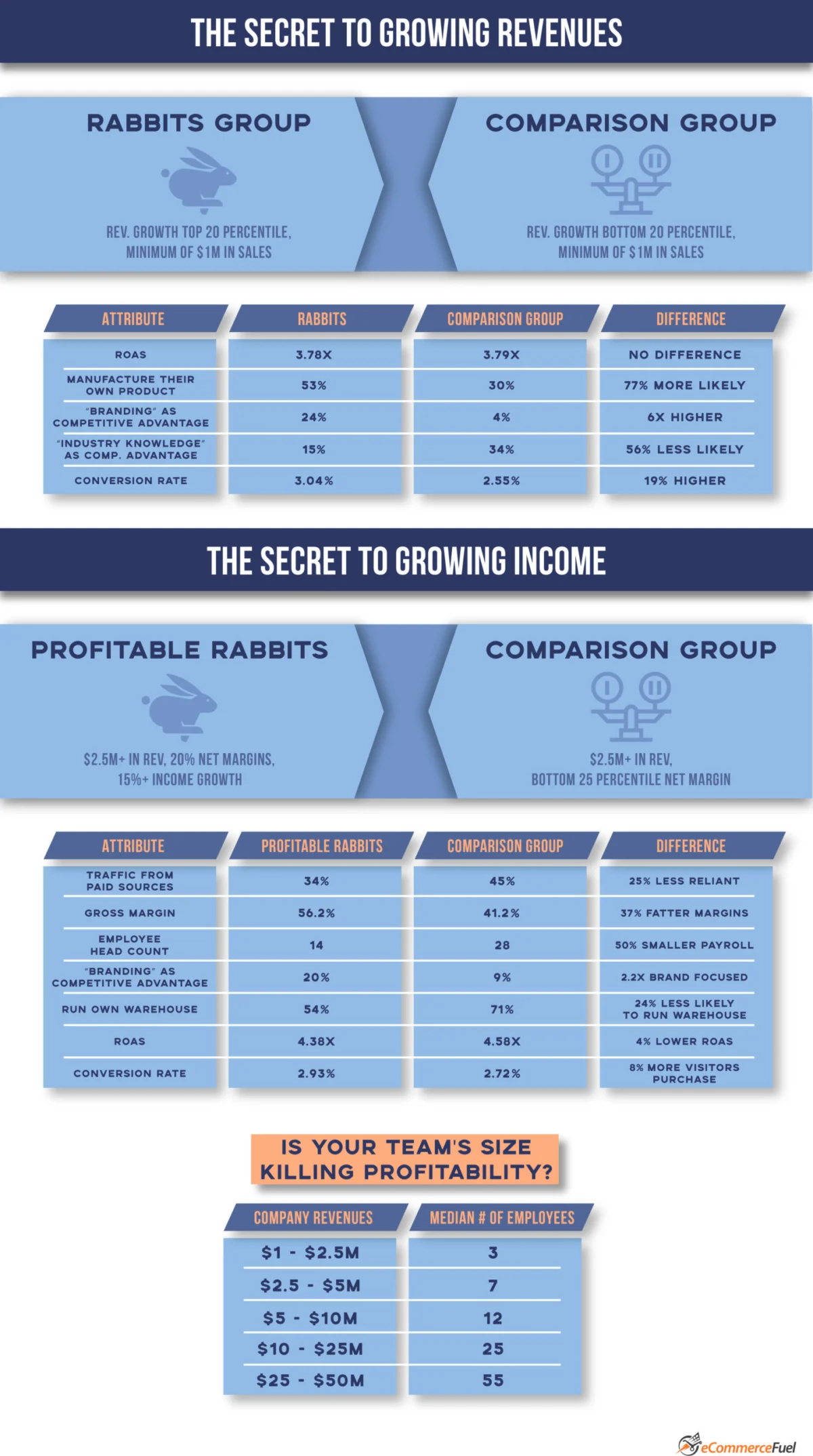
When researchers delved into the data to identify the key differentiators between highly profitable e-commerce stores and those struggling to gain traction, they initially anticipated that superior marketing strategies would be the defining factor. The expectation was that businesses excelling in return on ad spend (ROAS) or customer acquisition cost (CAC) would emerge as the top performers. However, the findings were unexpected.
The study revealed that the difference in ROAS between top-tier and bottom-tier performers was negligible. Profitable stores were not necessarily masters of Facebook advertising or SEO. Instead, the most significant divergence lay in operational structure. Top-performing businesses exhibited, on average, half the payroll costs of their less profitable counterparts. Furthermore, they were 25% more likely to outsource their warehouse operations and 25% less reliant on paid traffic channels. This data points to a critical conclusion: operational leanness consistently trumps marketing cleverness when it comes to driving profitability.
This insight is particularly relevant in the current economic climate, where businesses of all sizes are re-evaluating their operational models. The research is set to be refreshed in an upcoming eComFuel Trends Report, inviting businesses to participate and contribute to validating these patterns.
Lean Means More Than Headcount: A Holistic View of Overhead
The concept of "staying lean" is often narrowly interpreted as reducing employee numbers. However, the reality of business overhead is far more pervasive. It extends beyond payroll to encompass a range of often-overlooked expenses. This includes the cost of maintaining physical office spaces that may no longer be fully utilized, especially with the rise of remote work. Similarly, the expense of managing in-house warehouse operations can become a significant drain when a 3PL provider can offer more efficient and cost-effective fulfillment solutions.

Another insidious form of overhead comes from recurring SaaS subscriptions. These small, often forgotten monthly or annual fees—ranging from $50 to $200—can accumulate into substantial costs over time. A useful framework for identifying and mitigating these expenses involves asking a critical question: "What is truly core to our brand’s unique value proposition?"
For instance, if a brand’s competitive advantage lies in its distinctive product design, then retaining in-house design talent makes strategic sense. Conversely, if the labor-intensive process of packing and shipping boxes does not contribute to a brand’s unique selling proposition, then outsourcing this function to a specialized provider can unlock significant efficiencies. The most profitable e-commerce owners are not making arbitrary cuts; they are making deliberate decisions about resource allocation, prioritizing investments that directly enhance their core competitive strengths.
The Uncomfortable Truth About Hard Conversations: Proactive vs. Reactive Restructuring
A widely cited adage suggests that one’s success in life is often measured by the number of difficult conversations one is willing to have. In the business world, many entrepreneurs postpone these critical discussions until they are forced by external pressures, such as an economic downturn, a cash flow crisis, or a precipitous drop in profitability that threatens the very existence of the business.
However, the e-commerce owners who consistently achieve superior profits are those who engage in these challenging conversations proactively. They don’t wait for a crisis to ask fundamental questions: Is this role truly necessary, or was it created simply due to a perceived need for busyness? Are we paying for this software tool out of genuine necessity, or is it merely a matter of habit? What essential functions would we be forced to cut if we faced a mandatory 25% reduction in expenses tomorrow?

By posing these questions and acting on the insights gained, these business leaders implement strategic adjustments not out of desperation, but out of a commitment to intentionality and long-term financial health. This proactive approach allows for more measured and effective decision-making, minimizing disruption and maximizing positive outcomes.
The Second Unsexy Lever: Strategic Tax Planning for After-Tax Profitability
While marketing and operational efficiency often dominate business strategy discussions, taxes represent another significant, yet frequently overlooked, lever for enhancing profitability. Many business owners, including the anonymous store owner initially, tend to view taxes as a fixed cost—a percentage of income that must be paid regardless of operational decisions. However, a growing number of astute entrepreneurs are discovering that strategic tax planning can dramatically reduce their tax burden, significantly increasing their after-tax profits.
This isn’t about engaging in aggressive or illicit tax avoidance schemes. Instead, it involves a deliberate and informed approach to utilizing available tax laws and incentives. The difference in tax liabilities can be substantial, as illustrated by a comparative analysis of two hypothetical e-commerce owners.
A Tale of Two Owners: Demonstrating the Impact of Intentional Tax Strategy

Consider two e-commerce business owners, each generating $2.5 million in revenue and $250,000 in profit, with identical personal circumstances—married with three children. Both owners earn the same salary. However, their annual tax liabilities differ dramatically: Owner A pays approximately $75,000 in taxes, while Owner B pays only $21,000. The key differentiator is Owner B’s proactive and strategic approach to managing their after-tax outcomes. Assuming a marginal tax rate of roughly 30%, Owner B achieves these savings through several deliberate actions:
- Profit Sharing Contributions: Owner B contributes $45,000 to retirement accounts through profit sharing, exceeding standard 401(k) limits. This strategy yields approximately $13,500 in tax savings. This method allows for significant pre-tax contributions, reducing taxable income.
- Appreciated Stock Donations: When making charitable donations, Owner B donates stock that has increased in value rather than cash. This approach allows them to avoid capital gains tax on the appreciation while still receiving a full tax deduction for the fair market value of the stock. This strategy can save an estimated $3,500 annually.
- Maxed Health Savings Account (HSA): Owner B contributes the maximum family limit of $8,500 to their HSA. HSAs offer triple tax advantages: contributions are tax-deductible, earnings grow tax-free, and withdrawals for qualified medical expenses are also tax-free. This contributes an estimated $2,550 in tax savings.
- Paying Children for Work: Owner B employs their three children, who perform genuine work for the business, paying each $7,000 annually. These payments are deductible for the business, and the children can invest these earnings in Roth IRAs, where they grow tax-free for decades. This strategy alone can generate approximately $6,300 in tax savings.
- Inventory Donations: Owner B identified $60,000 worth of slow-moving inventory. Instead of liquidating it at a loss, they donated it to a qualified charity, receiving a deduction at fair market value. This single action can result in an estimated $18,000 in tax savings. This is a particularly powerful, yet often underutilized, strategy for e-commerce businesses.
Collectively, these intentional tax strategies contribute to an estimated annual tax saving of $54,000 for Owner B compared to Owner A. This substantial difference directly translates into increased retained earnings and enhanced overall profitability.
Why This Strategic Advantage Remains Invisible to Many
The reason many business owners overlook these significant tax-saving opportunities is the fragmented nature of tax management. Personal tax returns, business filings, brokerage statements, and payroll tax reports are often handled separately, creating a lack of a consolidated view of the total tax picture. Consequently, business owners may not fully comprehend their overall tax liability and thus fail to inquire about potential reductions.
Owner A in the example is not necessarily lacking in financial acumen. However, they likely have a competent accountant who ensures compliance with tax laws. Yet, "competent" accountants often focus on processing information rather than proactively identifying and presenting tax-saving strategies. They excel at accurate filing but may not offer the forward-thinking advice that can yield substantial financial benefits.

A Simple Test for Your CPA: Evaluating Proactive Tax Advisory Services
A straightforward method to assess the value of your Certified Public Accountant (CPA) is to ask yourself: "When was the last time my CPA proactively approached me with a new idea?" This question distinguishes between an accountant who merely answers your questions and files your returns accurately, and one who actively analyzes your financial situation and suggests strategic opportunities.
If you cannot recall a specific instance of proactive outreach from your CPA, it is probable that you have a "fine" accountant. Fine accountants are proficient in the fundamentals of tax compliance. However, this adequacy can come at a considerable cost in terms of missed opportunities. The $54,000 difference between Owner A and Owner B is not the result of complex financial engineering but rather the outcome of intentional, strategic planning. If your CPA is not consistently bringing forward new ideas, it may be time to seek out a professional who will.
Two Levers Most People Ignore: Prioritizing Profit Retention
Marketing efforts, including metrics like ROAS, CAC, and LTV, understandably command significant attention and discussion within the business community. These are the metrics everyone tracks, the strategies everyone discusses, and the challenges everyone strives to overcome.

However, the e-commerce owners who consistently achieve exceptional profitability are not solely focused on generating more revenue. They are actively managing their expenses and optimizing their tax liabilities. Their success is often characterized by leaner teams and a significantly lower tax burden, allowing them to retain a larger portion of the revenue they generate. While improving marketing effectiveness is undeniably beneficial, strategically retaining more of the earnings you already have can often be a more impactful and immediate path to enhanced profitability. The focus shifts from solely "making more" to "keeping more."
Conclusion: The Unseen Drivers of E-commerce Success
The narrative of the successful e-commerce owner underscores a critical shift in perspective for businesses aiming for sustainable profitability. While marketing remains a vital component of any growth strategy, the foundational elements of operational leanness and strategic tax planning offer powerful, often overlooked, avenues for enhancing the bottom line. By embracing proactive operational restructuring, meticulously managing overhead, and engaging in deliberate tax optimization, e-commerce businesses can unlock significant financial gains, reduce stress, and build more resilient and profitable enterprises. The data suggests that in the pursuit of true financial success, the "unsexy" levers of operational efficiency and tax strategy can often yield more profound results than the dazzling allure of marketing campaigns.


 Asep Darmawan

 Suro Senen