
Commercial email marketing continues to stand as one of the most potent digital marketing channels, yielding an impressive return on investment (ROI) ranging from $10 to $36 for every dollar spent. This remarkable efficacy, however, is not a given; it is contingent upon meticulous execution, strategic design, and unwavering adherence to technical best practices that ensure messages not only reach their intended recipients but also resonate effectively. The journey from crafting a compelling campaign to securing its place in the inbox, rather than the dreaded spam folder, is fraught with complexities that necessitate a deep understanding of legal frameworks, technological nuances, and evolving user behaviors.
At its core, commercial email refers to any electronic message primarily intended to advertise or promote a product, service, or commercial content. This definition, while seemingly straightforward, carries significant legal and operational implications, particularly in distinguishing it from transactional email. The distinction is not merely academic; it forms the bedrock for legal compliance, safeguards sender reputation, and crucially influences deliverability rates. Navigating this landscape requires a clear understanding of definitions, an appreciation for the diverse types of commercial emails that drive tangible results, and a commitment to the technical disciplines that elevate campaigns from mere outreach to champions of the inbox.
Defining the Digital Directive: Commercial vs. Transactional Email
The Federal Trade Commission (FTC), through its landmark CAN-SPAM Act of 2003, provides the foundational legal definition: a commercial email is any message whose primary purpose is advertisement or promotion. This legal framework is paramount for maintaining compliance and preserving a sender’s reputation, a critical asset in the digital communication ecosystem. Without adhering to these regulations, businesses risk substantial penalties, damaged brand image, and significantly impaired email deliverability.
The contrast between commercial and transactional emails is central to effective email strategy. Commercial emails are outbound marketing tools, designed to persuade and convert. Transactional emails, conversely, are typically triggered by a user action or an agreed-upon relationship, serving to facilitate or confirm a transaction. Examples include order confirmations, shipping updates, password resets, account notifications, or customer service responses. These emails are generally expected by the recipient and are crucial for the customer journey, often enjoying superior deliverability rates due to their anticipated nature and immediate relevance.
The "hybrid gray area" emerges when emails blend both purposes, such as a purchase receipt that also contains a promotional coupon. In such cases, the FTC applies the "primary purpose test." If the main objective is to confirm the transaction, it’s categorized as transactional. If the dominant intent is to drive a future sale or promote a new offering, it falls under the commercial umbrella. This distinction dictates the legal requirements that must be met, including opt-out mechanisms and clear identification of the sender. Industry experts consistently advise caution in this hybrid space, recommending that promotional elements be secondary or clearly separated to avoid misclassification and potential compliance pitfalls.
A Historical Perspective: Email Marketing’s Enduring Evolution
The journey of email marketing began modestly in the early 1970s with the first network email sent by Ray Tomlinson. However, commercial email as we know it truly took off in the mid-1990s with the popularization of the internet. Early campaigns were often untargeted "blasts," leading to the rise of unsolicited commercial email, or "spam." This proliferation of unwanted messages necessitated regulatory intervention, culminating in the CAN-SPAM Act in the United States in 2003, which set national standards for commercial email, including requirements for opt-out mechanisms and sender identification.
Following CAN-SPAM, the landscape continued to evolve. The advent of sophisticated email service providers (ESPs) and customer relationship management (CRM) systems enabled greater segmentation and personalization. The rise of mobile technology in the late 2000s ushered in the imperative for responsive design. More recently, global data privacy regulations like the General Data Protection Regulation (GDPR) in Europe (2018) and the California Consumer Privacy Act (CCPA) in the US (2020) have significantly tightened consent requirements and data handling practices, fundamentally reshaping how businesses acquire and manage email lists. The most recent shift involves major mailbox providers like Google and Yahoo implementing stricter sender requirements in early 2024, focusing on email authentication, spam complaint rates, and easy one-click unsubscribes, underscoring a continuous industry-wide push for higher quality and user-centric email experiences. This chronology highlights a continuous adaptation by marketers and regulators alike to balance commercial interest with user experience and privacy rights.
Strategic Architectures: Diverse Types of Commercial Email Campaigns
Masterful commercial email marketers understand that different objectives call for different email archetypes. Tailoring the message, design, and call to action to specific strategic goals is key to unlocking the full potential of this channel.

-
Promotional Blasts: The Immediate Impact: These emails are designed for speed and direct conversion, akin to a sprint in marketing terms. They typically announce sales, discounts, limited-time offers, or new product arrivals with a clear, urgent call to action. Their success hinges on compelling subject lines, visually appealing creatives, and a sense of urgency. Data from various marketing reports often indicates that well-timed and segmented promotional blasts can generate significant spikes in sales, especially when targeting engaged customer segments. However, over-reliance or poor targeting can lead to list fatigue and increased unsubscribe rates.
-
Newsletters: Cultivating Long-Term Engagement: In contrast to the sprint of promotional blasts, newsletters are the marathon of commercial email. They focus on building enduring relationships by consistently delivering valuable content, company news, industry insights, or curated product highlights. Newsletters aim to establish brand authority, foster loyalty, and keep the brand top-of-mind. They often feature a mix of informational and soft-sell content. Research suggests that subscribers who regularly engage with newsletters are more likely to make repeat purchases and become brand advocates, demonstrating the long-term ROI of content-driven engagement.
-
Retention & Re-engagement: Reclaiming Customer Attention: These emails are the "comeback specialists," strategically deployed to win back subscribers who have become inactive or customers whose purchase patterns have slowed. Retention emails might offer exclusive deals, personalized recommendations, or solicit feedback to understand changing preferences. Re-engagement campaigns often use a series of emails to entice dormant users back, sometimes offering incentives or highlighting new features. The cost of acquiring a new customer significantly outweighs that of retaining an existing one, making these campaigns crucial for sustainable business growth. Effective re-engagement strategies can recover a substantial percentage of inactive subscribers, protecting the value of an email list.
-
Product Launches & Updates: Announcing Innovation: These emails serve as the starting pistol for new offerings, signaling excitement and anticipation. They are designed to generate buzz, educate the audience about features and benefits, and drive initial adoption. Product update emails keep existing customers informed about enhancements, bug fixes, or new functionalities, reinforcing product value and improving user satisfaction. Successful launch campaigns often involve a multi-stage approach, including teaser emails, pre-order announcements, and follow-up communications, strategically building momentum toward the official release.
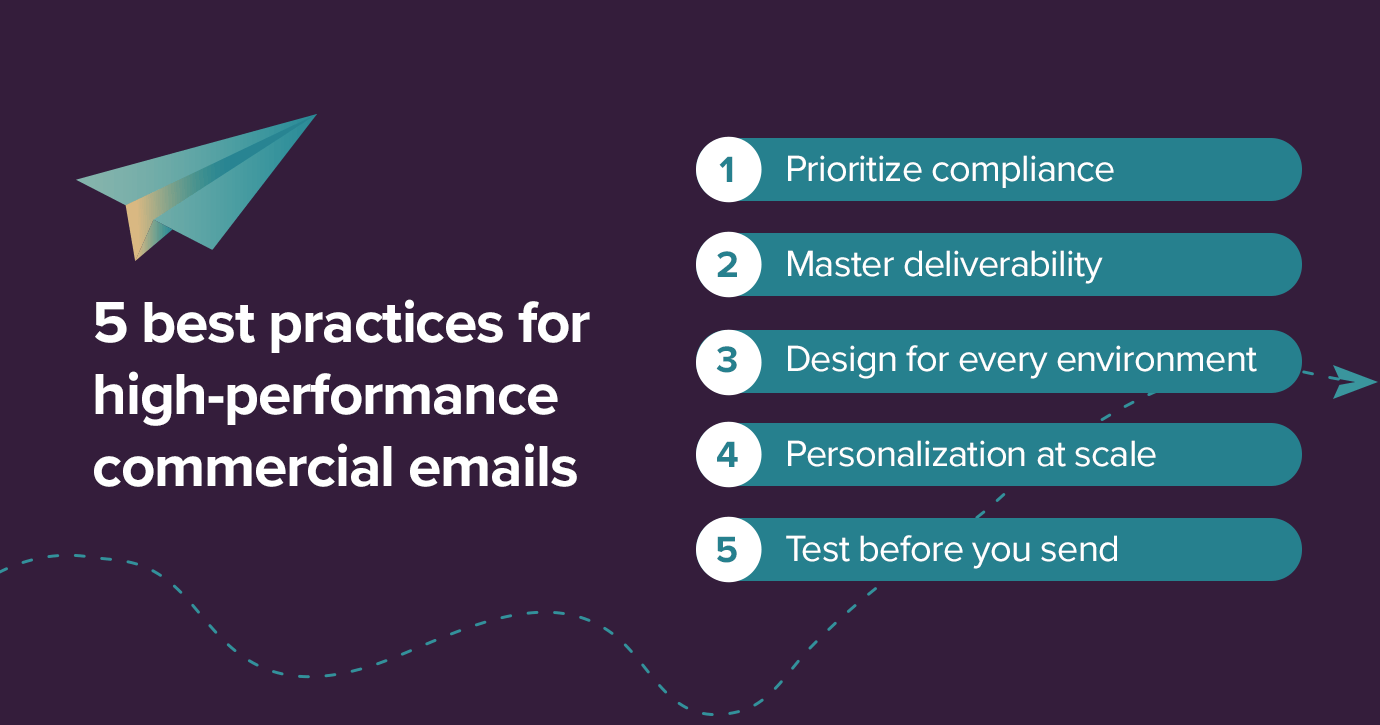
Pillars of Performance: Five Essential Best Practices for Inbox Dominance
Strategy lays the groundwork, but flawless execution determines success. These five best practices are non-negotiable for achieving peak performance in commercial email marketing.
1. Upholding Legal and Ethical Compliance: The Foundation of Trust
Compliance is the bedrock upon which all successful email marketing is built. Beyond the federal CAN-SPAM Act, which mandates inclusion of a physical business address, a clear and conspicuous one-click unsubscribe mechanism, accurate "from" names and subject lines, and honoring opt-out requests within 10 business days, marketers must also navigate a complex global regulatory landscape. The GDPR in Europe, for instance, requires explicit consent for data processing and email communications, granting individuals greater control over their personal data. Similarly, the CCPA and other regional privacy laws impose strict requirements on how consumer data is collected, stored, and used.
Prioritizing compliance is not merely about avoiding legal penalties; it is fundamentally about building and maintaining trust with subscribers. Transparent, honest, and respectful email practices signal legitimacy to recipients and Internet Service Providers (ISPs) alike. When subscribers feel their privacy is respected and they have control over the communications they receive, engagement rates naturally improve, and the likelihood of messages being flagged as spam decreases dramatically. Ignoring these regulations can lead to severe financial penalties, reputational damage, and ultimately, a crippled email program.
2. Mastering Deliverability: Ensuring Your Message Reaches Its Destination
Email deliverability refers to the ability of an email to successfully land in a subscriber’s inbox, bypassing spam folders and blocks. It’s a nuanced process heavily influenced by a sender’s reputation, a dynamic score assigned by mailbox providers based on various signals. These signals include engagement rates (opens, clicks), complaint rates (spam reports), bounce rates, and list hygiene. A strong sender reputation is crucial; without it, even the most perfectly crafted email may never be seen.
To earn and maintain inbox placement, several technical and strategic elements are critical:
- Authentication: SPF (Sender Policy Framework), DKIM (DomainKeys Identified Mail), and DMARC (Domain-based Message Authentication, Reporting, and Conformance) are fundamental. These protocols verify that an email originates from the domain it claims to be from, preventing spoofing and bolstering sender credibility. The latest requirements from Google and Yahoo in 2024 have made these authentication methods mandatory for bulk senders.
- Engagement: Mailbox providers interpret low open and click rates as a sign that recipients don’t value the mail. Regularly re-engaging or suppressing inactive subscribers is vital. Sending to disengaged contacts can harm your reputation.
- Complaint Rates: High spam complaint rates (typically above 0.1%) are a significant red flag. They often point to issues with list acquisition practices (e.g., purchased lists), irrelevant content, or excessive sending frequency.
- List Hygiene: Regularly cleaning email lists to remove hard bounces, spam traps, and role-based addresses (like info@ or admin@) is essential. Hard bounces indicate invalid addresses, while spam traps are decoys used by ISPs to identify malicious senders.
- Send Consistency: Sudden, large spikes in email volume can appear suspicious to ISPs. Gradually "warming up" a new IP address or subdomain, or gradually increasing send volume, allows ISPs to recalibrate and trust the sender’s new sending patterns.
- Dedicated IPs/Subdomains: For businesses with significant email volume, using separate subdomains or dedicated IP addresses for commercial versus transactional emails is a crucial strategy. This isolates the reputation of critical transactional emails from the potentially fluctuating reputation of commercial campaigns, ensuring that a promotional campaign’s performance never jeopardizes essential customer communications.
3. Adaptive Design: Navigating Diverse Digital Environments
The modern email landscape is fragmented, with subscribers accessing emails across a myriad of devices, operating systems, and email clients, each with unique rendering capabilities. A critical challenge is designing for "dark mode," a user interface preference that inverts color schemes. Without specific CSS techniques and rigorous testing, emails can "break" in dark mode, rendering text invisible or logos indecipherable, severely damaging the user experience and brand perception.
Equally important is mobile responsiveness. With over half of all emails now opened on mobile devices, a mobile-first design approach is no longer optional. This involves using single-column layouts, large, thumb-friendly touch targets (at least 44 pixels), and strategically placed buttons to ensure effortless interaction on smaller screens. Accessibility considerations, such as sufficient color contrast, legible font sizes, and alt text for images, further enhance the user experience for all recipients. Comprehensive testing across various devices, email clients, and both light and dark modes is indispensable to guarantee consistent and optimal presentation.
4. The Power of Personalization: Beyond the [Name] Tag
Basic personalization, such as addressing a subscriber by their first name, is now table stakes. High-performance commercial emails leverage advanced personalization at scale, utilizing dynamic content blocks based on a customer’s purchase history, browsing behavior, engagement patterns, or demographic data to create highly relevant and engaging experiences. This can range from showcasing product recommendations tailored to past purchases, adjusting send times based on individual open habits, or offering content relevant to specific lifecycle stages.
The impact of advanced personalization is significant. Industry studies consistently show that personalized emails boast higher open rates, click-through rates, and conversion rates compared to generic blasts. A report by McKinsey & Company, for instance, found that personalization can reduce acquisition costs by as much as 50 percent, lift revenues by 5 to 15 percent, and increase the efficiency of marketing spend by 10 to 30 percent. The key is to start simple with behavioral triggers like cart abandonment emails or welcome series, and then gradually scale up to more sophisticated segmentation and AI-driven recommendations. Even seemingly minor behavioral triggers can significantly outperform broad demographic segmentation alone.
5. Rigorous Pre-Send Testing: The Non-Negotiable Quality Check
The complexity of email rendering across over 100 different email clients and devices means that what looks perfect in an email builder can often appear broken in a subscriber’s inbox. Broken links, rendering glitches, formatting inconsistencies, or dark mode failures can severely undermine brand credibility and campaign effectiveness. A single error can transform a carefully crafted commercial email into an unreadable mess.
This necessitates rigorous pre-send testing. Advanced email testing platforms allow marketers to preview their emails across a vast array of clients and devices before hitting send, catching potential issues like dark mode display problems, mobile formatting disasters, and image loading failures. Beyond visual rendering, testing should also encompass subject line optimization to avoid spam filters, verification of all links, and ensuring that calls to action are prominent and clickable across every environment. A/B testing different subject lines, body copy, and calls to action is also a crucial iterative process for continuous improvement and maximizing engagement metrics.
The Broader Implications: Trust, Technology, and the Future of Engagement
The emphasis on high-performance commercial email extends beyond immediate campaign success; it profoundly impacts broader business objectives and the digital ecosystem. Building consumer trust through compliant, relevant, and well-designed communications fosters long-term brand loyalty and positive sentiment. In an era of increasing data privacy concerns, businesses that prioritize user experience and transparency are better positioned to thrive.
The ongoing evolution of technology, particularly the integration of Artificial Intelligence (AI) and machine learning, is poised to further revolutionize email marketing. AI can enhance personalization capabilities, optimize send times, predict customer behavior, and even automate content generation, leading to hyper-relevant and efficient campaigns. However, this also brings new ethical considerations regarding data usage and algorithmic transparency.
Economically, email marketing’s consistent high ROI makes it an indispensable channel for businesses of all sizes. It democratizes marketing efforts, allowing small businesses to compete with larger enterprises through direct, cost-effective communication. The continuous battle against spam and the evolving regulatory landscape mean that adaptability and a commitment to best practices will remain crucial for navigating this dynamic environment.
Conclusion: Championing the Inbox with Precision and Strategy
Commercial email, when executed with strategic foresight and technical precision, remains an unparalleled revenue driver. The difference between campaigns that achieve that coveted $36 ROI and those that languish in spam folders often boils down to a deep understanding of legal compliance, mastery of deliverability, adaptive design, intelligent personalization, and rigorous testing. As the digital marketing landscape continues to evolve, embracing these best practices will not only ensure compliance and preserve sender reputation but also cultivate stronger customer relationships and drive sustained business growth. It is time for marketers to embrace the discipline of an inbox champion, leveraging every tool and insight to send like a pro and unlock the full potential of this powerful channel.