Jia Lissa

A comprehensive study of 500 small and medium-sized business (SMB) go-to-market (GTM) professionals has revealed a significant disconnect between the perceived importance of sales and marketing alignment and the operational reality within these organizations. While 87% of GTM teams expect improved alignment to yield substantial performance lifts, only 56% currently describe their organizations as highly aligned. This "alignment gap" is not merely a failure of communication but is rooted in deep-seated structural issues, including data silos, tool bloat, and conflicting incentive models that are costing businesses revenue and increasing employee attrition.
The report, titled the "2026 Anatomy of Aligned Go-To-Market Teams," highlights that misalignment rarely presents as a single, catastrophic failure. Instead, it manifests through "qualified" leads that sales teams distrust, marketing campaigns that lack sales-level context, and a pipeline that appears healthy on paper but fails to convert into closed revenue. As SMBs navigate a more competitive and data-driven landscape, the cost of these inefficiencies is becoming unsustainable, prompting a reevaluation of how go-to-market functions interact.
The Perception Gap: Executives vs. Front-Line Teams
One of the most striking findings in the research is the disparity in how different levels of an organization perceive alignment. According to the data, 69% of executives report strong sales and marketing alignment, whereas only 47% of non-executive staff agree. This 22-point gap suggests a significant "information lag" within the corporate hierarchy.

Industry analysts suggest that executives often view alignment through the lens of strategic documentation and high-level meetings. If a weekly sync is scheduled and a shared mission statement exists, leadership tends to check the "aligned" box. However, front-line employees experience the friction of misalignment in their daily workflows. These barriers include data inconsistencies (cited by 28% of non-executives vs. 22% of executives), limited day-to-day communication (33% vs. 28%), and leadership silos (19% vs. 14%).
Functional differences also play a role in this perception. Approximately 62% of sales professionals feel highly aligned, compared to only 53% of marketing professionals. This suggests that marketing teams may feel more acutely the pressure of producing leads that sales ultimately rejects or ignores.
The Evolution of GTM Misalignment: A Five-Year Chronology
To understand the current state of GTM alignment, it is necessary to examine the evolution of these roles over the last several years.
- 2021–2022: The Growth-at-All-Costs Era. Following the pandemic, many SMBs over-hired and over-invested in specialized tools. Marketing focused on volume (MQLs) above all else, and sales focused on rapid expansion. Alignment was often overlooked in favor of raw speed.
- 2023–2024: The Efficiency Pivot. As interest rates rose and capital became more expensive, businesses began to scrutinize their "leaky funnels." This period saw the first major push toward "RevOps" (Revenue Operations) to unify data, though many teams struggled to integrate legacy tech stacks.
- 2025: The Tool Bloat Crisis. The explosion of AI-driven sales and marketing tools led to fragmented data environments. Teams bought more software to solve alignment problems, ironically creating more silos.
- 2026: The Integrated Operating Model. The current landscape shows that successful teams have moved away from "communication-first" strategies toward "operations-first" models. The focus has shifted from having more meetings to building shared data architectures.
Operational Barriers: Data Silos and Tool Bloat
The report identifies operational issues as the primary cause of misalignment, cited by 53% of respondents. Chief among these is the "data paradox": while 40% of teams report excellent cross-functional data sharing, 68% admit to encountering regular data inconsistencies.

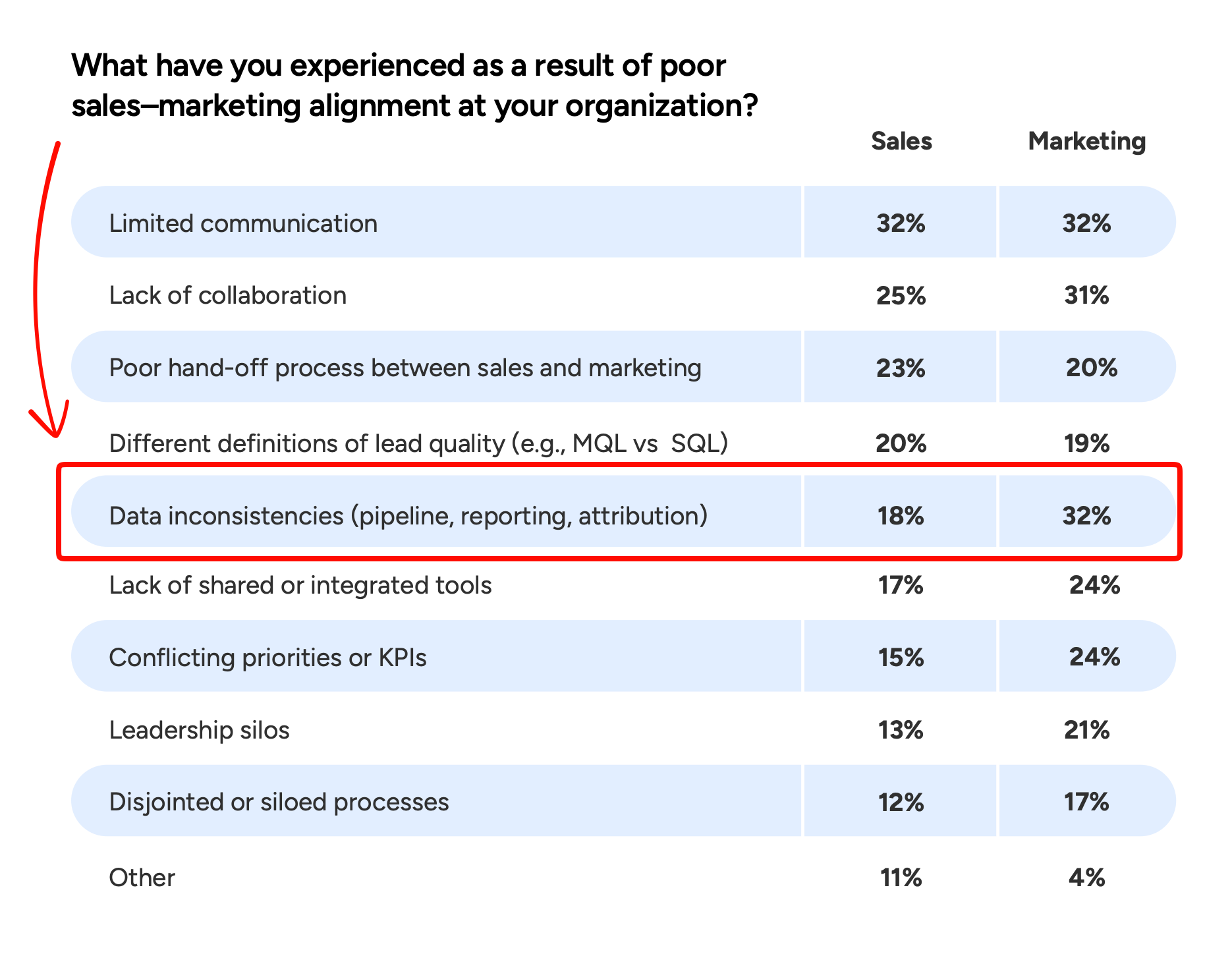
Marketing teams feel this gap most sharply, with 32% citing data inconsistencies as a major barrier compared to 18% of sales teams. This discrepancy occurs because marketing relies on data for attribution and campaign optimization, while sales often operates within rep-owned pipeline signals. When these two sources of truth do not match, the resulting friction undermines the entire go-to-market strategy.
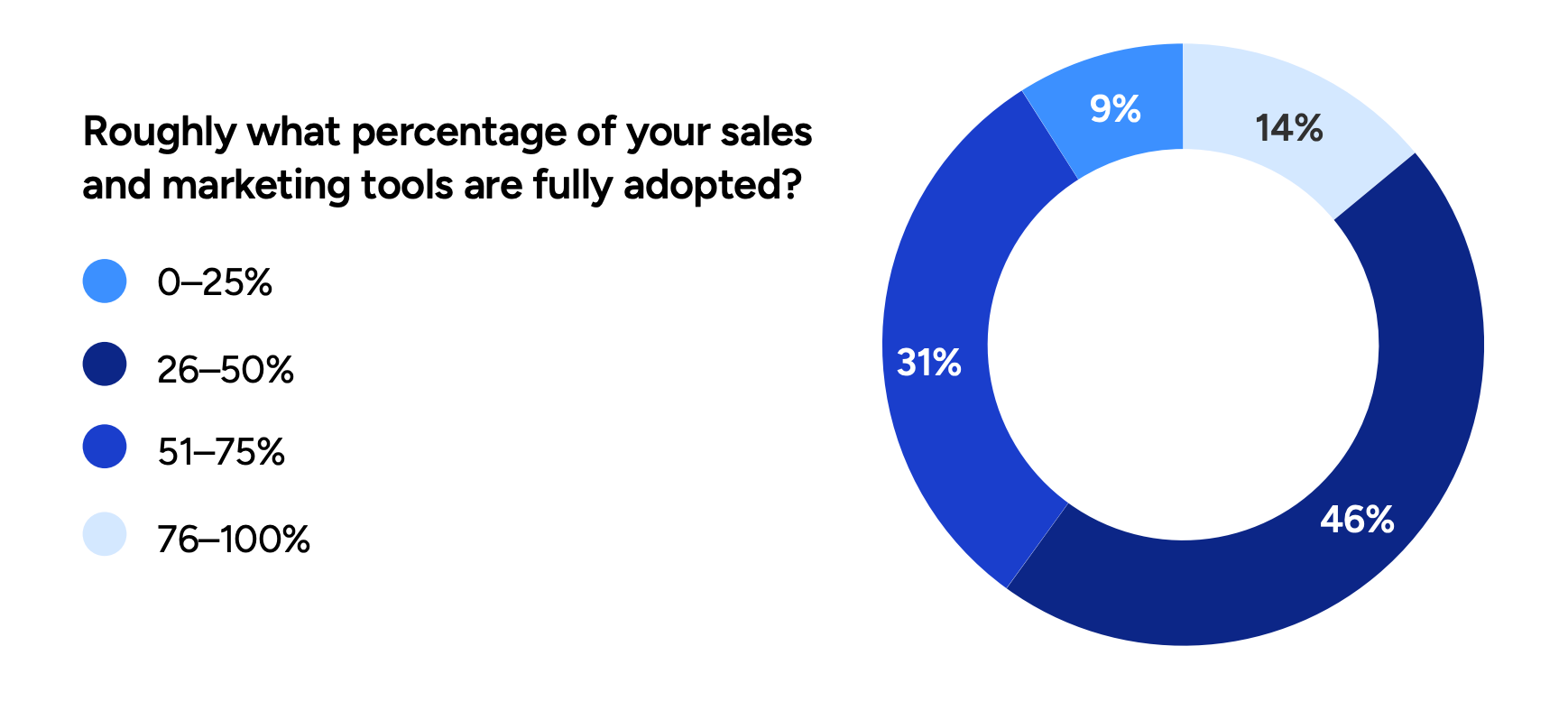
Furthermore, "tool bloat" has become a significant tax on productivity. Approximately 56% of GTM professionals report that their organizations suffer from an excess of software, with 60% of teams using less than half of their available tools. The data shows that 14% of teams use only 0-25% of their tech stack. This underutilization creates maintenance overhead and further fragments customer data, making it nearly impossible to maintain a single view of the buyer’s journey.
The Revenue Cost of Broken Handoffs
Misalignment is not just a cultural issue; it has a direct impact on the bottom line. The report identifies several high-cost consequences of poor GTM alignment:
- Employee Frustration (29%): Misalignment leads to burnout and turnover, particularly among high-performing sales reps who feel they are not being supported by quality marketing.
- Delayed Lead Follow-up (28%): When handoff processes are unclear, leads sit in the CRM without action. Marketing professionals are 10% more likely than sales professionals to flag this as a critical issue.
- Stalled Deal Cycles (20%): A lack of messaging consistency between marketing materials and sales conversations creates confusion for the prospect, slowing down the decision-making process.
The "MQL vs. SQL" debate remains a central point of friction. Roughly 20% of sales and 19% of marketing professionals cite differing definitions of lead quality as a primary blocker. Without a shared Service Level Agreement (SLA), marketing continues to celebrate lead volume while sales laments the lack of "sales-ready" opportunities. Currently, only 29% of GTM teams rate their overall lead quality as "excellent."
Strategies of High-Performing Aligned Teams
The Unbounce report provides a blueprint for what highly aligned teams do differently to overcome these challenges. The data suggests that these organizations focus on three core pillars: data unification, messaging consistency, and tech consolidation.
Data Unification and Shared Metrics
Highly aligned teams are 3.5 times more likely to have strong cross-functional data sharing (59% vs. 16% for misaligned teams). These organizations move beyond "discussing" data in meetings and instead build systems where both functions pull from a single source of truth. By aligning on shared Key Performance Indicators (KPIs)—such as Customer Acquisition Cost (CAC) and Pipeline Velocity—both teams are incentivized to support the same outcomes.
Messaging Consistency
Aligned teams report significantly fewer messaging inconsistencies (17% vs. 28% for others). They achieve this by treating buyer personas as a joint artifact rather than a marketing-only project. When sales provides direct input on customer objections and language, marketing can create content that more accurately reflects the reality of the sales call, leading to a more seamless buyer’s journey.
Radical Tech Consolidation
One of the most actionable findings in the report is the correlation between lean tech stacks and lead quality. Teams that significantly consolidated their technology are twice as likely to rate their lead quality as "excellent" (55% vs. 20%). Aligned teams are also more likely to describe their tech stacks as "lean and focused" (30% vs. 15%). By reducing the number of tools and increasing the adoption of the remaining ones, these teams minimize data silos and operational friction.
Broader Impact and Future Implications
The findings of the 2026 report suggest that the role of "Revenue Operations" will continue to grow in importance as the bridge between sales and marketing. For SMBs, the path to growth in the coming year will not be found in higher lead volumes or more aggressive sales tactics, but in the systematic removal of internal friction.
"Show me the incentive and I’ll show you the outcome," the report notes, quoting Charlie Munger. This sentiment reflects the growing realization that alignment cannot be achieved through better communication alone. It requires a fundamental shift in how people are rewarded. Until marketing is incentivized for revenue rather than just leads, and sales is incentivized for pipeline hygiene rather than just closes, the structural divide is likely to persist.
Looking ahead to the next twelve months, 44% of GTM teams are prioritizing data integration and AI-driven insights to make alignment more measurable. As businesses adopt these technologies, the focus will move toward "predictive alignment," where data can identify a breakdown in the handoff process before it impacts the quarterly revenue targets.
In conclusion, the 2026 GTM landscape is one where efficiency is the primary competitive advantage. SMBs that can close the 31-point gap between their expectations and their reality will be better positioned to capture market share, retain talent, and drive sustainable growth. The data is clear: the most successful teams are no longer just talking to each other—they are building the systems that make talking unnecessary.

 Raul Delapena Setiawan

 Siti Muinah