

In a seismic development for the digital marketing landscape, new research from Brainlabs reveals a significant and accelerating shift in how users interact with search engines, with profound implications for brands reliant on organic search visibility. An exhaustive analysis of 1.35 million keywords across nine key UK search categories demonstrates an unambiguous trend: traditional, short-tail "head terms" are in structural decline across seven out of nine categories, while the longer, more specific "longtail" queries are experiencing robust growth. Crucially, Google’s AI Overviews are increasingly appearing precisely where this search volume is migrating, raising urgent questions for businesses about their organic search strategies.
The findings emerge from a comprehensive study commissioned by Brainlabs, which sought to build upon and address unanswered questions left by a widely discussed August 2025 report by Semrush. The Semrush study, analyzing 260 billion rows of clickstream data, initially suggested that AI adoption, specifically the use of ChatGPT, was not replacing Google search but rather expanding overall search activity. Their conclusion was that users who adopted ChatGPT showed no statistically significant decline in daily Google sessions; in fact, overall search engagement saw a slight uptick.
While this initial report offered a degree of reassurance, Brainlabs’ analysis posits that it overlooked critical nuances. The Semrush study measured the frequency of Google usage, not the nature of the searches conducted or the results displayed. These latter two aspects are paramount for brands seeking to understand their organic visibility and paid search strategies in the coming years. Google itself has publicly acknowledged an increase in average query length, with users posing longer, more conversational questions – a trend that has been sharply amplified since the widespread introduction of AI Overviews. This real-world observation aligns with Brainlabs’ client experiences, which have indicated softening traffic from head terms, burgeoning longtail query volumes, and AI Overviews appearing in contexts far beyond the purely informational searches many initially anticipated.

To investigate these evolving dynamics, Brainlabs undertook its own detailed analysis, pulling 1.35 million keywords across nine UK categories from Ahrefs data. The research was driven by two core hypotheses:
Hypothesis 1: AI Adoption is Reshaping Query Composition within Google, Not Just Overall Volume.
While users may continue to engage with Google at a similar frequency, the substance of their searches is demonstrably changing. The increasing sophistication and accessibility of AI tools are training users to articulate more precise and detailed queries. Consequently, Brainlabs hypothesized that head terms – the short, high-volume queries historically driving significant traffic and value – would see a decline, with a corresponding increase in longtail and potentially branded queries. The Semrush study did not directly address this query composition shift, but Brainlabs’ research was designed to fill that gap.
Verdict: Largely confirmed, with head term decline observed in 7 out of 9 categories.
Hypothesis 2: AI Overviews are Appearing on Commercial Queries, Not Solely Informational Ones.
The prevailing assumption was that Google would strategically deploy AI Overviews primarily on informational queries (e.g., "how-to," "what is," research-based searches) to avoid cannibalizing revenue from commercial Search Engine Results Pages (SERPs) where paid ads dominate. Brainlabs hypothesized that this was only partially true, and that AI Overviews were already infiltrating a broader spectrum of keywords, including mid-funnel commercial queries. If this hypothesis proved correct, the risk of click suppression for brands would be more significant than widely assumed.

Verdict: Confirmed. AI Overview rates on longtail queries were found to be 2-3 times higher than on head terms across all analyzed categories.
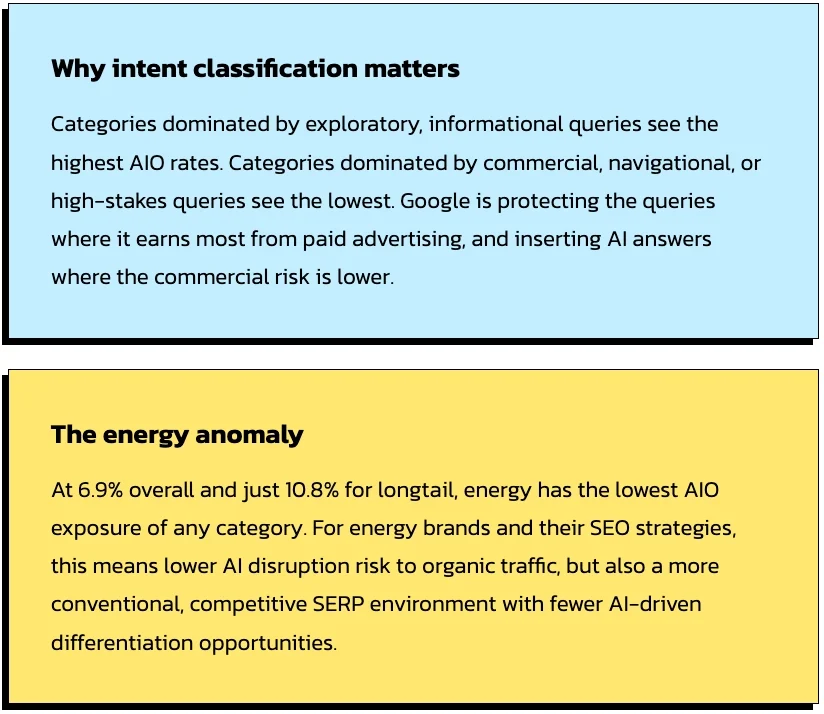
Methodological Distinction: It is important to note the complementary nature of the Brainlabs and Semrush studies. Semrush addressed the question of whether people are still using Google. Brainlabs’ research, utilizing keyword-level search volume trends from Ahrefs, focuses on what they are searching for and what Google is presenting in response. Both questions are vital, but the latter carries more immediate and direct implications for both organic and paid search strategies.
AI Overview Coverage Varies Significantly by Sector, Reflecting Strategic Intent
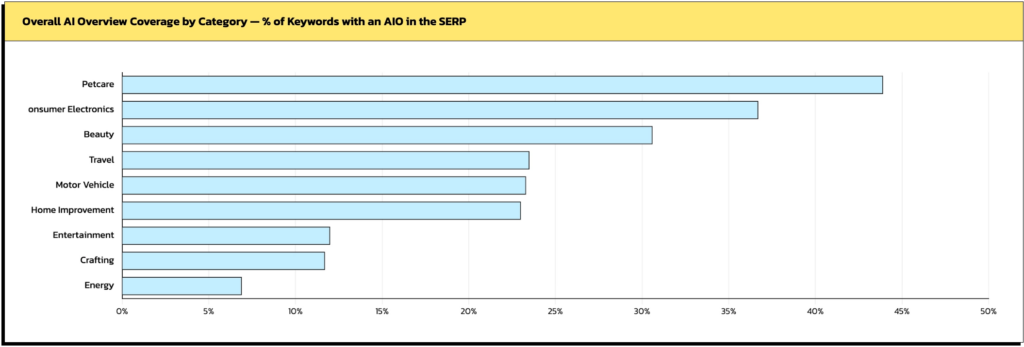
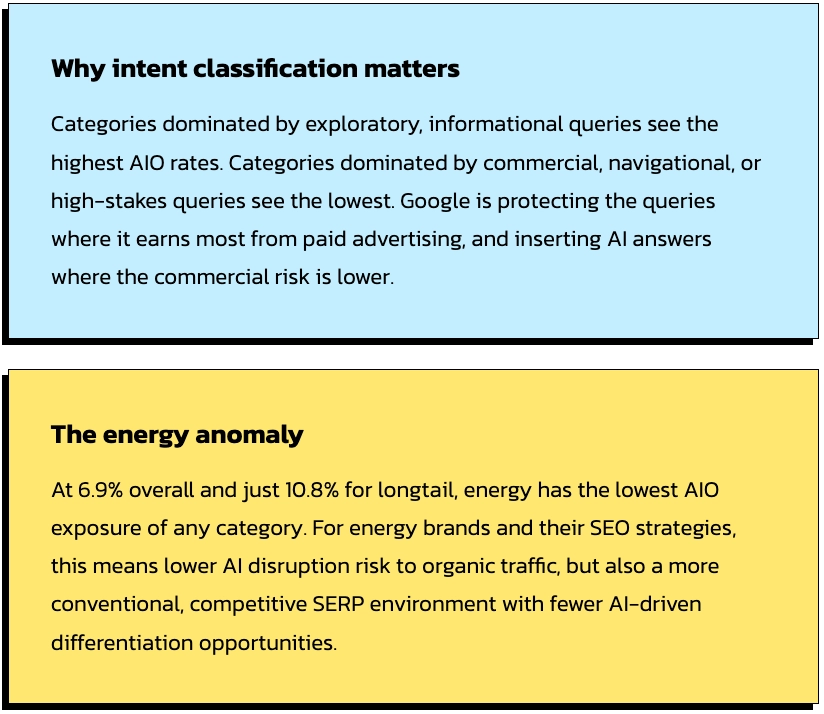
Google’s deployment of AI Overviews is not uniform; it exhibits considerable variation across different industry sectors. This disparity, Brainlabs’ analysis suggests, stems from deliberate intent classification by Google, rather than inconsistencies within the algorithm itself. The coverage rates range from a low of 6.9% to a high of 43.9%.
Petcare emerged as a category with the highest AI Overview penetration, largely attributed to its abundance of informational queries. Questions such as "What can dogs eat?", "Is chocolate toxic to cats?", and "How often should I worm my rabbit?" are areas where Google appears confident in its AI’s ability to provide accurate and helpful answers. This suggests that for the petcare industry, an AI-first content approach is likely to be highly rewarded.
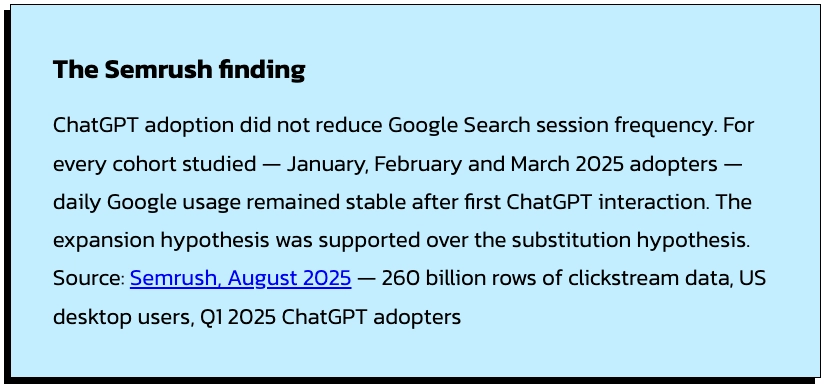
Conversely, Energy sits at the lower end of AI Overview deployment. The majority of energy-related queries are navigational or highly commercially specific, such as "British Gas contact number," "cheapest electricity provider," or "OVO Energy tariffs 2026." Google appears to recognize the significant liability associated with providing potentially inaccurate AI answers for queries where errors could result in substantial financial consequences for users. Consequently, it is more conservative in its AI Overview implementation in this sector.
Consumer electronics (36.7%) and beauty (30.6%) occupy the middle-to-upper range of AI Overview coverage. These sectors are characterized by strong consumer research and comparison behaviors, indicating that AI Overviews are being leveraged to assist users in these decision-making processes.
Travel (23.5%) and motor vehicles (23.3%) exhibit nearly identical AI Overview rates, despite their distinct demand profiles. This similarity suggests a shared dynamic where the strong commercial intent associated with these categories acts as a suppressant on broader AI Overview deployment.
Entertainment (12.0%) and crafting (11.7%) share a notably low AI Overview rate, even though they are generally considered informational categories. This finding warrants further investigation, as it deviates from the expected pattern and suggests other factors may be influencing Google’s AI Overview strategy in these niches.
Longtail Queries Attract AI Overviews at Nearly Double the Rate of Head Terms
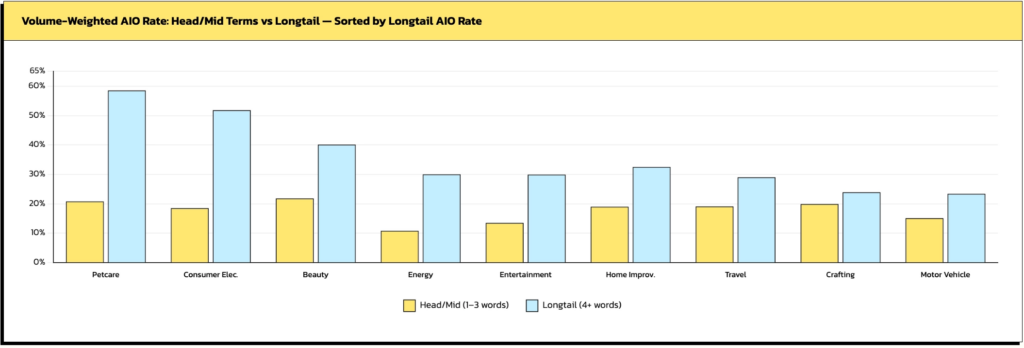
A consistent and striking pattern observed across all nine analyzed categories is that longtail queries (defined as four or more words) attract AI Overviews at a significantly higher rate than head terms (one to three words). This volume-weighted disparity is substantial in several sectors.
In Petcare, the gap is most pronounced: head terms see an AI Overview rate of 20.8%, while longtail queries reach 58.5%. Consumer electronics follows closely, with 18.5% for head terms and 51.8% for longtail queries. This consistent trend indicates that Google perceives longtail queries as the prime territory where AI-generated answers offer the greatest user value. Conversely, head terms are approached with more caution, with a greater tendency to defer to traditional ranked results.
The Motor Vehicles category presents a notable exception. The difference between head and longtail AI Overview rates is the smallest observed (15.1% vs. 23.4%), with a minimal longtail premium. This is attributed to the inherently high commercial intent of car buying, which spans almost all query types. Google treats nearly all such queries as too consequential for AI-generated shortcuts.
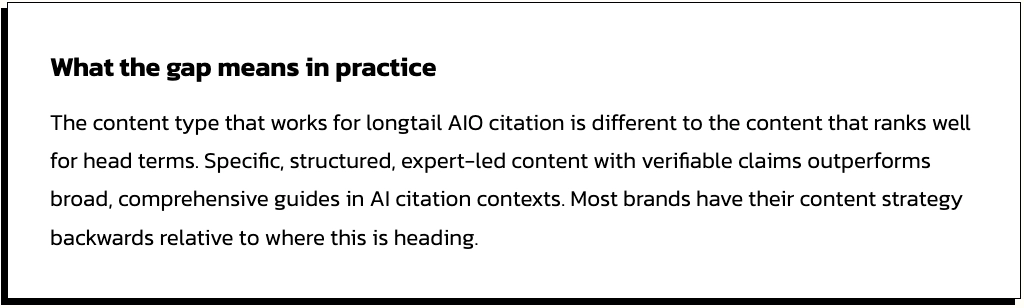
For brands operating in sectors like petcare and consumer electronics, this trend underscores that longtail optimization is no longer solely a strategy for driving traffic. Securing a citation within an AI Overview for high-intent longtail queries is emerging as a distinct and meaningful visibility objective, complementary to traditional organic rankings. As one expert noted, "In petcare, longtail has nearly three times the AI Overview rate of head terms. That gap defines where AI disruption is concentrated – and where the content opportunity is sharpest."
Head Terms Face Structural Decline in Seven of Nine Categories
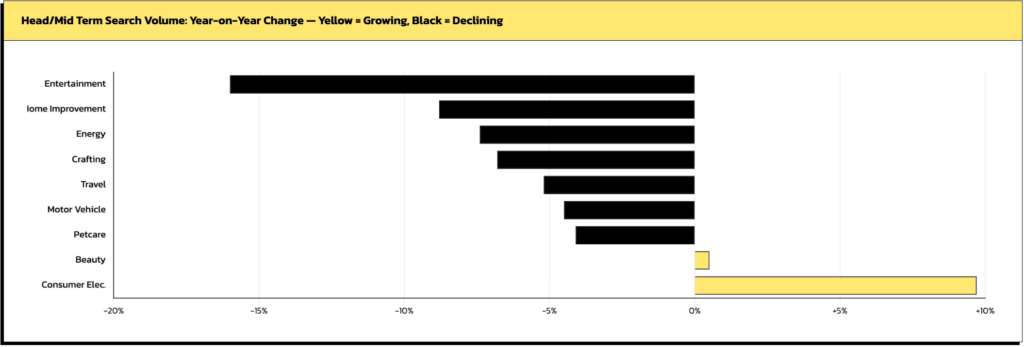
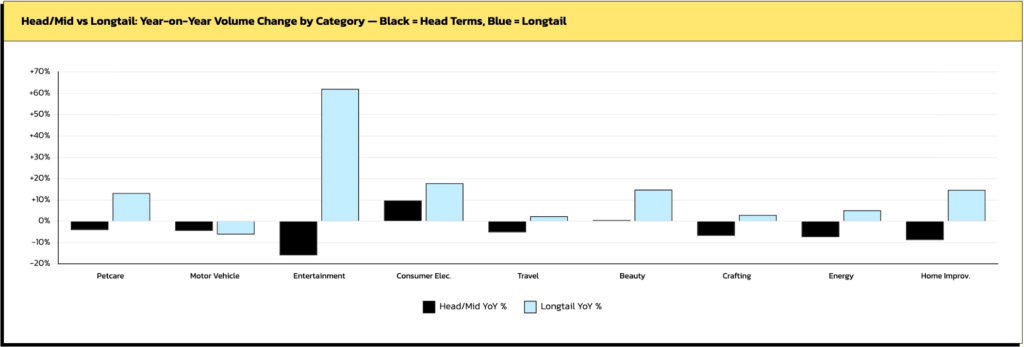
The year-on-year trend analysis for head and mid-length terms (one to three words) paints a clear picture of structural decline across most sectors. Entertainment and home improvement are experiencing the sharpest falls, while only consumer electronics is showing meaningful growth.
Entertainment leads the decline with a -16% year-on-year drop in head term search volume. This category is particularly susceptible to AI disruption, as AI tools can serve as credible substitutes for Google searches. For instance, queries like "what to watch tonight" can be directly answered by AI chatbots or streaming platform recommendation engines, potentially bypassing Google search altogether. This indicates that in some instances, queries are not merely migrating within Google but are leaving the platform entirely.
Home improvement (-8.8%), energy (-7.4%), and crafting (-6.8%) are also experiencing significant declines in head term volume. Travel (-5.2%) is concerning in absolute terms; given its substantial volume base, this decline represents tens of millions of lost impressions annually, with 69.6% of individual keywords already showing a downward trend.
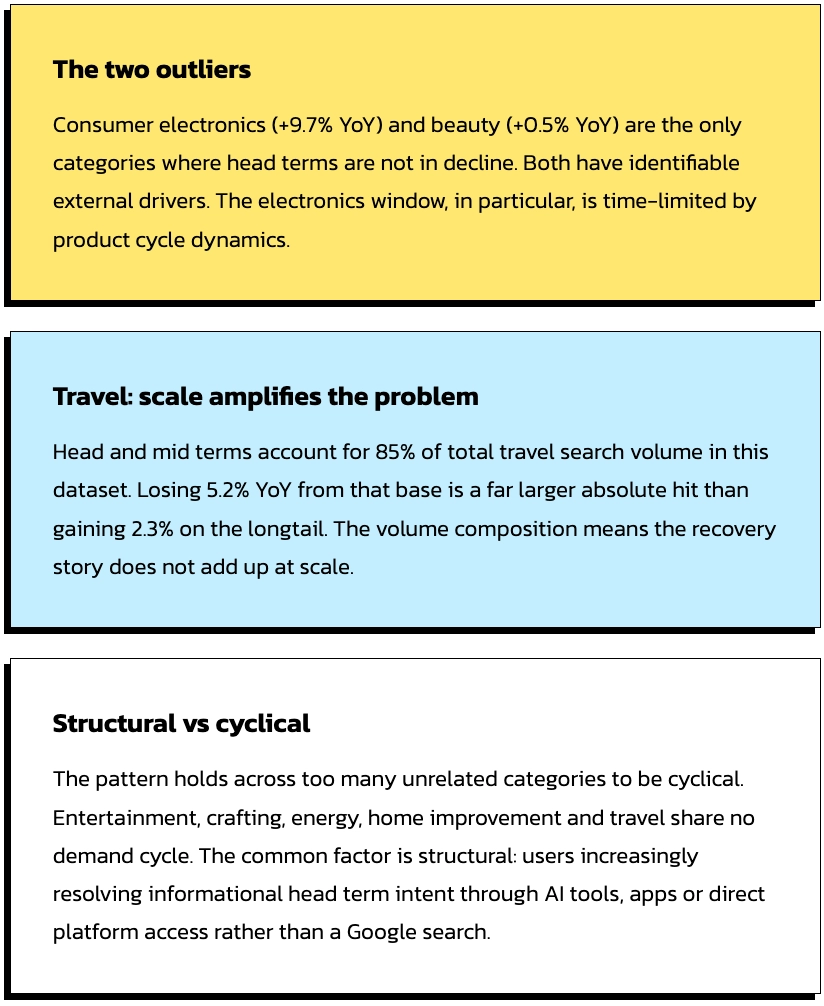
The outliers are consumer electronics (+9.7%) and beauty (+0.5%). Consumer electronics’ growth is currently fueled by the "AI device supercycle," with new product launches, spec comparisons, and upgrade queries driving head term volume. Beauty’s growth reflects the enduring influence of social media on discovery, with trend-led search terms bolstering category-level head queries. However, these trends may not be permanent. The consumer electronics forecast already indicates a deceleration, with a projected -4.7% for the next twelve months.
Longtail Growth Mostly Compensates for Head Term Declines, But Not Universally
When comparing year-on-year trends for head and longtail terms side-by-side, the scale of divergence becomes apparent. In most categories, the gap is significant. Only in beauty and consumer electronics are both longtail and head term volumes moving positively. Conversely, motor vehicles is the sole category where both are declining, signaling a potentially more profound structural challenge.
Entertainment exhibits the most dramatic divergence, with head terms falling by -16% while longtail queries surge by +62.1% year-on-year. This substantial longtail growth reflects a fundamental shift in how entertainment-related queries are being formulated. Users are moving from generic searches like "Netflix shows" or "best films" to more specific, conversational queries such as "what should I watch on Netflix if I liked Severance," "best British crime drama 2026," or "feel-good films to watch on a Sunday." Google is increasingly answering many of these with AI, driving rapid growth in this query segment.
Home improvement (+14.7% longtail, -8.8% head) and petcare (+13.2% longtail, -4.1% head) demonstrate a similar, albeit smaller-scale, dynamic. While head term declines are real, the longtail growth provides meaningful partial compensation in total volume. Furthermore, the higher AI Overview exposure on longtail queries alters the visibility calculus for brands.
Motor vehicles stands apart, with both head and longtail volumes in decline. This suggests a migration away from Google altogether, towards OEM apps, dealer configurators, and specialized automotive search tools. There is no longtail recovery to offset the declines, making it the most structurally challenged category within the dataset.
Comprehensive Data for All Nine Categories
The detailed breakdown across all nine categories provides a granular view of these trends. The methodology, based on 1.35 million Ahrefs keyword exports captured in May 2026, analyzes historical search volume data from May 2024 to April 2026 and forecasts data for May 2026 to May 2027. AI Overview presence was identified via SERP Features, and volume-weighted AI Overview rates were calculated to reflect actual user exposure. Head/mid terms were defined as 1-3 words, and longtail as 4+ words. Year-on-year trends were computed by comparing average monthly search volumes across two distinct 12-month periods.
The Evolving Demands of Search: Beyond Ranking to AI Citation and Brand Presence
The substantial shift towards longtail queries necessitates a strategic response that extends beyond simply creating more content. The critical challenge lies in the fact that longtail queries now represent the highest-exposure zone for AI Overviews. Across the analyzed categories, volume-weighted longtail AI Overview rates range from 23.4% to a significant 58.5%. This means that achieving position one for a longtail query no longer guarantees meaningful traffic if an AI Overview effectively resolves the user’s intent without a click.
Consequently, optimizing for AI Overview citation has emerged as a parallel objective to traditional ranking. This requires authoritative, well-structured content that presents clear, verifiable claims. The broad, hedged, "comprehensive guide to X" articles that historically performed well in organic rankings may no longer be sufficient. Google prioritizes citing sources it trusts, and trust in this context is built on specificity, demonstrable expertise, and factual precision. Many brands’ existing content libraries are not architected to meet these evolving demands.
A third objective has also emerged in categories with high AI Overview presence: achieving zero-click brand presence. When an AI Overview cites a brand as a source, it confers credibility and awareness, even if the user does not navigate to the brand’s website. Measuring this exposure requires different analytical frameworks than traditional organic traffic reporting, and most current analytics setups are not equipped to capture it.
The sheer volume of head terms means that their decline impacts total search volume more significantly than the percentages might initially suggest. Head and mid-length terms still account for between 65% and 85% of total search volume in most sectors. For example, the travel sector’s 165 million head term searches versus 28 million longtail searches highlight this imbalance. A 5-17% decline in head term volume represents a larger absolute loss of impressions than a 15-62% gain on a smaller longtail base, across nearly all categories except entertainment.
As one industry observer noted, "Most brands are optimizing for a SERP that is gradually becoming less relevant to the queries where they most need to be visible. The longtail AI Overview rate is not a future problem – it is a present one."
The two growing categories, consumer electronics and beauty, currently warrant a more aggressive content investment strategy, as demand is robust in a way it is not in entertainment, crafting, or energy. However, this window of opportunity may be temporary. The deceleration already observed in consumer electronics forecasts, and the modest head term growth in beauty, suggest that these positive trends could reverse with shifts in consumer behavior or market dynamics.
Implications for Google’s Advertising Revenue Model
The structural decline in head term search volume carries significant implications for Google’s advertising revenue model, which is disproportionately reliant on high-volume head term auctions. Advertisers typically pay considerably higher Cost-Per-Click (CPC) rates for short, high-intent head terms compared to longer, more fragmented longtail queries. Head terms drive auction depth, which in turn fuels CPC inflation and, consequently, Google’s revenue per search.
Categories experiencing sharp head term volume declines, such as entertainment (-16% YoY), energy (-7.4%), home improvement (-8.8%), and crafting (-6.8%), present a direct risk to this revenue stream. A reduction in available impressions and a potential decrease in advertiser competition could lead to lower CPCs, even if advertiser budgets remain stable. The travel sector, with its vast search volume base and widespread keyword declines, is particularly concerning in this regard.
While longtail growth offers partial compensation through increased ad impressions, the revenue per click is materially lower, the inventory is more fragmented, and the complexity of managing ad campaigns increases. For Google to offset head term revenue declines at scale, longtail volume growth would need to be substantially higher than currently observed, outside of specific growth sectors like consumer electronics and entertainment.
The more significant long-term risk for Google is not direct cannibalization of ad revenue by AI Overviews, but rather the potential loss of users who now turn to AI tools like ChatGPT or Gemini for informational head term queries, thereby never reaching a Google SERP. These "missing" queries do not migrate within Google; they simply do not appear in the data. Entertainment and crafting are prime candidates for this silent attrition, as conversational AI offers a credible and often more efficient alternative to a traditional Google search for knowledge and inspiration.
For paid search advertisers, the immediate implication is that CPCs in declining-volume categories might initially rise due to constrained supply meeting persistent demand before potentially falling. The longer-term trajectory will depend on whether advertisers follow search volume into the longtail or maintain head term allocations for brand visibility. While most large advertisers will likely pursue both strategies, slowing the adjustment process, the overall shift is undeniable, and its scale is becoming increasingly apparent across the data.
Data Gathering and Analysis Methodology
The foundation of this research lies in a comprehensive data export from Ahrefs, a leading SEO data platform renowned for its extensive web crawling and live SERP data collection capabilities. AI Overview presence was specifically tracked as a SERP feature within Ahrefs’ keyword data.
The dataset comprises 1.35 million keywords, meticulously curated across nine distinct UK consumer categories: petcare, motor vehicles, entertainment, consumer electronics, travel, beauty, crafting, energy, and home improvement. Each category dataset contains up to 150,000 keywords, all representing UK (gb) search queries captured in May 2026.
AI Overviews were identified by their presence in the "SERP Features" column of the Ahrefs export. To provide a more representative understanding of user exposure, volume-weighted AI Overview rates were calculated. This method weights each keyword’s AI Overview flag against its monthly search volume, acknowledging that high-volume keywords have a far greater impact on user experience than niche keywords with minimal search traffic.
Volume-Weighting Explained: To illustrate, consider the Petcare category. If "dog food" receives 500,000 monthly searches and a highly specific query like "labrador puppy grain-free wet food pouches" receives only 50, simply counting keywords with an AI Overview would treat both equally. However, "dog food" represents a significantly larger portion of actual user search volume. Volume-weighting addresses this by assessing the proportion of total search volume within a category that is exposed to an AI Overview. This approach offers a more accurate reflection of real-world impact, avoiding skewing by numerous low-volume niche terms. The "Overall AIO %" column, however, uses a count-based method to answer a different question: what percentage of keywords within a space exhibit AI Overviews at all, reflecting content coverage.

Search volume trends were analyzed using Ahrefs’ monthly search volume time series data. The historical series spans May 2024 to April 2026, providing a two-year baseline. A forecast series, covering May 2026 to May 2027, was generated using Ahrefs’ proprietary forecasting model. Year-on-year trends were calculated by comparing the average monthly volume of Year 1 (May 2024-April 2025) against Year 2 (May 2025-April 2026). Keywords with incomplete data series were excluded from trend calculations to ensure data integrity.
Keyword classification into "head/mid terms" (1-3 words) and "longtail" (4+ words) aligns with standard industry practice, recognizing the typical shift in user intent as query length increases. All volume-weighted figures utilize Ahrefs-reported monthly search volume as the weighting factor.
Limitations: It is crucial to acknowledge that AI Overview presence is a dynamic snapshot; Google’s deployment is subject to frequent changes. Ahrefs’ SERP crawls, while extensive, do not capture every query at every moment, meaning the rates reflect a strong sample rather than a complete census. Forecast data, being model-generated, should be interpreted as directional rather than definitive.
Understanding Your Category’s Position
Brainlabs offers ongoing analysis of this evolving search landscape, conducting this type of research against specific client keyword sets as part of their strategic SEO and Paid Search services. For brands operating in sectors not covered by this report, or for those seeking a deeper dive into their proprietary data, engagement with Brainlabs’ SEO team is recommended. The window to adapt to the shifting sands of search is narrowing, and proactive strategic planning is paramount for sustained digital success.









