

The marketing landscape is undergoing a profound transformation, driven by the rapid evolution of artificial intelligence and its integration into search engines. Traditional search engine optimization (SEO) metrics, once the bedrock of digital marketing strategies, are rapidly being supplanted by the imperative of AI Answer Engine Optimization (AEO). This shift necessitates sophisticated tools that go beyond mere monitoring, enabling marketing teams to strategically close citation gaps, integrate AI search data with CRM attribution, and scale programs across diverse regions and content workflows. As the digital ecosystem progresses towards 2026, a new generation of AI visibility platforms is emerging, offering advanced capabilities to ensure brand presence in a world increasingly dominated by generative AI.
The Evolving Landscape of AI Search and Brand Visibility
The way consumers discover and engage with brands has fundamentally changed. Buyers are no longer solely relying on traditional Google searches, which prioritize keyword rankings and organic click-through rates. Instead, they are increasingly turning to AI answer engines like ChatGPT, Perplexity, and Gemini to synthesize information, compare products, and receive recommendations before ever visiting a vendor’s website. This behavioral shift renders outdated the 2021 framework of measuring search performance, demanding a new approach focused on AI visibility.
AI visibility monitoring, also known as AI brand monitoring, is the practice of tracking how frequently and favorably a brand appears in responses generated by these AI answer engines. Unlike traditional analytics that measure clicks and rankings, AI visibility measures "presence"—how often a brand is mentioned, its placement within an AI-generated answer, and the sentiment (favorable, neutral, or negative) conveyed. Platforms like Peec AI have been instrumental in establishing this new paradigm, tracking brand mentions across multiple AI models simultaneously. However, as the market matures, the need for tools that offer actionable insights and integrated solutions, rather than just isolated monitoring, has become paramount. Industry reports indicate that the market for AEO tools is projected to grow significantly, reaching an estimated $X billion by 2028, reflecting the urgent need for brands to adapt.
Addressing the Gaps: Why Marketers Seek Advanced AEO Solutions
While foundational AI visibility tools like Peec AI effectively track brand mentions and monitor sentiment, many marketers encounter significant hurdles that limit their ability to translate monitoring into measurable business outcomes. Common challenges include:
- Remediation Deficiencies: Many monitoring tools excel at identifying citation gaps but fall short in providing direct means to address them. Marketers are left to manually create content or briefs, disconnecting insight from action.
- Attribution Disconnect: A critical flaw in many standalone AEO platforms is the lack of native CRM integration. AI visibility data often remains siloed in a dashboard, making it difficult to connect directly to sales pipelines, revenue, or broader campaign performance without extensive manual data export and complex attribution modeling.
- Scalability Limitations: For global brands or those managing extensive content workflows across multiple regions, reporting and program management can become unwieldy if the AEO platform lacks robust scalability features.
- Historical Data Gaps: Some platforms initiate tracking only upon subscription, offering no historical data backfill. This prevents benchmarking against past performance or understanding long-term AI visibility trends.
- Platform Coverage Nuances: While many cover prominent AI models, some platforms may lack comprehensive coverage of emerging answer surfaces or employ prompt methodologies that rely on synthetic queries rather than real user prompts, impacting accuracy.
These limitations highlight a growing demand for integrated solutions that empower marketing and RevOps teams to not only measure but also act on AI visibility data, directly linking it to the customer journey and revenue generation.
-1.png)
Leading the Charge: A Comprehensive Look at Peec AI Alternatives in 2026
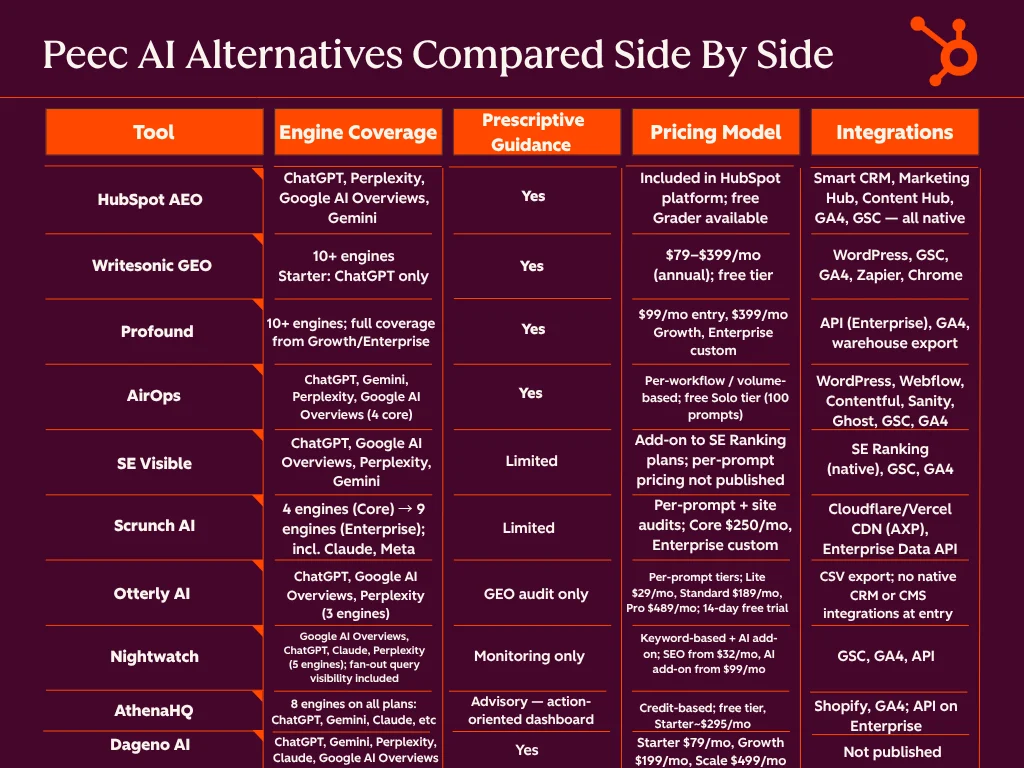
The market for AI visibility platforms is rapidly innovating, with several contenders offering specialized strengths that address the shortcomings of basic monitoring tools. Here’s an in-depth look at the strongest alternatives anticipated to shape the AEO landscape in 2026:
1. HubSpot AEO: Native CRM Integration for Revenue Attribution
HubSpot AEO stands out as the premier choice for B2B marketing and RevOps teams prioritizing direct integration of AI visibility data with their CRM. Built natively within HubSpot’s Smart CRM, it tracks brand mentions, citation rates, prompt share of voice, and competitive benchmarks across major AI answer engines. This data is seamlessly presented alongside contact records, deal stages, and campaign performance, eliminating the need for complex custom integrations. For teams grappling with proving the ROI of their AEO initiatives, HubSpot AEO provides an immediate, closed-loop attribution model. Sales representatives can gain invaluable context, understanding if a prospect originated from a ChatGPT citation, which prompt triggered the visit, and how competitors are positioned—all within their existing workflow. While specialized tools might offer deeper prompt dataset analytics or AI crawler diagnostics, HubSpot AEO’s strength lies in its ability to connect AI visibility directly to tangible business outcomes.
2. Writesonic GEO: Prescriptive Optimization and Content Creation
For organizations where the primary bottleneck is content execution rather than just measurement, Writesonic GEO offers a compelling solution. It provides both AI visibility monitoring and integrated content generation capabilities. When a citation gap is identified, Writesonic allows teams to act immediately, drafting or briefing content without switching platforms. This seamless integration between insight and creation provides a compounding advantage, accelerating content operations and ensuring a rapid response to visibility opportunities. While its monitoring layer is relatively newer compared to dedicated trackers, its end-to-end optimization workflow is a significant differentiator.
3. Profound: Enterprise Analytics, Security, and Scalable Content
Profound caters specifically to enterprise marketing teams, large agencies, and organizations where AI recommendations directly influence substantial revenue. It delivers a comprehensive feature set, tracking mentions, citations, sentiment, and prompt volume data across over 10 AI platforms. Its "Agents" feature empowers the creation of AEO-optimized content at scale, incorporating human-in-the-loop review for quality assurance. Profound also boasts an impressive prompt dataset, including over 1.5 billion real user prompts and 400 million anonymized conversations, lending significant credibility to its measurement. Its robust enterprise-grade security features, including SSO, role-based access, and data residency options, make it a secure choice for organizations with stringent compliance requirements.
4. AirOps: Agency Workflows and Multi-Site Content Production
AirOps is designed for content operations teams and agencies managing multiple brands or extensive content libraries. Beyond tracking citation rate, mention rate, and sentiment via AirOps Insights, its Page360 feature links this visibility data to Google Search Console and GA4. The "Quill" (Playbooks) feature is a game-changer, enabling users to research, draft, and publish content directly to popular CMS platforms like Webflow, WordPress, and Contentful. This integrated workflow from insight to publishing offers unparalleled operational leverage for agencies running AEO programs across diverse client portfolios. While its tracking depth might be newer than dedicated monitors, its production capabilities are highly advanced.
5. SE Visible (by SE Ranking): Unified SEO and AEO Tracking
For teams already entrenched in SE Ranking for traditional SEO, SE Visible offers a streamlined path to integrating AI visibility without adding a separate subscription. It brings AI overview tracking into the existing SE Ranking ecosystem, providing 13+ years of historical SEO context alongside new AI capabilities. The unlimited seats feature across all plans makes it an accessible option for entire marketing teams to gain dashboard access without prohibitive cost escalation. This unified view of both traditional and AI search performance is particularly beneficial for marketers who need a holistic understanding of their brand’s online presence.
6. Scrunch AI: Deep AI Crawler Analytics for Technical AEO
Scrunch AI occupies the high-end enterprise segment, providing advanced AI crawler analytics in addition to standard visibility tracking. It offers insights into how AI bots and agents interact with a site before constructing their answers, a unique diagnostic capability for technical SEO teams. Its Agent Experience Platform (AXP) can automatically serve AI-optimized content to AI agents without affecting the human-facing website. While its entry price point is substantial, its detailed input-level diagnostics and enterprise-grade coverage make it invaluable for large organizations requiring deep technical understanding of AI interaction.

7. Otterly AI: Cost-Effective Entry into AI Visibility
Otterly AI provides an accessible entry point for startups, SMBs, solo founders, or teams experimenting with AEO on a limited budget. Starting at an affordable price, it tracks brand mentions and citations across multiple answer engines and includes a GEO audit feature that evaluates 25+ on-page factors with actionable fix-it checklists. This combination of monitoring and thin optimization at an entry-level price makes it a rational choice for establishing a baseline before committing to more expensive platforms.
8. Nightwatch: Understanding the "Why" Behind AI Citations
Nightwatch is ideal for teams seeking to understand the underlying AI reasoning process, not just the final output. Its fan-out query visibility feature reveals the real-time web searches AI systems conduct before formulating their answers. This diagnostic capability provides a unique understanding of which sources the AI fetched and what queries it ran, offering direct signals for content gap prioritization. For SEO and content teams focused on the citation pathway rather than just the result, Nightwatch offers a distinct advantage.
9. AthenaHQ: Free Entry for Proof-of-Concept
AthenaHQ provides a crucial free entry point, making it suitable for early-stage programs or teams needing to demonstrate value before securing budget. Positioned as a brand intelligence tool with AI visibility capabilities, it covers mentions, citations, and competitive share of voice. While it lacks advanced auditing or optimization features and enterprise-grade security, it serves as an excellent starting point for building a business case with real data.
10. Dageno AI: Full-Workflow GEO Execution
Dageno AI, a newer entrant, aims to offer a comprehensive workflow from data monitoring to strategy, content generation, and result attribution. For teams ready to move beyond basic monitoring without immediately jumping to enterprise pricing, Dageno AI presents a direct upgrade path. Its ambition to connect content actions to visibility outcomes, and ultimately to ROI, addresses a critical need in the market. As an early-stage tool, verifying feature maturity during a trial period is advisable.
Strategic Criteria for Evaluating AI Visibility Platforms
Choosing the right AEO platform requires a clear understanding of an organization’s specific needs and existing tech stack. Key evaluation criteria include:
- Integration Ecosystem: Does the platform integrate with your CRM, analytics tools (e.g., GA4, Google Search Console), and content management systems? Native integration, like HubSpot AEO’s, significantly reduces friction.
- Actionability and Remediation: Does the tool merely identify problems, or does it offer features (e.g., content generation, brief creation, workflow automation) to help solve them?
- Prompt Methodology and Accuracy: Does the platform use real user prompts or synthetic queries? Transparency in methodology, as offered by Profound, is crucial for data accuracy.
- Engine Coverage and Scalability: How many AI answer engines does it cover? Can it scale to multiple regions and languages?
- Attribution Capabilities: Can AI visibility data be directly linked to pipeline, revenue, and customer lifecycle stages?
- Security and Compliance: For enterprise users, SSO, role-based access, and data residency are non-negotiable.
- Pricing Model: Understand whether pricing is based on prompt volume, number of users, engine coverage, or features, to accurately assess total cost of ownership.
Before embarking on any paid trial, a prudent step is to benchmark current AI visibility using a free tool like HubSpot’s AI Search Grader. This provides a baseline score against which to measure the performance of any new platform.
Connecting AI Visibility to Measurable ROI
.png?width=650&height=488&name=White%20Simple%20Comparison%20Graph%20(2).png)
The true value of an AEO program materializes when AI visibility is inextricably linked to an organization’s attribution model. This requires a deliberate strategy:
- Tag AI-Sourced Traffic: Implement dedicated UTM parameters for AI-sourced campaigns and configure channel groupings in GA4 to capture known AI referrer patterns (e.g., perplexity.ai, chatgpt.com). HubSpot’s Smart CRM can then capture this source data at contact creation.
- Standardize UTM and Tracking: Every piece of content published as part of an AEO workflow should include campaign parameters that map back to the specific AI visibility gap it addresses. This establishes a clear lineage from "tool X identified gap Y" to "content Z generated N pipeline-influenced contacts."
- Build CRM Dashboards: Create custom properties in your CRM for "AI Visibility Initiative" and automate their population based on UTM parameters. This allows for the creation of CRM dashboards that filter pipeline views by "originated from AI search," fundamentally shifting budget conversations towards demonstrable ROI.
Building an Actionable AEO Workflow: From Monitoring to Action
Effective AEO programs follow a repeatable cycle, transforming insights into tangible results:
- Prompt Research: Identify high-intent queries relevant to target personas.
- Visibility Auditing: Assess current brand presence and identify citation gaps.
- Competitive Analysis: Understand how competitors are cited and their content strategies.
- Content Briefing & Creation: Develop AEO-optimized content directly addressing identified gaps.
- Publishing & Syndication: Distribute content across relevant platforms.
- Performance Tracking & Optimization: Continuously monitor citation rates and refine content.
Tools like HubSpot Content Hub, combined with AI-assisted drafting features, can provide the necessary infrastructure for scalable content workflows, from brief generation and approval processes to centralized asset libraries. This creates a closed loop: detect a gap, brief it, draft it, publish it, and measure its impact on citation rates and ultimately, revenue.
Future Outlook and Strategic Imperatives for Marketers
The landscape of AI search and brand visibility is dynamic, necessitating continuous adaptation from marketing teams. The platforms reviewed here represent the leading edge of this evolution, offering capabilities that extend far beyond the basic monitoring of the past. As AI models become more sophisticated and consumer search habits continue to evolve, the ability to seamlessly connect AI visibility to revenue will become a non-negotiable requirement for marketing success.
The choice of an AEO platform should be dictated by an organization’s specific challenges and strategic priorities. Whether the need is for native CRM attribution, robust content generation, enterprise-grade security, or simply a cost-effective entry point, the market now offers diverse solutions. However, the consistent thread among all successful AEO programs is the commitment to move beyond passive monitoring to proactive action, integrating AI visibility data into the core of marketing strategy and demonstrating its quantifiable impact on the bottom line. Marketers who embrace these advanced tools and methodologies will be best positioned to thrive in the AI-driven future of brand discovery and engagement.








