

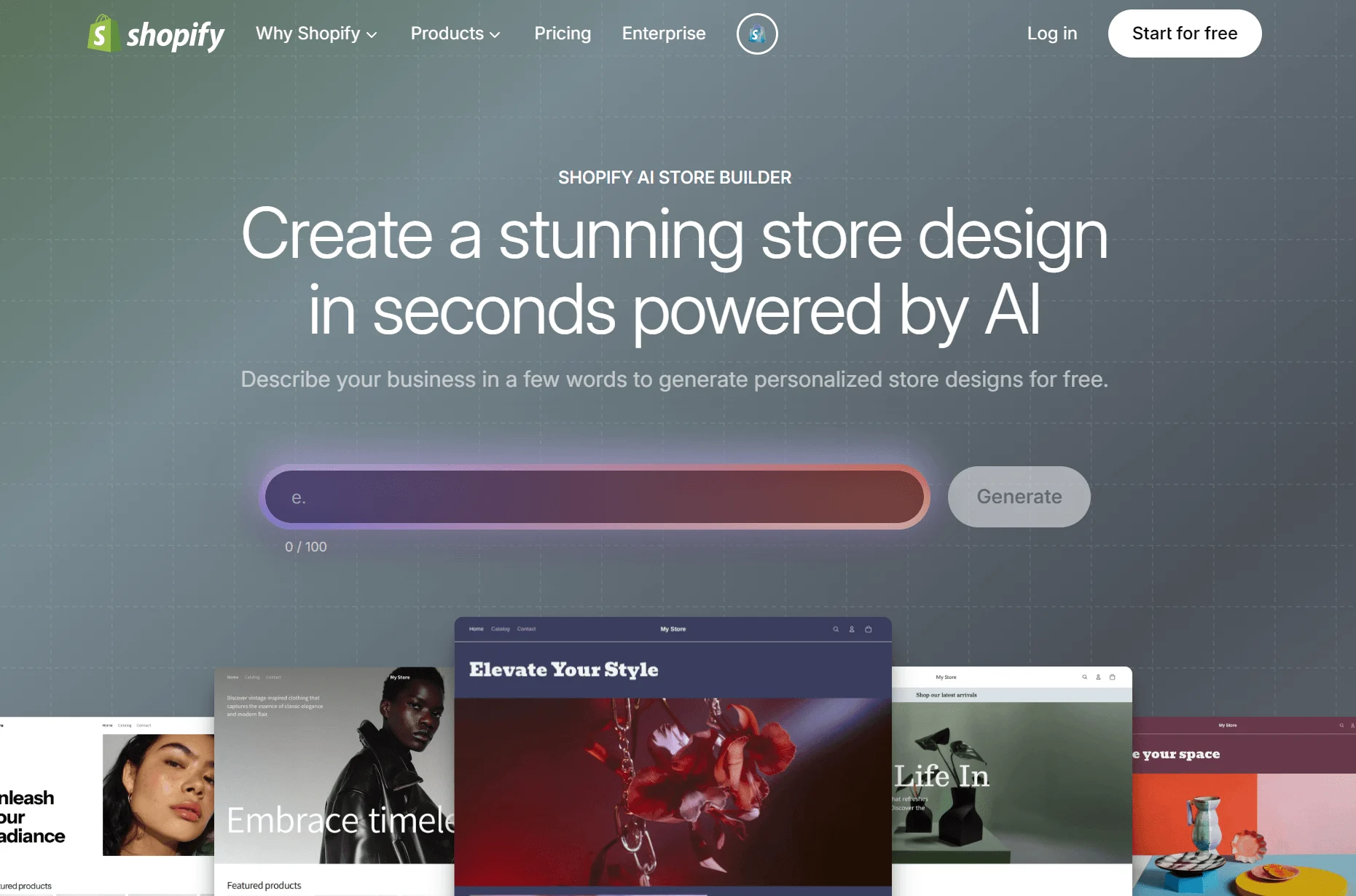
The landscape of e-commerce is undergoing a profound transformation, driven by the relentless advancement of artificial intelligence. What once necessitated weeks of meticulous design and development work for a Shopify store can now be accomplished in mere minutes, thanks to a new generation of AI-powered store builders. These sophisticated tools, rapidly evolving, are projected to become indispensable by 2026, automating everything from homepage layouts and product pages to generating compelling product descriptions, establishing basic branding guidelines, optimizing for search engines (SEO), and overall store design. This paradigm shift democratizes e-commerce, making professional online storefronts accessible to a broader array of entrepreneurs and small businesses.
Beyond core store creation, many AI builders offer specialized functionalities tailored to specific business needs. Some can generate an entire store from a single product link or a defined niche, streamlining the initial setup for dropshippers or niche retailers. Others focus on optimizing existing stores, handling landing page creation, intricate page design, sophisticated dropshipping setups, or advanced conversion rate optimization (CRO). The proliferation of these tools necessitates a comprehensive understanding of their capabilities to select the most suitable solution for individual goals, budget constraints, and desired levels of customization. This guide delves into eight of the leading AI Shopify store builders, providing a detailed comparison to aid informed decision-making.
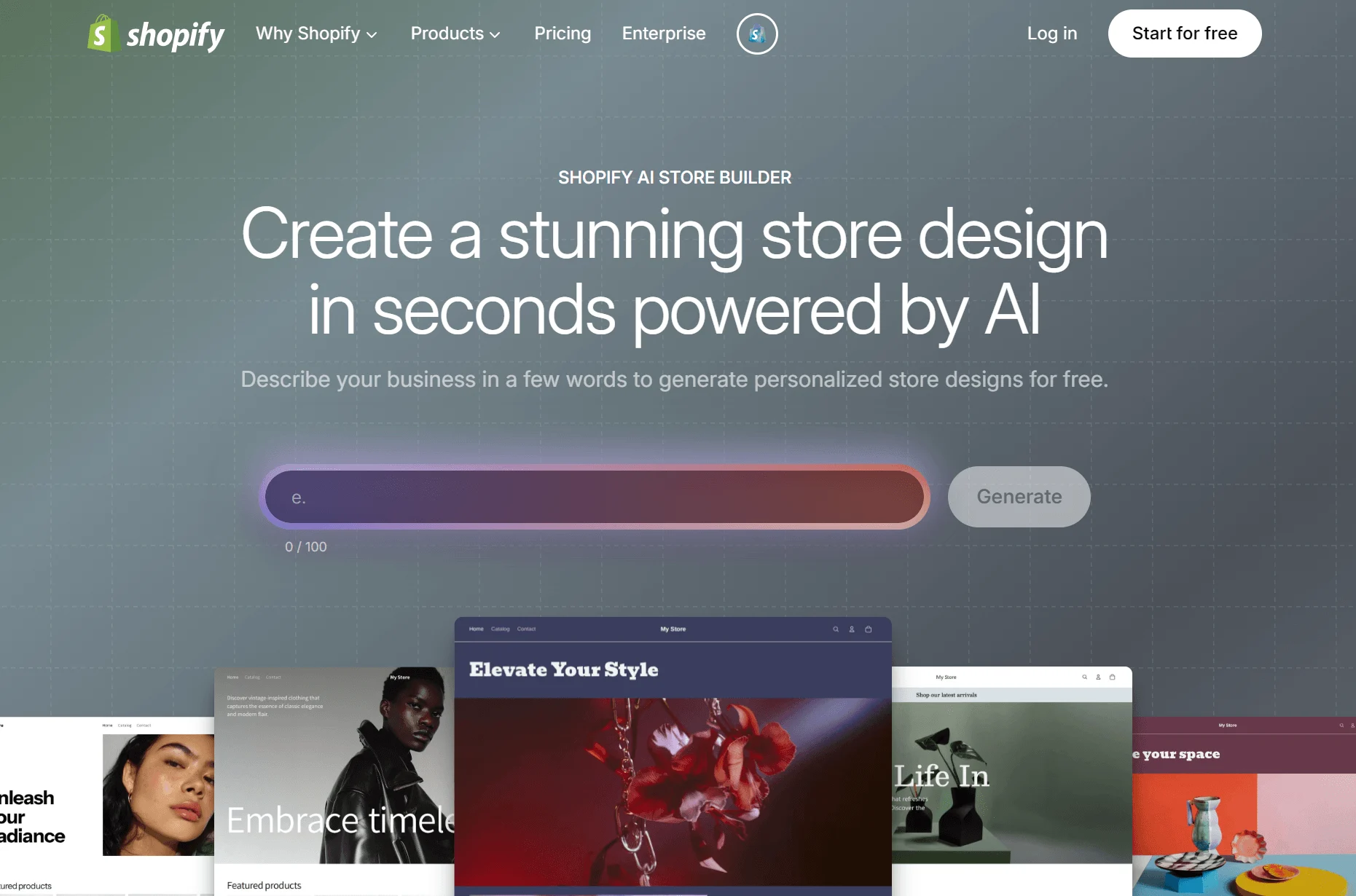
The E-commerce Landscape and the AI Imperative
E-commerce has witnessed exponential growth over the past decade, with global online sales consistently breaking records. Platforms like Shopify have been instrumental in this expansion, empowering millions of merchants worldwide. However, as the market matures, so too do customer expectations. A professional, visually appealing, and highly functional online store is no longer a luxury but a prerequisite for success. Traditionally, achieving this required significant investment in web designers, developers, and copywriters—resources often out of reach for nascent businesses or solopreneurs.
The integration of artificial intelligence into e-commerce store building addresses this challenge directly. AI leverages machine learning algorithms to analyze design principles, user experience best practices, and market trends. By processing vast datasets of successful online stores, product categories, and marketing copy, AI can rapidly generate highly optimized and aesthetically pleasing store elements. This not only dramatically cuts down on development time and cost but also allows entrepreneurs to iterate on designs and launch new products or ventures with unprecedented agility. The year 2026 is often cited as a benchmark because by then, the capabilities of these AI tools are expected to have matured considerably, offering even more sophisticated and autonomous design features.
Understanding AI Shopify Store Builders: Capabilities and Types
At its core, an AI Shopify store builder is a software application that employs artificial intelligence to automate or significantly reduce the manual effort involved in creating or customizing a Shopify store. Instead of a merchant meticulously crafting every element, they provide the AI tool with key inputs—such as a specific niche, a product URL, a brand description, or even just a few keywords—and the AI generates the corresponding store components.
The scope of AI assistance varies widely but generally includes:
- Homepage Layouts: Generating visually engaging and conversion-optimized front pages.
- Product Pages: Crafting detailed and persuasive layouts for individual products, often including dynamic elements.
- Landing Pages: Designing dedicated pages for marketing campaigns, focusing on specific offers or lead generation.
- Product Descriptions: Writing compelling, SEO-friendly, and brand-consistent product copy.
- SEO Basics: Integrating fundamental search engine optimization elements like meta titles, descriptions, and alt text for images.
- Branding Elements: Suggesting color palettes, fonts, and visual styles consistent with a brand’s identity.
- Design Sections and Images: Creating or recommending relevant visual assets to enhance the store’s aesthetic.
These tools typically fall into two main categories:
- Full Store Generators: These tools aim to build an entire, ready-to-launch store from minimal input, often complete with products (imported or suggested), initial copy, and a cohesive theme. They are ideal for new ventures or those looking for a rapid overhaul.
- Page/Element Builders & Optimizers: These focus on enhancing specific parts of an existing store, such as individual pages, sales funnels, or conversion optimization. They are invaluable for merchants seeking to refine their current online presence and boost performance.
It is crucial to emphasize that while AI provides an excellent starting point, it rarely delivers a perfectly finished product without human review. Merchants should always expect to shape the details, fine-tune the content, and ensure brand alignment before publishing their AI-generated store. This human touch remains vital for authenticity and ultimate success.
Key Players in the AI Shopify Store Builder Market (2026 Outlook)
As of 2026, the market for AI Shopify store builders is robust and competitive, offering solutions for a diverse range of needs and budgets. The following table provides a quick overview, with detailed reviews to follow. Note that prices are for the builder’s service, and a separate paid Shopify plan is always required for a live store.
| Tool | Best for | Starting Price | Build a Full Store? | Best Feature |
|---|---|---|---|---|
| Shopify AI Store Builder | Native build, then manual edits | Free | ✅ | Generates three storefronts from one prompt |
| Dropmagic | Dropshipping with market research | Free; Pro $79/month | ✅ | Persona and angle targeting in Strategy section |
| Atlas | Full stores, product pages, landing pages | $39/month | ✅ | Dashboard tracking store, upsell, bundler revenue |
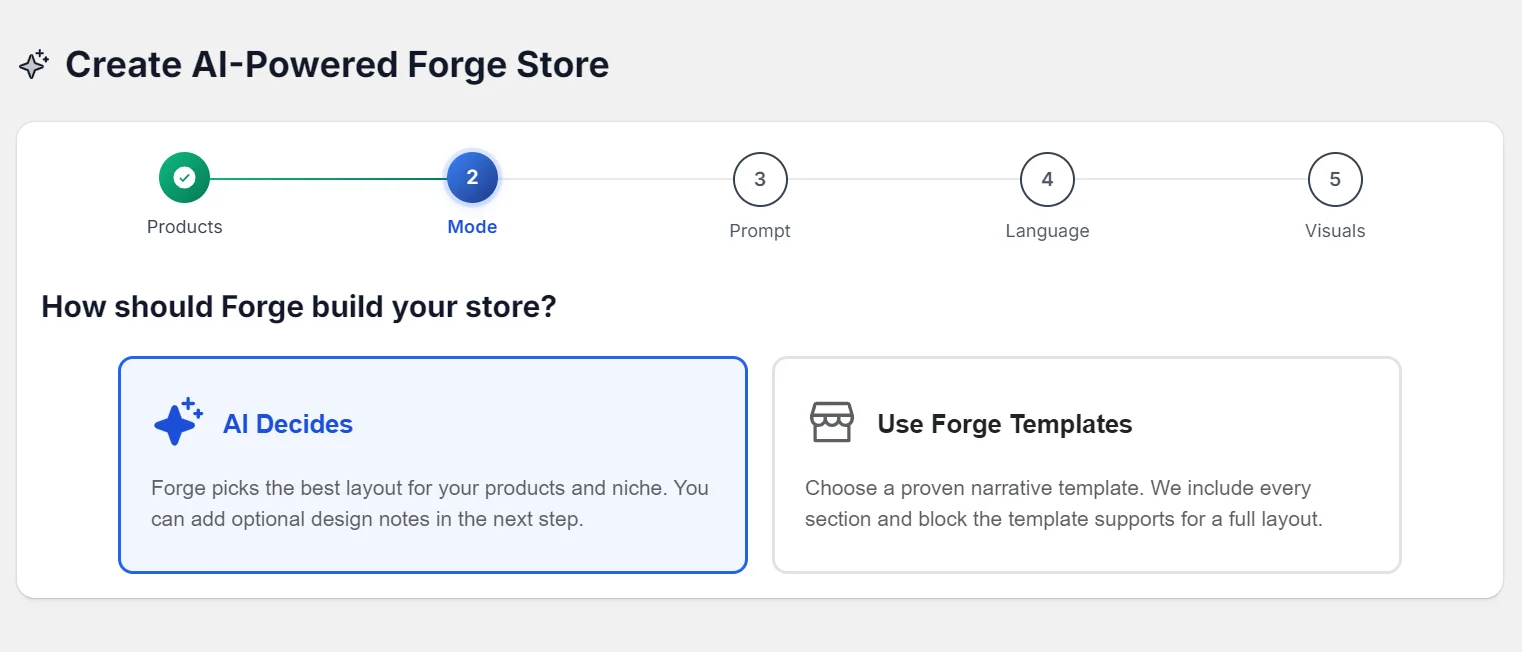
| Forge | 4K product images and conversion tools | $24.99/month | ✅ | Guided onboarding: full AI build or templates |
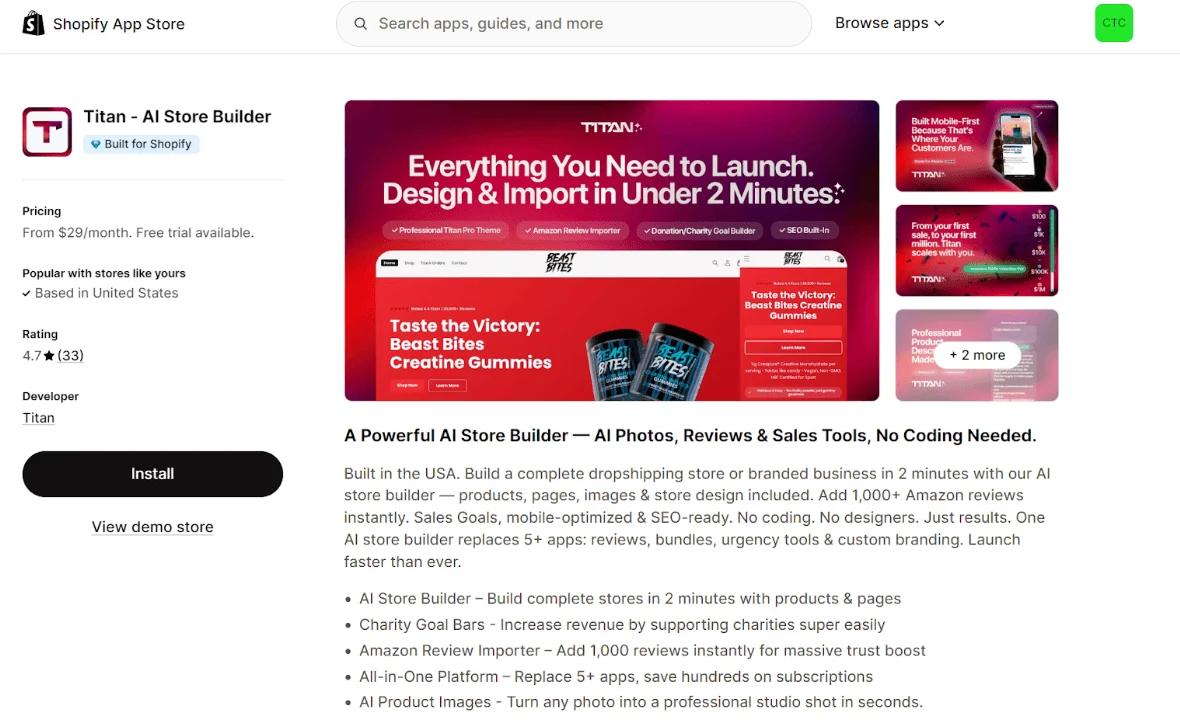
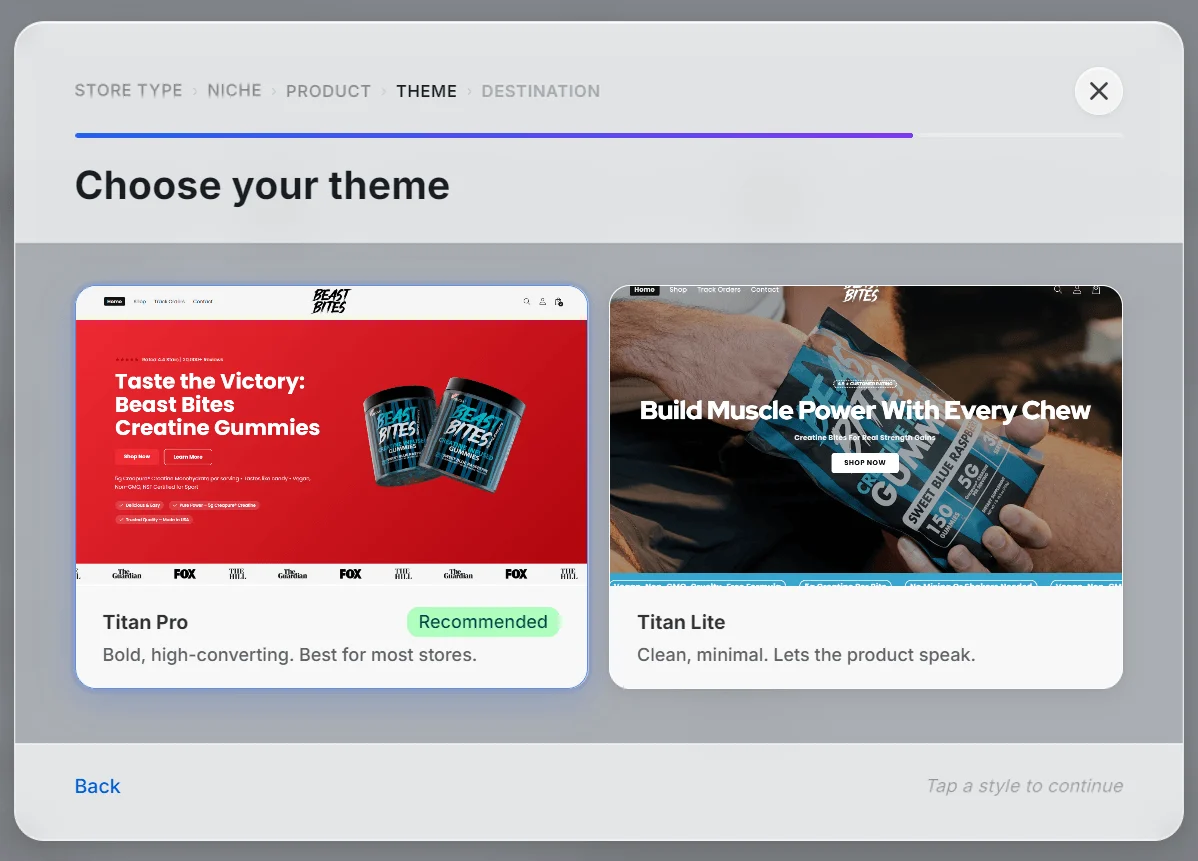
| Titan | One-product niche stores with urgency tools | $29/month | ✅ | Minimalist or bold layouts built around products |
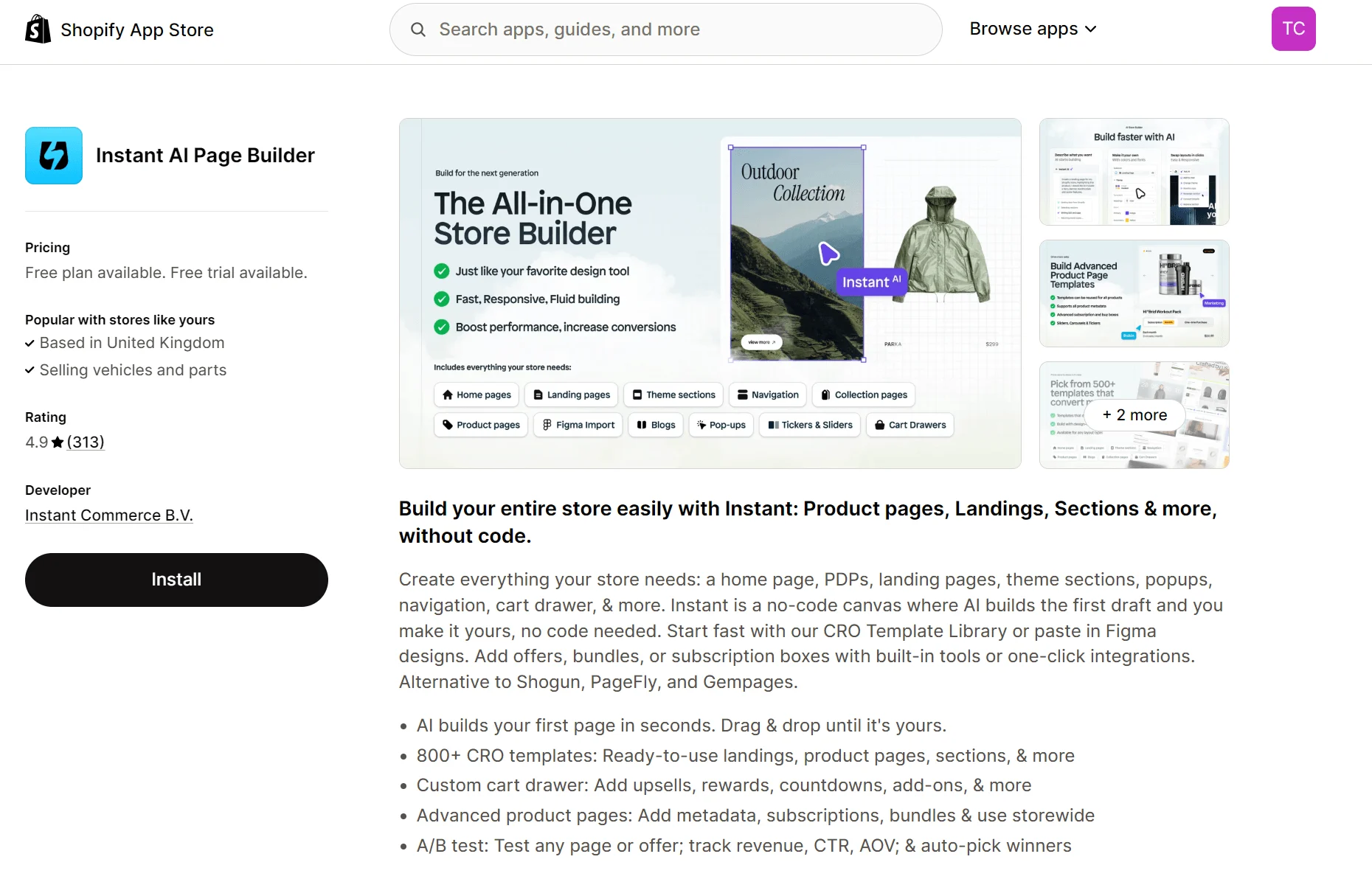
| Instant | Staggered page-by-page builds | $39/month | ❌ | AI Agent pulls branding from a URL |
| GemPages | Rebuilding revenue pages and funnels | $29/month; Free plan | ❌ | Sales funnel builder, pre-sale to post-purchase |
| PageFly | Landing page CRO with analytics | $24/month; Free plan | ❌ | CRO modules with heatmaps and AI audits |
Detailed Guide to the Top AI Shopify Store Builders:
-
Shopify AI Store Builder: The Native, Free Option
- Best for: Entrepreneurs seeking an initial, automated store build that can then be extensively customized using Shopify’s native editor. It’s particularly suitable for small stores or those with confident design skills who want to avoid third-party app subscriptions.
- Starting Price: Free, as it’s an integrated Shopify feature available on all plans.
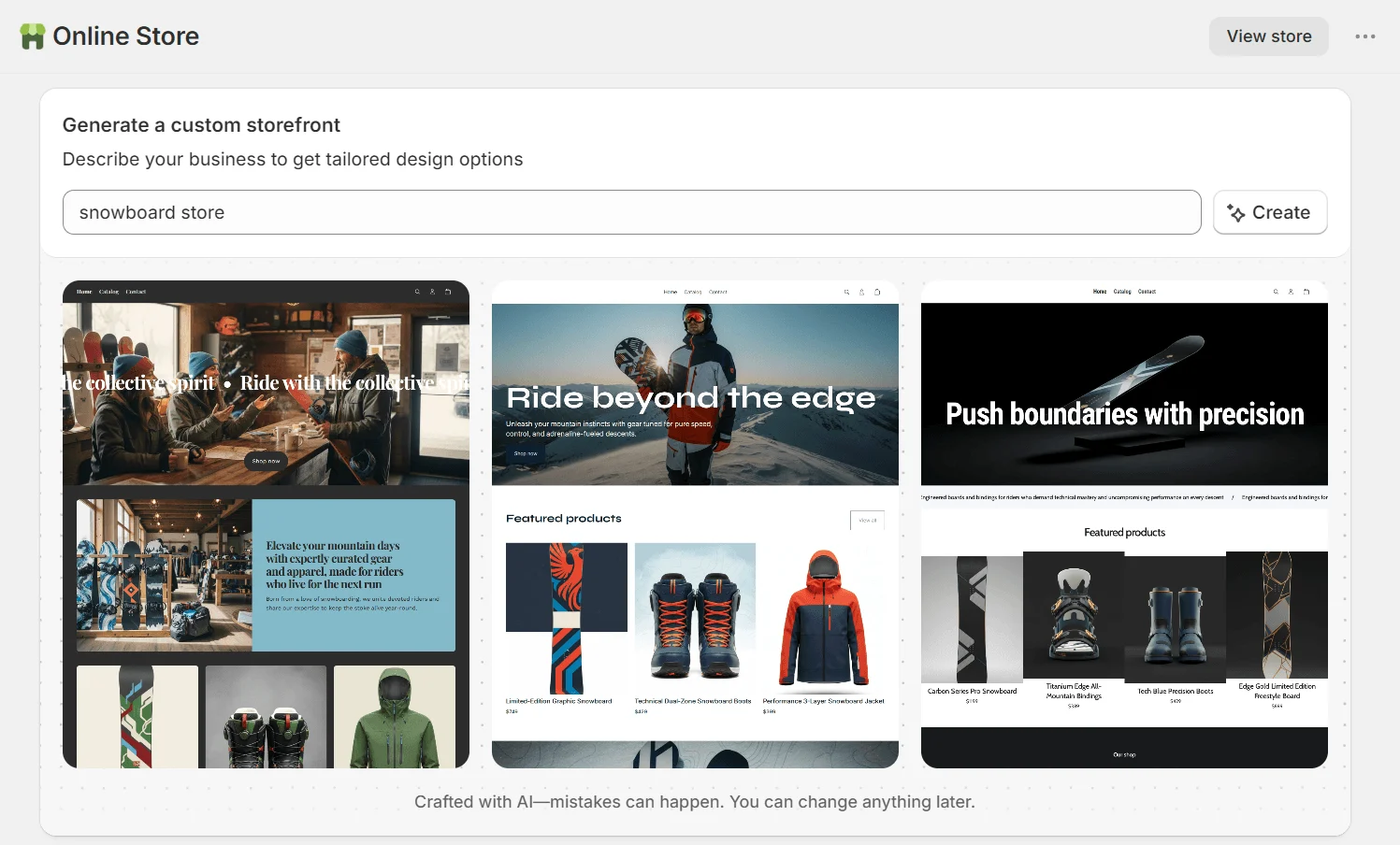
- Standout Feature: The intuitive one-prompt box directly accessible from the Shopify Online Store page. Users describe their business, and the AI rapidly generates three distinct storefront templates within seconds. This seamless integration means no app installation is required, allowing for immediate publication after selection.
- Analysis: Shopify’s native AI builder is a strategic move to lower the barrier to entry for new merchants. While it provides a solid foundation, its primary limitation is the lack of iterative refinement within the AI interface itself. Users must transition to the standard theme editor for subsequent manual adjustments. This makes it a robust starting point but requires a hands-on approach for detailed customization.
-
Dropmagic: AI-Powered Dropshipping & Market Research
- Best for: Dropshippers and merchants focused on rapid storefront creation without extensive manual design. Dropmagic excels at generating stores based on automated market research, providing valuable insights into product and market positioning.
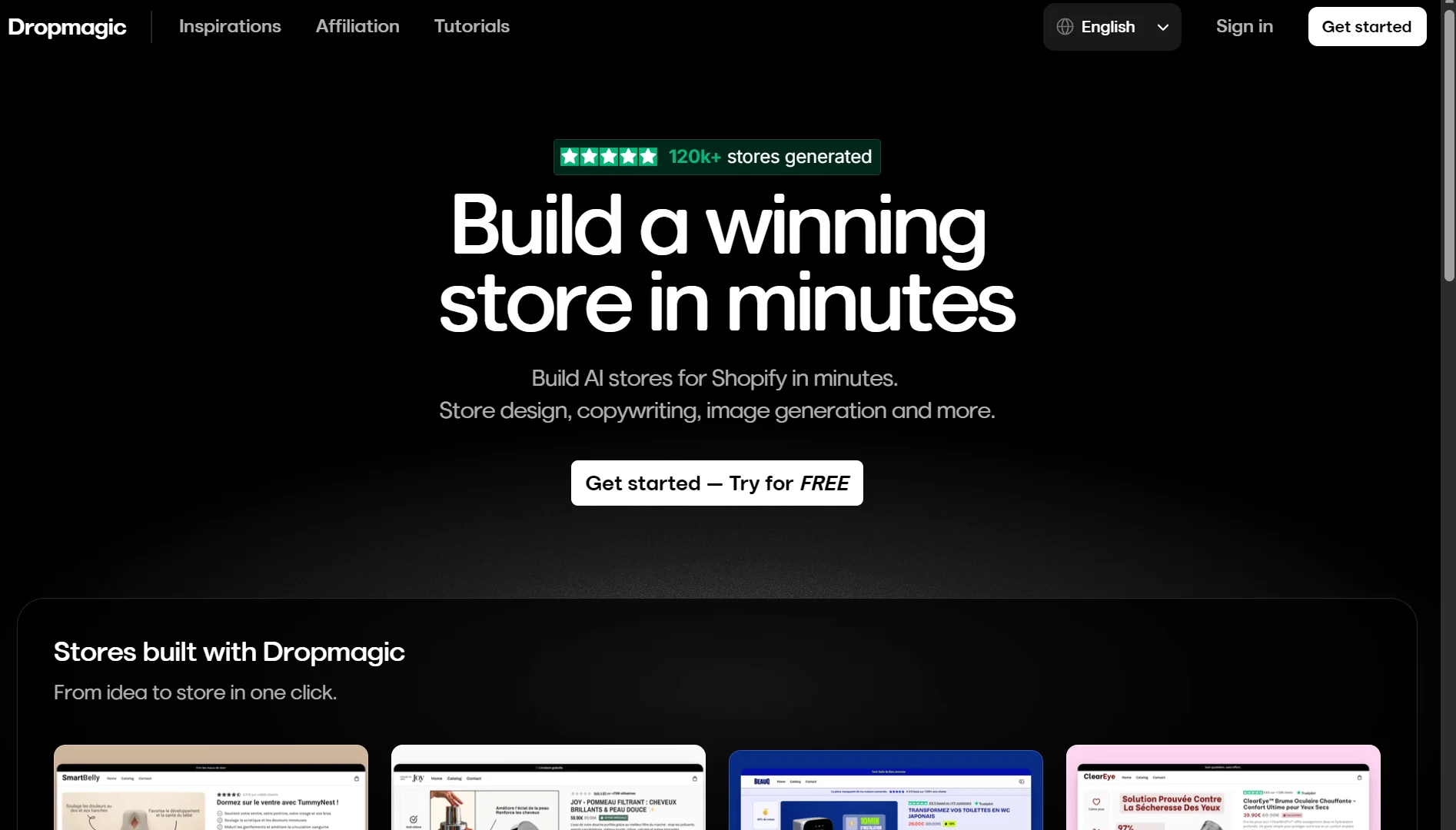
- Starting Price: A free plan offers unlimited store creation and access to 57+ sections. The Pro plan at $79/month unlocks advanced features like a Bundle app, AI image generation, unlimited copywriting, and one-click product imports.
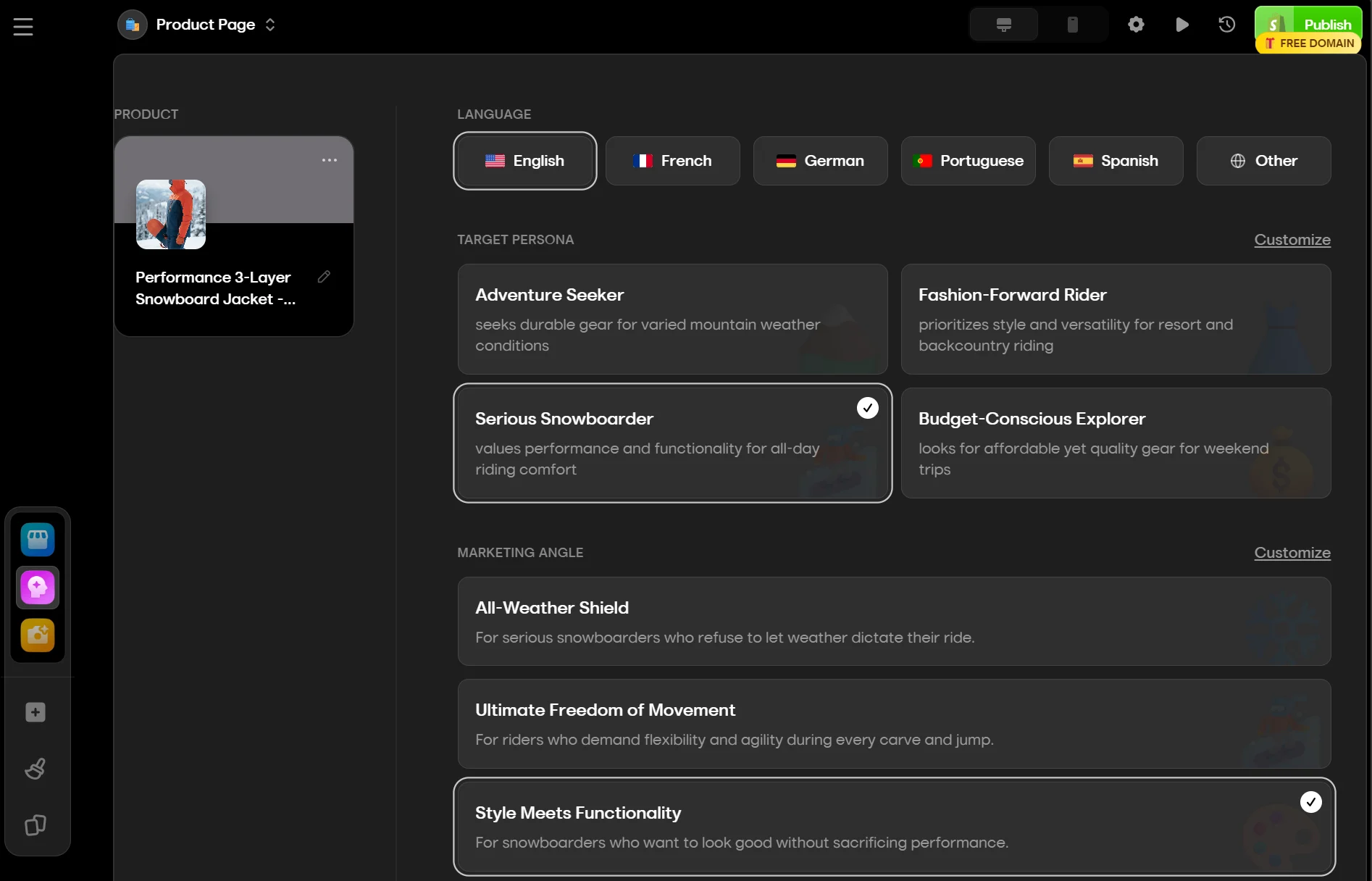
- Standout Feature: The "Strategy" section, which enables precise targeting of buyer personas and marketing angles. For instance, a snowboard store might choose between "adventure seeker," "fashion-forward rider," "serious snowboarder," or "budget-conscious explorer" personas, automatically adjusting content positioning and tone.
- Analysis: Dropmagic distinguishes itself by integrating market intelligence into the design process. By analyzing industry trends and competitor data, it aims to build not just a visually appealing store but one strategically positioned for success. Its ability to generate a workable design from a Shopify URL in under 30 seconds highlights its efficiency, particularly for the fast-paced dropshipping model.
-
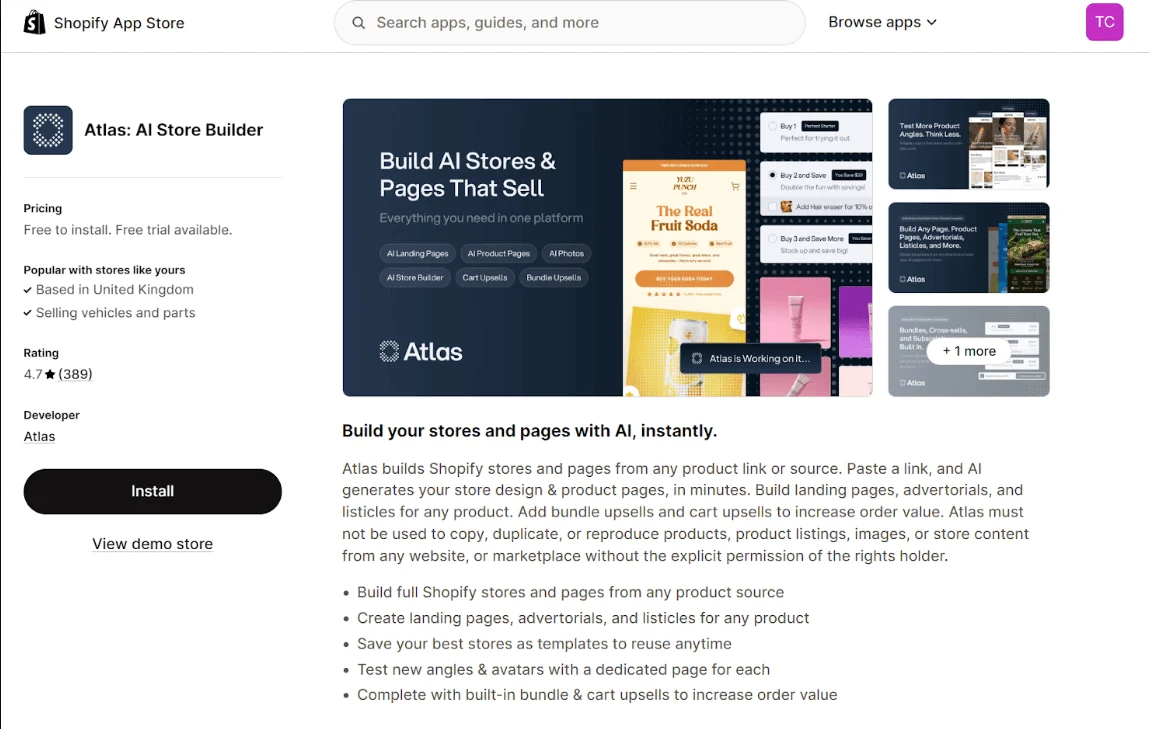
Atlas: The Dedicated AI Store Builder with Performance Tracking
- Best for: Stores requiring a comprehensive AI Shopify app for building complete stores, specific product pages, and effective landing pages, all informed by product and market analysis. It’s ideal for merchants who want a unified AI solution within their Shopify ecosystem.
- Starting Price: The core paid plan is $39/month for all features. Additional tiers apply for "Atlas Pages," "Atlas Cart orders," and "Atlas Bundler revenue," starting at an extra $10/month per tool, requiring careful budgeting.
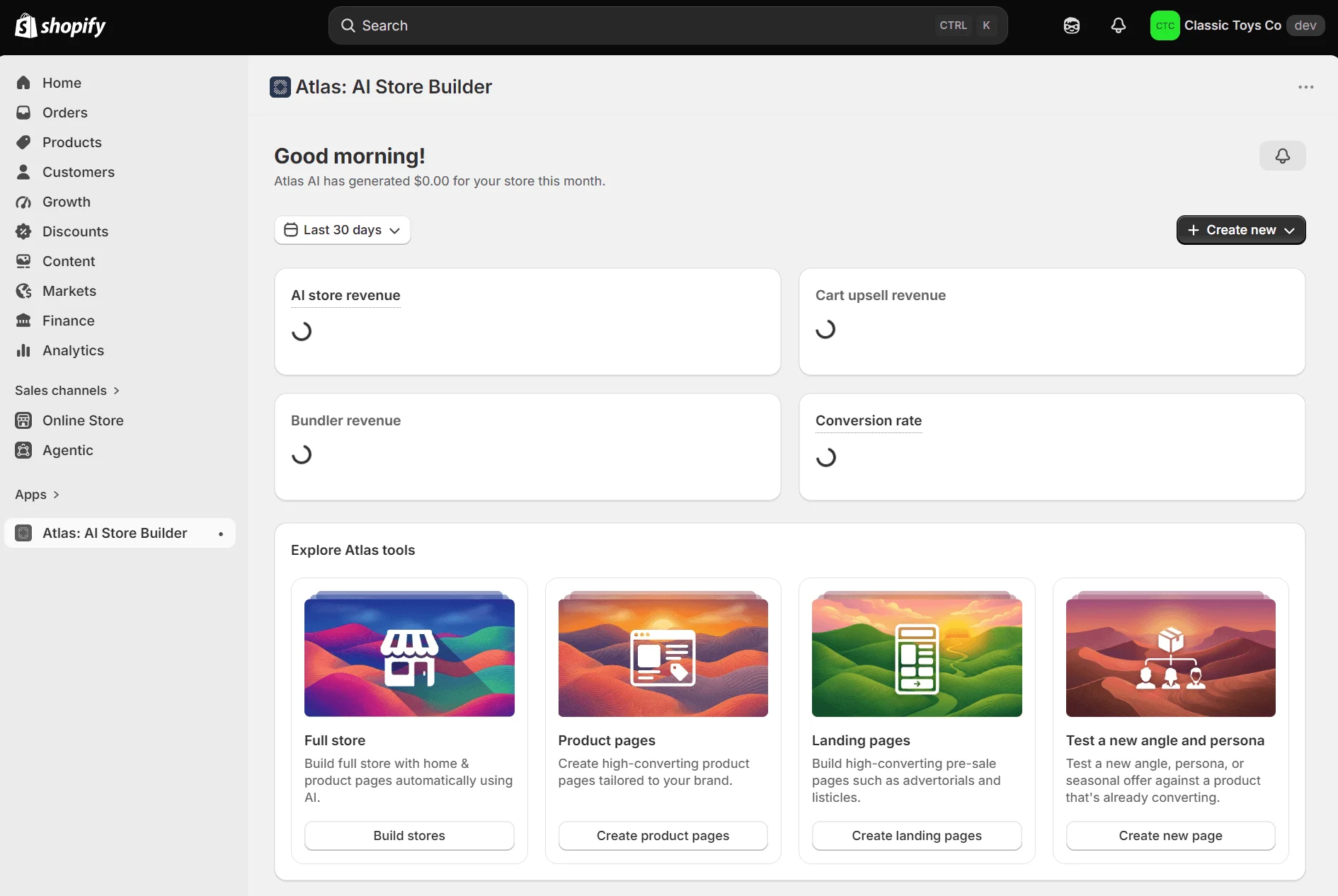
- Standout Feature: Its native Shopify app dashboard provides a consolidated overview of performance metrics, including Atlas AI store revenue, cart upsell revenue, bundler revenue, and conversion rates. This integrated analytics capability is invaluable for tracking the direct impact of AI-generated elements.
- Analysis: Atlas offers a robust and user-friendly experience, seamlessly integrating with the Shopify theme editor. Its capacity to write copy, conduct market research, and create themes in one go streamlines the entire process. The high quality of its generated stores makes it a strong contender for dropshipping and other direct-to-consumer models, especially for those who value integrated performance tracking.
-
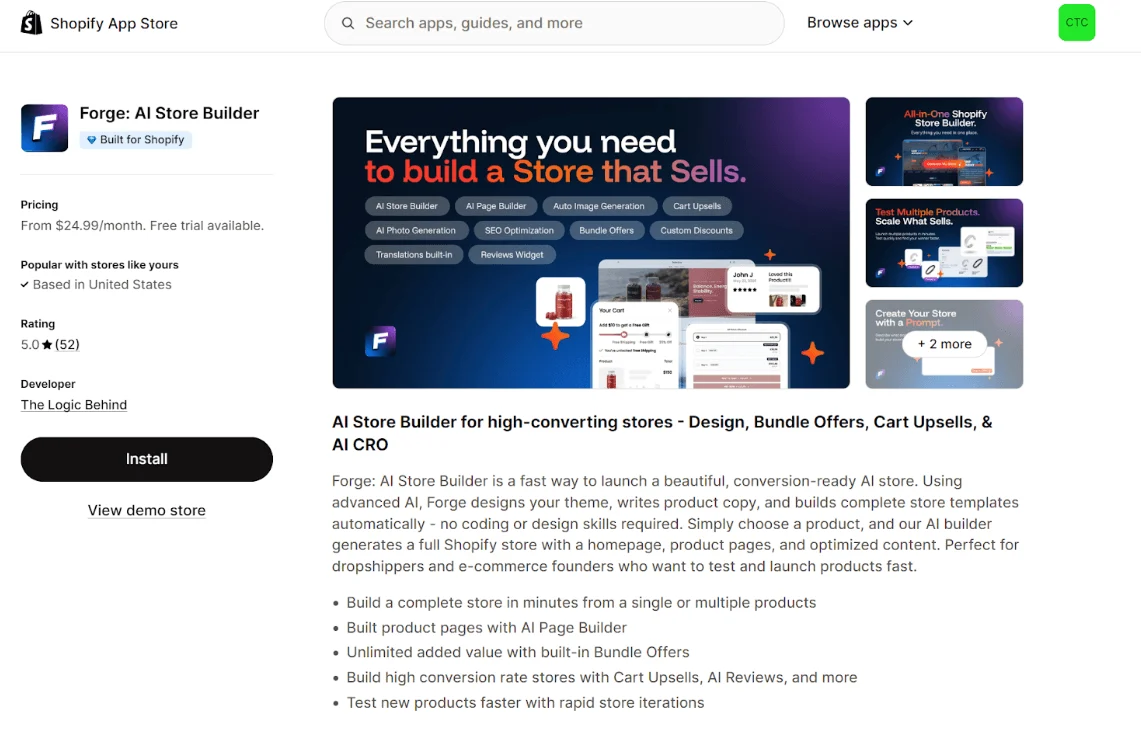
Forge: Media-Rich AI Store Building with Conversion Tools
- Best for: Stores prioritizing high-quality (4K) product image generation and a suite of integrated conversion elements, such as custom discounts, auto-translation, and bundle offers.
- Starting Price: The Essential plan is $24.99/month, allowing generation of six stores/month and 10 product pages/day. Higher tiers (Growth and Scale) increase these limits.
- Standout Feature: The guided onboarding process, which offers a clear choice between a full AI build or selecting from Forge’s templates. This structured approach helps users, regardless of their design expertise, navigate the creation process effectively.
- Analysis: Forge excels in visual content generation, offering a significant advantage for product-centric businesses. Its integration of conversion features directly into the builder reduces the need for multiple separate apps, streamlining the tech stack. While the requirement of an active Shopify plan for editing generated stores (even for development) during the trial period is a consideration, its comprehensive feature set for media and conversion makes it a strong choice.
-
Titan: Optimized for One-Product Niche Stores
- Best for: One-product and mid-volume sellers who need an AI page builder to create highly focused, niche stores with built-in cart urgency tools designed to maximize conversions.
- Starting Price: The Basic Plan at $29/month is strictly for single-product stores. The Pro plan at $39/month supports multi-product stores, and the Plus plan at $79/month is tailored for marketplace sellers, including support for 1,000 Amazon review imports.
- Standout Feature: The ability to choose between minimalist or bold store designs, where Titan dynamically builds different page layouts based on the selected products and content. This flexibility ensures the design perfectly complements the product.
- Analysis: Titan’s strength lies in its specialization. By focusing on one-product stores and incorporating urgency tools (like countdown timers or limited stock notifications), it aims to create high-converting pages. While the basic plan’s limitation to single-product stores and exclusion of dynamic product recommendations is a constraint, its efficiency in generating sales-ready designs for popular niches (fashion, fitness, etc.) makes it a valuable tool.
-
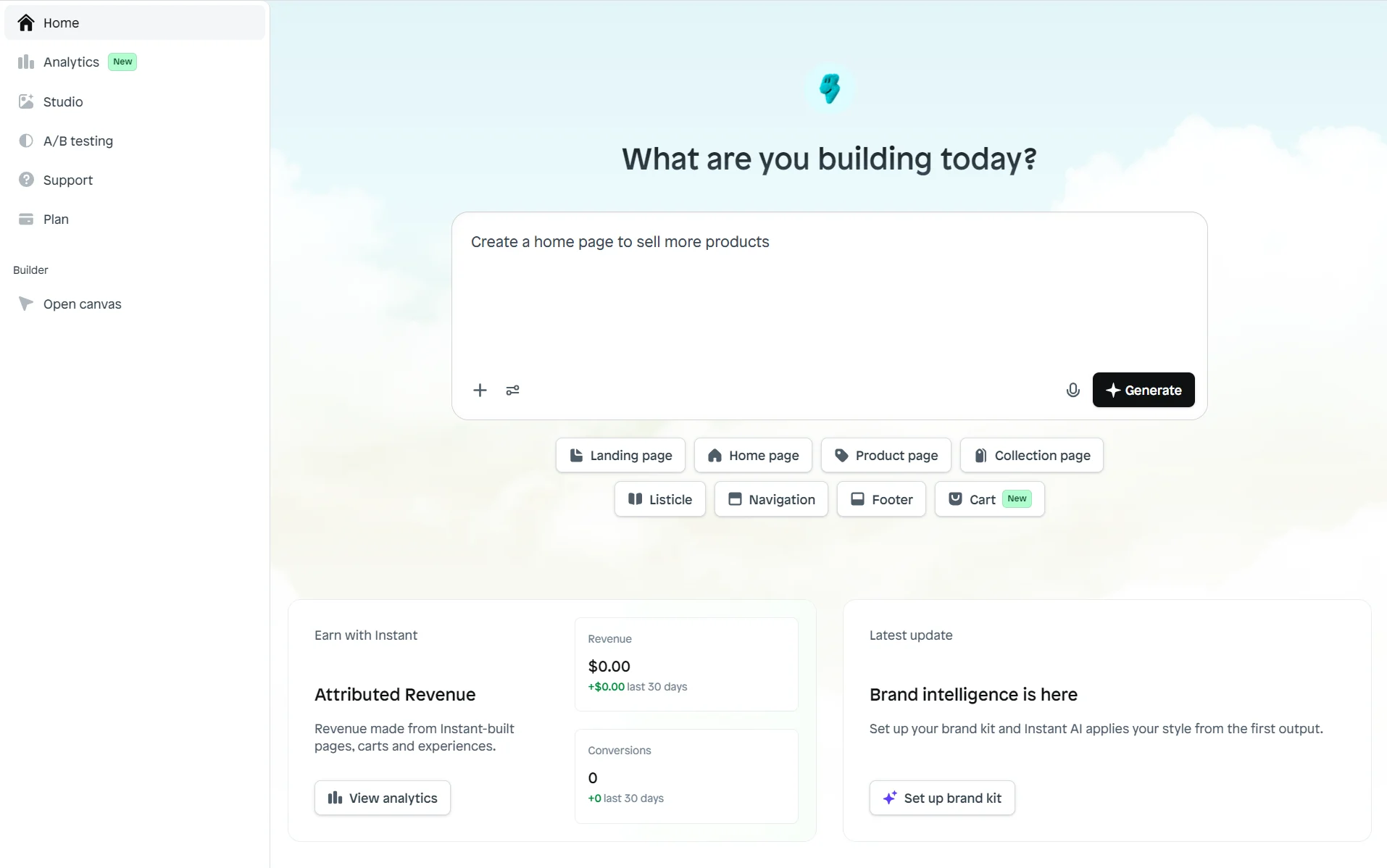
Instant: Conversational and Staggered Page Builds
- Best for: Solopreneurs and smaller businesses that prefer a conversational AI approach to building their store pages incrementally, rather than generating everything at once. Instant builds individual homepages, product pages, and landing pages as standalone, editable elements.
- Starting Price: The Starter plan is $39/month, offering unlimited landing pages, 10 Shopify theme sections, and 1,000 AI credits for content generation.
- Standout Feature: Instant’s dashboard includes an AI prompt section at the top, allowing users to create any page using natural language commands. Its "AI Agent" chatbot can even set up a brand kit by analyzing a provided URL, pulling in branding elements from an existing website.
- Analysis: Instant provides a unique, interactive building experience. The conversational AI guides users through the design process, making it highly accessible for those without a development team. While the build time might be slightly longer due to the interactive questioning, the real-time visualization of the build in the editor offers immediate feedback and control. Its ability to pull branding from a URL is a significant time-saver for existing brands.
-
GemPages: AI-Enhanced Page Builder for Sales Funnels
- Best for: Existing Shopify stores looking to rebuild or optimize revenue-generating pages and construct sophisticated sales funnels using templates and AI-assisted features, rather than a full store build.
- Starting Price: The Build plan is $29/month, allowing unlimited page publishing, CRO templates, and 20 theme sections. A Free plan is available for one published page and basic features.
- Standout Feature: Its comprehensive sales funnel builder, designed to increase average order value (AOV) through a series of pages from pre-sales to post-purchase offers. This is particularly beneficial for digital product sellers or businesses with complex upsell/cross-sell strategies.
- Analysis: GemPages differentiates itself as an AI-enhanced page builder, focusing on optimization rather than initial store creation. Its "image-to-layout" feature, which converts an image URL into an editable web page layout, is a testament to its AI capabilities. With over 450 sections and elements and direct app block integration, it offers extensive customization within a drag-and-drop editor, making it ideal for crafting cohesive customer journeys and maximizing conversions.
-
PageFly: AI Page Builder for Conversion Rate Optimization (CRO)
- Best for: Merchants prioritizing the creation of high-performing landing pages with AI and their subsequent optimization based on granular analytics, including built-in clickmaps and AI audits. It’s a powerful tool for revenue refinement.
- Starting Price: The Builder plan is $24/month for five published pages, with additional pages costing $5 per five. A Free plan allows one page and one section.
- Standout Feature: Its robust CRO modules, which include detailed analytics, heatmaps, sales funnel insights, and section performance tracking. PageFly can use AI to audit pages, suggest conversion improvements, and even assess a page’s readiness for AI shopping agents.
- Analysis: PageFly stands out for its deep focus on CRO. Its conversational AI agent guides users through page creation and refinement, building pages in real-time based on product selection. While the tiered pricing for published pages can lead to escalating costs for large sites, its comprehensive analytics and AI-driven optimization suggestions make it an indispensable tool for merchants committed to maximizing the performance of individual pages.
Strategic Considerations for Adopting AI Builders
Choosing the optimal AI Shopify store builder requires careful evaluation beyond just initial impressions. The best tool for a business hinges on factors such as the desired level of automated finish, specific customization requirements, seamless integration with existing applications, and overall cost-effectiveness.
To make an informed decision, consider these pointers:
- Project Scope: Are you building an entirely new store from scratch, or do you need to optimize specific pages within an existing one? Full store builders like Shopify AI, Dropmagic, Atlas, Forge, or Titan are suitable for the former, while Instant, GemPages, and PageFly excel at page-level enhancements.
- Budget: While Shopify’s native AI is free, third-party apps range from free tiers to premium subscriptions. Factor in not just the monthly cost but also potential tiered pricing for additional pages, features, or usage credits.
- Customization Needs: How much control do you want over the final design? Some tools offer more templates and pre-set options, while others provide a highly flexible drag-and-drop interface for granular adjustments.
- Technical Expertise: Are you comfortable with minor coding or complex theme editing, or do you prefer a highly intuitive, conversational AI interface?
- Integration Ecosystem: Ensure the chosen AI builder integrates smoothly with your other critical Shopify apps, such as email marketing platforms, inventory management systems, and analytics tools.
- Scalability: Consider your future growth. Can the chosen tool accommodate an expanding product catalog, increased traffic, and evolving design needs?
- Trial Periods: Leverage free trials to test the functionality, ease of use, and compatibility with your workflow before committing to a paid plan.
- Customer Support: Investigate the quality and availability of customer support, as you may encounter questions or issues during the build process.
The Broader Impact and Future Outlook
The advent of AI Shopify store builders signifies a pivotal moment in the evolution of e-commerce. They lower the barrier to entry for entrepreneurs, enabling individuals and small businesses to establish a professional online presence with unprecedented speed and affordability. This democratization of e-commerce tools is fostering a new wave of digital entrepreneurship.
For traditional web designers and developers, the role is shifting. Instead of tedious manual coding or repetitive design tasks, their expertise will pivot towards strategic oversight, sophisticated customization, AI prompt engineering, and ensuring brand consistency and user experience at a higher level. The human element remains critical for injecting unique creativity, understanding nuanced market psychology, and performing the final audit for quality and authenticity.
Looking ahead, AI’s capabilities in e-commerce design are only expected to grow. We can anticipate more sophisticated personalization features, where AI adapts store layouts and product recommendations in real-time based on individual visitor behavior. Predictive design, where AI anticipates future trends and suggests proactive changes to store aesthetics, could become commonplace. Furthermore, AI may increasingly assist with dynamic A/B testing, automatically optimizing elements for maximum conversion.
However, challenges persist. Over-reliance on AI without human oversight can lead to generic designs or copy that lacks a distinct brand voice. Ensuring data privacy and mitigating potential AI biases in design choices will also be ongoing concerns. Ultimately, the future of e-commerce design will likely be a synergistic blend of advanced AI capabilities and invaluable human creativity and strategic direction.
Conclusion
AI Shopify store builders are unequivocally reshaping how online businesses are conceived and launched. They dramatically reduce the time and effort traditionally associated with establishing or refreshing an e-commerce presence, offering generative designs that are professional and largely ready for deployment with minimal human intervention. While some tools are comprehensive site builders, others focus on optimizing individual pages or funnels, catering to specific needs for refinement and conversion.
The selection of the "best" AI store builder is highly subjective, depending on your project’s scope, budget, desired level of automation, and technical comfort. Whether you need complete store generation or targeted product page optimization, there is an AI tool designed to accelerate your journey toward publication. Pricing structures vary widely, emphasizing the importance of evaluating value against features and usage limits.
Irrespective of the chosen AI solution, the imperative for human audit and refinement remains paramount. It is crucial to meticulously review the AI-generated copy, design elements, policy pages, images, and navigation to ensure accuracy, brand consistency, and proper integration with all other essential applications, such as your email and SMS marketing platform. This blend of AI efficiency and human discernment is the formula for enduring success in the dynamic world of e-commerce.
FAQs about AI Shopify Store Builders
What is the best Shopify AI store builder?
Atlas is widely regarded as an excellent dedicated AI store builder, capable of branding templates based on your niche and scraping product data for a highly usable store. For dropshipping, Dropmagic offers robust market research integration, while Instant is ideal for a conversational, page-by-page build experience.
What is the best free AI Shopify store builder?
The native Shopify AI Store Builder is the best free tool. It is built directly into the Shopify platform and requires only a single prompt to generate multiple design templates, making it an accessible starting point for any new merchant.
How much do AI Shopify store builders cost?
Costs for AI Shopify store builders can range from free to over $300/month, depending on the tool’s sophistication, your store’s size, and your specific build requirements. Free options typically provide basic, one-store builds with limited features. More costly apps and higher-tier plans usually offer unlimited access, premium features, advanced analytics, and higher usage credits for AI generation.
Can AI build a complete Shopify store?
Yes, AI can build a complete Shopify store. The right AI application can generate templates, content, initial images, and basic branding. However, while AI provides a strong foundation, it is essential for human oversight to add the final polish, ensure brand voice, verify accuracy, and confirm that all elements function correctly before launch.








