Siti Muinah

In an increasingly visual digital landscape, the proper description of images has transcended mere aesthetic enhancement to become a cornerstone of effective content strategy. High-quality imagery significantly boosts user engagement, but its true power is unlocked only when accompanied by accurate and descriptive metadata, specifically alt text. This textual descriptor is not merely an optional addition; it is a critical component that facilitates understanding for screen readers, empowers search engines to index and rank visual content, and enables advanced artificial intelligence models to interpret and present images in novel ways, such as in visual search and AI-powered results. While often overlooked or misunderstood, the meticulous application of alt and, to a lesser extent, title attributes is foundational for achieving broad online visibility and ensuring an inclusive web experience.
A Historical Perspective: From Text Browsers to AI Vision
The concept of providing textual alternatives for images is as old as the World Wide Web itself, predating the sophisticated graphical interfaces we take for granted today. Its evolution reflects the changing demands of internet usage, from basic accessibility to complex machine learning.
-
Early Web Accessibility: The Birth of Alt Text
When HTML was first developed, text-only browsers were common, and bandwidth was often limited, making image loading slow or impossible. Thealtattribute, introduced with the<img>tag, was designed to provide a textual description that would appear in place of an image if it couldn’t be displayed. This foundational utility quickly extended to assistive technologies like screen readers, which vocalize web content for individuals with visual impairments. For these users,alttext became the window into the visual information of a webpage, ensuring they could understand charts, product images, and other critical visual cues that sighted users perceived instantly. The World Wide Web Consortium (W3C), through its Web Content Accessibility Guidelines (WCAG), has consistently emphasizedalttext as a primary requirement for web accessibility, with current guidelines (WCAG 2.1 and upcoming 2.2) explicitly detailing its necessity for non-text content. -
SEO’s Embrace: Image Optimization in the Algorithm Era
As search engines evolved beyond keyword matching to contextual understanding, thealtattribute gained significance in the realm of Search Engine Optimization (SEO). Google, for instance, has long stated thatalttext helps its algorithms understand the content and context of images. Unlike human eyes, early search engine crawlers could not "see" images; they relied on associated text to decipher visual content. By providing descriptivealttext, webmasters offered crucial signals to search engines about what an image depicted and how it related to the surrounding page content. This contributed not only to the image’s discoverability in dedicated image search results but also to the overall relevance and ranking of the webpage itself, especially for queries where visual content was highly relevant. -
The Mobile Revolution and Visual Search
The proliferation of smartphones and high-quality cameras ushered in a new era of visual interaction with the web. Technologies like Google Lens, Pinterest Lens, and various augmented reality applications allow users to initiate searches by simply pointing their camera at an object. This shift from text-based queries to image-based queries has profoundly elevated the importance of image metadata. For an AI-powered visual search engine to accurately identify a product, a landmark, or a plant from a photograph, it needs robust textual anchors. While computer vision technology has advanced dramatically, human-providedalttext offers invaluable contextual cues that complement and refine machine interpretations, bridging the gap between pixel data and semantic meaning.
Demystifying Alt and Title Attributes: Definitions and Distinctions
Understanding the precise function of alt and title attributes is crucial for their effective application. While often conflated, they serve distinct purposes, with alt text holding significantly more weight in contemporary web development. A complete HTML image tag, for reference, typically appears as: <img src="image.jpg" alt="image description" title="image tooltip">.
-
Alt Text: The Voice for Images
Thealtattribute (short for "alternative text") is designed to be a functional replacement for an image when it cannot be displayed or understood by a user. Its primary purpose is to convey the essential information or function of the image. For screen readers, it provides an auditory description, narrating what is visually present to users with visual impairments. For search engines and AI, it offers a textual interpretation, helping them categorize and contextualize the image within the broader web. Every non-decorative image must havealttext. The content of thealttext should be concise yet descriptive, reflecting the image’s content and its relevance to the surrounding text. For instance, an image of a red waterproof running shoe should havealt="Red waterproof running shoe with breathable mesh upper", rather than justalt="shoe".
-
Title Attribute: A Fading Feature
Thetitleattribute, in the context of an<img>tag, is intended to provide supplementary information that appears as a tooltip when a user hovers their mouse cursor over the image. While it might seem useful, its practical utility for images is minimal and often discouraged. Screen readers do not reliably announcetitleattributes for images, and mobile users, lacking a hover state, cannot access them at all. This renders thetitleattribute largely inaccessible and ineffective for conveying crucial information. If information is important enough to be shared, it should be integrated directly into the visible page content, where it benefits all users. The only context where thetitleattribute remains critically important for accessibility is on<iframe>elements, where it serves as the accessible name, allowing screen reader users to understand the embedded content. For standard images, however, its role has largely diminished, often leading to its omission. -
Handling Decorative Images and iFrames
Not all images on a webpage carry semantic meaning. Many are purely decorative elements, such as background textures, borders, or visual separators, that serve no informational purpose. For these images, providing verbosealttext would be redundant and potentially disruptive for screen reader users, who would have to listen to descriptions of non-essential elements. The recommended practice for purely decorative images is to assign an emptyaltattribute:<img src="decorative.png" alt="">. This signals to screen readers that the image should be skipped, maintaining a cleaner and more efficient auditory experience. Ideally, purely decorative images should be handled via CSS background properties rather than HTML<img>tags, further separating presentation from content.
The Imperative of Accessibility: Ensuring an Inclusive Web
The mandate for robust alt text extends far beyond SEO benefits, deeply embedding itself in the principles of web accessibility. Ensuring that digital content is perceivable, operable, understandable, and robust for all users, including those with disabilities, is both an ethical imperative and, increasingly, a legal requirement.
-
Legal and Ethical Frameworks
Globally, numerous laws and regulations underscore the necessity of web accessibility. In the United States, the Americans with Disabilities Act (ADA) and Section 508 of the Rehabilitation Act mandate that public and government websites, respectively, be accessible. Similar legislation exists in Europe (e.g., European Accessibility Act), Canada, Australia, and many other countries. Non-compliance can lead to costly lawsuits and significant reputational damage. The W3C’s WCAG provide internationally recognized guidelines for achieving web accessibility, with specific success criteria directly addressing the provision of text alternatives for non-text content. Ethically, creating an inclusive web means recognizing the right of every individual to access information and participate fully in the digital sphere, regardless of their physical abilities. Goodalttext is a fundamental step towards fulfilling this ethical obligation. -
The User Experience for Visually Impaired Individuals
For the approximately 2.2 billion people worldwide living with some form of visual impairment, the internet can be either an empowering tool or an impenetrable barrier. Screen readers are their primary means of navigating the web, converting visual information into synthesized speech or refreshable braille. Without descriptivealttext, an image becomes an "unlabeled graphic" or "image," conveying no information. Imagine navigating an e-commerce site where product photos are undescribed, or a news article where infographics are silent. This creates significant frustration, hinders comprehension, and effectively excludes a large segment of the population from accessing essential information, goods, and services. Thoughtfulalttext, therefore, directly translates into an improved, equitable, and functional user experience for millions.
SEO in the Age of Visuals and AI: Beyond Keywords
While accessibility is paramount, the strategic application of alt text also yields substantial SEO benefits, especially as search engines grow more sophisticated in their understanding of visual content and the integration of AI.
-
Google’s Directives and Best Practices
Google’s Search Central documentation consistently advises webmasters to "use descriptive filenames, titles, and alt text." This is not a casual suggestion but a directive stemming from the understanding that these elements help Google’s algorithms accurately interpret images. Google usesalttext to understand what an image shows and how it relates to the surrounding text, which can influence both organic search rankings and appearances in Google Images. The company explicitly warns against "keyword stuffing"—the practice of excessively loadingaltattributes with keywords—as this can negatively impact user experience and lead to a site being flagged as spam. The focus should always be on creating useful, information-rich content that uses keywords naturally and contextually. -
Enhancing Discoverability in Image Search and AI Overviews
Descriptivealttext is a primary factor in how images rank in Google Images, a significant source of traffic for many websites. For specific product searches, detailedalttext including product names, IDs, colors, and features can significantly improve visibility. Beyond traditional image search, the rise of AI Overviews and generative AI features in search results further elevatesalttext’s importance. When Google’s AI synthesizes information to answer a query, it often pulls relevant images to illustrate its response. Well-described images with accuratealttext are far more likely to be selected by these AI models as pertinent visual aids, thereby increasing their exposure and driving traffic back to the source.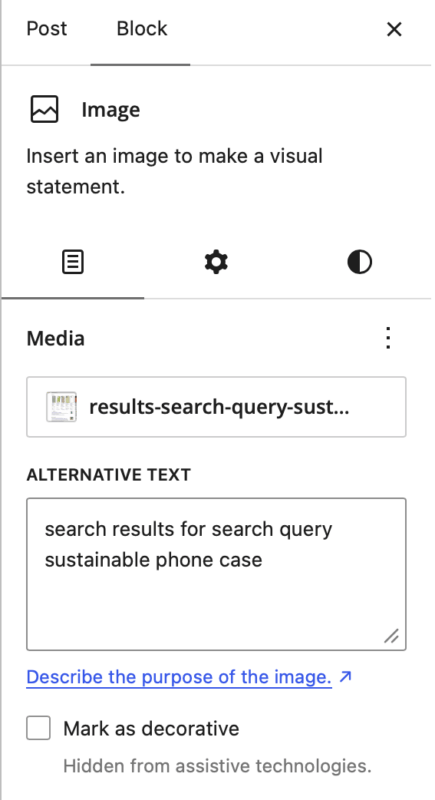
-
Strategic Keyword Integration (and Avoiding Stuffing)
The goal is not to force keywords into everyalttag, but rather to integrate them naturally where they enhance the description and context. If an image depicts a "vintage leather briefcase," thealttext should accurately reflect that, and if "vintage leather briefcase" is a target keyword, its natural inclusion is beneficial. For e-commerce products, including the full product name, model number, and key attributes in thealttext is a best practice. For example,alt="Acme X100 Professional DSLR Camera, 24MP, Black"provides rich detail for both users and search engines. However,alt="camera best camera photography new camera good camera"is a clear example of keyword stuffing and should be avoided.
Practical Application: Implementing Alt Text in Content Management Systems (CMS)
Most modern Content Management Systems (CMS) simplify the process of adding alt text, but user diligence remains essential.
-
WordPress: A Case Study
WordPress, powering over 40% of the web, offers a straightforward interface for managing image metadata. When uploading an image to the media library or inserting it into a post, a dedicated "Alt Text" field is available. While WordPress might auto-populate this field with the image filename if left blank (e.g.,IMG_1234.jpg), this is rarely helpful. Users are strongly encouraged to take the moment to write a proper, descriptive alternative text. WordPress also provides options to mark an image as decorative, which can be useful for theme-level imagery that doesn’t convey content. Specialized plugins, such as Yoast SEO AI+ and Yoast WooCommerce SEO, further enhance this process, offering AI-driven suggestions for product images, streamlining the workflow for large catalogs. -
Descriptive Filenames and Structured Data: Complementary Strategies
Beyondalttext, two other elements significantly bolster image SEO and AI understanding:- Descriptive Filenames: Before uploading, renaming image files from generic names like
DCIM0001.jpgto descriptive ones likered-waterproof-running-shoe.jpgprovides another valuable signal to search engines. This reinforces the image’s context and content. - Structured Data: Implementing Schema.org markup (e.g.,
ImageObject,Productschema) directly within the HTML provides explicit, machine-readable descriptions of your images and the content they represent. For e-commerce, linking product images toProductschema with details like price, availability, and reviews significantly improves discoverability in rich results and visual shopping experiences. This structured data gives AI platforms a clear, unambiguous understanding of the image’s role and associated properties.
- Descriptive Filenames: Before uploading, renaming image files from generic names like
The Rise of AI-Powered Alt Text Generation: Efficiency Meets Oversight
The sheer volume of images on many websites, particularly large e-commerce platforms, makes manual alt text generation a time-consuming and often daunting task. Artificial intelligence offers a compelling solution for automating this process, but it’s not without its caveats.
-
Automating the Tedious: Benefits for Large Catalogs
AI alt text tools leverage computer vision and natural language processing to analyze images and automatically generate descriptive text. For an e-commerce site with thousands of product images, this can be a game-changer, significantly reducing the manual workload and helping to clear backlogs. These tools can accurately identify objects, colors, settings, and even actions within an image, producing initial descriptions like "blue ceramic mug with handle on wooden table." This automation allows content creators to focus their efforts on more complex or high-value images, where nuanced human description is critical. -
The Human Element: Why AI Needs a Guardian
Despite rapid advancements, AI is not yet perfect. Generic AI tools, while capable of object recognition, often lack the nuanced understanding of context, brand voice, or specific product details that humans possess. An AI might identify a "shirt," but struggle to differentiate between a "navy blue linen casual shirt" and a "royal blue silk evening blouse." It might not understand the emotional intent of a hero image or the critical statistical message embedded in an infographic. Crucially, AI cannot reliably discern whether an image is purely decorative or carries essential information, often generating unnecessary descriptions for the former. Furthermore, AI models can sometimes "hallucinate" details or perpetuate biases present in their training data. Therefore, the output of AI alt text generators should always be treated as a starting point, requiring human review, editing, and sometimes complete regeneration. The human expert remains the ultimate arbiter of accuracy, relevance, and accessibility. -
Yoast’s Approach: Smart Automation with Human Review
Tools like Yoast SEO AI+ and Yoast WooCommerce SEO exemplify a balanced approach to AI-assistedalttext generation. By integrating AI capabilities directly into the CMS (like WordPress’s product editor or the Yoast SEO bulk editor), these tools can leverage existing product data and user-defined focus keyphrases to generate more contextually relevant suggestions. For instance, if a user specifies "running shoes" as a keyphrase, the AI can prioritize descriptions that include "running" rather than just "shoes." This hybrid model ensures that while AI handles the heavy lifting of initial generation, the final decision and refinement rest with the content creator, guaranteeing accuracy, brand consistency, and optimal accessibility.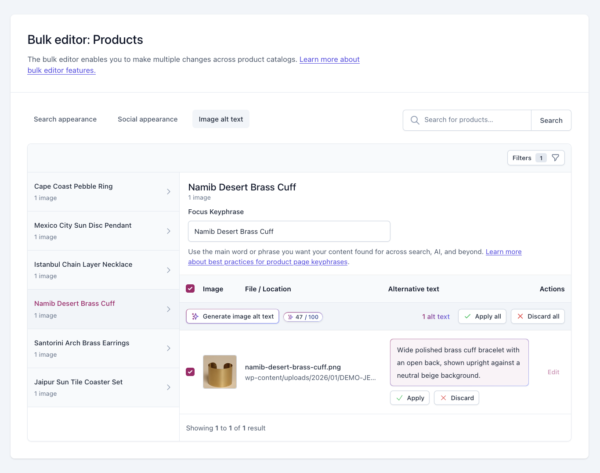
The Broader Impact: E-commerce, User Trust, and the Future Web
The careful crafting of alt text is not an isolated technical task; it has far-reaching implications for various aspects of the digital economy and the future of web interaction.
-
Product Discovery and Conversion
For e-commerce,alttext is a direct contributor to product discoverability. Detailed descriptions allow products to appear in a wider range of visual and traditional search queries, leading to increased organic traffic. Beyond discovery, clearalttext also aids in conversion. If a visually impaired user can accurately understand the features and appearance of a product through itsaltdescription, they are more likely to make an informed purchasing decision. This expands the potential customer base and improves sales. -
Building Trust and Credibility
A website that prioritizes accessibility and offers comprehensive image descriptions signals professionalism and a commitment to inclusivity. This builds trust and credibility with users, including those who do not directly rely onalttext. It demonstrates a thoughtful approach to content creation and a respect for all potential visitors, fostering a positive brand image. Conversely, a site riddled with inaccessible images can alienate users and damage reputation. -
Shaping the Future of AI-Driven Content Understanding
As artificial intelligence continues to play a more central role in how we interact with information, human-providedalttext serves a critical function in shaping these AI models. By offering accurate, context-rich textual descriptions of images, we are, in essence, providing high-quality training data for AI. This helps to reduce biases, improve the accuracy of computer vision, and ultimately lead to more intelligent and inclusive AI systems that can better understand and interpret the visual world. The continued investment in goodalttext today directly contributes to a more capable and ethical AI tomorrow.
Conclusion: A Small Attribute with Monumental Impact
The alt attribute, a seemingly minor detail in the vast landscape of web development, holds monumental importance. It is a fundamental pillar of web accessibility, ensuring that everyone, regardless of visual ability, can access and understand digital content. It is a powerful tool for SEO, driving visibility in an increasingly visual and AI-driven search environment. And it is a crucial input for the ongoing development of artificial intelligence, helping machines "see" and interpret the world with greater accuracy and nuance. While the title attribute’s role has diminished for images, the alt attribute’s significance has only grown. As the digital world becomes more immersive and AI-powered, the commitment to crafting descriptive, accurate, and accessible alt text is no longer just a best practice; it is an essential requirement for any website aiming for broad reach, inclusivity, and long-term success.

 rifanmuazin
 Laily UPN