
Global digital advertising expenditure is on an unprecedented trajectory, projected to surpass $740 billion by 2026. This surge, fueled by an ever-expanding ecosystem of marketing channels, presents a significant challenge for businesses: coordinating these diverse platforms effectively. The average marketing team struggles to keep pace with the proliferation of digital touchpoints, leading to fragmented campaigns and missed opportunities. Enter cross-channel marketing, a strategic discipline designed to bridge this gap by orchestrating customer engagement across paid, owned, and earned media.
At its core, cross-channel marketing is a sophisticated approach that leverages data from each channel to inform the messaging and timing of others. This creates a cohesive and continuous customer journey, preventing the repetitive and disjointed experiences that plague multichannel efforts. As the digital advertising landscape continues to evolve at breakneck speed, understanding and implementing cross-channel strategies is no longer a competitive advantage but a necessity for survival and growth.
The Multichannel Trap: Coverage vs. Coordination
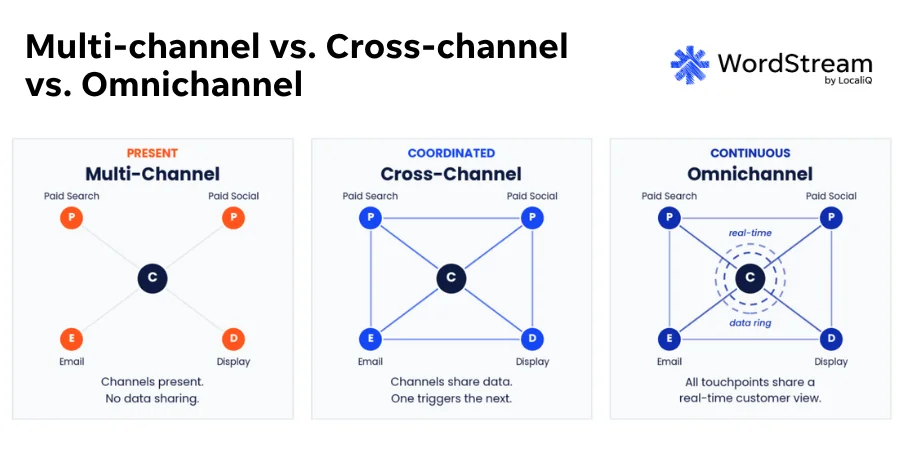
The distinction between multichannel and cross-channel marketing is critical. Multichannel marketing involves utilizing various platforms to reach customers, but these channels often operate in silos. This means running ads on Google, social media, and email without any meaningful data sharing or synchronization between them. This approach, while providing broad coverage, lacks the strategic coordination that defines true cross-channel marketing.

Cross-channel marketing, conversely, operates on three foundational layers: a unified audience definition pushed to all platforms, a consistent creative system adapted for native channel execution, and a singular measurement framework that aggregates data from all channels to answer a central ROI question. Removing any of these layers transforms a cross-channel initiative into a mere multichannel strategy with additional operational steps.
For small and medium-sized businesses (SMBs) and mid-market companies, the immediate goal should be cross-channel execution. While omnichannel marketing—an all-encompassing approach that integrates offline and online touchpoints with real-time data synchronization—represents the ultimate aspiration, it often requires a level of data infrastructure and technological sophistication that is beyond the reach of many organizations. The journey to omnichannel typically begins with mastering cross-channel coordination.
Navigating the Evolving Marketing Channel Mix
The average marketer now juggles approximately 10 customer engagement channels. However, high-performing marketers are adept at personalizing experiences across only about six of these. This four-channel gap between channels used and channels effectively coordinated highlights the persistent challenge of cross-channel marketing. The sheer volume of available channels continues to grow, while the capacity for strategic coordination lags behind.
Cross-channel marketing does not necessitate the simultaneous activation of every available channel. Instead, it emphasizes the strategic integration of the channels that are actively employed, ensuring they share audiences, triggers, and measurement insights. For businesses with limited resources, a focused cross-channel mix involving just a few well-coordinated channels can yield significant results.
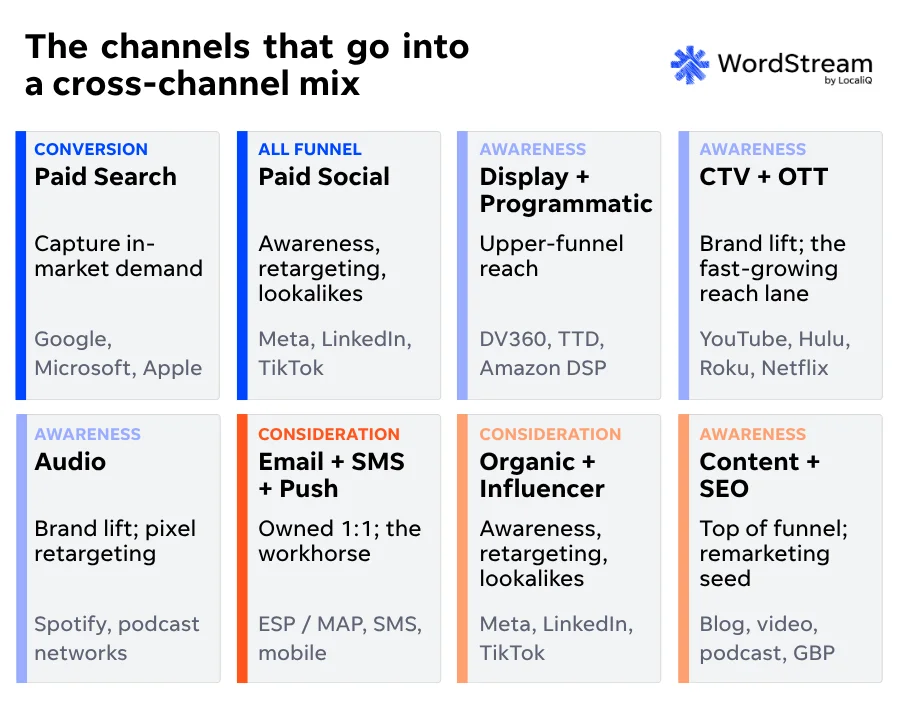
These channels can be broadly categorized by their role in the marketing funnel:
- Conversion Channels (Paid Search/Shopping): Platforms like Google Ads, Microsoft Ads, and Apple Search Ads are crucial for capturing in-market demand and can serve as a source for downstream audience segmentation.
- All-Funnel Channels (Paid Social): Meta, LinkedIn, TikTok, and others are versatile, supporting awareness campaigns, retargeting efforts, and the seeding of lookalike audiences.
- Awareness Channels (Display/Programmatic/CTV/OTT): Services such as DV360, The Trade Desk, and Amazon DSP are vital for upper-funnel reach, with CTV/OTT emerging as a key growth area.
- Awareness Channels (Audio): Spotify, podcast networks, and programmatic audio platforms can drive brand lift and enable retargeting through pixel-enabled hosts.
- Owned Channels (Email/SMS/Push): Email service providers, SMS platforms, and mobile apps form the backbone of direct, one-to-one communication.
- Earned Channels (Organic Social/Influencer): Brand social media handles, creators, and affiliates provide validation and can contribute to retargeting pools.
- Top-of-Funnel Channels (Content/SEO): Blogs, videos, and podcasts attract audiences at the initial stages of their journey and can be used to seed remarketing efforts.
- Offline Channels: Direct mail, Out-of-Home (OOH) advertising, events, and in-store experiences can extend reach and be measured through QR codes, unique URLs, and promotional codes.
The effectiveness of a cross-channel mix is determined not by the number of channels but by the seamless flow of audiences and signals between them.
The Tangible Benefits of Cross-Channel Marketing
Implementing a cross-channel marketing strategy requires dedicated effort, but the rewards are substantial. While it may not be the primary driver for immediate, raw lead or sales increases, cross-channel coordination optimizes existing spend for better yield. Its core benefits include:
- Improved Customer Experience: By presenting a consistent and relevant message across touchpoints, businesses foster stronger customer relationships and reduce friction in the buyer journey.
- Enhanced Campaign Efficiency: Coordinated messaging prevents message fatigue and wasted ad spend by ensuring prospects are not bombarded with redundant communications.
- Increased Conversion Rates: A well-orchestrated sequence of messages across channels can guide prospects more effectively through the funnel, leading to higher conversion rates.
- Deeper Customer Insights: The integrated data from cross-channel efforts provides a more holistic view of customer behavior, enabling more precise targeting and personalization.
- Greater Brand Loyalty: A seamless and personalized customer experience cultivates trust and loyalty, encouraging repeat business and advocacy.
Building a Robust Cross-Channel Marketing Strategy
The foundation of a successful cross-channel strategy is a clearly defined target audience. This audience definition should be established outside of individual ad platforms, often using a CRM or CDP as the central source of truth. This unified audience profile is then disseminated across relevant platforms, including Google Ads Customer Match, Meta Custom Audiences, email service providers, and demand-side platforms.
The next critical step is mapping the customer journey, prioritizing the sequence of stages, channels, messages, and the subsequent best action. Many organizations reverse this process, starting with budget allocations and retrofitting journey logic. A customer-centric approach, however, ensures that marketing efforts align with how customers actually interact with a brand.
A unified creative system is essential for maintaining brand consistency. This involves developing a core campaign promise, offer, and proof point that is then translated into channel-specific executions. This ensures that while the message is adapted for each platform, the overarching brand experience remains cohesive.
Crucially, the technical infrastructure must support identity and signal sharing. This means ensuring that conversion events—such as purchases, form submissions, or calls—are accurately communicated across all advertising platforms. Enabling features like Enhanced Conversions in Google Ads and the Conversions API in Meta are fundamental, often overlooked, data upgrades. Server-side tagging, while requiring technical expertise, is invaluable for ensuring accurate data flow.
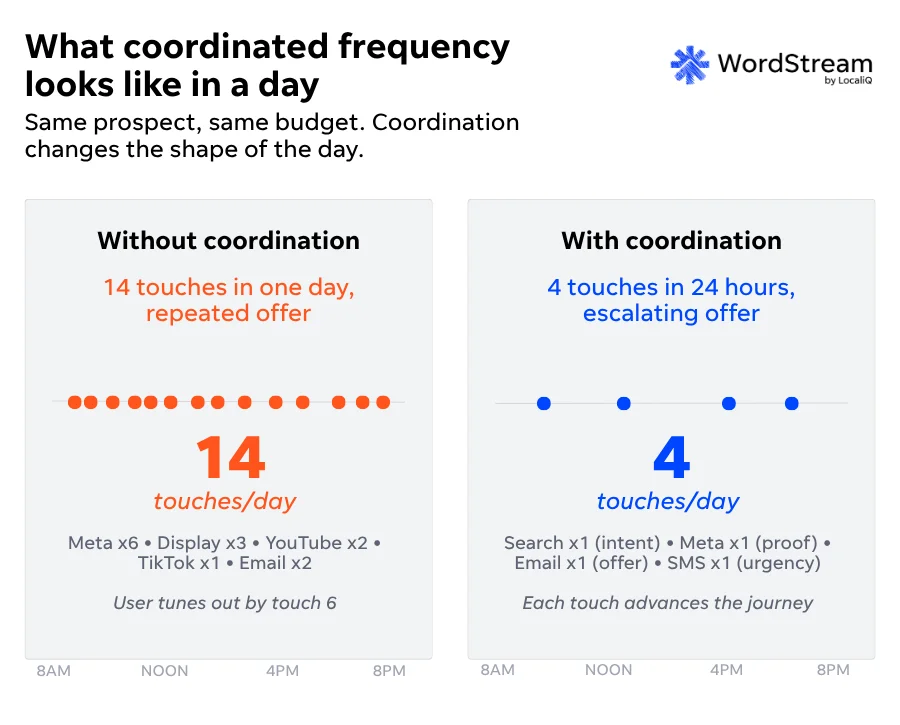
Frequency capping also needs a cross-channel perspective. Instead of capping ad impressions within each individual platform, a unified approach considers the total number of exposures a prospect receives across all channels. This prevents over-saturation and reduces ad fatigue. Implementing cross-channel frequency capping typically requires a unified user ID facilitated by identity resolution.
Finally, defining success metrics before launching a campaign is paramount. Identifying one or two key performance indicators (KPIs)—such as cost per lead or return on ad spend (ROAS)—and documenting them prior to campaign commencement prevents the temptation of cherry-picking favorable metrics post-launch.
Illustrative Cross-Channel Marketing Examples
1. B2C E-commerce: Apparel Brand
An apparel brand integrates its browse-abandon and cart-abandon audiences across Meta, Google Ads, and Klaviyo, drawing from a central customer data source. A website browse triggers a retargeting ad, capped at three impressions across all three platforms combined. An email follows at the 24-hour mark, and an SMS is sent at 48 hours for opted-in users. This coordinated approach ensures the same prospect doesn’t see excessive ads from each platform individually, optimizing ad spend by avoiding redundant exposures.
2. B2B SaaS/Account-Based Marketing (ABM)
Given the complex nature of B2B purchasing decisions involving multiple stakeholders, a coordinated approach is vital. An ABM platform monitors account activity across LinkedIn ads, display ads, and the company website. When individuals within a target account exhibit increased engagement, direct mail campaigns are automatically amplified to that account. Conversely, if an account goes quiet, sales teams are alerted to shift focus to more engaged prospects. This ensures all channels operate on unified signals regarding account engagement.
3. Local and Multi-Location SMB: Auto Service Shop
A local auto-service shop leverages Local Services Ads, Google Ads, Meta, organic Google Business Profile, and email marketing. A key cross-channel mechanic involves pushing phone call conversions from Google Ads into Meta as custom conversion events. This allows for targeted retargeting; for instance, a searcher who called for a brake quote might receive a Meta ad for an oil change, rather than a generic "schedule service" ad they previously ignored. Server-side tagging, often facilitated by a marketing services partner, enables this seamless data flow between platforms, crucial for SMBs lacking extensive data teams.

Measuring Cross-Channel Success in a Evolving Landscape
The digital advertising landscape is in constant flux, particularly with the decline of third-party cookies. Multi-touch attribution coverage has significantly decreased, and customers increasingly utilize AI platforms for research, further complicating the trackable funnel. This necessitates a shift in measurement strategies.
A robust cross-channel measurement stack is crucial. This typically includes:
- Server-Side Tracking: Ensures clean and accurate input data for all marketing platforms.
- GA4 Data-Driven Attribution: Provides day-to-day optimization insights, especially when a minimum of 400 conversions are recorded per 28 days.
- Media Mix Modeling (MMM): Essential for strategic budget allocation across channels.
- Quarterly Incrementality Tests: Validate causal relationships and measure true campaign impact.
Key performance indicators (KPIs) that truly matter for cross-channel marketing include:
- Customer Lifetime Value (CLTV): Measures the total revenue a customer is expected to generate.
- Customer Acquisition Cost (CAC): Tracks the cost of acquiring a new customer.
- ROAS (Return on Ad Spend): Assesses the profitability of advertising campaigns.
- Conversion Rate: Indicates the percentage of users who complete a desired action.
- Incremental Lift: Measures the additional conversions driven by specific campaigns or channels.
- Unified Audience Engagement: Tracks how a single audience interacts across multiple touchpoints.
Practices to avoid in cross-channel measurement include:

- Last-Click Attribution: Over-credits the final paid touchpoint and ignores preceding interactions.
- Summing Channel-Specific ROAS: Platform-reported ROAS figures are often inflated and not directly comparable, leading to an inaccurate overall picture.
Common Pitfalls in Cross-Channel Marketing
Several recurring mistakes can undermine cross-channel efforts:
- Treating channels as isolated silos: Failing to share data and signals between platforms.
- Using disparate audience definitions: Creating inconsistent targeting across channels.
- Inconsistent creative messaging: Lacking a unified brand voice and offer.
- Ignoring frequency capping across channels: Leading to ad fatigue and wasted spend.
- Flawed measurement frameworks: Relying on outdated or incomplete attribution models.
- Lack of internal alignment: Siloed marketing teams or departments hindering collaboration.
The Future of Customer Engagement: Cross-Channel as a Growth Engine
Cross-channel marketing represents a paradigm shift in how businesses connect with their audiences. By blending strategic creative, sophisticated technology, and a deep understanding of buyer psychology, it offers a powerful pathway to increased leads, conversions, and sustainable growth. The scalability of cross-channel strategies allows businesses of all sizes—from burgeoning e-commerce ventures to established multi-location enterprises—to tailor their approach to specific goals. As the digital advertising landscape continues its rapid evolution, mastering cross-channel marketing is not just an option, but a fundamental requirement for achieving enduring success.