A comprehensive survey of 1,306 digital marketing professionals has revealed that data errors and missing product information remain the paramount challenge in managing product feeds, a persistent issue that has seen little meaningful improvement over the past decade. The findings, released in March 2026 as part of the "State of PPC Global Report 2026," underscore a critical juncture for e-commerce businesses as the advertising ecosystem rapidly shifts towards an AI-driven paradigm.
The report, which surveyed a broad spectrum of PPC professionals, identified that 54% of respondents cited inaccurate or incomplete product data as their primary hurdle. This statistic, largely unchanged from previous iterations of the report, points to a fundamental disconnect between the demands of modern advertising platforms and the operational capabilities of many businesses. For twelve years, industry veterans have observed this recurring problem, and the consensus points to a dynamic and ever-changing digital marketplace as the root cause.
The Shifting Sands of Performance Marketing
Beyond the perennial challenge of evolving channel requirements, a new, increasingly significant factor is emerging: the fundamental transformation of the optimization discipline itself. Performance marketing, historically reliant on creative prowess—enhanced copy, compelling imagery, and strategic bidding—is now pivoting towards a data infrastructure problem. The traditional Business-to-Consumer (B2C) model is yielding to a Business-to-Robot (B2R) approach.
The algorithms that govern product visibility on platforms like Google Shopping, Performance Max, and emerging AI-powered search engines such as Gemini and Perplexity, are no longer primarily swayed by creative elements. Instead, technical attributes such as attribute completeness, feed consistency, and data accuracy have become the dominant signals. Brands that proactively address and rectify their product feed quality are not merely undertaking a maintenance task; they are laying the groundwork for the next generation of agentic commerce discovery.
The Relentless Evolution of Channel Demands
The persistent struggle faced by the 54% of professionals grappling with data errors is intrinsically linked to the dynamic nature of e-commerce channels. Amazon, a dominant player in online retail, frequently updates its product attribute requirements. For instance, the platform might mandate ten additional attributes in one month, followed by another five in the subsequent period. Simultaneously, evolving regulatory landscapes, particularly in European markets, introduce mandatory fields related to product safety documentation and compliance links. These new requirements can render previously compliant product feeds non-compliant overnight, necessitating immediate and often complex adjustments.
Google, a key driver of product visibility, continuously refines its product taxonomy, further complicating the management of product feeds. Moreover, the popularity and strategic importance of specific channels can fluctuate significantly across different geographical markets, requiring brands to maintain a nuanced understanding of regional demand and platform performance.
The sheer operational complexity of keeping pace with these cascading changes across multiple channels simultaneously is where many brands falter. This challenge is less about the availability of technological solutions and more about the consistent application of operational discipline.
Building on a Solid Foundation: The "Must-Dos" First
When a brand identifies a need to rapidly improve its product feed quality, a strategic approach is paramount. Experts consistently advise prioritizing the "must-do" requirements over the "nice-to-have" optimizations. The common pitfall for many brands attempting to address all issues at once is the dilution of effort, leading to the ineffective resolution of any single problem.

Each advertising channel operates with a distinct hierarchy of requirements. Certain fields are critical; their absence or inaccuracy can lead to product rejection or suppression, rendering the listing invisible. Other fields are recommended and can significantly enhance performance. A long tail of optional optimizations exists, but their true value is only realized once the foundational elements are robustly in place. Achieving 100% product listing and eligibility across all essential fields can unlock approximately 80% of the potential performance gains derived from feed optimization.
The core attributes that consistently carry the most weight across nearly every channel include titles, descriptions, and essential product characteristics. A product title, for instance, must be sufficiently descriptive to convey what the product is and who it is intended for, while also being tailored to the specific formatting constraints of each channel. A title optimized for Google Shopping might exceed Amazon’s character limit or be too brief for a comparison shopping engine.
Treating all channels as interchangeable is one of the most pervasive and costly errors in product feed management. Each channel possesses unique characteristics and user engagement patterns that demand tailored data.
The definition of "completeness" itself is a moving target. Google’s recent introduction of Conversational Attributes for Merchant Center, including fields like Question & Answer, Document Link, and Popularity Rank, illustrates this evolution. These additions are designed to empower AI systems to better understand and surface products. Brands that are early adopters of these new attributes are strategically positioning themselves to capitalize on Google’s expanding AI-driven shopping experiences. Attribute completeness is not a static objective but a dynamic target, and maintaining it requires ongoing vigilance and adaptation.
The Hero and Underperformer Framework: Maximizing Impact
Once a solid foundation of feed quality is established, the subsequent strategic step involves performance segmentation. It is a widely recognized principle that not all products warrant equal attention, and not all optimization efforts yield comparable returns.
A practical approach involves analyzing the product catalog along two key dimensions: clicks and revenue. Products exhibiting both high click volume and strong revenue generation can be categorized as "heroes"—these are the products that are performing well and are likely to continue to do so with consistent management. Conversely, "underperformers" are products that attract a high number of clicks but fail to convert into sales. These are prime candidates for focused optimization, as the existing demand signal indicates consumer interest, but the product data is failing to facilitate a purchase decision.
The diagnosis for underperformers typically falls into one of three categories: the product title lacks specificity, leading to misaligned expectations; crucial attributes are missing, causing the product to appear in overly broad search queries; or there are data inconsistencies, such as price or availability mismatches, that erode consumer trust during the comparison phase.
The impact of addressing these underperformers can be substantial. During a recent carnival season, German retailer Deiters applied this framework. They identified products that were receiving advertising spend but generating minimal returns, alongside products with significant potential that had limited visibility. Instead of treating their entire catalog uniformly, Deiters restructured their campaigns to focus on these performance segments. This strategic realignment resulted in over €500,000 in additional revenue while maintaining their target Return on Ad Spend (ROAS). Furthermore, the number of products receiving zero impressions plummeted from over 4,000 to approximately 500.
The outsized impact of this approach stems from a fundamental principle: it focuses on converting existing demand rather than attempting to generate demand from scratch.

After addressing underperformers, brands should re-evaluate their "heroes." Even high-performing products may possess untapped potential. Often, brands overlook opportunities for further improvement because existing results appear satisfactory. However, in a competitive marketplace, "good enough" may not be sufficient for sustained growth.
Navigating the Channel Landscape: Quality Over Quantity
While the allure of broad channel visibility is understandable, brands must approach multi-channel presence with strategic intent. The key is not to spread the same data thinly across numerous platforms, but rather to meticulously optimize for each individual channel with the appropriate attributes, format, and signals.
The operational demands of managing multiple channels are significant. Each platform has its unique attribute requirements, content standards, and rate of change. Attempting to maintain a presence on numerous channels with limited investment often results in ineffective management across all of them.
A more effective strategy involves shifting the focus from "how many channels" to "where is the demand concentrated for my category?" Identifying channels where a brand’s category exhibits genuine scale, verifying eligibility to sell on those platforms, and establishing a robust presence before expanding is a more sustainable approach. A single, well-optimized channel will consistently outperform three under-resourced ones.
Product Feed Quality: Beyond Maintenance
In the emerging era of Business-to-Robot (B2R), brands face the critical task of ensuring their product data is sufficiently trustworthy for machine interpretation and surfacing. The signals that resonate with AI engines differ significantly from those that appeal to human consumers. While humans respond to emotion, narrative, and brand recognition, AI systems prioritize attribute completeness, feed consistency, and data accuracy. A well-established brand with an incomplete or inconsistent product feed can be outperformed by a smaller competitor whose product data is precise and comprehensive.
Consider the distinction between a product titled "blue running shoe, size 10" and one described as "lightweight trail running shoe, recommended for marathon training, high-arch support, waterproof, 280g." While both refer to the same product, the latter provides a wealth of information that directly answers potential customer queries, enabling AI systems to better identify and surface it. AI-driven platforms are designed to surface products that effectively answer questions.
The Dawn of Agentic Commerce and the Imperative of Data Accuracy
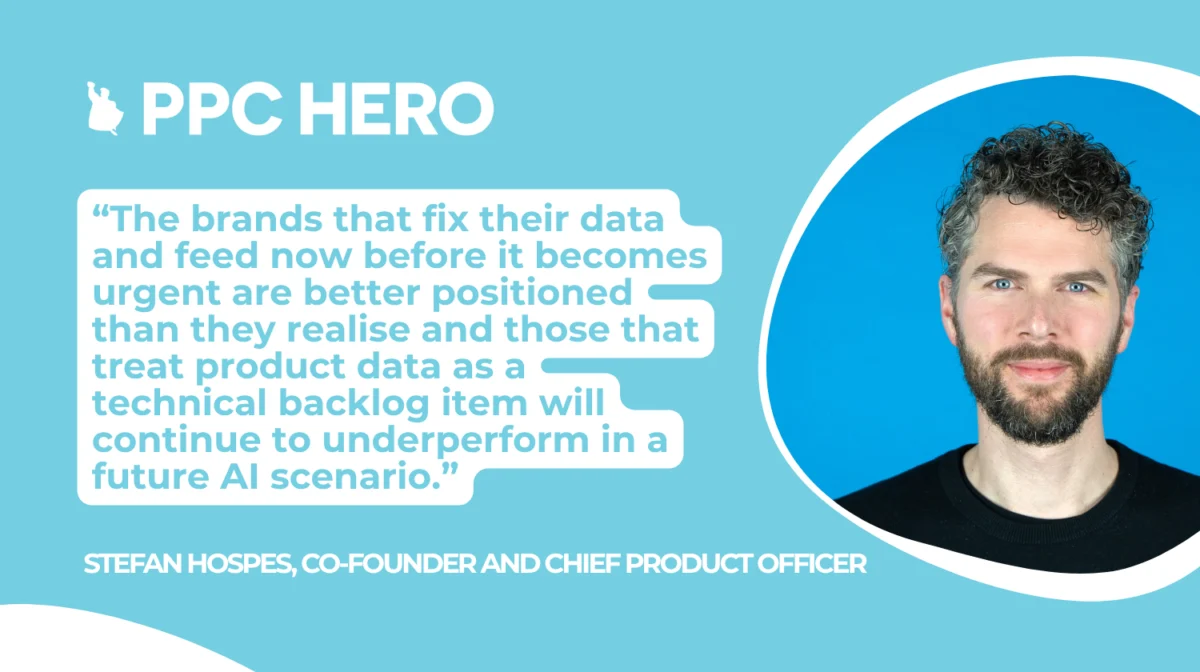
The landscape of agentic commerce, where AI agents actively participate in the purchasing process, is still in its nascent stages. The volume of transactions influenced by these agents is currently modest, and the tools for measuring AI-driven visibility are far less mature than those available for traditional search. However, brands that proactively address their data and feed quality now, before it becomes an urgent necessity, are positioning themselves for future success in ways they may not yet fully appreciate. Conversely, those that relegate product data management to a technical backlog item risk continued underperformance in an AI-dominated future.
The 54% of professionals still grappling with fundamental data errors are not only missing out on the full efficiency potential of platforms like Performance Max but are also conceding ground in a competitive race that has already begun. The machines are watching, and a well-maintained product feed is the key to being seen.