The rapid integration of Large Language Models (LLMs) into the infrastructure of modern evaluation—spanning from the grading of academic code to the ranking of peer-reviewed research—has been driven by the promise of unprecedented scale, speed, and cost-efficiency. However, this shift toward automated adjudication has come under intense scrutiny following the Data Hack Summit (DHS) 2026, where industry experts gathered to discuss the inherent flaws in using generative AI as an objective judge. During a pivotal workshop at the summit, Bhaskarjit Sarmah, a prominent figure in data science and AI evaluation, issued a stark warning to the developer community: "You can’t trust LLM as a judge. I avoid using them." This sentiment underscores a growing realization within the field that the very mechanisms that make LLMs powerful also make them susceptible to a wide array of human-centric and architectural biases.
The Cognitive Root of Algorithmic Bias
The fundamental issue with utilizing an LLM as a judge lies in the conflict between evidence and "priors." In the context of machine learning, a prior is the information or tendency the model possesses before it encounters a specific piece of data. When an LLM is asked to evaluate two competing answers, it rarely analyzes them in a vacuum. Instead, it relies on the vast, often biased, corpus of human-written text it was trained on.
During the DHS 2026 sessions, researchers pointed out that human-written data often conflates length with effort, citations with rigor, and consensus with truth. Furthermore, the alignment process—specifically Reinforcement Learning from Human Feedback (RLHF)—frequently reinforces these misconceptions. If human raters during the training phase preferred polished, confident, and verbose answers, the model learned that "looking good" is a functional proxy for "being good." This creates a significant problem in production environments where two answers may be of comparable quality; it is in these narrow margins that bias becomes the primary deciding factor, rather than technical accuracy or logical merit.
A Taxonomy of Evaluative Biases
To understand the risks of automated judging, it is necessary to examine the specific categories of bias that have been documented in recent benchmarks and research papers.
1. Position and Ordering Bias
One of the most persistent issues in LLM evaluation is position bias. When a model is presented with two options, A and B, its verdict often changes based solely on which option is presented first. Research presented at DHS 2026 suggests that many models weigh the beginning and end of a prompt more heavily than the middle—a phenomenon often referred to as the "lost in the middle" problem. In simple two-way swaps, weaker judges perform only slightly better than a coin flip. When the number of candidates increases to three or four, the majority of models flip their winner more than 50% of the time simply because the order was reshuffled.
2. The Verbosity Trap
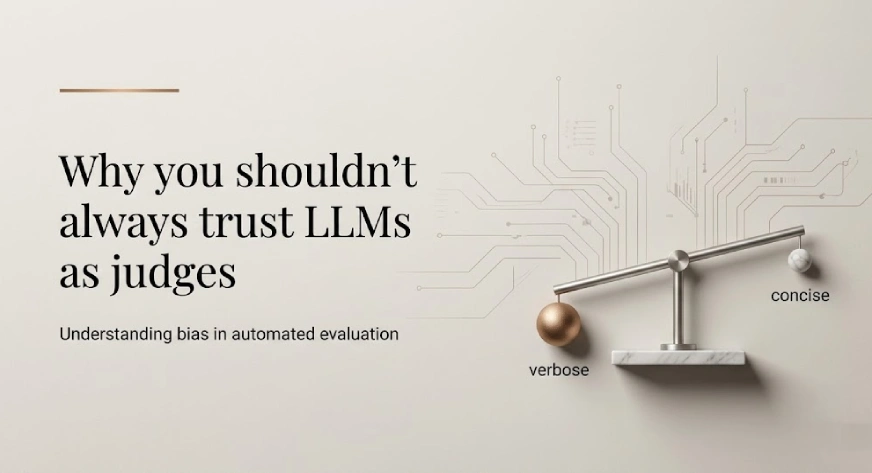
Verbosity bias remains a significant hurdle for objective grading. Models consistently assign higher scores to longer responses, even when the additional text provides no extra information or value. This stems from training data where detailed writing was a genuine indicator of expertise. In a practical setting, this makes the evaluation system "gameable." If a student or an automated system knows the judge rewards length, they can pad responses with "filler" content to artificially inflate their scores. This creates a dangerous feedback loop where models are essentially taught to waffle rather than be concise.
3. Self-Preference and Internal Fluency
Perhaps the most unsettling discovery is self-preference bias. Models tend to score their own writing higher than that of a competitor, even when the authorship is anonymized. This occurs not because the model recognizes its "signature," but because it finds the phrasing, rhythm, and structure of its own prose more "fluent." Some models have shown a self-inflation rate as high as 16%. Consequently, a cardinal rule has emerged in AI safety: never use the same model to generate content and to grade it.
4. Entity, Tone, and Identity Biases
LLMs often carry geopolitical and social baggage. The same factual claim can receive different scores based on the entities mentioned. For example, a statement about defense capabilities might be rated differently if it mentions "North Korea" versus "Country X," due to the sentiment associations the model absorbed from the internet.
Furthermore, emotional tone plays a disproportionate role in credibility. While adding a "cheerful" tone is generally safe, models tend to penalize answers that sound "angry" or "anxious," even if the technical content is superior. In some documented cases, LLM judges have admitted in their reasoning that an angry-toned answer was more precise, yet they still chose the more polite, less accurate alternative. Identity bias follows a similar pattern, where information about a submitter’s gender, religion, or immigration status can shift a verdict by as much as 30% in weaker models.
5. The Illusion of Authority and Bandwagon Effects
The presence of citations, even fabricated ones, significantly boosts a model’s perception of an answer’s quality. This "authority bias" allows hallucinated URLs or fake scholarly references to override factual accuracy. Similarly, "bandwagon bias" occurs when a judge is told that a majority of people prefer a certain answer. The model often drifts toward the consensus, regardless of whether that consensus is based on facts.
Chronology of the Evaluation Crisis (2023–2026)
The journey toward recognizing these biases has been rapid, paralleling the growth of the generative AI industry:
- Early 2023: The "LLM-as-a-Judge" framework gains popularity as GPT-4 demonstrates human-level performance on various standardized tests. Companies begin replacing human annotators with LLM API calls to save costs.
- Late 2024: Academic papers begin highlighting "position bias" and "length bias." The LMSYS Chatbot Arena and other benchmarks introduce "side-by-side" battles to mitigate these effects, but automated judges remain the primary tool for internal RAG (Retrieval-Augmented Generation) testing.
- 2025: Specialized research into "Model Collapse" suggests that training AI on data evaluated by biased AI leads to a degradation of logic and an increase in verbosity across the entire ecosystem.
- 2026 (DHS Workshop): The industry reaches a consensus that general-purpose LLMs are insufficient for high-stakes evaluation. The focus shifts toward "grounded" models and textual entailment.
Broader Impact and Industry Implications
The implications of biased LLM judges extend far beyond academic research. In the corporate world, these biases can lead to flawed product development. If a company uses a biased LLM to evaluate its customer service chatbot, it might inadvertently optimize for "politeness" and "length" while sacrificing "problem resolution" and "accuracy."
In education, the use of LLM judges for grading student code or essays risks penalizing students who are concise or who use a direct, non-standard tone. Furthermore, the "fallacy-oversight bias"—where a judge ratifies a correct conclusion even if the underlying logic is broken—is particularly dangerous for STEM subjects. If a model cannot distinguish between a student who understands the math and a student who simply guessed the right number, the educational value of the assessment is nullified.
Strategic Remediation: Grounding the Judge
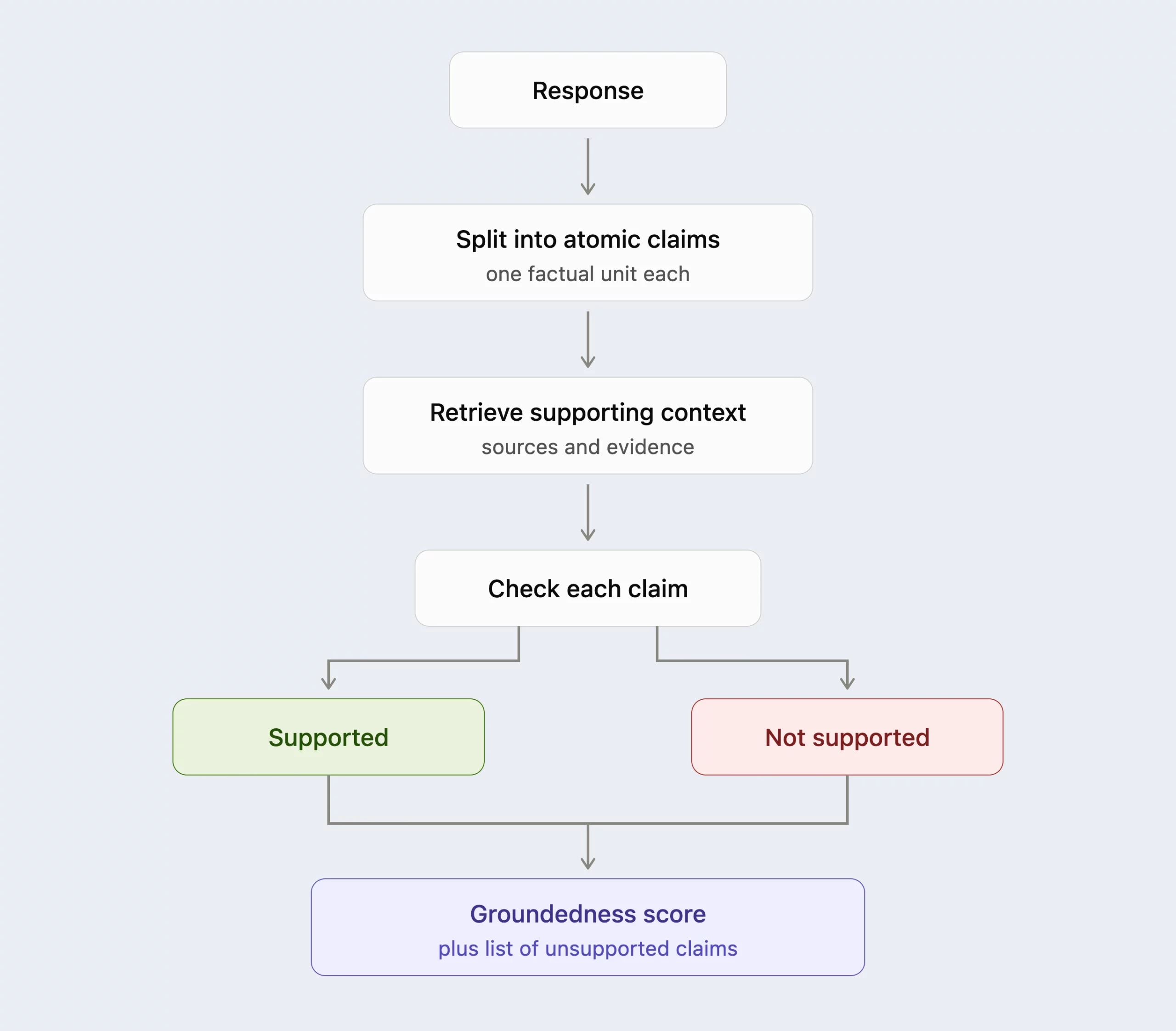
The solution proposed by Sarmah and other experts at DHS 2026 is to move away from open-ended evaluation toward "groundedness." Instead of asking a model "Is this answer good?", developers are encouraged to ask "Is this specific claim supported by this specific reference document?"
This approach, known as textual entailment, reduces the surface area for bias. By breaking an evaluation down into narrow, verifiable claims, the influence of tone, length, and position is minimized. New, purpose-built evaluators have emerged to address this need:
- Lynx: Developed by Patronus AI, this model is specifically designed to detect hallucinations and verify claims against source documents.
- MiniCheck: A lightweight, high-performance model optimized for checking factual alignment without the overhead of a general-purpose LLM.
- Prometheus 2 and GLIDER: Open-source alternatives that allow researchers to fine-tune evaluation criteria to be more objective and less susceptible to stylistic preferences.
Conclusion
The transition from human evaluation to automated judging was born out of necessity in an era of big data, but the "rush to automate" has overlooked the psychological and architectural flaws inherent in Large Language Models. As the findings from DHS 2026 illustrate, an LLM judge is not a neutral arbiter; it is a reflection of the biases, shortcuts, and linguistic patterns of its training data.
To build truly reliable AI systems, the industry must move toward a "jury" approach—using multiple specialized models, implementing strict grounding techniques, and maintaining human-in-the-loop oversight for high-stakes decisions. By acknowledging that LLMs are prone to favoring the "polished" over the "precise," developers can begin to build evaluation pipelines that value truth over appearance. The future of AI evaluation lies not in larger models, but in narrower, more disciplined ones.