rifanmuazin
Do you have a website or are you contemplating its creation, with an ambition to significantly expand your business reach and attract a broader audience? If the answer to these fundamental questions is affirmative, then Search Engine Optimization (SEO) unequivocally deserves a central role in your overarching marketing strategy. It stands as an indispensable methodology for cultivating brand recognition and driving qualified traffic to your digital presence. To effectively harness its power, however, a foundational understanding of SEO’s core principles and practical application is essential. This article will provide an in-depth exploration of what SEO entails, its historical evolution, its profound importance in the contemporary digital ecosystem, and how businesses can strategically embark on their SEO journey.
At its core, SEO, an acronym for Search Engine Optimization, represents a sophisticated and multifaceted discipline. As articulated by Alex Moss, Principal SEO at Yoast, “SEO is both the art and science of improving a website, and pages within, to be as visible as possible for when people search for a relevant topic within any search platform. SEO covers many areas from technical aspects including optimizing a site’s performance and structure, to enhancing brand authority by providing great content and matching it with that person’s search intent.” This definition underscores the dual nature of SEO, combining meticulous technical execution with creative content strategy.
Fundamentally, SEO is the systematic practice of enhancing a website and its constituent content to ensure it is readily discoverable, comprehensively understood, and inherently trusted by search engines when users initiate searches for pertinent topics. While historically centered on traditional search engines such as Google and Bing, the scope of SEO has expanded dramatically. Today, it also encompasses optimizing content for visibility within nascent AI-powered search experiences, sophisticated chatbots, and various other emerging discovery platforms. This holistic approach integrates technical improvements, granular content optimization, and strategic brand-building initiatives to amplify online visibility, attract a precisely targeted audience, and ultimately, bolster overarching business objectives.
The Mechanics of Search Engine Operation
To grasp the essence of SEO, it is imperative to understand the underlying mechanisms of search engines. Platforms like Google operate through a complex, three-stage process: crawling, indexing, and ranking. The initial phase involves “crawlers,” which are automated online bots dispatched across the internet to systematically discover and collect all publicly accessible web pages. These crawlers meticulously traverse links, read content, and gather data, which is then stored in a colossal database known as the “index.” This index is in a perpetual state of flux, constantly updated with newly published pages or revised versions of existing ones.
When a user performs an online search, the search engine rapidly queries its vast index. Employing highly intricate algorithms, it then evaluates and determines which pages are most relevant and authoritative to the specific search query. This algorithmic assessment dictates the “ranking” – the order in which results are presented to the user. For instance, a search for “sustainable phone case” prompts Google to analyze its index for pages matching this query and the implicit user intent, subsequently displaying what it deems the most pertinent results. This process highlights the critical role of SEO in influencing a website’s position within these search results.

Organic Versus Paid Search: A Strategic Distinction
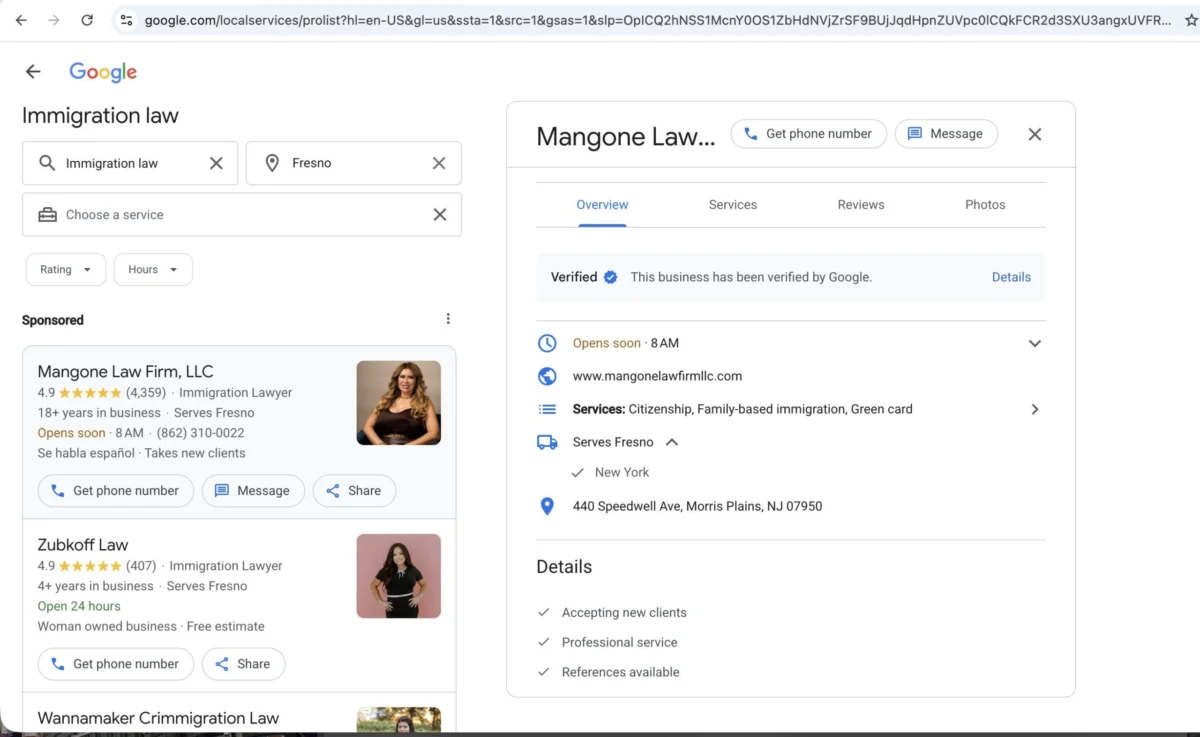
SEO primarily concentrates on generating “organic traffic” to a website – visitors who arrive via unpaid search results. However, modern search engine results pages (SERPs) are often bifurcated, displaying both organic listings and paid advertisements. These sponsored results, frequently positioned at the top of the page, are generated through pay-per-click (PPC) campaigns. While PPC offers immediate visibility for specific search terms, incurring a cost for each user click, SEO cultivates sustained, cost-effective traffic over time. The acronyms commonly used to delineate these are SEO (Search Engine Optimization), SEM (Search Engine Marketing, which encompasses both SEO and PPC), and PPC (Pay-Per-Click). While distinct, SEO and PPC are not mutually exclusive; they often serve as complementary forces within a comprehensive digital marketing strategy, leveraging both immediate impact and long-term growth.
The Evolving Lexicon: SEO, Not GEO
The dynamic nature of SEO, particularly with the ascendance of AI-powered search, has led to the emergence of new terminologies. One such term, “Generative Engine Optimization” (GEO), has gained traction in online discussions, purporting to describe optimization efforts aimed at enhancing visibility within responses generated by AI tools. However, industry experts, including those at Yoast, maintain that the established acronym SEO remains sufficiently comprehensive. The underlying principles of optimizing for discoverability, understanding, and trust persist, regardless of whether the platform is a traditional search engine, an AI assistant, or a social media channel. The core tenets of SEO simply adapt to how these new platforms process and present information.
Why SEO is Indispensable for Site Owners
The widespread investment in SEO by businesses of all sizes stems from its profound potential impact. The sheer volume of online searches underscores this significance. In 2024, Google, the world’s predominant search engine, processed approximately 8.3 billion searches daily – a staggering figure that has consistently escalated since its inception in 1998. For any entity with an online presence, ensuring visibility across Google and other search platforms is not merely advantageous; it is imperative for survival and growth.
Intent-Driven Engagement: A distinguishing characteristic of online search, particularly when compared to other marketing channels like social media, is its inherent intent-driven nature. On social media, brands often interrupt a user’s experience to capture their attention, making conversion more challenging. Conversely, appearing in search results directly aligns with an existing demand; users are actively seeking information, products, or solutions. This positions SEO as a potent inbound marketing strategy, wherein customers proactively seek out a business rather than being passively targeted. This pre-existing intent significantly elevates the likelihood of conversion, making SEO an essential conduit for attracting high-quality leads.

Competitive Advantage in a Crowded Digital Landscape: The proliferation of new websites makes achieving and maintaining customer loyalty increasingly arduous. SEO offers a decisive competitive edge by providing sustained online visibility, fostering a robust brand identity, establishing authority within a given field, increasing touchpoints with the target audience, and driving higher-quality traffic to both online and offline presences. These cumulative benefits contribute directly to enhanced brand loyalty and augmented revenue streams.
Beyond the Click: Brand Awareness and Credibility: Modern SEO transcends the singular objective of earning clicks from search results. Content optimized for search may now be cited within AI-generated answers, referenced in AI overviews, or discovered through diverse platforms like social media or video platforms. Even in scenarios where users do not immediately click through to a website, appearing as a trusted and authoritative source in these contexts significantly boosts brand awareness, reinforces credibility, and can generate future demand for a business’s offerings.
Categorizing SEO: A Multifaceted Discipline
While the foundational principles of SEO remain consistent, the discipline itself encompasses several specialized areas. Understanding these different types allows businesses to tailor their optimization efforts to specific goals:
- Technical SEO: Focuses on website infrastructure to improve crawlability, indexability, security, and speed.
- On-Page SEO: Optimizes individual web pages for search engines and users, including content, keywords, titles, and internal links.
- Off-Page SEO: Involves activities outside the website to build authority and credibility, primarily through backlinks, brand mentions, and social signals.
- Local SEO: Targets local customers, optimizing for geographic-specific searches, often relying on Google Business Profile.
- E-commerce SEO: Tailors optimization for online stores, focusing on product pages, categories, and transactional keywords.
- Mobile SEO: Ensures websites are optimized for mobile devices, critical given the prevalence of mobile search.
- Video SEO: Optimizes video content for visibility on platforms like YouTube and in general search results.
- Voice Search SEO: Adapts content to be discoverable through voice queries, often focusing on natural language and question-based keywords.
- International SEO: Optimizes websites for different languages and regions, using Hreflang tags and country-specific targeting.
The Three Pillars of SEO: A Framework for Optimization
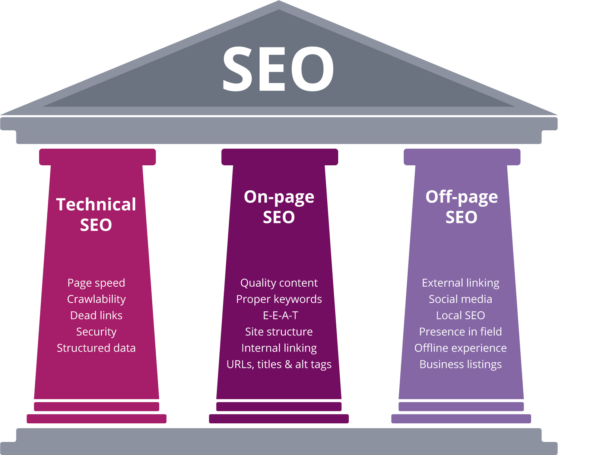
Effective SEO hinges on optimizing various aspects of a website, broadly categorized into three interdependent pillars: Technical SEO, On-Page SEO, and Off-Page SEO.
1. Technical SEO: This pillar concerns the underlying architecture and infrastructure of a website, ensuring it is readily accessible, comprehensible, and provides a superior user experience for both search engines and human visitors. Key components of technical SEO include:

- Crawlability and Indexability: Ensuring search engine bots can efficiently access and process all relevant pages (e.g., through optimized robots.txt files, XML sitemaps).
- Site Speed (Page Experience): Optimizing loading times for both desktop and mobile, often guided by Google’s Core Web Vitals metrics (Largest Contentful Paint, Cumulative Layout Shift, First Input Delay).
- Mobile-Friendliness: Guaranteeing a responsive and intuitive user experience across all mobile devices.
- Website Architecture: Structuring the site logically and intuitively, facilitating easy navigation for users and crawlers.
- HTTPS Security: Implementing SSL certificates to encrypt data and ensure secure connections, a crucial ranking signal.
- Structured Data (Schema Markup): Adding specific code snippets to help search engines better understand the content on a page, leading to rich results (e.g., star ratings, recipes, event information) in SERPs and aiding AI interpretation.
- Canonicalization: Preventing duplicate content issues by specifying the preferred version of a URL.
- Broken Links and Redirects: Identifying and fixing broken links, and implementing proper 301 redirects for moved or deleted pages.
Search engines prioritize these technical elements because they are directly correlated with user satisfaction. A website that loads slowly, is difficult to navigate on mobile, or presents security risks offers a poor user experience and is less likely to rank prominently. Moreover, aspects like crawlability and structured data empower search engines to accurately interpret a page’s relevance, thereby improving its potential ranking.
2. On-Page SEO: While technical SEO addresses the “under-the-hood” aspects, on-page SEO focuses on optimizing the content and visible elements of individual web pages. This involves:
- High-Quality Content: Creating comprehensive, authoritative, relevant, and engaging content that directly addresses user intent, demonstrating Experience, Expertise, Authoritativeness, and Trustworthiness (E-E-A-T).
- Keyword Research and Integration: Identifying target keywords and phrases that users search for, and strategically incorporating them into content without overstuffing. This includes understanding semantic keywords and long-tail variations.
- Title Tags and Meta Descriptions: Crafting compelling and keyword-rich titles and meta descriptions that entice users to click from search results.
- Header Tags (H1, H2, H3): Structuring content logically with hierarchical headings to improve readability and signal content importance to search engines.
- Image Optimization: Using descriptive file names, alt text, and compressing images for faster loading.
- Internal Linking: Strategically linking to other relevant pages within the same website to distribute link equity and improve navigation.
- URL Structure: Creating clean, descriptive, and keyword-friendly URLs.
- Readability: Ensuring content is easy to understand and digest for the target audience.
On-page SEO primarily revolves around content optimization and leveraging surrounding elements to enhance a page’s discoverability for relevant search terms.
3. Off-Page SEO: This pillar encompasses all SEO activities conducted outside of a website to bolster its authority, credibility, and brand presence. Key off-page SEO strategies include:
- Link Building (Backlinks): Acquiring high-quality, relevant backlinks from other reputable websites. These links act as “votes of confidence,” signaling trustworthiness and authority to search engines. Focus is placed on natural, editorial links rather than manipulative tactics.
- Brand Mentions: Generating mentions of the brand across the web, even without a direct link, contributing to brand recognition and authority.
- Social Media Marketing: While social media activity doesn’t directly impact rankings, it can drive traffic, increase brand visibility, and facilitate content sharing, indirectly influencing SEO.
- Local SEO (Off-Site Components): Managing and optimizing Google Business Profile listings, ensuring consistent Name, Address, Phone (NAP) information across local directories, and encouraging customer reviews.
- Digital PR: Engaging in public relations activities online to earn media coverage, features, and mentions from influential publications and websites.
- Influencer Marketing: Collaborating with relevant influencers to promote content and brand, leading to increased exposure and potential backlinks.
Off-page SEO is crucial for building a website’s reputation and expanding its reach. For local businesses, customer experience, both offline and online (e.g., through positive reviews and social media engagement), is paramount.
Key SEO Ranking Factors
Search engines utilize a multitude of ranking factors to determine the order of search results. While the exact algorithms are proprietary and constantly updated, extensive research and industry consensus point to several highly influential signals:
- Content Quality and Relevance: Comprehensive, unique, valuable content that directly answers user queries and demonstrates E-E-A-T.
- Backlink Profile: The quantity, quality, and relevance of links pointing to a website from other authoritative sites.
- User Experience (UX): Factors like page speed, mobile-friendliness, site navigation, and overall user satisfaction (e.g., low bounce rates, high time on page).
- Keyword Optimization: Strategic use of keywords in titles, headings, content, and meta descriptions.
- Technical SEO Health: Site architecture, crawlability, indexability, and security (HTTPS).
- Domain Authority and Trust: The overall credibility and established reputation of the website.
- Mobile-First Indexing: Google’s preference for mobile versions of websites for indexing and ranking.
- Freshness of Content: For certain queries, newer, updated content may rank higher.
- Search Intent Alignment: How well the content matches the underlying goal or question a user has when searching.
Focusing on these critical factors provides a strong foundation for any SEO strategy. Tools like Yoast’s SEO Checker can assist in identifying and addressing potential issues, offering actionable recommendations for improvement.
A Brief History of SEO: From Keywords to AI
The journey of SEO reflects the rapid evolution of the internet and search engine technology.
The Early Days (1990s – Early 2000s): SEO emerged in the mid-1990s as websites began to proliferate. In this nascent stage, search engine algorithms were relatively unsophisticated, often relying heavily on simple metrics like “keyword density.” The prevailing “trick” was to repeatedly use target keywords within page content and meta tags, leading to a proliferation of low-quality, keyword-stuffed pages. This era was characterized by rudimentary tactics and a focus on manipulating algorithms rather than serving user needs.
Search Engines Evolve (Mid-2000s – 2010s): Search engine companies, particularly Google, quickly recognized the limitations of keyword-centric ranking, which often delivered irrelevant or spammy results. This spurred a continuous effort to develop more intelligent and nuanced algorithms. Significant updates like Google’s PageRank algorithm (emphasizing link quality) and subsequent “Florida” and “Caffeine” updates marked a shift towards combating spam and rewarding more authoritative sites. The introduction of major algorithm updates became a regular occurrence, each designed to refine search quality.
The Era of Quality and User Experience (2011 – Present): The 2010s witnessed a profound transformation in SEO, driven by Google’s commitment to user experience and high-quality content. Landmark updates include:
- Panda (2011): Targeted thin, low-quality, and duplicate content.
- Penguin (2012): Dealt with manipulative link schemes and unnatural backlinks.
- Hummingbird (2013): Represented a major overhaul in how Google processed queries, focusing on semantic search and understanding the context and intent behind searches, rather than just individual keywords.
- Mobilegeddon (2015): Prioritized mobile-friendly websites in mobile search results.
- RankBrain (2015): Introduced machine learning into Google’s ranking algorithm, particularly for understanding ambiguous or novel queries.
- Core Web Vitals (2021): Emphasized page experience metrics like loading speed, interactivity, and visual stability as ranking signals.
These updates underscored a fundamental shift: from optimizing for search engines to optimizing for users, with search engines striving to mirror human judgment of quality and relevance.
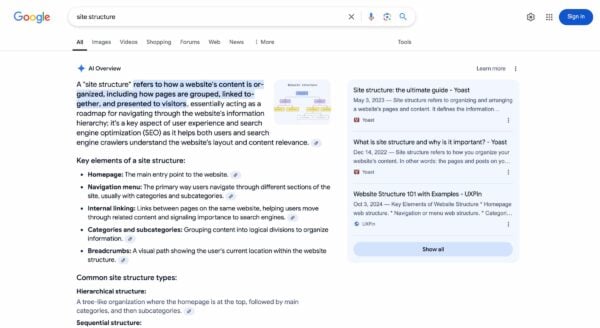
SEO in the AI Era (2026 and Beyond): The trajectory of SEO continues its rapid evolution, heavily influenced by advancements in artificial intelligence. As predicted by Yoast experts, SEO in 2026 will still prioritize high-quality content and robust technical factors (site speed, security, mobile parity). However, the critical development is the expansion of SEO beyond traditional SERPs. Information discovery now spans AI assistants, AI-generated search results, social platforms, and video platforms.
The core tenets of SEO remain steadfast, hence the continued use of the term. The channels for visibility are broadening, but the principles of discoverability, relevance, and trust endure. Google’s AI Overviews, where AI compiles and synthesizes information from various sources to provide a direct answer within the search results, exemplify this shift. This can lead to “zero-click searches,” where users find their answer directly on the SERP without visiting a website. While this might reduce direct website clicks, being the authoritative source cited in an AI overview still offers immense brand value. This trend highlights a crucial directional shift: move beyond solely chasing clicks and fixed rankings to building a powerful, omnipresent brand across diverse digital touchpoints.
As Carolyn Shelby, Principal SEO at Yoast, emphasizes, “Rankings still matter, but they are no longer the end goal. They are a proxy for visibility, not a guarantee of impact. As search shifts from ranking pages to selecting sources, rankings should be interpreted alongside presence, citation, and narrative accuracy.” This perspective underscores the evolving metrics of success in an AI-driven search landscape.
Redefining SEO Goals and Metrics
Historically, SEO professionals meticulously tracked ranking positions, click-through rates, website traffic, and bounce rates. While these data points remain pertinent, the advent of AI and diversified content discovery platforms necessitates a reevaluation of primary SEO goals. The focus is shifting from a mere numbers game to cultivating a holistic brand perception and ensuring strategic presence across all relevant online avenues.
Contemporary SEO goals should encompass engagement metrics, brand awareness, comprehensive user experience on the website, overall user satisfaction, and how these factors contribute to tangible business outcomes such as sales or desired audience actions. This requires a more nuanced approach than simply monitoring daily rankings but offers a more accurate gauge of an SEO strategy’s long-term success and how a brand is perceived by both online tools and its target audience. Reports like the Yoast Perspective report 2026 advocate for a shift in metrics, moving from solely tracking traffic to assessing broader influence.
Embarking on Your SEO Journey: A Practical Approach

Despite its multifaceted nature, a significant portion of SEO can be effectively managed internally. For those looking to begin, a structured approach is recommended.
Laying the Technical Foundation: Prioritizing technical SEO is paramount. Before delving into content creation, ensure your website’s technical health is robust. This involves addressing redirects, optimizing page speed, guaranteeing crawlability, securing the site with HTTPS, and implementing structured data. If internal expertise is lacking, engaging a web developer or a technical SEO specialist is a wise initial investment. Once the technical foundation is solid, attention can shift to site structure and on-page content optimization.
Strategic Content Creation: Robust keyword research is the cornerstone of effective content strategy. By understanding the terms and questions your target audience uses, you can craft content that not only aligns with your business objectives but also directly addresses user intent, driving qualified traffic. In an era increasingly saturated with AI-generated content, the imperative for original, insightful, and expert-driven content is amplified. This approach enables the development of a sustainable SEO strategy and content calendar. SEO is an ongoing endeavor, not a one-time task. Therefore, establishing a realistic, consistent plan and adhering to it is crucial for long-term success. While demanding, these efforts yield significant returns in increased traffic, enhanced brand equity, and enduring customer loyalty.
Companies like Yoast democratize SEO through accessible tools and educational resources. Their free and premium SEO plugins for WordPress and Shopify offer features like SEO and readability analyses, technical SEO automation, and advanced keyword capabilities. Furthermore, the Yoast SEO Academy provides a wealth of courses, including free modules for beginners and comprehensive programs for premium users, covering various aspects of SEO. Complementing these are extensive blog resources dedicated to SEO basics, advanced topics, and emerging trends, providing users with the knowledge and tools required to effectively manage their own SEO.
In conclusion, SEO has evolved from a technical niche into an indispensable strategic imperative for any business operating in the digital sphere. By understanding its foundational principles, adapting to its dynamic evolution, and embracing a holistic approach that prioritizes user experience, technical excellence, and brand authority, organizations can unlock unparalleled visibility, attract highly engaged audiences, and secure a lasting competitive advantage in an increasingly complex digital landscape.