In the dynamic realm of professional networking, LinkedIn has long stood as the undisputed titan, a sprawling digital ecosystem boasting over 1.3 billion registered members across more than 200 countries and territories. Acquired by Microsoft in 2016 for an impressive $26.2 billion, the platform has evolved far beyond a simple online resume repository. It functions as a public CV, a comprehensive people directory, a relationship graph, a content feed, a robust job board, a potent recruiter database, a sales intelligence tool, an events platform, and a ubiquitous messaging system, all unified under a single login. Its sheer scale and multifaceted utility make it an indispensable tool for many seeking career advancement, talent acquisition, or professional development.
The Unmatched Colossus: Understanding LinkedIn’s Dominance
LinkedIn’s journey from a nascent professional networking site in 2002 to a global powerhouse is a testament to its strategic evolution. Early on, it capitalized on the internet’s potential to digitize and connect professional identities, offering a more formal and career-focused alternative to general social media platforms. Its integration of job listings directly with professional profiles revolutionized recruitment, allowing employers to actively source candidates and job seekers to apply with a single click. The subsequent addition of features like LinkedIn Learning, content publishing, and industry-specific groups further cemented its status as a holistic professional development platform. For many, maintaining a strong LinkedIn presence is synonymous with professional visibility and credibility. Its vast network effect means that for most general professional needs—from finding a former colleague to researching a company or sharing industry insights—LinkedIn remains the default.
Why Seek Alternatives? Unpacking the Niche Demands
Despite its unparalleled reach and feature set, LinkedIn is not without its limitations, prompting a growing number of professionals to explore specialized alternatives. The primary critique often centers on its "one-size-fits-all" approach, which, while offering broad utility, can dilute the experience for niche communities. For instance, a software developer might find the general content feed less relevant than a platform focused purely on technical projects. Similarly, a graphic designer’s visual portfolio might be better showcased elsewhere than on a text-heavy LinkedIn profile.
Other common pain points include:
- Content Overload and Irrelevance: The sheer volume of content can make it challenging to find genuinely valuable insights, with many users lamenting the proliferation of generic motivational posts or self-promotional content.
- Algorithm Frustration: Like any large social platform, LinkedIn’s algorithm dictates content visibility, which can be frustrating for users trying to reach specific audiences.
- Niche Specialization: Certain industries, particularly creative, technical, or academic fields, require platforms that prioritize specific types of work, project showcases, or peer-to-peer interaction that LinkedIn’s general framework struggles to accommodate effectively.
- Regional Focus: In some markets, local platforms have maintained strong footholds due to cultural nuances, language barriers, or specific labor market structures.
- Cost and Feature Limitations: While LinkedIn offers a robust free tier, advanced features for recruiters, sales professionals, or premium users come with a significant subscription cost, leading some to seek more cost-effective or specialized tools.
- Data Privacy Concerns: As a large tech company, LinkedIn, like others, faces scrutiny over data privacy and usage, which can drive some users to smaller, more focused platforms.
The crucial understanding is that no single platform can truly "replace" LinkedIn in its entirety. Instead, the market is witnessing the rise of highly specialized networks designed to fulfill specific professional needs more effectively than a generalist platform ever could. This shift reflects a broader trend in the digital landscape: as platforms mature and become ubiquitous, users often seek out smaller, more curated spaces that align precisely with their unique requirements.

The Rise of Specialized Networks: A Comprehensive Overview
A thorough examination of over 20 contemporary professional platforms reveals a clear trend: the future of professional networking is in specialization. These alternatives cater to distinct professional identities, geographic regions, or functional needs.
I. For Tech Professionals: Showcasing Skills and Projects
For those in the rapidly evolving technology sector, platforms that prioritize demonstrable skills and project-based work often surpass LinkedIn’s traditional resume format.
-
Peerlist: The Tech-Centric Professional Hub
- Best for: Developers, designers, and tech builders.
- What it replaces: Work profile, feed, jobs, project launches.
- Main Catch: The community is deliberately tech-focused.
- Analysis: Peerlist represents one of the most credible attempts to reimagine professional networking for the tech community. Launched with the explicit goal of showcasing "work over titles," it allows users to aggregate projects from GitHub, Dribbble, Medium, and other platforms into a cohesive, verifiable profile. With over 240,000 members, while modest compared to LinkedIn, its value lies in its high concentration of "builders"—individuals actively creating and contributing to technology. Its "Scroll" feed encourages sharing work-in-progress and seeking feedback, fostering a more collaborative and tangible professional discourse than LinkedIn’s often abstract discussions on leadership or productivity. For tech professionals, Peerlist offers a more authentic representation of their capabilities and a more relevant peer network.
-
GitHub: The Developer’s Definitive Portfolio
- Best for: Software developers.
- What it replaces: Technical proof, collaboration, professional profile.
- Main Catch: No broad LinkedIn-style job marketplace.
- Analysis: Acquired by Microsoft in 2018 for $7.5 billion, GitHub is not a social network in the traditional sense, but for software developers, it serves as an unparalleled professional profile. It provides tangible evidence of coding skills, collaboration abilities, and open-source contributions through public repositories, commit history, and project documentation. A well-maintained GitHub profile with thoughtfully pinned projects can convey more about a developer’s expertise than any list of skills on a resume. While it lacks LinkedIn’s broad job marketplace, it acts as a critical "proof layer" that complements other job-seeking platforms like Wellfound or Peerlist, offering a deep dive into a candidate’s technical prowess.
II. Regional & Industry-Specific Hubs: Tailored Networking
Beyond tech, several platforms have carved out significant niches by focusing on specific geographies or highly specialized industries.

-
XING: The DACH Market’s Professional Cornerstone
- Best for: Professionals in Germany, Austria, and Switzerland.
- What it replaces: Profile, job search, recruiter discovery.
- Main Catch: Regional and increasingly job-first.
- Analysis: XING stands out as the most substantial conventional LinkedIn rival with meaningful regional scale, specifically dominating the DACH (Germany, Austria, Switzerland) labor market. Founded in 2003, XING has deep roots in these countries, with its recruiting business boasting a talent pool of 21 million candidates in German-speaking regions. While it maintains traditional professional profiles and networking features, XING has explicitly rebranded itself as "the jobs network," emphasizing its robust job board with over a million listings. For anyone working in or planning to enter the DACH market, XING offers unparalleled access to local job opportunities, recruiters, and salary insights that a global platform might miss. Its strong regional focus, however, limits its utility outside this specific economic bloc.
-
The Dots: The Creative Industry’s Network
- Best for: Creative, media, fashion, and marketing professionals.
- What it replaces: Portfolio, network, jobs, advice, events.
- Main Catch: Its strongest gravity remains in the UK.
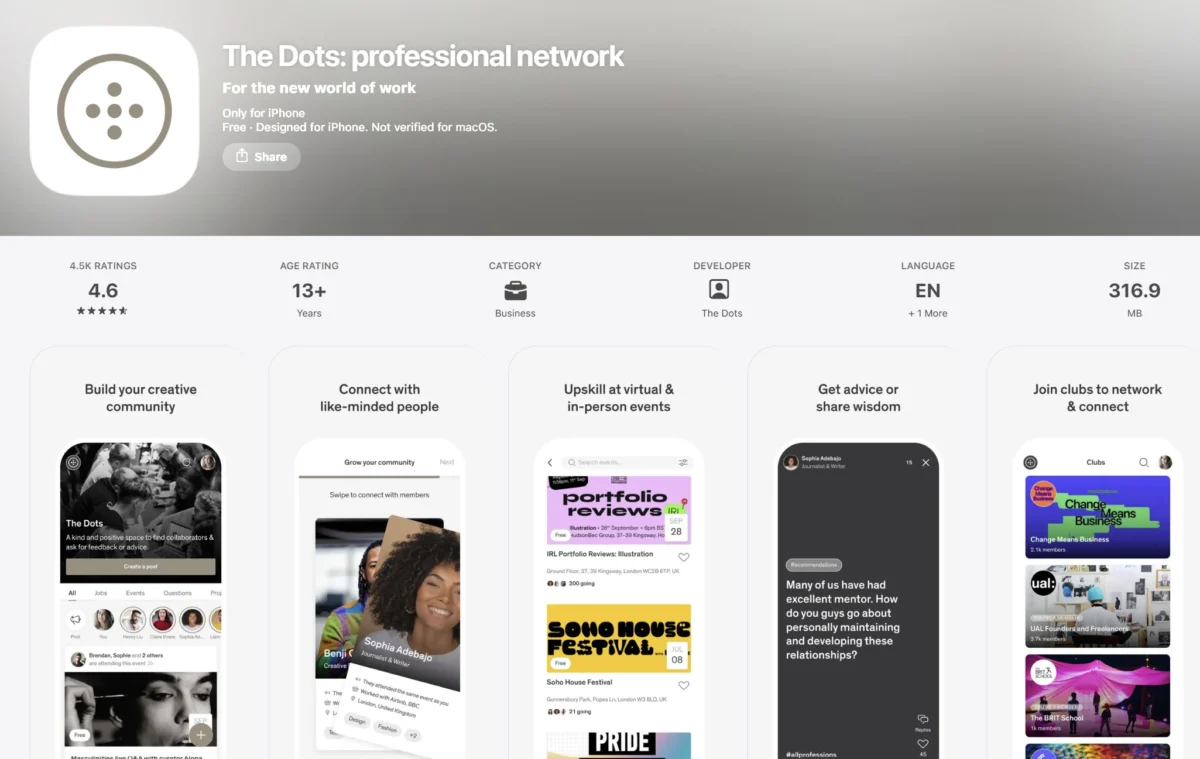
- Analysis: The Dots positions itself as a professional network for those who "don’t wear suits to work." It specifically caters to creative industries such including design, advertising, film, and fashion. Unlike generic platforms, The Dots emphasizes visual portfolios, allowing creative professionals to showcase their work as projects rather than just listing job titles. It fosters a vibrant community where members can connect, seek advice, find collaborators, and access industry-specific job listings and events. While globally accessible, its cultural and employer density is strongest in the UK, making it a powerful tool for London-based designers or media professionals, but requiring local verification for those in smaller markets.
-
ResearchGate: The Scientist’s Essential Nexus
- Best for: Scientists and academic researchers.
- What it replaces: Research identity, publications, peers, jobs.
- Main Catch: Almost no value outside research.
- Analysis: For the scientific and academic community, ResearchGate is indispensable. It centers professional identity around publications, research interests, citations, and collaborations, offering a level of specificity that LinkedIn cannot match. With over 25 million researchers and an index of 160 million publication pages, it provides a dedicated space for scientists to share work (where rights permit), track impact, ask questions, and discover scientific jobs. This platform perfectly illustrates how niche density can trump total size; a molecular biologist needs a network of relevant peers and literature, not a billion loosely connected profiles. It augments, rather than replaces, institutional academic pages and persistent identifiers.
-
Alignable: The Local Business Referral Engine
- Best for: North American small-business owners.
- What it replaces: Local referrals, groups, introductions, events.
- Main Catch: Not designed for conventional job seekers.
- Analysis: Alignable targets a distinct segment: small business owners in North America. Unlike LinkedIn, which often focuses on corporate hierarchies, Alignable facilitates local business connections for referrals, partnerships, and advice. With over 10 million business owners across 35,000 North American communities, it functions more like a digital chamber of commerce. It helps local accountants, agencies, photographers, or consultants find referral partners in their city, fostering trust and community engagement vital for small enterprises. While not a platform for conventional job seekers, it’s invaluable for entrepreneurs seeking to build a local network.
III. Dedicated Job Search Platforms: Beyond the Network
For many, "LinkedIn alternative" simply means "another place to find a job." These platforms prioritize job listings and application processes over broad social networking.
-
Indeed: The Universal Job Search Engine
- Best for: Broad job seekers.
- What it replaces: Job search, resume profile, employer research.
- Main Catch: It is not a professional social network.
- Analysis: Indeed is the pragmatic choice for comprehensive job searching. As one of the largest job aggregation sites globally, it brings millions of listings into one centralized place. Job seekers can create free accounts, upload resumes, set alerts, and research companies. Its strength lies in its sheer volume and accessibility, covering a vast spectrum of industries and job levels that professional networking sites might overlook. Indeed prioritizes the job application process, allowing users to focus on finding employment rather than maintaining a personal brand. However, it lacks the networking and relationship-building features of LinkedIn, operating purely as a job board.
-
Wellfound (formerly AngelList Talent): The Startup Ecosystem

- Best for: Startup candidates and hiring teams.
- What it replaces: Startup jobs, candidate profile, direct hiring contact.
- Main Catch: Narrow by design.
- Analysis: Wellfound is the definitive platform for those seeking opportunities within the startup ecosystem. Spun out from AngelList in 2022, it connects candidates directly with founders and hiring managers at over 27,000 startups. Its unique features include commonly exposing salary and equity information, which is often opaque on other platforms. Wellfound’s candidate network of over 10 million people specifically interested in startup roles ensures a highly curated talent pool. This targeted approach makes it invaluable for engineers, product managers, designers, and growth specialists looking for early-stage roles, but it is intentionally narrow, not catering to traditional corporate or public sector positions.
-
Handshake: Building Early Careers
- Best for: Students and recent graduates.
- What it replaces: Jobs, career events, peer and mentor network.
- Main Catch: Best when your education and employer ecosystem is active there.
- Analysis: Handshake addresses a critical gap: LinkedIn is often least effective for individuals with minimal professional experience. This platform is specifically designed for students, recent graduates, and those seeking internships or entry-level roles. It combines personalized job recommendations with career advice, virtual career fairs, and a network of peers and mentors. Handshake collaborates directly with universities and employers, integrating education and career services into the job search process. Its efficacy heavily relies on the engagement of the user’s educational institution and its employer partners, making it a powerful resource for launching a career when supported by an active ecosystem.
-
Jobcase: The Frontline Worker’s Network
- Best for: Hourly and frontline workers.
- What it replaces: Jobs, worker profile, groups, peer support.
- Main Catch: Primarily US-focused and job-centric.
- Analysis: Jobcase stands apart by focusing on a workforce often underrepresented on LinkedIn: hourly, frontline, service, logistics, retail, and skilled roles. It offers a unique blend of job search capabilities, worker profiles, community discussions, and an AI career coach. Visible job categories like cashier, truck driver, and stock clerk highlight its commitment to a broader definition of "professional." Jobcase functions more as a worker support network, allowing members to aggregate listings, seek advice from peers, and follow hiring activity. Predominantly US-focused, it serves as a vital resource for a significant segment of the labor market overlooked by more corporate-centric platforms.
IV. Showcasing Work & Freelancing: The Gig Economy’s Platforms
The rise of the gig economy and independent work has spurred platforms that integrate portfolios, project management, and payment processing.
-
Contra: Freelance Contracts, Commission-Free
- Best for: Freelancers and independent professionals.
- What it replaces: Portfolio, opportunities, contracts, payments.
- Main Catch: A work marketplace, not a full career network.
- Analysis: Contra offers one of the most comprehensive solutions for independent professionals, integrating the entire freelance workflow from showcasing work to getting paid. It allows users to create portfolios, describe services, browse opportunities, send proposals, manage contracts, invoice clients, and receive commission-free payments. While it does levy fees on the client side or for optional premium features, its "commission-free" model for freelancers is a significant draw, differentiating it from platforms that take a percentage of the freelancer’s earnings. Contra is particularly strong for design, writing, marketing, and software work that can be project-based and publicly showcased.
-
Behance: The Visual Creative’s Portfolio Powerhouse
- Best for: Designers and visual creatives.
- What it replaces: Portfolio discovery, follows, freelance and full-time work.
- Main Catch: Weak as a conventional CV or relationship graph.
- Analysis: Owned by Adobe, Behance remains a critical discovery platform for graphic design, photography, illustration, UI/UX, and other visual disciplines. Its core strength lies in centering the project rather than the person, allowing creators to let their work speak for itself. Users can follow creators, browse curated work, contact freelancers, and find jobs. Recent expansions have integrated freelance inquiries, proposals, and payments, transforming it from merely a gallery into a more complete work platform. While invaluable for showcasing visual talent, Behance is a weak substitute for a full career history or a broad relationship graph, as it prioritizes visual output over traditional resume details.
V. Community, Discussion & Audience Building: Beyond Formal Connections
Some alternatives emphasize authentic peer discussion, niche communities, and direct audience engagement, often leveraging less formal structures.

-
Meetup: Real-World Networking, Localized
- Best for: Local and in-person networking.
- What it replaces: Groups, recurring events, real-world relationships.
- Main Catch: Quality varies sharply by city and organizer.
- Analysis: Meetup excels where LinkedIn’s digital connections fall short: fostering real-world relationships. It connects individuals through local or online groups centered around shared interests, industries, skills, and professional development. The power of Meetup lies in repeated contact; attending the same well-run group multiple times builds trust and allows for genuine professional relationships to form, often more effectively than a flurry of online connection requests. Its effectiveness is highly dependent on local density and the quality of event organizers, meaning its value can vary significantly by city.
-
Reddit: Unfiltered Professional Dialogue
- Best for: Niche discussion and candid peer advice.
- What it replaces: Communities, reputation, professional discovery.
- Main Catch: Identity is often pseudonymous and networking is indirect.
- Analysis: Reddit, while not a professional network, offers unparalleled opportunities for candid professional discussions within its vast array of subreddits. Communities dedicated to programming languages, finance, law, medicine, specific career paths, or small businesses allow for a level of honesty and peer advice often absent on platforms where professional identities are meticulously curated. The pseudonymous nature can foster frank dialogue. Networking on Reddit is indirect and reputation-based; successful engagement comes from consistent, valuable contributions rather than direct solicitation. Its utility is in deep, niche engagement rather than broad professional outreach.
-
Substack: Owning Your Audience and Expertise
- Best for: Experts, consultants, writers, and analysts.
- What it replaces: Publishing, follower discovery, community, direct audience.
- Main Catch: Requires sustained publishing rather than profile maintenance.
- Analysis: Substack offers an alternative for professionals whose value lies in their expertise and ability to communicate it directly to an audience. It allows creators to publish articles, audio, and video content, building a direct relationship with subscribers. This strategic difference is crucial: unlike LinkedIn, which controls content distribution within its ecosystem, Substack empowers creators to own their content and subscriber list, ensuring that the audience relationship is portable and enduring. While it requires sustained publishing efforts, Substack is invaluable for building durable authority and monetizing intellectual capital, offering a powerful tool for thought leaders and consultants.
The Evolving Landscape of Professional Connection
The landscape of professional networking is undeniably diversifying. While LinkedIn’s overarching dominance remains unchallenged for broad professional utility, the emergence and maturation of specialized platforms signify a fundamental shift. Professionals are increasingly seeking tailored experiences that cater precisely to their industry’s nuances, their career stage, or their specific professional goals. This trend points to a future where individuals may leverage a "stack" of professional platforms—LinkedIn for general visibility, Peerlist for tech projects, The Dots for creative portfolios, Indeed for mass job searching, and Substack for thought leadership—each serving a distinct purpose more effectively than any single platform could.
This specialization fosters more authentic connections, more relevant content, and more efficient pathways to career and business opportunities within niche communities. As the digital world continues to fragment and personalize, the professional’s toolkit will likely grow to include a diverse array of platforms, each a powerful alternative for a specific slice of the professional pie, rather than a single replacement for the entire feast.