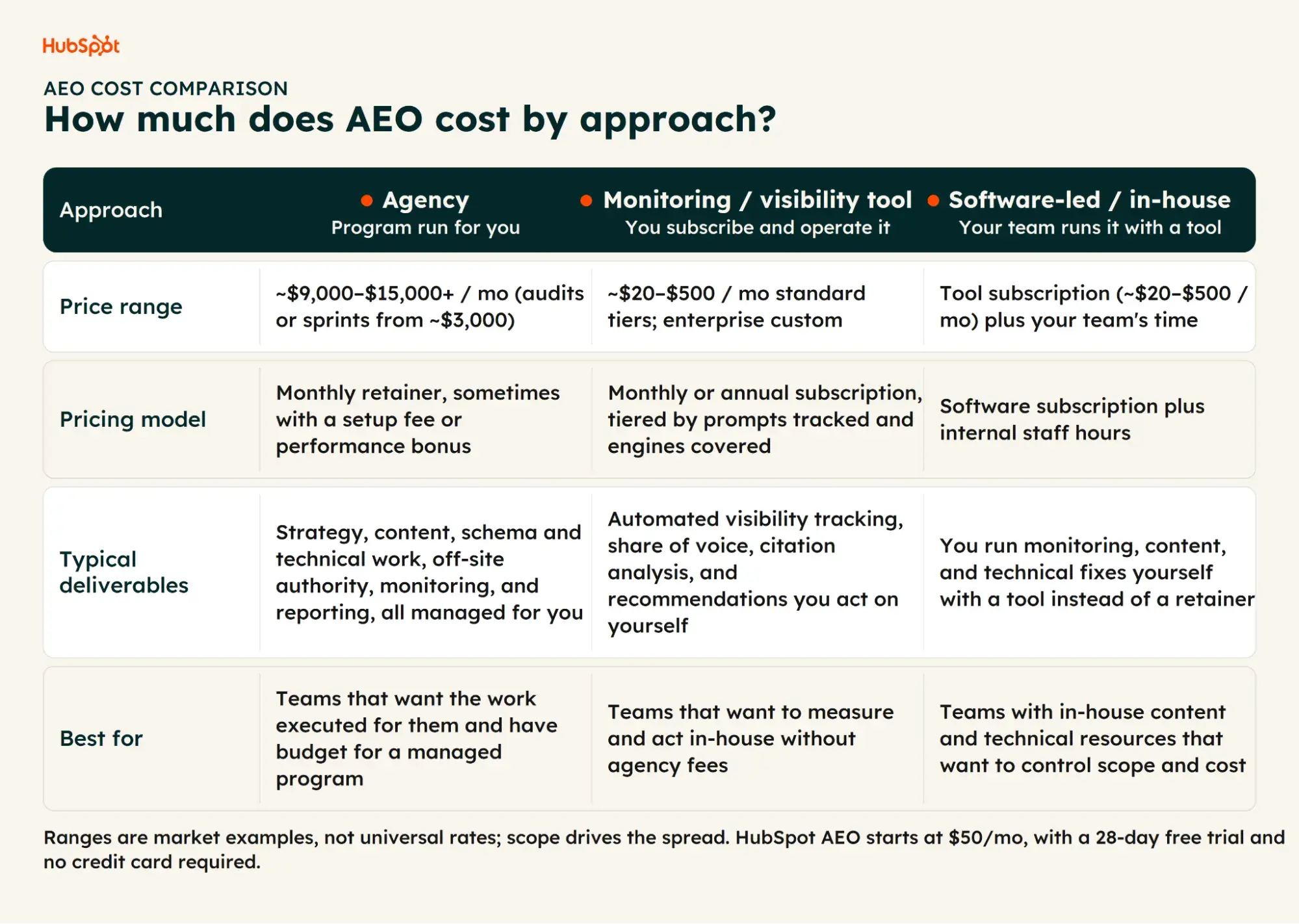
The financial commitment required for Answer Engine Optimization (AEO) exhibits a vast spectrum, ranging from approximately $30 per month for rudimentary self-service monitoring tools to upwards of $15,000 monthly for comprehensive, full-service agency programs that manage all facets of the optimization process. This wide divergence in pricing is primarily dictated by the scope of services procured and the depth of execution required, reflecting the nascent yet rapidly maturing nature of this critical digital marketing discipline. As businesses increasingly contend with the shift from traditional search engine results pages (SERPs) to AI-generated answers, understanding the cost implications of AEO becomes paramount for strategic allocation of marketing budgets.
The Emergence and Imperative of Answer Engine Optimization
AEO represents a specialized facet of digital optimization, distinct yet intrinsically linked to traditional Search Engine Optimization (SEO). While SEO focuses on enhancing website visibility and ranking in conventional search results to drive organic traffic, AEO aims to ensure a brand’s presence, authority, and accurate representation within the synthesized answers generated by artificial intelligence models like ChatGPT, Google Gemini, Perplexity AI, and other burgeoning conversational AI platforms. The rapid proliferation of these AI-powered answer engines has fundamentally altered how users seek and consume information, creating an urgent imperative for businesses to adapt their content strategies.
The journey from keyword-centric search to intent-driven AI answers has been swift. For decades, SEO dictated the rules of online visibility, emphasizing factors like keywords, backlinks, and technical site health to secure top organic rankings. However, with the advent of sophisticated Large Language Models (LLMs) and their integration into search interfaces, users are increasingly presented with direct, summarative answers rather than lists of links. These AI-generated responses often cite multiple sources to formulate their summaries, and for brands, being one of those cited sources is the new frontier of digital authority. This paradigm shift means that even if a brand’s website ranks highly in traditional search, it may remain invisible if its content isn’t optimized for AI summarization and citation. The demand for AEO services has thus surged, prompting a diverse market of tools and agencies to emerge, each offering varying levels of support and, consequently, disparate pricing structures.
Deconstructing AEO Costs Across Diverse Approaches
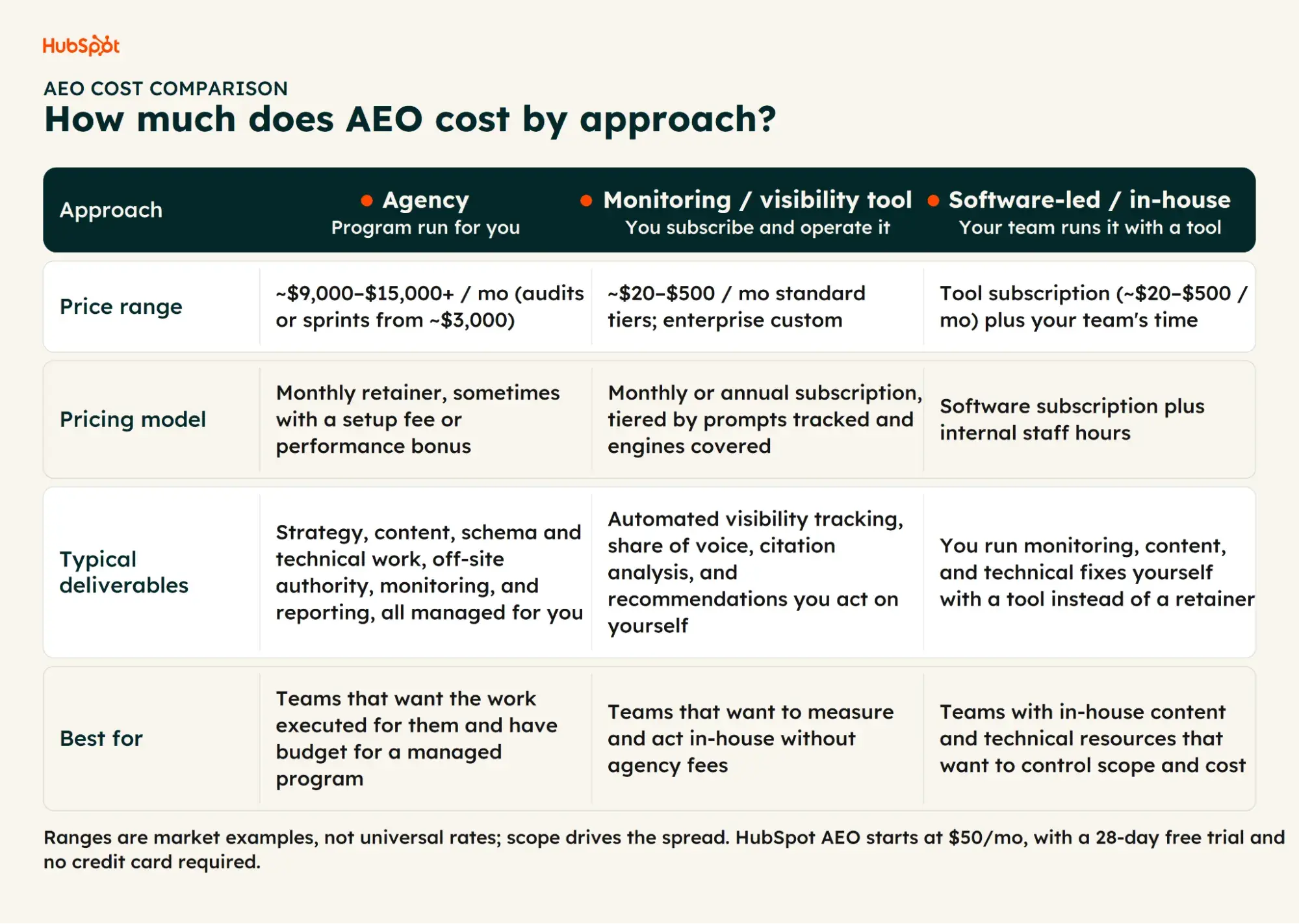
The cost of AEO is not a flat fee but rather a reflection of the chosen strategic approach, which can broadly be categorized into three primary models: specialized monitoring tools, in-house or software-led execution, and full-service agency partnerships. Each model caters to different organizational needs, internal capabilities, and budgetary constraints.
-
Monitoring and Visibility Tools:
At the most accessible end of the spectrum are AEO monitoring tools, designed to provide insights into how a brand’s content performs within AI answer environments. These tools typically track brand mentions, analyze citation patterns, measure share of voice against competitors, and often provide actionable recommendations for content optimization. Pricing for these self-serve solutions generally ranges from approximately $29 to $489 per month for standard tiers, with enterprise-level plans often custom-quoted. For instance, platforms like HubSpot AEO offer comprehensive tracking across multiple engines (ChatGPT, Gemini, Perplexity) for around $50 per month, while others like Profound begin at $99 per month for single-engine tracking, with multi-engine capabilities pushing costs to $399 per month or higher. Peec AI offers similar services starting from $95 per month. The cost usually scales with the number of prompts tracked, the variety of AI engines covered, and the depth of analytics provided. These tools are ideal for teams with existing content and technical resources who wish to manage their AEO efforts internally but require data-driven insights. -
Software-Led or In-House Execution:
This approach combines the use of AEO monitoring tools with internal team effort. Beyond just tracking, an in-house team leverages the insights from these tools to actively implement AEO strategies. This includes optimizing existing content for clarity, conciseness, and entity recognition, developing new content specifically tailored for AI summarization, implementing appropriate schema markup, and ensuring technical site health. The cost here encompasses the subscription fees for monitoring tools (as detailed above) plus the internal staff hours dedicated to strategy, content production, technical implementation, and reporting. While seemingly more cost-effective by avoiding agency retainers, this model necessitates a significant investment in skilled personnel – content strategists, writers, technical SEO specialists – who understand the nuances of AI content consumption. For organizations already using marketing platforms, AEO features might be integrated; for example, HubSpot AEO is included with Marketing Hub Professional and Enterprise subscriptions, offering a seamless workflow from insight to action within a unified platform. This approach offers maximum control over scope and cost but demands considerable internal expertise and bandwidth. -
Full-Service Agency Programs:
Representing the premium tier of AEO services, agencies offer a comprehensive, managed solution where external experts handle all aspects of a brand’s answer engine optimization. This can range from one-time audits or strategic sprints starting around $3,000, to ongoing monthly retainers typically ranging from $9,000 to over $15,000. High-end programs, such as RevenueZen’s Total Market package, exemplify the top tier at $15,000 per month or more, especially for custom, enterprise-level engagements. Agency services encompass strategy development, extensive content production (optimizing existing assets and creating new, AI-friendly content), technical AEO (schema implementation, entity disambiguation), off-site authority building (e.g., securing high-quality citations, managing knowledge panels), continuous monitoring, and detailed performance reporting. Agencies are best suited for organizations lacking the internal resources, expertise, or time to manage AEO effectively, providing a turnkey solution that can accelerate results. Payment structures often include monthly retainers, sometimes with an initial setup or audit fee, or increasingly, a hybrid model linking a portion of the payment to performance metrics.
Key Factors Driving AEO Pricing Variability
The significant price differential in AEO services is not arbitrary but systematically influenced by several critical factors that dictate the complexity and resource intensity of the work involved:
-
Scope of Services: This is arguably the most dominant factor. A basic package might only include monitoring and reporting, leaving implementation to the client. A mid-tier offering could add strategic consultation and some content optimization. A full-service agency, however, handles everything from initial audits and strategy formulation to content creation, technical fixes, off-site authority building, continuous monitoring, and detailed performance analysis. Each additional layer of service escalates the cost.

-
Volume and Complexity of Content: The size of a brand’s content library significantly impacts AEO efforts. A large website with thousands of pages requires extensive auditing, optimization, and ongoing maintenance to ensure AI readiness. Furthermore, the complexity of the industry and its terminology can influence content creation costs, as specialized knowledge is often required to produce accurate, authoritative, and AI-citable content.
-
Number of Answer Engines and AI Models Tracked: The AI landscape is fragmented, with multiple major players (ChatGPT, Gemini, Perplexity) and various industry-specific or custom LLMs emerging. Tracking brand visibility and performance across a broader array of these engines requires more sophisticated tooling and analytical effort, naturally increasing costs.
-
Competitive Intensity: Operating in highly competitive markets necessitates more aggressive and sophisticated AEO strategies. This can involve deeper competitive analysis, more extensive content development, and continuous adaptation to evolving AI algorithms, all of which contribute to higher service costs.
-
Depth of Reporting and Analytics: Basic monitoring tools might offer standard reports. However, advanced AEO programs provide custom dashboards, granular data analysis, competitive benchmarking, and detailed ROI attribution, connecting AEO efforts directly to business outcomes. Such comprehensive reporting requires more sophisticated platforms and expert analysis, leading to higher pricing.
AEO Pricing Models in Detail
Beyond the factors influencing cost, the method of billing also varies, offering different financial structures for businesses:
-
Retainer-Based: Predominantly used by agencies, this model involves a fixed monthly fee for a predefined set of ongoing services. It provides predictability for both the client and the agency, ensuring continuous support and strategic execution over time.
-
Subscription-Based: Standard for AEO software and monitoring tools, this model charges a recurring fee (monthly or annually) for access to the platform’s features, often tiered by usage limits (e.g., number of prompts tracked, features unlocked).
-
Project-Based/Audit Fees: For specific, time-bound deliverables such as an initial AEO audit, a content gap analysis, or a technical schema implementation sprint, a one-time project fee is common. This is useful for businesses seeking targeted interventions or proof-of-concept projects.
-
Hybrid (Retainer + Performance): An emerging model, particularly with agencies, where a base retainer is supplemented by performance-based incentives. This could involve bonuses for achieving specific increases in brand mentions, share of voice, or citations, aligning the agency’s financial interests more closely with the client’s results.
Budget Tiers and Corresponding AEO Deliverables
To facilitate budgeting, AEO services can be broadly grouped into three expenditure tiers, each offering distinct levels of engagement and deliverables:
-
Entry-Level (Under $100-$500/month): This tier is primarily dominated by self-serve monitoring tools. Businesses can expect automated tracking of brand mentions and citations across selected AI engines, basic share-of-voice analysis, and perhaps automated recommendations for content improvement. This is suitable for small businesses, startups, or larger organizations conducting initial pilot programs with limited resources, relying heavily on in-house teams for implementation.

-
Mid-Tier ($500-$5,000/month): At this level, options expand to include more advanced monitoring tools, potentially combined with limited agency support for specific projects, or dedicated internal staff leveraging these tools. Deliverables might include in-depth competitive analysis, regular strategic consultations, and potentially the optimization of a limited number of key content pieces. This tier suits growing businesses with some internal marketing capacity but who benefit from expert guidance or targeted outsourced execution.
-
Enterprise/Full-Service (Over $5,000-$15,000+ per month): This tier is characterized by comprehensive agency partnerships providing end-to-end AEO management. Services include sophisticated strategy development, large-scale content creation and optimization, extensive technical AEO implementation, proactive off-site authority building, continuous multi-engine monitoring, and detailed performance reporting with dedicated account management. This level is designed for large enterprises or brands in highly competitive sectors that require a fully outsourced, proactive, and aggressive AEO strategy to maintain market leadership.
It is crucial to emphasize that AEO expenditure should ideally complement, rather than replace, SEO investments. The two disciplines are synergistic; strong SEO performance often underpins AEO success by making content more discoverable and authoritative for AI models to cite.
AEO vs. SEO: A Symbiotic Relationship, Not a Zero-Sum Game
The distinction between AEO and SEO, while critical, should not lead to a false dichotomy in budgeting. Both disciplines are foundational for digital visibility, but they operate with different primary objectives and measurement metrics. SEO targets organic rankings, click-through rates, and impressions on traditional search result pages, writing content for human scanners of links. AEO, conversely, aims for brand citations and mentions within AI-generated answers, measured by share of voice and direct citations, with content needing to satisfy the AI engine first.
The relationship is inherently symbiotic: content that is well-optimized for SEO—meaning it is authoritative, credible, technically sound, and clearly structured—is inherently more likely to be selected and cited by AI answer engines. Research by Search Engine Land indicates that while AI referral traffic tripled from January 2025 to December 2025, it still constitutes less than 2% of total referral traffic in the studied dataset. This data underscores that while AI’s influence is growing rapidly, traditional search remains a dominant channel. Consequently, diverting all resources from SEO to AEO would be a strategic misstep, potentially eroding the foundational visibility that often feeds AI citations. A balanced approach, where AEO is integrated into a broader SEO strategy, ensures maximum digital reach.
Navigating the Emerging AEO Market: Red Flags to Avoid
Given the relative novelty of AEO, the market for services and tools is still maturing, leading to a lack of standardized pricing and practices. Businesses must exercise due diligence to avoid common pitfalls:
- Unrealistic Guarantees: Be wary of vendors promising guaranteed citations or specific ranking positions within AI answers. The non-deterministic nature of AI models means outcomes can vary, and no ethical vendor can make such absolute promises.
- Selling SEO as AEO: A common tactic is to rebrand traditional SEO services as "AEO" without offering specialized strategies for AI summarization, entity optimization, or multi-engine tracking. Scrutinize statements of work to ensure they explicitly address AI-specific deliverables.
- Lack of Transparency: Vague pricing structures, unclear deliverables, or a reluctance to detail methodologies are significant red flags. A reputable AEO provider will clearly outline what services are included, how success will be measured, and the underlying strategy.
- Excessive Long-Term Contracts for Pilots: For an evolving field like AEO, committing to multi-year contracts without first proving efficacy through a pilot program is risky. Opt for shorter terms or performance-based agreements, especially for initial engagements.
- Exaggerated ROI Claims: While AEO can deliver significant value, be skeptical of vendors presenting overly optimistic or unsubstantiated ROI projections without a clear methodology for attribution.
Budgeting for a Strategic AEO Pilot Program (60-90 Days)
A well-executed pilot program is indispensable for validating the efficacy of AEO for a specific brand before committing substantial long-term resources. The objective is to gather early signals of impact within a focused timeframe, typically 60 to 90 days.
-
Start Lean and Focused: Resist the temptation to launch a broad, resource-intensive campaign. Instead, anchor the pilot within the entry-level budget tier, primarily utilizing a monitoring subscription (e.g., $30-$50/month) potentially supplemented by a one-time diagnostic audit. Avoid heavy investments in content production or extensive off-site authority building during this initial phase, as these are long-term efforts whose full impact cannot be accurately assessed in a short window.
-
Prioritize High-Impact, Low-Cost Actions: For small teams or those with limited budgets, a strategic prioritization is crucial:
- Monitor and Baseline: Establish current brand mentions, share of voice, and citations across target AI engines (e.g., ChatGPT, Gemini, Perplexity) in week one.
- Technical Foundations: Ensure core content is technically sound, with clear schema markup, structured data, and well-defined entities that AI models can easily parse and understand.
- Content Refinement: Focus on optimizing existing high-value content for clarity, conciseness, and direct answer potential, particularly for frequently asked questions in the brand’s niche.
-
Define and Track Core AEO Metrics: Success in AEO is measured differently than in SEO. Key performance indicators (KPIs) for a pilot should include:
- Brand Mentions: How often the brand is directly named in AI answers.
- Share of Voice (SOV): The brand’s proportion of mentions relative to competitors for specific prompts or topics.
- Citations: The frequency with which the brand’s content is explicitly referenced as a source by AI models.
Track these metrics consistently against the established baseline, observing trends over time rather than isolated snapshots, given the non-deterministic nature of AI outputs.
-
Leverage Free Trials and Cost-Effective Tools: To minimize initial outlay, exploit free trials offered by AEO monitoring platforms. HubSpot AEO, for instance, provides a 28-day free trial that tracks 25 prompts across multiple major AI engines without requiring a credit card. This allows for nearly a month of free monitoring, covering a significant portion of a short pilot program’s tracking needs. Post-trial, its $50/month cost means a three-month pilot’s monitoring costs a mere $100, providing continuous visibility into brand mentions and citation trends.
Should the pilot yield positive signals, AEO can then be integrated into the broader marketing strategy and recurring SEO budget planning, transitioning from an experimental project to a core component of digital visibility.
HubSpot AEO’s Role in the Cost Conversation
Once the initial pilot phase confirms the value of AEO, the subsequent challenge for many organizations is scaling measurement and implementation effectively. This is where a software-led approach, exemplified by platforms like HubSpot AEO, becomes particularly relevant.
HubSpot AEO is designed to fill the critical gap between identifying the need for AEO and executing a data-driven strategy. It provides comprehensive visibility tracking across ChatGPT, Gemini, and Perplexity, pinpointing instances where competitors are cited instead of the brand. Beyond simple monitoring, the platform analyzes which domains and content types are frequently referenced by AI engines within a specific category, then generates a prioritized list of actionable recommendations for optimization. This measurement-first methodology was developed from HubSpot’s own internal AEO strategy, documented in their CRM AI-search case study, demonstrating its practical application and effectiveness.
Available as a standalone product for $50 per month, HubSpot AEO offers robust visibility tracking, citation analysis, competitor benchmarking, and actionable recommendations. For existing users of HubSpot Marketing Hub Professional or Enterprise, AEO capabilities are seamlessly integrated at no additional cost, allowing for a unified approach where AI visibility insights are directly connected to CRM data and content creation tools. This integration empowers teams to not only identify AEO opportunities but also to execute on them efficiently within a familiar ecosystem.
Frequently Asked Questions About AEO Cost and Strategy
-
Is AEO different from SEO, and do I need both? Yes, they are distinct but complementary. SEO focuses on ranking web pages in traditional search results, while AEO aims to get your brand cited within AI-generated answers. Both are crucial, as strong SEO often contributes to AEO success by making content more authoritative and discoverable for AI models. Neglecting one can weaken the other.
-
Can I manage AEO myself with just monitoring tools? Partially. Monitoring tools provide essential data on your brand’s AI visibility and highlight areas for improvement. However, they don’t automate the implementation of fixes. Your internal team or an outsourced agency will still be responsible for content optimization, technical schema work, and off-site authority building based on the insights provided by the tools.
-
How long does it take to see results from AEO? Initial signals, such as increased brand mentions or a slight improvement in share of voice, can typically be observed within 60 to 90 days of a focused pilot program. However, comprehensive content optimization and off-site authority building are slower-moving processes, with their full impact compounding over six months to a year or more. Due to the non-deterministic nature of AI answer engines, tracking trends over time is more reliable than relying on single snapshots.
-
What should be included in an AEO statement of work (SOW)? A robust AEO SOW should be specific, detailing deliverables rather than vague promises. Key inclusions should be the number of prompts to be tracked, the specific AI engines covered, the volume of content to be produced or optimized, any schema or entity work, the scope of off-site authority building, and the frequency and format of reporting. Also, clarify contract term lengths, as some agencies require a minimum of three months.
-
How should a small team budget for AEO? Small teams should adopt a lean, phased approach. Begin with a cost-effective monitoring subscription (e.g., $30-$50/month) and potentially a one-time audit to identify quick wins. Prioritize fixing high-value, low-cost gaps in existing content and technical setup. Defer large-scale content creation or extensive off-site work until early positive signals confirm the value of AEO efforts. Leveraging free trials, such as HubSpot AEO’s 28-day offer, can also significantly reduce initial investment while providing valuable insights.
In conclusion, the cost of AEO is a dynamic reflection of the chosen strategy, the depth of services, and the evolving landscape of AI-driven search. By carefully evaluating internal capabilities, understanding the various pricing models, and prioritizing a strategic pilot program, businesses of all sizes can effectively navigate this new frontier of digital visibility and secure their brand’s presence in the era of answer engines.


 Nana Wu
 Nana
Nana