The rapid proliferation of artificial intelligence (AI) in search and content generation has fundamentally reshaped the digital marketing landscape, ushering in a new era where traditional search engine optimization (SEO) metrics are no longer sufficient. Marketing teams are increasingly seeking AI visibility platforms that transcend basic monitoring, offering capabilities to bridge citation gaps, integrate AI search data with CRM attribution, and streamline content workflows across diverse regions. As of 2026, the market for these advanced AI Optimization (AEO) tools is robust, with several contenders vying for leadership. This analysis delves into the critical features, strengths, and limitations of leading Peec AI alternatives, offering a strategic guide for marketers navigating this complex and rapidly evolving domain.
The Paradigm Shift in Digital Discovery
For decades, Google’s search engine results pages (SERPs) dictated the rules of online visibility. Marketers meticulously tracked keyword rankings, organic traffic, and click-through rates, optimizing content to appear prominently in a predictable, link-driven ecosystem. However, the advent of sophisticated AI answer engines like ChatGPT, Google Gemini, and Perplexity has shattered this established framework. Buyers are no longer solely "Googling" their queries; instead, they are engaging in conversational AI interfaces, prompting these systems for synthesized recommendations, product comparisons, and expert opinions before ever visiting a vendor’s website. This profound shift necessitates a new approach to brand visibility—one that focuses on how frequently and favorably a brand is cited within AI-generated responses.
Peec AI emerged as one of the early players in this new frontier, specializing in AI visibility monitoring. It tracks a brand’s presence, positioning, and sentiment within AI-generated answers across multiple models. While adept at surfacing where a brand appears (or doesn’t), the core challenge for many marketing and revenue operations (RevOps) teams lies in moving beyond mere observation to actionable strategies that demonstrably contribute to the pipeline and revenue. This gap between monitoring and measurable business impact has fueled the demand for more comprehensive AEO platforms.
Understanding AI Visibility Monitoring and Peec AI’s Role
AI visibility monitoring, sometimes referred to as AI brand monitoring, is the systematic practice of observing and analyzing how a brand, its products, and key personnel are represented in the output of AI answer engines. Unlike traditional rank tracking, which focuses on a page’s position on a SERP, AI visibility measures presence, context, and citation. It assesses whether an AI system has incorporated a brand into its synthesized answer, the location of that mention within the response, and the overall sentiment (favorable, neutral, or negative).
Peec AI excels in this foundational monitoring aspect, operating across numerous AI models simultaneously. Its strength lies in providing a detailed "share-of-voice" metric for AI-generated answers, moving beyond simple ranking positions to a nuanced understanding of brand prominence in conversational AI. A particularly valuable feature is its citation analysis capability. If an AI recommends a competitor over a user’s brand for a specific query, Peec AI’s Source Identification feature can pinpoint the underlying sources (third-party reviews, comparison pages, documentation) that informed the AI’s conclusion. This diagnostic capability offers content and SEO teams a prioritized roadmap for content creation and optimization, enabling them to reverse-engineer AI recommendations. This focus on the "citation layer" is critical, as AI search engines are increasingly reshaping how marketing teams define and build authority.
However, despite its strengths, Peec AI exhibits certain limitations that prompt the exploration of alternatives. Its primary shortcomings include:
- Remediation: While Peec AI identifies opportunities, it doesn’t offer native tools for content generation, brief creation, or automated publishing workflows. Teams must rely on external resources to act on the insights.
- Attribution: A significant constraint for RevOps-minded teams is the lack of native CRM integration. Visibility data remains siloed within Peec AI’s dashboard, requiring manual export and complex, custom attribution models to connect it to pipeline and revenue.
- Historical Data: Tracking commences upon subscription, without the ability to backfill historical data. This impedes benchmarking against past performance or understanding long-term AI visibility trends.
- Platform Coverage and Prompt Methodology: While covering popular engines, Peec AI’s reliance on AI-generated queries rather than real user prompts can impact accuracy and comprehensiveness, and its coverage of emerging answer surfaces may be less extensive than some competitors.
These limitations highlight a growing market demand for AEO platforms that not only provide insights but also facilitate action and integrate seamlessly into broader marketing and sales ecosystems.
Essential Criteria for Evaluating AEO Platforms in 2026
-1.png)
Selecting the right AEO platform requires a refined evaluation framework, moving beyond superficial feature comparisons. The most impactful tools address core challenges faced by marketing teams, bridging the gap between data and revenue. Key buyer criteria that truly matter include:
- Native CRM Attribution: The ability to automatically connect AI visibility data to contact records, deal stages, and campaign performance within a CRM, eliminating manual data reconciliation.
- Content Remediation & Generation: Tools that move beyond mere identification of citation gaps to offer integrated solutions for content briefing, drafting, and publishing.
- Real User Prompt Datasets: Platforms that analyze actual user queries to generate insights, ensuring that visibility data reflects genuine buyer intent rather than synthetic prompts.
- Multi-Engine & Multi-Region Coverage: Comprehensive monitoring across a broad spectrum of AI answer engines (ChatGPT, Gemini, Perplexity, Claude, etc.) and support for global, multi-language content strategies.
- Diagnostic Depth: Capabilities that explain why a brand is (or isn’t) cited, such as fan-out query visibility (showing what AI searches for before answering) or AI crawler analytics.
- Enterprise Security & Compliance: For larger organizations, features like Single Sign-On (SSO), role-based access control, and data residency options are non-negotiable.
- Scalability & Workflow Integration: The capacity to manage AEO programs across multiple brands, large content libraries, and integrate with existing content management systems (CMS) and marketing automation platforms.
Leading Peec AI Alternatives: A Side-by-Side Analysis
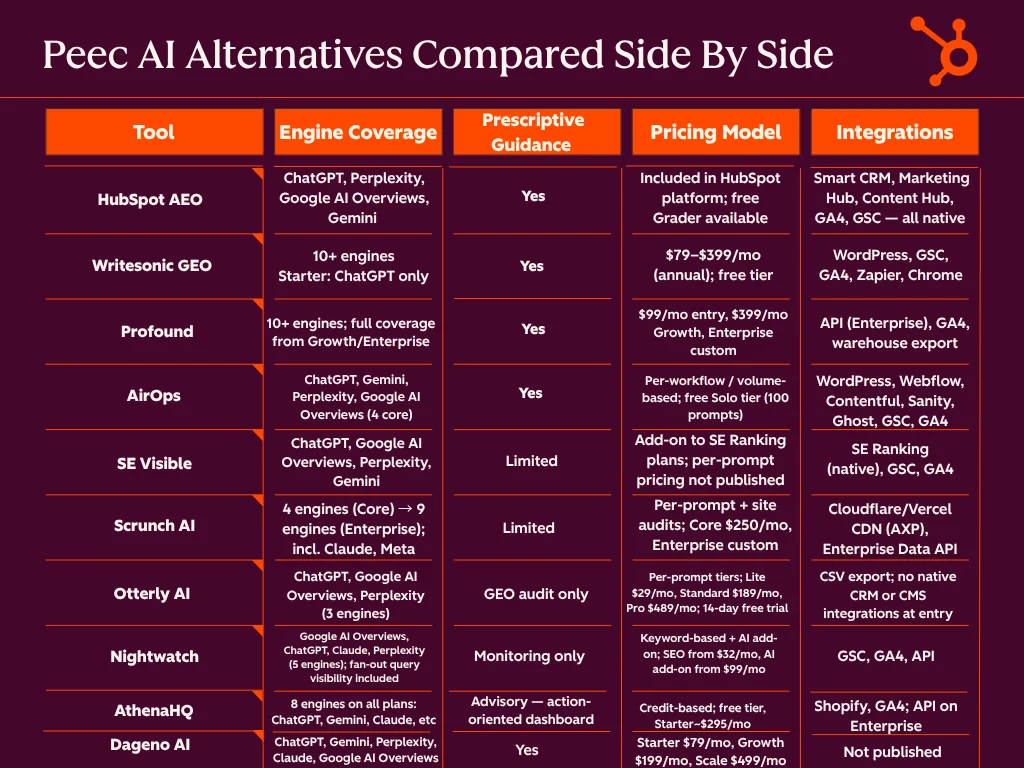
The market for Peec AI alternatives is diverse, with each platform addressing specific pain points or catering to particular organizational needs.
1. HubSpot AEO: Best for CRM-Native AI Visibility
- Target Audience: B2B marketing and RevOps teams focused on connecting AI visibility directly to sales pipeline and revenue.
- Core Strengths: Unique for its native integration within HubSpot’s Smart CRM. It tracks brand mentions, citation rates, and competitive benchmarks, surfacing this data alongside contact records, deal stages, and campaign performance. This eliminates the need for custom integrations, providing immediate context for sales teams on how prospects were influenced by AI search. The attribution loop is closed by default.
- Limitations: Currently in beta, meaning some monitoring depth and multi-engine coverage might be less extensive than specialist platforms.
- Key Differentiator: The seamless, out-of-the-box connection between AI visibility and CRM data for quantifiable ROI.
2. Writesonic GEO: Best for Prescriptive Optimization and Content Generation
- Target Audience: Teams whose primary bottleneck is the execution of content to address visibility gaps.
- Core Strengths: Offers an end-to-end solution combining AI visibility monitoring with robust content generation capabilities. When a citation gap is identified, teams can immediately generate content or briefs within the same platform.
- Limitations: The monitoring layer is newer compared to dedicated trackers, and entry-plan engine coverage may be narrower.
- Key Differentiator: Its integrated approach to identifying gaps and facilitating immediate content creation, fostering a compounding advantage for active content operations.
3. Profound: Best for Enterprise Analytics, Security, and Real User Data
- Target Audience: Enterprise marketing teams, large agencies, and organizations with stringent security requirements where AI recommendations directly influence significant revenue.
- Core Strengths: Comprehensive feature set including brand mentions, citations, sentiment, and prompt volume data across 10+ AI platforms. Boasts the largest prompt dataset figures (1.5B+ real user prompts), ensuring high data credibility. Its "Agents" feature can create AEO-optimized content at scale with human-in-the-loop review. Offers enterprise-grade security (SSO, role-based access).
- Limitations: High price point, making it overkill for smaller teams or nascent AEO programs.
- Key Differentiator: Unparalleled data depth from real user prompts combined with enterprise security and content creation capacity, providing both measurement credibility and execution power.
4. AirOps: Best for Agencies and Multi-Site Content Operations
- Target Audience: Content operations teams and agencies managing numerous brands or extensive content libraries.
- Core Strengths: A content operations platform with AEO research and visibility analysis. Insights track citation rate, mention rate, and sentiment, while Page360 integrates with Google Search Console and GA4. Its "Quill" (Playbooks) feature allows for researching, drafting, and direct publishing to popular CMS platforms (Webflow, WordPress, Contentful).
- Limitations: Tracking depth is newer than dedicated monitors; teams focused purely on measurement might find production capabilities redundant.
- Key Differentiator: Streamlined agency workflow design, allowing templated playbooks and direct CMS publishing for operational leverage across multiple clients.
5. SE Visible (by SE Ranking): Best for Unified SEO + AEO
- Target Audience: Teams already leveraging SE Ranking for traditional SEO who seek integrated AI visibility without additional subscriptions.
- Core Strengths: Integrates AI overview tracking into the existing SE Ranking ecosystem, providing 13+ years of historical SEO context alongside new AI capabilities. Offers unlimited seats across all plans, removing cost barriers for growing teams.
- Limitations: AI visibility data is relatively newer compared to SE Ranking’s established SEO features, potentially less developed than pure-play AEO tools.
- Key Differentiator: Provides a single platform for both traditional SEO and emerging AEO, offering comparative benchmarking with historical SEO data.
6. Scrunch AI: Best for Enterprise AI Crawler Analytics
- Target Audience: Enterprise brands and agencies requiring deep AI crawler analytics in addition to standard visibility tracking.
- Core Strengths: Extends beyond standard brand visibility to include AI crawler analytics, demonstrating how AI bots interact with a site before generating answers. Its Agent Experience Platform (AXP) can automatically serve AI-optimized content to agents without affecting the human-facing site. Covers multiple answer engines, with API access on enterprise plans.
- Limitations: Significant entry price point; content generation layer is less developed than Writesonic or AirOps.
- Key Differentiator: Provides unique diagnostic capability by showing AI inputs (how bots crawl and read) rather than just outputs, invaluable for technical SEO teams.
7. Otterly AI: Best for Low-Cost Entry and SMBs
- Target Audience: Startups, SMBs, solo founders, and teams exploring AEO without a large budget commitment.
- Core Strengths: Most affordable credible entry point ($29/month), tracking brand mentions and citations across multiple answer engines. Includes a GEO audit feature with fix-it checklists for basic optimization.
- Limitations: Narrower engine coverage compared to top-tier tools; no CRM integrations at entry price points.
- Key Differentiator: Provides real monitoring capabilities at a highly accessible price, ideal for establishing a baseline before larger investments.
8. Nightwatch: Best for Diagnosing "Why You’re Not Appearing"

- Target Audience: Teams seeking to understand the AI reasoning process and those for whom traditional rank tracking remains a primary concern.
- Core Strengths: Most affordable option including "fan-out query visibility," which reveals the real-time web searches AI systems conduct before composing answers. Covers Google AI Overviews, ChatGPT, Claude, and Perplexity.
- Limitations: Narrower engine coverage than enterprise alternatives; AI tracking as an add-on can feel fragmented.
- Key Differentiator: Provides deep diagnostic insights into the AI’s information retrieval process, explaining why citations are missed, not just that they are.
9. AthenaHQ: Best for Budget-Constrained Entry and Proof-of-Concept
- Target Audience: Early-stage AEO programs, teams evaluating AEO for the first time, or those needing a proof of concept to secure budget.
- Core Strengths: Offers a free entry point, making it highly accessible for demonstrating value before a financial commitment. Functions as a brand intelligence tool with AI visibility capabilities (mentions, citations, competitive share of voice).
- Limitations: Lacks auditing and optimization capabilities; limited enterprise-grade security. It serves as a starting point rather than a long-term, comprehensive solution.
- Key Differentiator: Low-friction entry allows teams to build a data-driven business case for AEO investment without upfront costs.
10. Dageno AI: Best for Full-Workflow GEO Execution (Emerging)
- Target Audience: Teams seeking to integrate monitoring, strategy, content generation, and attribution within a single platform without immediate enterprise pricing.
- Core Strengths: Ambitious scope for its price point, aiming for a full workflow from data monitoring to strategy, content generation, and result attribution. Focuses on connecting content actions to visibility outcomes and ultimately ROI.
- Limitations: As a newer, less established tool, its breadth of claims means the depth of each capability is still developing. Feature maturity should be verified during trials.
- Key Differentiator: Aims to provide a comprehensive, integrated workflow at a mid-market price point, bridging the gap between monitoring and execution with an attribution layer.
Connecting AI Visibility to Revenue in Your CRM
The ultimate value of any AEO program hinges on its ability to translate visibility into measurable revenue. The most common pitfall is treating AI visibility data as an isolated metric, residing in a dashboard that remains disconnected from core business outcomes. To truly monetize AI visibility, marketers must integrate it into their attribution models.
A practical approach involves:
- Traffic Attribution: Implement robust tracking to correctly tag AI-sourced traffic. Since many AI answer engines do not consistently pass standard referrer data, often resulting in "dark traffic" (appearing as "direct" in analytics), customized UTM parameters for AI campaigns are essential. Configure channel groupings in GA4 to capture known AI referrer patterns (e.g., perplexity.ai, chatgpt.com) and ensure the CRM (like HubSpot’s Smart CRM) captures this source at contact creation.
- Standardized UTM and Tracking: Establish a consistent UTM taxonomy across all AEO content. Every piece of content published as part of an AEO workflow should include campaign parameters that map back to the specific AI visibility gap it was designed to address. This creates a clear lineage from "tool X identified a citation gap for query Y" to "content Z was published, generating N pipeline-influenced contacts."
- CRM Integration for ROI: Utilize CRM functionalities to create custom properties (e.g., "AI Visibility Initiative") and populate them via workflow automation when UTM parameters match AEO campaign taxonomies. This allows every deal in the pipeline to carry a signal about whether AI visibility work contributed. Building CRM dashboards that filter contacts by lifecycle stage, deal stage, and revenue, specifically for "originated from AI search," fundamentally shifts budget conversations with leadership, demonstrating tangible ROI.
From Monitoring to Action: Content and AI Workflows
Monitoring without subsequent action is an inefficient allocation of resources. Effective AEO programs integrate monitoring with a scalable content and workflow infrastructure. A repeatable six-step cycle for AEO includes:
- Query Clustering: Group tracked prompts into thematic clusters (e.g., product comparisons, use cases). AI SEO tools can accelerate this by surfacing related query patterns.
- Citation Gap Analysis: For underperforming clusters, identify the sources AI currently cites (third-party reviews, competitor documentation, industry publications). Each source type dictates a different content strategy.
- Entity and Schema Hygiene: Ensure accurate and consistent representation of your brand, products, and key personnel in structured data. AI systems heavily rely on entity disambiguation, making a strong entity profile crucial.
- Answer-First Content Creation: Prioritize content that directly answers the target query at the outset, followed by context. AI systems favor immediate utility, making lengthy preambles detrimental to citation likelihood.
- Comparison and Alternative Formats: Content structured as comparisons (e.g., "X vs. Y," "Best alternatives to X") consistently garners higher AI citation rates, directly addressing commercial investigation queries.
- Measurement and Refresh: Track citation rate changes post-publication. A content piece earning its first AI citation within approximately 37 days (the median for ChatGPT and Claude, according to Profound’s research) indicates effectiveness. Uncited content beyond this window warrants investigation for technical issues or content thinness.
For managing AEO programs at scale, leveraging a Content Hub (such as HubSpot’s) provides essential workflow infrastructure: content briefs linked to campaign objectives, approval workflows, and a centralized asset library. Pairing this with AI-assisted drafting tools can significantly accelerate the research-to-draft cycle, especially for structured comparison and FAQ content. This creates a closed loop: detect a gap, brief it, draft it, publish it, and measure citation rate improvement within a single, connected stack.
Pricing Models and Value Considerations for AEO Platforms
The pricing landscape for AEO tools is fragmented, necessitating careful evaluation beyond sticker price. Understanding the underlying models is crucial for effective negotiation and avoiding unnecessary expenditure.
- Per-Prompt Pricing: Common among dedicated AEO tools, where users pay for a set number of prompts. The risk is that prompt volume, a technical constraint, may not align with intuitive business metrics, often leading teams to exceed their initial plan.
- Per-Seat Pricing: A traditional SaaS model that can lead to cost escalation for agencies and larger cross-functional teams, as each user requiring dashboard access adds to the monthly fee.
- Unlimited Seat Models: Offered by platforms like SE Visible (and Peec AI on higher tiers), these eliminate friction, making them ideal for democratizing dashboard access across larger teams.
- Legacy SEO Platform Add-ons: Tools like Semrush AI Toolkit or Nightwatch’s AI add-on layer AI tracking onto existing SEO subscriptions, often priced by traditional units (keywords, articles). While offering consolidation, the AI component may be less developed than dedicated AEO solutions.
When evaluating pricing, key comparison points include prompt volume at each tier, the number of AI engines covered, and whether seat pricing is unlimited. These factors significantly influence the total cost of ownership. During negotiations, vendors should be pressed for clarity on data retention policies, the distinction between real user prompts and synthetic queries, the ability to customize AI models for specific industry contexts, and the exact methodology for measuring citation rates and sentiment.
.png?width=650&height=488&name=White%20Simple%20Comparison%20Graph%20(2).png)
AEO and GEO Best Practices for Maximizing ROI
Regardless of the chosen platform, the tool’s efficacy is directly proportional to the AEO program built around it. Best practices include:
- Query Clustering and Intent Mapping: Group prompts by intent (navigational, informational, commercial investigation), prioritizing commercial queries for their higher value.
- Entity and Schema Hygiene: Maintain consistent brand, product, and personnel definitions across all digital properties and structured data.
- Answer-First Content Structure: Lead pages with direct answers to target queries to enhance utility for AI systems.
- Consistent Brand Descriptors: Use specific, indexable language to describe your brand and products, avoiding vague marketing jargon.
- Comparison and Alternative Formats: Structure content as comparisons to directly address common commercial investigation queries, leading to higher citation rates.
- Regular Testing and Refresh Cadence: Implement a 90-day refresh cycle for high-priority pages, as AI training data and citation preferences evolve.
- Validation with Owned Data: Cross-reference AEO tool data with GA4, Search Console, and CRM data to ensure consistency and validate true impact on AI-referred traffic.
Frequently Asked Questions About Peec AI Alternatives
Is there a low-cost Peec AI alternative worth testing first?
Yes, Otterly AI ($29/month, 14-day free trial) and AthenaHQ (free entry tier) offer credible starting points for establishing a measurement baseline without significant financial commitment. Nightwatch also provides an affordable AI tracking add-on. For teams that outgrow these standalone monitoring tools, HubSpot AEO provides a seamless migration path by consolidating visibility tracking and attribution within an existing CRM.
Which Peec AI alternatives provide actual optimization recommendations?
Writesonic GEO and AirOps offer the most actionable optimization workflows by integrating gap identification with content creation tools. Profound’s Agents feature creates AEO-optimized content at scale. Otterly AI provides fix-it checklists based on its GEO audit. Tools that stop at dashboards (like Scrunch AI, AthenaHQ, and Peec AI itself) require teams to devise solutions independently.
How do I validate the accuracy of AI visibility data?
Cross-reference AEO tool data with independent sources: GA4 for AI-referred sessions, Search Console for AI Overview impression data, and manual spot checks by running prompts directly in AI engines. Crucially, ascertain whether the tool uses real user prompts or synthetic queries, as synthetic prompts can distort visibility metrics. Profound’s published prompt methodology and dataset size serve as an industry benchmark for data credibility.
Do these tools integrate with CRM and analytics for attribution?
Native CRM integration is rare, with HubSpot AEO being a notable exception, built directly into HubSpot’s Smart CRM for seamless data flow. AirOps connects to Google Search Console and GA4. Profound and Scrunch AI offer API access for custom CRM integrations on enterprise plans. For most other tools, manual CSV exports or Zapier-compatible webhooks are the primary integration methods. Connecting any AEO tool to a Smart CRM via API or Zapier, using custom contact and deal properties to tag AI-sourced leads, is the most reliable approach for robust attribution.
What’s the best Peec AI alternative for multi-language brands?
Peec AI itself is strong in multi-country and multi-language tracking. Among alternatives, Profound and Scrunch AI support multi-region tracking on their enterprise tiers. SE Visible leverages SE Ranking’s established multi-language keyword infrastructure. For global brands, the key is to ensure multi-language support is native to the core platform rather than a bolt-on, for more reliable cross-market reporting.
Conclusion
The selection of a Peec AI alternative is a strategic decision that must align with an organization’s specific program maturity and immediate challenges. For seamless CRM attribution and pipeline connection, HubSpot AEO stands out as the only platform offering native integration. Teams struggling with content production will find Writesonic GEO and AirOps invaluable for their integrated monitoring and creation capabilities. Enterprises prioritizing deep analytics, security, and real user data should consider Profound. For diagnostic depth and understanding the "why" behind AI citations, Nightwatch offers unique insights. Finally, for budget-conscious teams or those needing a proof of concept, Otterly AI and AthenaHQ provide credible starting points. The overarching trend indicates that tools facilitating action and measurable ROI beyond mere dashboards will ultimately drive the most significant program value in the rapidly evolving landscape of AI search.