Ammar Sabilarrohman
The digital marketing landscape in 2026 has reached a critical inflection point where the distinction between a "polished" digital presence and a "messy" one directly dictates a brand’s bottom line. Industry experts from Unbounce, including Luke Bailey, Colin Loughran, and Paul Park, have codified a foundational principle for modern commerce: professional landing page design is no longer a luxury but a strategic necessity for conversion rate optimization (CRO). As marketing budgets face increased scrutiny, the transition from generic homepages to high-performance, standalone landing pages has become the standard for successful advertising and email campaigns.

The Strategic Anatomy of a Modern Landing Page
A landing page is defined as a standalone web page created specifically for a marketing or advertising campaign. Unlike a traditional homepage, which serves as a general-purpose hub for navigation and brand exploration, a landing page is architected for a singular objective. This objective, often referred to as a "Call to Action" (CTA), focuses on converting visitors into leads or customers by eliminating the distractions typical of a broader website.

Data suggests that the inclusion of video elements on these pages can increase conversion rates by as much as 86%. This shift toward multimedia engagement is a cornerstone of the 40 best examples identified by industry analysts, which span sectors from Software as a Service (SaaS) and healthcare to niche ecommerce and professional services.
Chronology of Landing Page Evolution: From Static to Dynamic
The evolution of the landing page can be traced through three distinct eras of digital marketing:

- The Early Digital Era (1995–2010): Marketing pages were largely text-heavy and served as digital brochures. Conversion tracking was rudimentary, and design was limited by slow connection speeds and primitive HTML.
- The Optimization Era (2010–2020): The rise of drag-and-drop builders, such as Unbounce, democratized high-quality design. Marketers began prioritizing mobile responsiveness and A/B testing, moving away from "gut feeling" toward data-driven decisions.
- The Personalization Era (2020–2026): Current standards demand hyper-relevant, "polished" experiences. Modern pages utilize AI-driven insights, dynamic text replacement, and ultra-high-resolution visuals to provide a seamless transition from the initial advertisement to the final conversion.
Analysis of Top-Performing Industry Examples
SaaS and Entertainment: The Netflix and Spotify Models
Netflix and Spotify represent the pinnacle of "low-friction" design. Netflix’s strategy focuses on a clear value proposition—unlimited entertainment for a fixed monthly price—presented through a simple, high-contrast interface. With over 300 million subscribers globally, Netflix’s landing page avoids complexity, utilizing a single field for email entry to minimize the psychological barrier to entry. Similarly, Spotify leverages its universal brand recognition to skip lengthy descriptions, focusing instead on the immediate "streaming" experience.

Health and Wellness: Calm and Goby
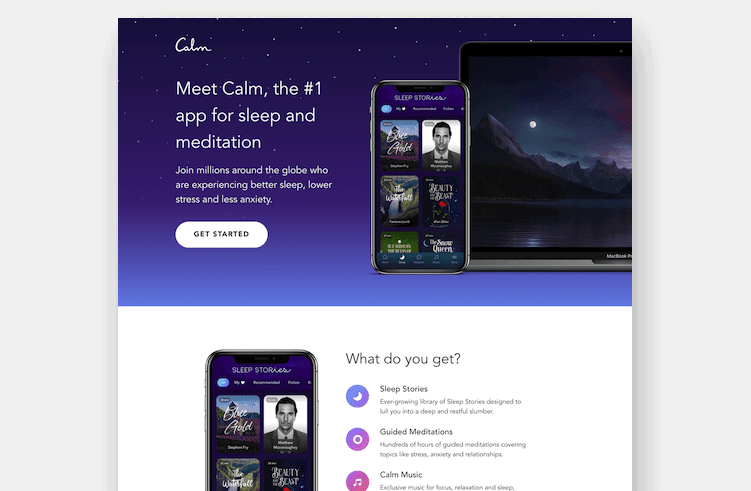
The health sector requires a balance of tranquility and trust. Calm’s landing page utilizes serene imagery and a minimalist layout to reflect the product’s core benefit: meditation and sleep. In the ecommerce dental space, Goby uses social proof and award-winning accolades to justify its "Brushing Perfected" headline, backed by a money-back guarantee that reduces perceived consumer risk.

Service Economy and Logistics: DoorDash and Rover
For platforms like DoorDash and Rover, the landing page serves a dual purpose: customer acquisition and contractor recruitment. DoorDash’s driver-focused pages use aspirational copy regarding earnings and flexibility to convert prospective delivery personnel. Rover, a pet services platform, utilizes "benefit-driven design" to build trust, ensuring that pet owners feel secure in the vetting process of the sitters featured on the page.

Education and Professional Services: Athabasca University and LinkedIn
Institutional pages, such as those for Athabasca University, must manage high volumes of information without overwhelming the user. By focusing on specific certificate programs rather than the entire university catalog, these pages allow for targeted enrollment initiatives. LinkedIn Premium’s landing page targets the professional’s desire for career advancement, highlighting specific tools for job seekers to "stand out" in a competitive market.

The Role of Agency Strategy in High-Conversion Assets
Professional agencies have refined the art of the landing page through rigorous testing and specific aesthetic choices. Analysis of work from agencies like J7 Media, MuteSix, and Webistry reveals a trend toward "experience-based selling."

- J7 Media (Coco Village): This agency focuses on visual delight. For Coco Village, they utilized a collection-style layout that remains focused on a single click-through goal, proving that multiple products can be showcased without diluting the conversion focus.
- BuzzShift (Mooala): Cameron Gawley, BuzzShift’s co-founder and CEO, emphasizes the importance of the "consideration phase." By offering a coupon in exchange for an email address, the agency captures soft conversions that can be nurtured into long-term customer relationships.
- Webistry (Panda7 and NANOR): This agency excels in creating "sensory" experiences through digital design. For NANOR scented candles, Webistry focused on luxury aesthetics to sell an "experience" rather than just a physical product. For Panda7, an insurance provider, they focused on "friction reduction," promising a quote within minutes to solve the common consumer pain point of complex insurance paperwork.
Supporting Data: The Conversion Benchmark Framework
According to the latest Conversion Benchmark Reports, the success of a landing page is measured by several key performance indicators (KPIs):

- Headline Matching: Conversion rates are significantly higher when the primary headline of the landing page matches the copy of the referring ad or email.
- Above-the-Fold Clarity: Content visible without scrolling must communicate the value proposition within the first three seconds of the page load.
- Form Optimization: Every additional field in a sign-up form typically decreases the conversion rate. The highest-performing pages use "multi-step" forms to make data entry feel less intimidating.
- Social Proof: Authentic testimonials and third-party logos (as seen in the Campaign Monitor example) provide the "magical x-factor" that builds credibility.
A 10-Step Implementation Framework for Marketers
To replicate the success of industry leaders, the following chronology of development is recommended:

- Objective Definition: Determine if the goal is lead generation, a direct sale, or a free trial signup.
- Audience Segmentation: Research the specific motivations and pain points of the target demographic.
- CTA Selection: Create a single, actionable goal that is clear and compelling.
- Platform Selection: Utilize drag-and-drop builders to ensure rapid deployment and ease of testing.
- Headline Crafting: Write a "hook" that addresses the visitor’s primary need.
- Visual Asset Integration: Use high-resolution photography or video backgrounds to increase engagement.
- Benefit-Focused Copy: Shift the narrative from product features to consumer benefits.
- Social Proof Inclusion: Add reviews, ratings, or "as seen in" logos.
- Form Design: Minimize friction by keeping fields to a necessary minimum.
- A/B Testing: Continuously run experiments on headlines, colors, and layouts to optimize performance.
Broader Impact and Industry Implications
The shift toward specialized landing pages signifies a broader trend in the global economy toward personalization and efficiency. As digital noise increases, consumers are becoming less tolerant of generic marketing messages. The data suggests that companies failing to adopt a "landing page-first" strategy for their paid campaigns see a 20-50% increase in customer acquisition costs (CAC).

Furthermore, the rise of "mobile-first" browsing has forced a redesign of the landing page architecture. Modern pages must be lightweight for fast loading on cellular networks while maintaining the visual impact required to hold attention in the "scroll culture" of 2026.
In conclusion, the analysis of these 40 best landing page examples demonstrates that success in the digital marketplace is a combination of aesthetic polish, psychological triggers, and technical optimization. Whether a brand is selling a $10 streaming subscription or a $1,000 home office desk, the principles of clarity, trust, and simplicity remain the primary drivers of conversion. As digital tools continue to evolve, the ability to build and test these assets rapidly will remain the defining characteristic of elite marketers.


 Asep Darmawan
 Neng Nana