
 rifanmuazin
The rapid democratization of software development through “vibe coding” has reached a critical juncture, as businesses increasingly deploy complex applications without the traditional oversight of experienced developers. While generative artificial intelligence has drastically lowered the barrier to entry for software creation, a growing body of evidence suggests that this “vibe-based” approach is leaving a trail of significant security vulnerabilities, technical debt, and data privacy risks. The phenomenon, characterized by users prompting AI to generate entire codebases based on a general “vibe” or intent rather than structured engineering principles, is now a mainstream business practice, particularly among small and medium-sized businesses (SMBs) seeking to minimize costs and accelerate time-to-market.
Recent data highlights the scale of this shift. According to the 2025 AI Engineering Trends report by Jellyfish, approximately 67% of software engineers now incorporate AI tools into their workflows, with 14% of all pull requests being generated autonomously by AI agents. More strikingly, Silicon Valley accelerator Y Combinator reported in early 2025 that a quarter of the startups in its winter cohort featured codebases that were 95% AI-generated. However, this velocity comes with a hidden price. A survey of 5,600 publicly available apps built via vibe-coding platforms conducted by security firm Escape uncovered over 2,000 vulnerabilities, ranging from unsecured APIs to the exposure of sensitive medical and financial records.
The Evolution and Chronology of Vibe Coding
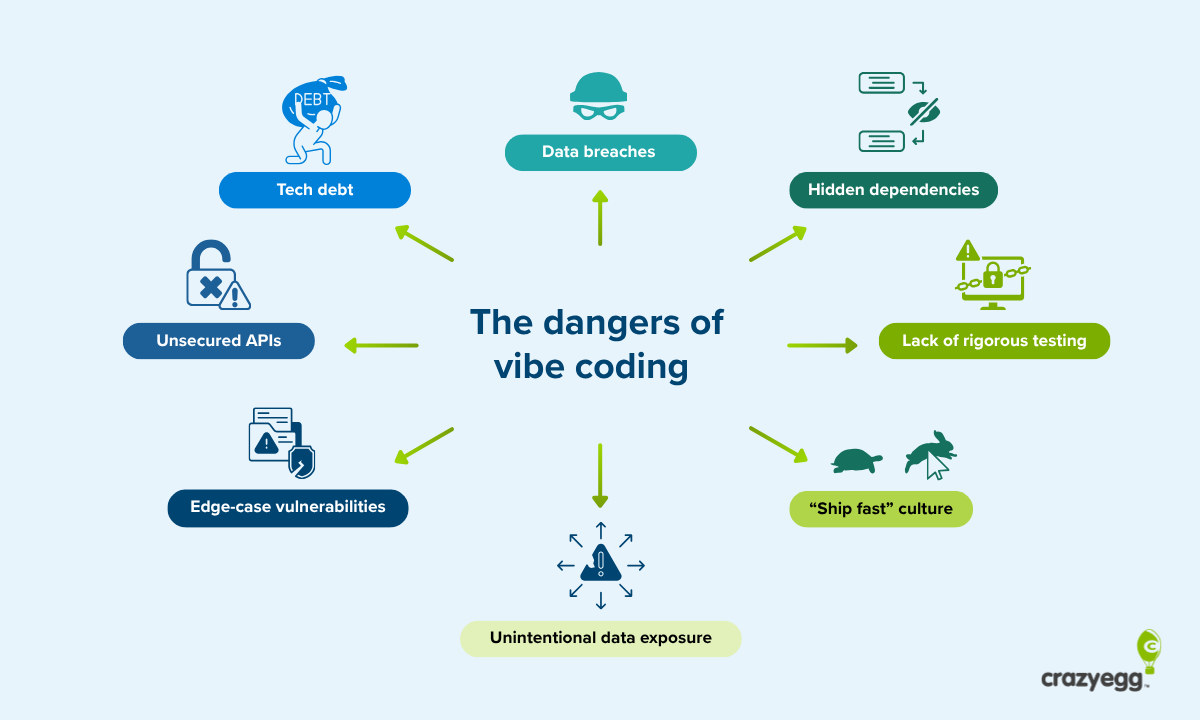
The term “vibe coding” was popularized by Andrej Karpathy, a founding member of OpenAI and former Director of AI at Tesla. Karpathy described the process as a shift away from traditional syntax-heavy programming toward a high-level orchestration of AI agents. The chronology of this transition reflects the staggering pace of AI advancement:
2021–2022: The introduction of GitHub Copilot and OpenAI’s Codex marked the “autocomplete” era, where AI suggested snippets of code to assist human developers.
2023: The launch of GPT-4 and Claude 2 enabled the generation of entire functions and scripts, leading to the rise of “low-code” solutions for non-technical users.
2024: The emergence of agentic tools, such as Claude Code and autonomous coding assistants, allowed users to execute multi-stage workflows, including file system access and cloud deployment.
2025: “Vibe coding” becomes a recognized industry term as non-developers begin shipping full-stack applications with minimal human intervention.
2026: The “OpenClaw” security crisis serves as a watershed moment, highlighting the dangers of autonomous agents with unsecured local system access and the mass exposure of private data through social-agent marketplaces.
Technical Debt and the Knowledge Gap
Amy Gottler, PhD, a specialist in technology-enhanced learning and founder of eLearning Academy, warns that the primary danger for SMBs is “not knowing what they don’t know.” Gottler notes that while building a static landing page carries low risk, the danger escalates exponentially when businesses use AI to handle data-sensitive functions like customer bookings or payment processing.
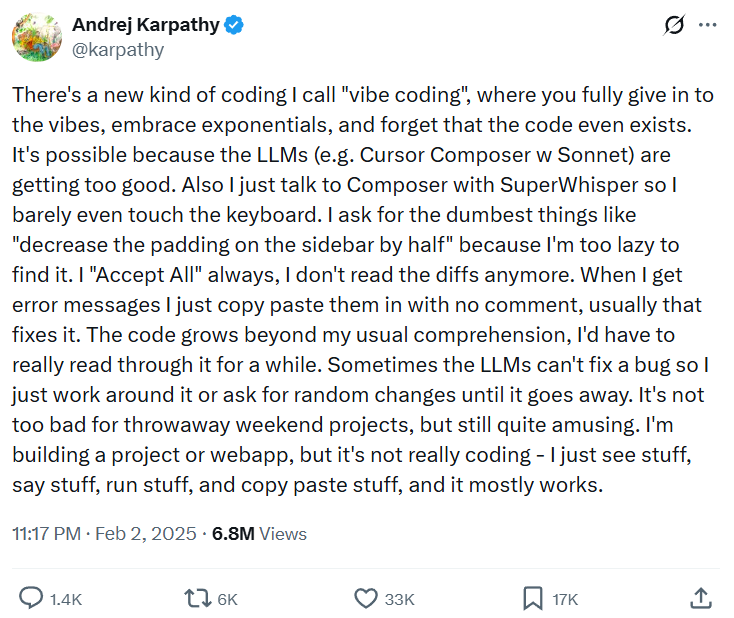
“A business owner might use an AI tool to build a reservation system for a salon,” Gottler explains. “Without an understanding of backend security, they might inadvertently create a database where passwords or credit card details are stored in plain text. AI implements the functionality requested, but it doesn’t always implement the security that should be implied.”
This lack of foundational knowledge leads to a compounding issue known as technical debt. In larger organizations, “semi-developers”—professionals with basic coding knowledge who use AI to extend system functionality—often introduce “rogue code” that appears to work initially but breaks during system updates. These hidden dependencies and cross-stack compatibility issues create significant troubleshooting costs later, effectively negating the initial savings gained by avoiding professional developers.
The Disruption of the Development Workflow
David Mytton, CEO of the security platform Arcjet and a researcher at the University of Oxford, argues that AI has fundamentally altered the traditional three-phase development lifecycle: planning, implementation, and testing. In the vibe-coding era, the middle “implementation” phase is being entirely consumed by AI.
“The middle phase is where all the value used to be,” Mytton says. “Now, AI generates the code in seconds. This delivers incredible speed, but it removes the human oversight inherent in the writing process. AI is trained on an imperfect body of existing code, meaning it frequently replicates known insecure patterns and fails to account for edge cases.”
Mytton draws a sharp distinction between “agentic engineering”—where AI is integrated into a rigorous, human-validated workflow—and “vibe coding,” where code is prompted and pushed to production with little to no testing. He notes that the recent release of built-in security tools by major AI providers like Anthropic and OpenAI is a tacit admission that the industry is struggling to contain the risks of rapid, unverified deployments.
The Infrastructure Crisis and Unsecured Gateways
The security risks of vibe coding are often rooted in the backend infrastructure. Matthew Rockwell, founder of ATOMiK and a former engineer at Keysight Technologies, points to unsecured two-way gateways as a primary point of failure. Vibe coders often view data movement as a one-way street, failing to realize that an API or interface created to display data can also be exploited to extract it.
“It is like creating a radio and assuming you are the only one who can talk,” Rockwell says. “In reality, you are creating an exposed environment. Without a strong virtual sandbox or an encrypted router, vibe-coded apps essentially present customer data to hackers on a silver platter.”
Rockwell highlights the 2026 OpenClaw incident as a prime example of these risks. The platform, which allowed for the creation of autonomous AI agents, suffered from a release bug that permitted hackers to hijack browser connections and control local user instances. The subsequent database exposure via the Moltbook network underscored the catastrophic potential of allowing AI agents to handle private information without robust infrastructure guardrails.
Implications for the Future Workforce
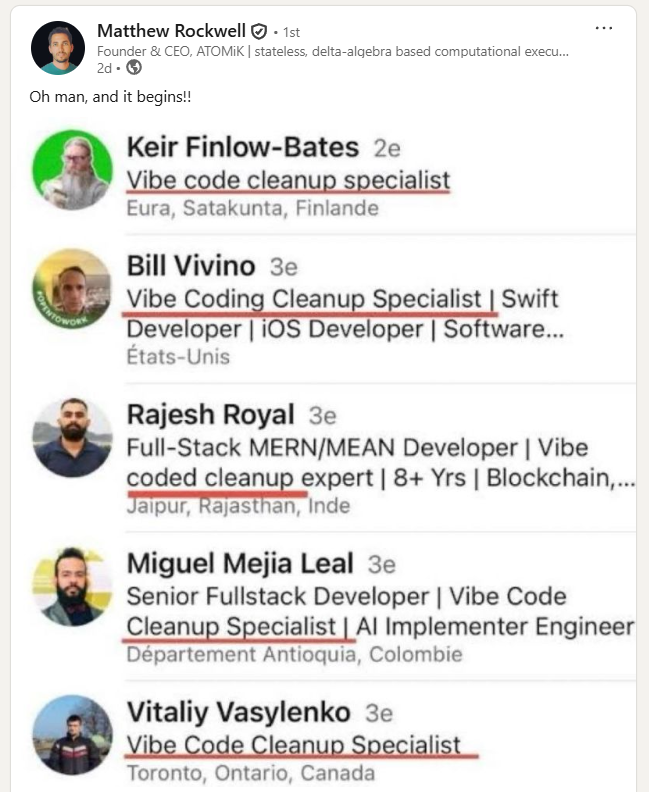
The rise of vibe coding is already reshaping the labor market. While some businesses are attempting to replace developers with AI licenses to cut costs, a new specialized role is emerging: the “vibe code cleanup specialist.” These are experienced engineers hired specifically to untangle the messy, insecure, or inefficient codebases generated by AI agents.
Furthermore, the industry is seeing a shift toward the “infrastructure engineer.” As the actual writing of code becomes a commodity, the value of human professionals is shifting toward the creation of safe testing environments, the management of complex data storage, and the orchestration of multiple AI agents. Experts agree that for high-sensitivity industries—such as healthcare, finance, and industrial manufacturing—the adoption of AI coding tools will remain slow until security protocols can match the speed of generation.
Governance and Mitigation Strategies for Businesses
To navigate this landscape safely, experts recommend that businesses adopting AI coding tools implement a formal governance framework. This includes four critical pillars:
-
Blast Radius Mapping: Organizations should categorize their codebase based on the potential damage a breach could cause. Low-risk areas (like front-end design) can afford higher AI autonomy, while high-risk areas (like login flows and payment processing) must require human-in-the-loop verification.
-
Frontend-Backend Alignment: For companies with existing IT staff, it is essential to maintain tight communication between creative teams using AI for frontend features and technical teams managing the backend. This prevents the accumulation of technical debt and ensures that new features do not compromise system integrity.
-
Utilization of Managed Services: Vibe coders are strongly advised to avoid building core security infrastructure from scratch. Instead, they should utilize established third-party providers for databases, authentication, and payment processing. These entities invest billions in encryption and security updates that an AI-generated script cannot replicate.
-
Prohibition of AI-Generated Cryptography: A standing rule in professional engineering is that developers should never write their own cryptography. This rule must be extended to AI. Core security features, including encryption protocols and secrets management, should rely on battle-tested libraries rather than generative outputs.
Conclusion: Balancing Innovation with Responsibility
Vibe coding represents a powerful shift in how humanity interacts with technology, offering the promise of a “democratized” digital world where creativity is the only barrier to software creation. However, the transition from “vibe” to “reality” requires a sobering acknowledgment of the technical requirements of security and stability.
As the “OpenClaw” era has demonstrated, the speed of deployment is a poor metric for success if it leads to the compromise of user privacy and corporate integrity. The future of software development will likely not be a choice between human and machine, but a hybrid model where AI provides the velocity and humans provide the guardrails. For small businesses and enterprises alike, the goal is to enjoy the creative freedom of vibe coding without sacrificing the foundational principles of secure engineering. The emergence of cleanup specialists and infrastructure engineers suggests that while the “vibe” may start the project, professional expertise is still required to finish it safely.








