
 rifanmuazin
Digital marketing experts and business analysts are observing a fundamental shift in how corporate websites function within the modern sales funnel. Traditionally viewed as digital brochures or static informational hubs, websites are increasingly being re-engineered into proactive sales representatives through a series of tactical optimizations known as Conversion Rate Optimization (CRO). According to industry data, the gap between a standard informational site and a high-converting lead generation engine can mean the difference between stagnation and exponential growth, with some companies reporting conversion increases of over 100% through minor, data-driven adjustments.
The evolution of the web has moved from the static pages of the early 2000s to the highly personalized, AI-driven experiences of the current era. Marketing professionals now prioritize agility, frequently bypassing traditional IT bottlenecks to implement real-time changes that capture and qualify leads. This report examines 17 specific strategies utilized by top-tier marketing firms to maximize the return on investment (ROI) from existing web traffic.
The Shift Toward Targeted Landing Experiences
One of the most significant trends in digital lead generation is the move away from the “homepage-first” approach. While a corporate homepage serves many stakeholders, it often fails to provide a specific path for a user arriving from a targeted advertisement. Statistics indicate that dedicated landing pages—pages designed for a single campaign with one specific goal—consistently outperform homepages in lead capture.
The primary advantage of a dedicated landing page is the elimination of “choice paralysis.” By removing global navigation and competing calls to action (CTAs), marketers can focus the visitor’s attention entirely on the value proposition. This methodology aligns the “ad scent,” ensuring that the promise made in a Google search or social media ad is immediately reflected in the headline and content of the landing page. Industry leaders suggest that this message match is critical for reducing bounce rates and building immediate trust with a prospect.
Data-Driven Optimization and the Impact of A/B Testing
In the realm of lead generation, empirical data has replaced intuition. A/B testing, the process of comparing two versions of a webpage to see which performs better, has become a cornerstone of modern marketing. A notable case study involves the travel deals company Going, which achieved a 104% increase in month-over-month conversions by altering just three words in their call to action—changing “Sign up for free” to “Trial for free.”
This level of impact highlights the necessity of testing high-leverage elements, including:
- Headlines: The first point of contact that determines if a user stays.
- CTA Buttons: Testing color, size, placement, and micro-copy.
- Lead Forms: Balancing the need for data with the friction of long forms.
- Imagery: Determining whether human-centric photos or product screenshots drive more engagement.
- Social Proof: Testing the placement and type of testimonials or trust badges.
The Technical Imperative: Speed and Mobile Accessibility
The technical performance of a website is no longer just an IT concern; it is a primary driver of conversion. Research into user behavior reveals that 53% of mobile site visitors will abandon a page if it takes more than three seconds to load. Furthermore, website conversion rates have been shown to drop by approximately 4.42% for every additional second of load time between seconds zero and five.
To combat this, high-performance sites utilize several technical optimizations:
- Image Compression: Using Next-Gen formats like WebP to reduce file sizes without sacrificing quality.
- Minification: Reducing the size of CSS, JavaScript, and HTML files.
- Content Delivery Networks (CDNs): Serving site data from servers geographically closer to the user.
As mobile traffic continues to surpass desktop traffic in many sectors, the “mobile-first” approach is essential. A slow-loading site acts as a barrier to entry, effectively neutralizing even the most expensive advertising campaigns before the visitor has a chance to engage with the brand.
Value Exchange: The Evolution of Lead Magnets
The “value exchange” is the psychological core of lead generation. To persuade a visitor to provide their contact information, a business must offer something of equal or greater perceived value. However, the efficacy of generic “free guides” and “success tips” has waned as consumers become more protective of their digital privacy.
Modern lead magnets have evolved into utility-based tools. High-converting offers now include:

- Interactive Tools: Calculators, graders, and templates that provide immediate results.
- In-Depth Research: Proprietary data or industry reports that cannot be found elsewhere.
- Exclusive Access: Early entry to webinars, product betas, or community forums.
By solving a specific, immediate problem for the user, these assets not only capture a lead but also establish the company as an authority in its field.
AI and Real-Time Personalization
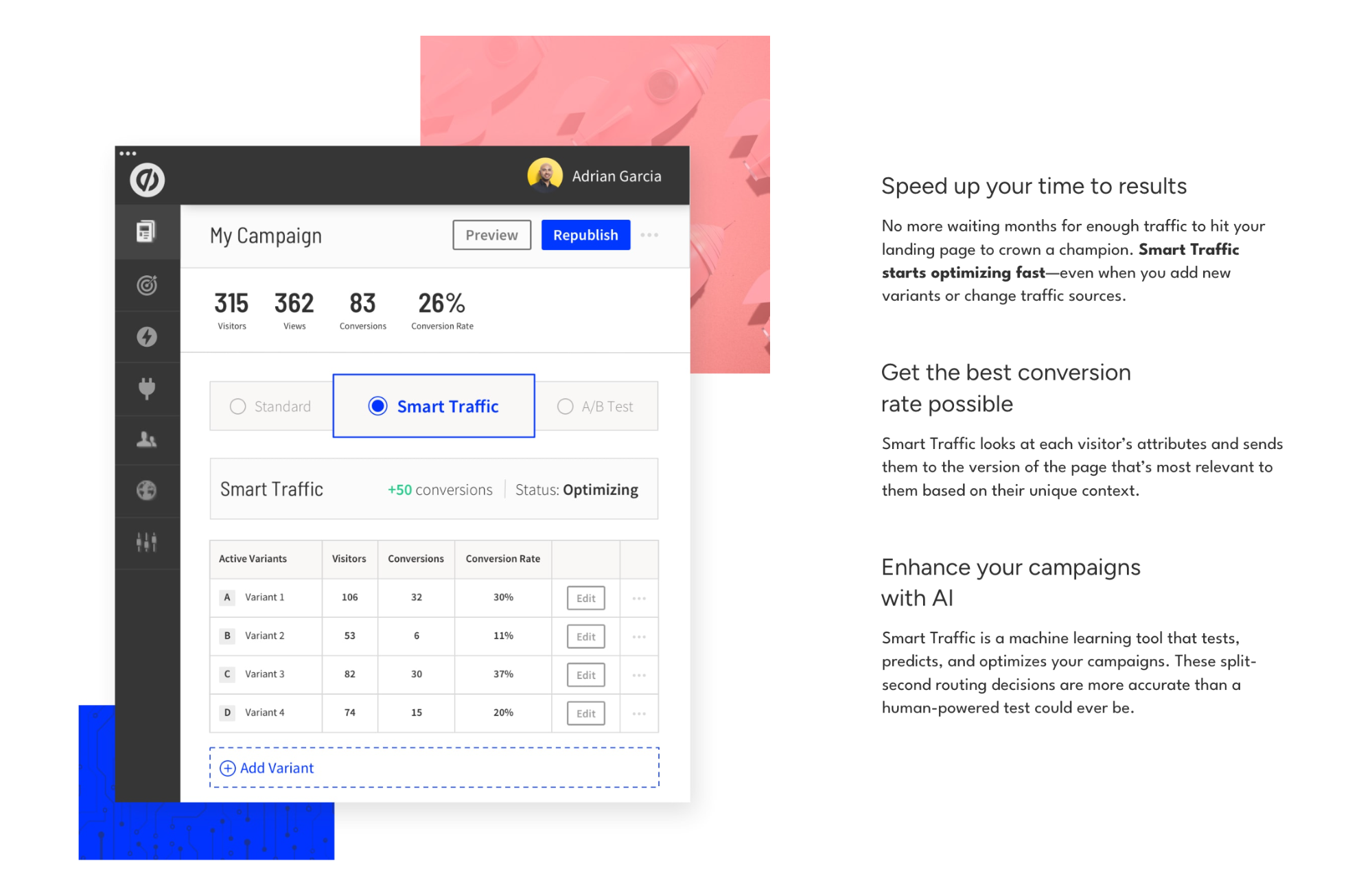
The integration of Artificial Intelligence (AI) has introduced a new level of efficiency in traffic routing. Technologies such as “Smart Traffic” use machine learning to analyze visitor attributes—such as location, device type, and time of day—to automatically direct them to the page variant most likely to convert them. Unlike traditional A/B testing, which requires weeks to reach statistical significance, AI-driven models can begin optimizing after as few as 50 visits.
Furthermore, personalization through Dynamic Text Replacement (DTR) allows marketers to customize the copy on a page to match the user’s search query. If a user searches for “enterprise accounting software,” the landing page can automatically update its headlines to reflect that specific phrase, creating a bespoke experience that significantly increases the likelihood of a conversion.
User Interface Optimization: CTAs and Forms
The physical placement of conversion elements is governed by “heat mapping” and eye-tracking studies. Strategic placement of CTAs in the hero section (above the fold), at the end of high-value content, and in “sticky” navigation bars ensures that the user always has a clear path to the next step.
Concurrently, the simplification of lead capture forms is a critical factor in reducing friction. Industry best practices suggest asking for the bare minimum of information—typically just an email address and name—to maximize the volume of leads. For companies requiring more detailed data, “conditional logic” forms are used to display questions progressively, preventing the user from feeling overwhelmed by a long list of required fields.
Trust, Social Proof, and Real-Time Engagement
In an era of digital skepticism, social proof serves as the “trust currency” of a website. This includes customer testimonials, client logos, industry awards, and real-time social proof (e.g., “50 people signed up in the last 24 hours”). Case studies are particularly effective when placed near lead forms, as they provide evidence of success at the moment the user is deciding whether to convert.
To further reduce the barrier to entry, many firms are implementing live chat and AI-powered chatbots. These tools address user questions in real-time, preventing “bounce” behavior caused by unanswered queries. By providing immediate assistance, businesses can capture leads that might otherwise have been lost to competitors.
Organizational Alignment: Marketing and Sales Synergy
The final stage of a successful lead generation strategy is the qualification of leads before they reach the sales team. This process, known as Lead Scoring, involves assigning values to prospects based on their behavior and demographic data. This ensures that the sales department focuses its resources on “Sales Qualified Leads” (SQLs), while “Marketing Qualified Leads” (MQLs) are entered into automated email nurturing sequences.
Effective follow-up is essential; data suggests that leads contacted within five minutes are significantly more likely to convert than those contacted even thirty minutes later. Automated email workflows help maintain “mindshare,” providing consistent value to the prospect until they are ready to make a purchasing decision.
Broader Impact and Future Implications
The transition of the website from a passive asset to an active lead generation engine represents a broader trend in the democratization of web technology. As drag-and-drop builders and AI optimization tools become more prevalent, marketing teams are gaining the autonomy to test, iterate, and scale campaigns with unprecedented speed.
This shift has profound implications for business growth. Companies that embrace a culture of testing and optimization are finding that they can increase their revenue without necessarily increasing their advertising spend. By focusing on the “middle of the funnel”—the conversion of existing traffic—businesses are creating more sustainable and efficient growth models. As AI continues to evolve, the expectation for hyper-personalized, instantaneous, and high-value digital interactions will only increase, making these 17 strategies not just “best practices,” but essential requirements for digital survival in the mid-2020s and beyond.








