Paid search advertising has solidified its position as the cornerstone of the global digital economy, generating a staggering $102.9 billion in U.S. revenue in 2024 alone. This figure represents approximately 39.8% of all digital advertising revenue, making it the largest single format in the industry by a significant margin. The scale of this sector is driven by a fundamental marketing truth: paid search allows brands to intercept consumers at the precise moment of intent. However, as the marketplace enters 2025, the landscape is shifting from a simple bidding war to a complex ecosystem defined by artificial intelligence, rising costs, and a critical focus on the post-click user experience.
The State of the Paid Search Marketplace
The dominance of paid search is not merely a product of its age but of its continuous evolution. In the current fiscal environment, marketers are grappling with a dual reality: the unparalleled reach of search engines and the increasing cost of participation. Recent industry data indicates that the average cost-per-lead (CPL) across all industries rose from $66.69 in 2024 to approximately $70.11 in 2025. This upward trend in costs means that efficiency is no longer optional; it is a requirement for survival.
The market is currently bifurcated between two primary titans. Google Ads remains the undisputed leader, commanding roughly 90% of the global search market. Its ecosystem extends far beyond the traditional search results page, encompassing YouTube, the Google Display Network (GDN), Gmail, and Google Maps. Meanwhile, Microsoft Advertising has carved out a high-value niche. While Bing’s standalone search share remains in the single digits, the Microsoft Advertising network syndicates ads across Yahoo, AOL, DuckDuckGo, and Ecosia. Furthermore, Microsoft’s recent expansion into exclusive channels, such as Netflix’s ad-supported tier, offers advertisers access to premium audiences that are unavailable through Google’s traditional search channels.
The Mechanics of the Real-Time Auction
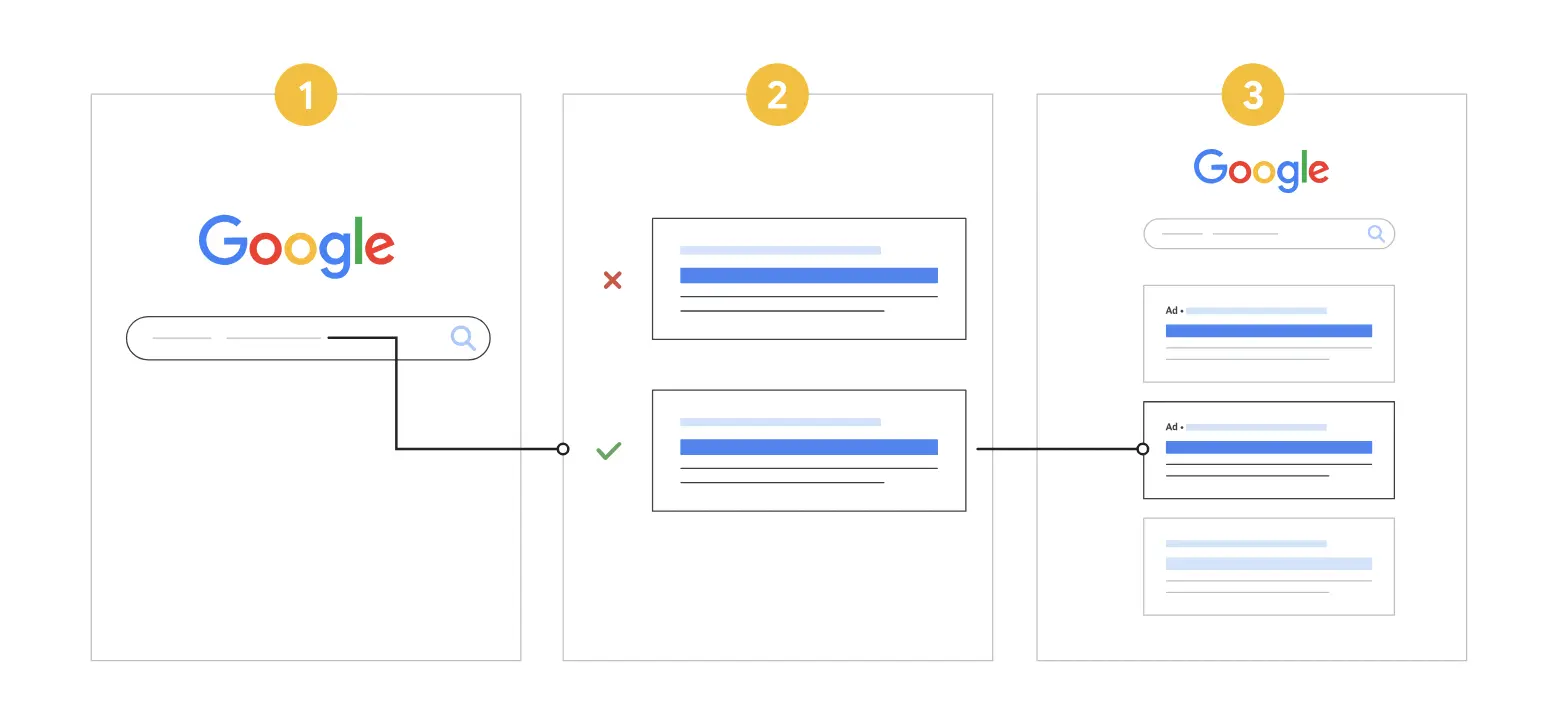
To understand why some brands thrive while others burn through budgets, one must analyze the millisecond-fast automated auction that occurs every time a user enters a query. This five-step process determines the visibility and cost of every ad served.
- The Query Trigger: A user enters a specific keyword or phrase.
- Auction Activation: The search engine identifies all advertisers bidding on relevant keywords who also meet specific targeting criteria, such as geographic location and device type.
- Ad Rank Calculation: This is the most misunderstood aspect of paid search. Google does not simply reward the highest bidder. Instead, it calculates an “Ad Rank” based on the maximum bid, the Quality Score (which includes expected click-through rate, ad relevance, and landing page experience), and the expected impact of ad assets (extensions).
- Winner Determination: The advertiser with the highest Ad Rank secures the top position. Crucially, a well-optimized ad with a high Quality Score can outrank a competitor who is bidding significantly more but providing a poorer user experience.
- Actual CPC Billing: Under the second-price auction model, winners do not pay their maximum bid. Instead, they pay the minimum amount required to outrank the competitor immediately below them, typically just $0.01 more than the next highest Ad Rank.
A Chronology of Strategic Evolution: From Keywords to AI
The history of paid search is a timeline of increasing automation. In the early 2000s, “search engine marketing” (SEM) was a manual process of matching exact keywords to specific text ads. By the mid-2010s, the introduction of “Enhanced Campaigns” began the shift toward device-based targeting.

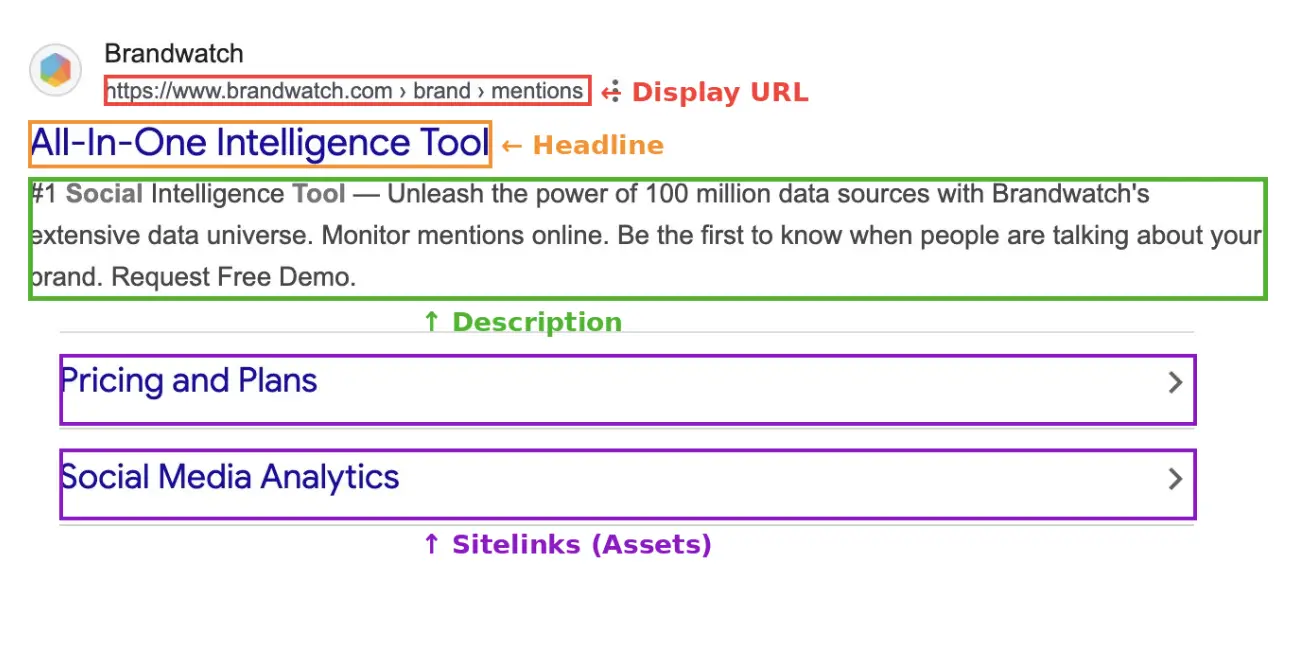
Today, the industry is in the era of “Performance Max” (PMax) and “Responsive Search Ads” (RSAs). RSAs have become the default format, requiring advertisers to provide up to 15 headlines and four descriptions. Google’s machine learning then tests these combinations in real time to serve the version most likely to convert for a specific user. This shift represents a move away from “human-led” campaign management toward “AI-steered” optimization, where the marketer’s role is to provide high-quality creative assets and “audience signals” rather than micro-managing individual bids.
Diversification of Ad Formats
As search engines evolve into “answer engines,” the variety of ad formats has expanded to capture different types of intent:
- Dynamic Search Ads (DSAs): These ads do not rely on keyword bids. Instead, Google crawls an advertiser’s website and automatically generates headlines and targets queries based on the site’s actual content. This is particularly effective for large e-commerce sites with frequently changing inventory.
- Shopping Ads: These are driven by product feed data rather than traditional copy. They appear at the top of the Search Engine Results Pages (SERPs) with images, prices, and store names, serving as a direct digital storefront.
- Apple Search Ads: A specialized and rapidly growing segment, these ads appear at the top of App Store search results. As mobile app discovery becomes more competitive, this format has become essential for developers, offering two tiers: “Basic” for automated setup and “Advanced” for granular keyword control.
- Performance Max: Google’s fully automated campaign type that serves ads across the entire Google inventory—Search, Display, YouTube, and Maps—from a single campaign.
The Post-Click Imperative: Conversion Optimization
Industry analysts and veteran marketers increasingly agree that the “pre-click” phase (the ad itself) is only half the battle. The “post-click” experience—what happens after a user clicks—is where the ROI is actually determined.
Data shows that the performance gap between a generic homepage and a dedicated landing page is massive. While generic pages often convert at a rate of 2% to 4%, dedicated, message-matched landing pages can achieve conversion rates of 10% to 15% or higher. The logic is simple: a user searching for a “free 14-day trial for CRM software” who clicks an ad promising exactly that expects to land on a page that immediately facilitates that trial. If they are instead sent to a corporate homepage with 12 navigation links and a general “About Us” section, the intent is diluted, and the bounce rate skyrockets.
Furthermore, technical performance has a direct financial impact. Research indicates that a one-second delay in mobile page load time can reduce conversions by up to 20%. In a high-stakes environment where a single click might cost $50 in industries like legal or insurance, a slow-loading page is a direct drain on capital.
Measuring Performance and Financial Benchmarks
The shift toward data-driven marketing has made measurement more sophisticated. With the industry-wide transition to Google Analytics 4 (GA4), advertisers now track “Paid Search” as a distinct channel group, allowing for a view of the full user journey.
Key performance indicators (KPIs) have shifted from simple click-through rates (CTR) to more holistic financial metrics:
- Return on Ad Spend (ROAS): Calculating the revenue generated for every dollar spent on ads.
- Cost Per Acquisition (CPA): The total cost to acquire one paying customer.
- Search Impression Share: A metric that indicates how much of the available market a brand is actually capturing versus what they are losing due to budget constraints or low Ad Rank.
Industry experts note that the most effective way to lower CPA in 2025 is not to bid less, but to improve the Quality Score and conversion rate. By doubling a conversion rate from 3% to 6%, an advertiser effectively halves their CPA without needing to change their ad budget or keyword strategy.
Broader Impact and Future Implications
The continued growth of paid search, forecasted to reach $355.10 billion in global spend by 2025, suggests that search remains the most resilient form of digital advertising. Unlike social media advertising, which relies on “interruption marketing,” search advertising relies on “permission marketing.” The user has asked a question, and the advertiser is providing the answer.

However, the industry faces headwinds. Privacy regulations and the phasing out of third-party cookies are forcing platforms to rely more on first-party data and modeled conversions. Additionally, the rise of Generative AI in search (such as Google’s Search Generative Experience) is changing how users interact with SERPs. Advertisers must now prepare for a world where “search” might involve a conversation with an AI rather than a list of blue links.
Ultimately, paid search remains a high-leverage tool for immediate visibility and scalable growth. For businesses entering the market, the strategy is clear: define goals with precision, leverage AI-driven formats for reach, and invest heavily in the post-click experience to ensure that every dollar spent on a click has the highest possible chance of turning into revenue. In the $100 billion search economy, the winners are no longer those with the deepest pockets, but those with the most relevant and frictionless user journeys.