Muslim

More than half a century ago, management guru Peter Drucker articulated a foundational principle for business success: the ultimate goal of marketing is to render selling unnecessary. This vision, rooted in a deep understanding of customer needs and a product that inherently meets those needs, stands in stark contrast to the operational realities of many contemporary B2B marketing departments. Evidence from industry surveys and evolving buyer behaviors suggests that a significant disconnect exists, one that is being amplified by the increasing sophistication of AI-powered purchasing processes.
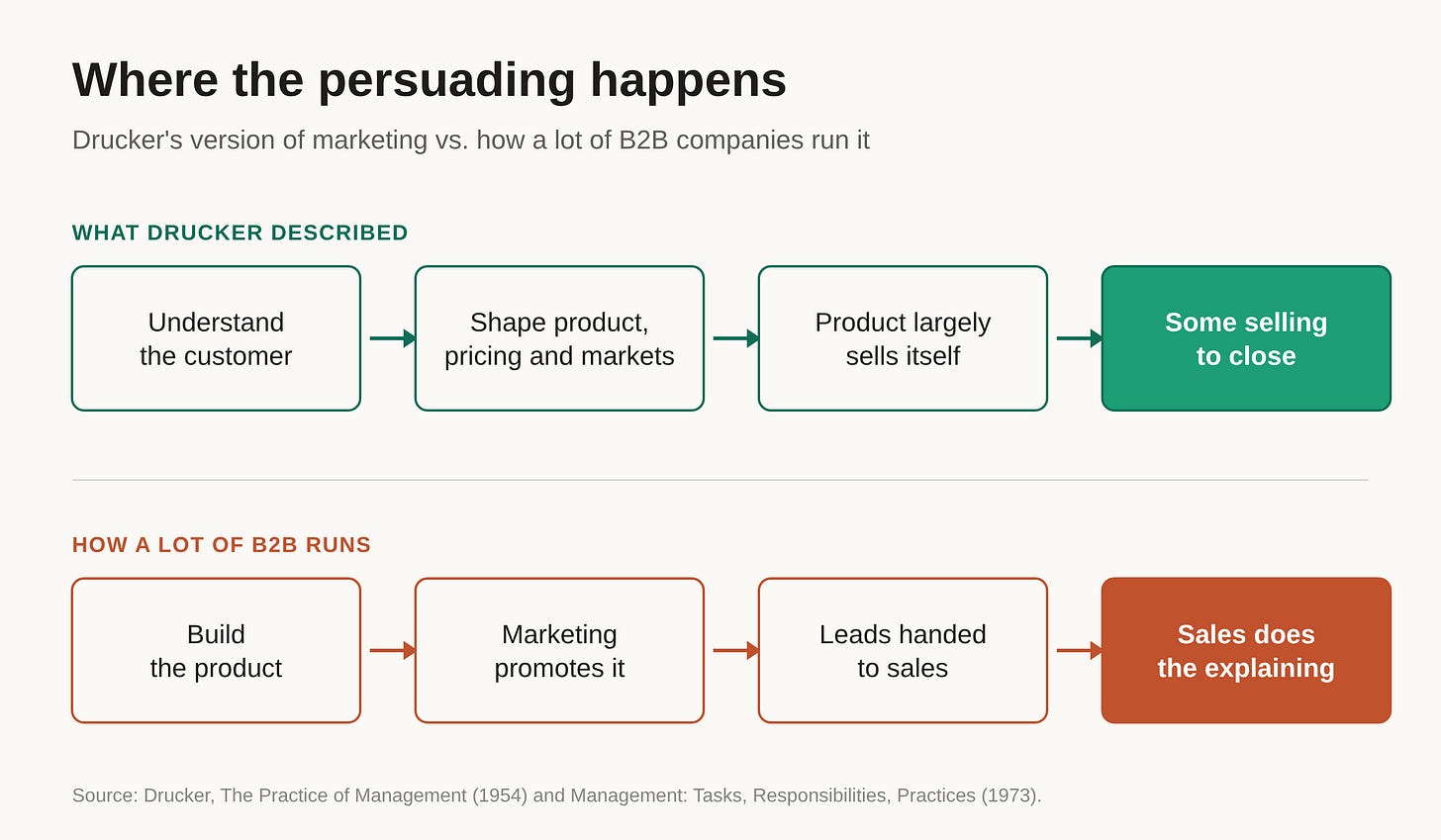
Drucker’s enduring philosophy, first outlined in his seminal 1954 work, The Practice of Management, posited that marketing and innovation were the sole essential functions of any business, as their purpose is to create customers. He argued that marketing was not merely a departmental silo but an encompassing philosophy, viewing the entire enterprise through the lens of the customer. This perspective was further refined in his 1973 book, Management: Tasks, Responsibilities, Practices, where he famously stated, "The aim of marketing is to make selling superfluous." This meant cultivating such profound customer insight that products would naturally resonate and require minimal persuasive effort from sales teams. Drucker was not anti-sales; rather, he believed the heavy lifting of persuasion should be accomplished through superior product development and market understanding, minimizing the need for overt sales pressure.
The Disconnect: Marketing’s Evolving Scope and Responsibilities
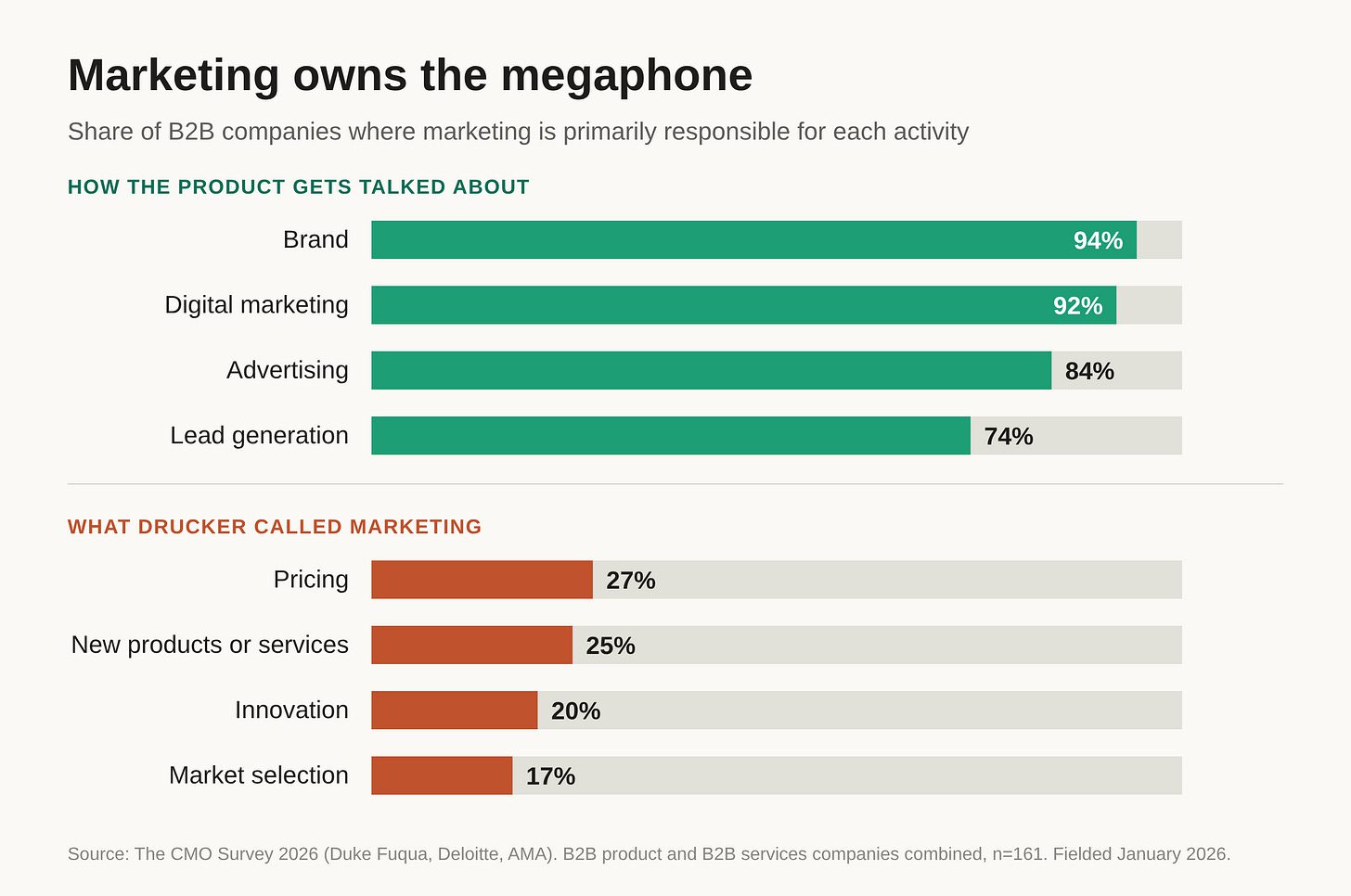
Current industry data, however, reveals a different picture. The CMO Survey, a comprehensive annual study conducted by Duke University’s Fuqua School of Business in collaboration with Deloitte and the American Marketing Association, consistently polls marketing leaders on their departmental responsibilities. In its latest iteration, a survey of 161 B2B companies highlighted a striking distribution of duties. The top responsibilities attributed to marketing departments predominantly align with traditional communications functions, including content creation, digital marketing, and brand management.
Conversely, the core functions Drucker would have identified as central to marketing – pricing, product development, and market strategy – are largely situated outside the purview of many B2B marketing departments. For instance, in the aforementioned survey, pricing strategies were a primary responsibility for only a small fraction of marketing teams, with product development and market selection faring similarly. Sales, in its direct capacity, accounted for a mere 14 percent of primary marketing responsibilities.

This data indicates a structural divergence: in approximately three-quarters of surveyed B2B companies, marketing departments are primarily tasked with articulating the company’s offerings rather than shaping what those offerings are, how they are priced, or which markets they target. While Drucker envisioned marketing as an integrated customer-centric approach permeating all business functions, the modern departmentalization has often confined it to a communications role, wielding the "megaphone" but not necessarily influencing the underlying message’s creation or its value proposition.
Leadership’s Perception: Effectiveness in Market Shaping
The implications of this organizational structure are further underscored by leadership perspectives. A recent Gartner survey of 125 CEOs and CFOs revealed that only 14 percent considered their Chief Marketing Officer (CMO) highly effective at "market shaping"—Gartner’s definition of identifying and fulfilling unmet customer needs, which closely mirrors Drucker’s concept of marketing. This suggests a significant perception gap between the operational focus of marketing departments and the strategic market influence expected by top leadership.
The emphasis on pipeline generation and lead volume, driven by quarterly performance metrics, often incentivizes marketing teams to prioritize activities that yield easily quantifiable results. While these metrics are crucial for business growth, they can inadvertently steer marketing away from the more ambiguous, long-term strategic work of deep customer understanding and market shaping that Drucker championed. The consequence is a marketing function that, while effective in generating conversations for sales, may not be adequately equipping the product or pricing strategies to stand on their own merit.
The Rise of the AI-Assisted Buyer
The landscape of B2B purchasing is undergoing a seismic shift, with technology, particularly artificial intelligence, playing an increasingly prominent role. Buyers are no longer solely reliant on sales interactions to gather information. Instead, they are leveraging AI tools to conduct extensive pre-purchase research, effectively running Drucker’s "test" before a sales representative even enters the equation.
Gartner research highlights this trend: a significant majority of B2B buyers (73 percent) actively avoid suppliers who engage in irrelevant outreach, and 67 percent prefer a buying experience entirely free of sales representatives. Furthermore, a substantial portion of buyers (45 percent) have already incorporated AI into their recent purchasing decisions. This digital-first approach means that a buyer’s initial impression and evaluation are formed based on publicly available information—website content, product documentation, pricing pages, and comparative analyses.
This environment presents a critical challenge for B2B companies where pricing, packaging, and product fit are not primarily owned or strategically shaped by marketing. When buyers, or their AI assistants, are constructing shortlists without direct sales engagement, the product must effectively "sell itself." Any inconsistencies or gaps in this publicly available information, such as discrepancies between website claims and seller narratives (reported by 69 percent of buyers in a Gartner survey), can lead to lost opportunities. AI tools can readily identify these disparities and potentially steer buyers towards competitors who have better aligned their public-facing information with customer needs.
Implications for Sales and Marketing Alignment
The traditional model, where sales representatives were expected to bridge the informational gaps left by marketing, is rapidly becoming obsolete. As fewer buyers are willing to wait for a sales call to clarify fundamental aspects of a product’s value proposition, pricing, or competitive positioning, they will turn to AI or other readily accessible resources. This dynamic necessitates a fundamental re-evaluation of how B2B companies structure their marketing and sales functions to meet the demands of the modern, self-directed buyer.
While Drucker’s assertion that marketing should make selling "superfluous" may be an overstatement in the context of complex, high-consideration purchases, his core message about the centrality of customer understanding remains profoundly relevant. Even in intricate buying processes involving multiple stakeholders, the initial groundwork of product fit, value articulation, and competitive differentiation must be so robust that it minimizes the need for extensive sales-led persuasion on these foundational elements. Gartner’s research indicates that buyers still value seller input for assessing situational fit, and confident buyers are more likely to achieve high-quality deal outcomes. This suggests that sellers’ time should be strategically allocated to the unique human-centric aspects of a sale—such as building relationships, addressing complex objections, and tailoring solutions to specific organizational challenges—rather than on educating prospects about basic product attributes or pricing structures.
The Drucker Test: Three Critical Questions for B2B Marketing
To realign with Drucker’s principles and navigate the evolving B2B purchasing landscape, marketing departments and their leadership must proactively address key strategic areas. This requires a collaborative approach, ideally involving quarterly discussions with executive leadership and product teams. Three fundamental questions, framed as a "Drucker Test," can illuminate areas for improvement:
Does Marketing Own Pricing and Packaging?
If marketing lacks a significant role in pricing and packaging decisions, it is being asked to champion a value proposition it did not help shape. Effective marketing requires an intimate understanding of what customers compare a product against, their willingness to pay, and the factors that might create hesitation. Without input into these crucial elements, marketing’s ability to craft a compelling and accurate value story is severely hampered. This ownership extends to understanding the competitive pricing landscape and aligning packaging with distinct customer segments’ needs and budgets.
Does Customer Insight Inform Product Development?
The insights gleaned from win/loss analyses, buyer research, and regular feedback from sales and customer success teams are invaluable. When marketing uncovers critical customer needs or pain points, this intelligence must translate into tangible changes in the product roadmap, not just messaging documents. If customer insights do not influence upstream product development, marketing is functioning primarily as a communications department, disseminating information rather than driving strategic product evolution. This feedback loop is essential for ensuring the product genuinely addresses market needs and reinforces the "make selling superfluous" ethos.
Could a Buyer Decide Without Sales Engagement?
In the current digital-first environment, buyers are increasingly empowered to make significant purchasing decisions based on readily available information. Marketing teams should critically assess their own websites and digital presence from the perspective of a skeptical buyer, or even use AI tools to simulate this process. Can a potential customer easily determine who the product is for, its approximate cost, how it compares to alternatives, and why they should trust the company? Every gap in clarity or completeness represents an opportunity for a seller to step in, a scenario that becomes increasingly inefficient and costly as buyer self-sufficiency grows. This "buyer-ready" state is the hallmark of a marketing function that has truly internalized Drucker’s philosophy.
The Path Forward: Embracing Customer-Centricity
Peter Drucker’s admonition that the aim of marketing is to make selling superfluous remains a potent benchmark for B2B organizations. The rise of AI-assisted buyers is not a distant threat but a present reality that is already enforcing this principle by enabling more independent and informed purchasing journeys. The question for B2B marketing departments is whether they will proactively adapt and embrace a more holistic, customer-centric approach—one that deeply integrates pricing, packaging, and product development with market insights—or whether they will be compelled to evolve by the very buyers they aim to serve. The imperative is clear: to truly create customers, marketing must champion the customer’s perspective across the entire business, not just through the megaphone of communication.
This article originally appeared on Matt Heinz’s Substack.


 Siti Muinah

 Suro Senen