The landscape of online search is undergoing a transformation more profound than any witnessed in the last two decades. The global rollout of Google’s AI Overviews and the integration of large language models into everyday search behaviors have triggered a wave of pronouncements forecasting the demise of Search Engine Optimization (SEO), the collapse of organic traffic, and the ultimate end of the click. While some of these pronouncements hold a kernel of truth, many mistake a fundamental shift in user behavior for the obsolescence of an entire marketing channel.
To navigate this evolving terrain, a comprehensive analysis was conducted, examining Google Analytics 4 (GA4) data across 54 clients spanning 19 diverse industries and multiple global markets. The study meticulously compared eight months preceding the widespread adoption of AI Overviews with the subsequent eight months. By focusing on portfolio-level trends rather than isolated case studies, the research aimed to illuminate how search behavior is changing at scale and, more critically, to redefine the strategic implications for SEO.
The findings confirm a palpable pressure on organic traffic. However, the analysis also unveils a significant countervailing trend: the emergence of artificial intelligence as a nascent discovery channel, driving visitors with distinct behaviors compared to traditional search users. This crucial distinction necessitates a re-evaluation of how marketing success is measured in the AI-driven era.
The Tangible Impact: Organic Traffic Under Pressure
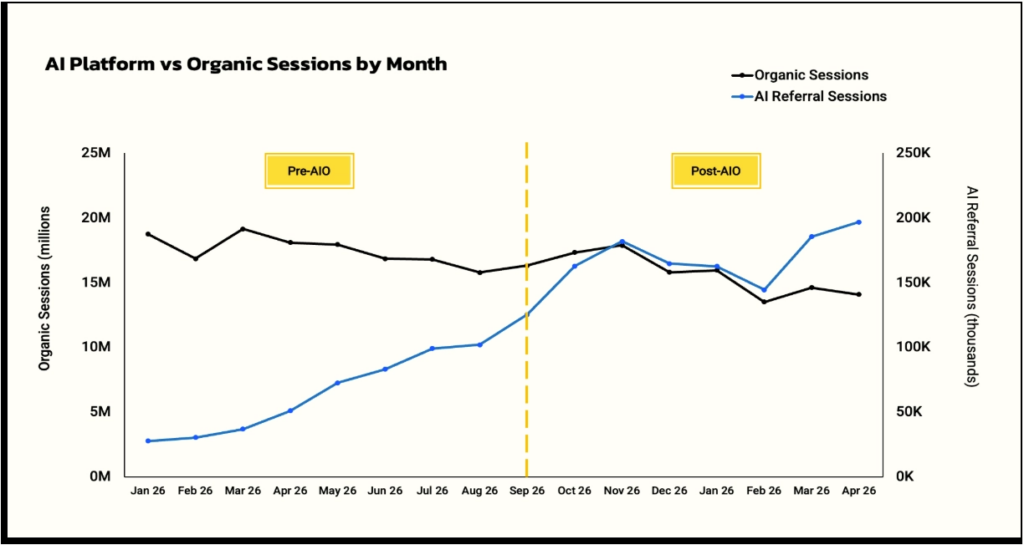
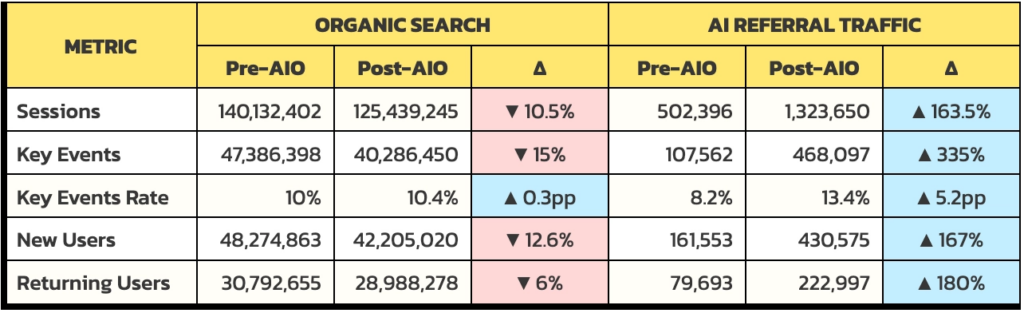
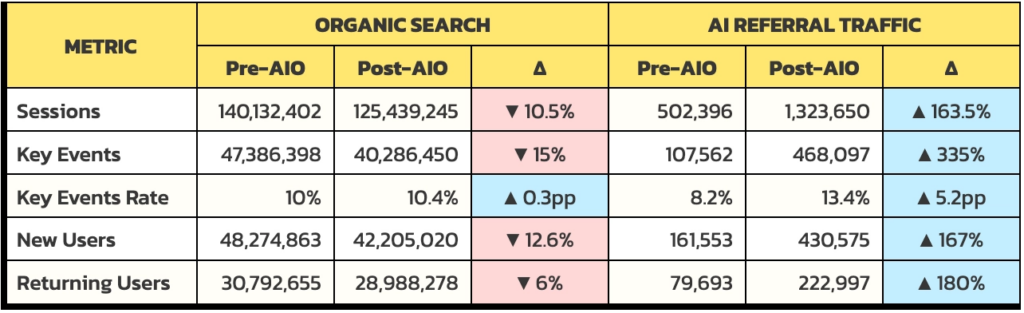
The data presents a clear and irrefutable picture: organic traffic is indeed experiencing a decline. Comparing the eight months prior to September 2025 – identified as a pivotal inflection point – with the subsequent eight months, a notable decrease in organic sessions was observed across the analyzed client portfolio. Total organic sessions fell by 10.5%, shrinking from 140.1 million to 125.4 million. This trend was remarkably consistent, with 46 out of the 54 clients in the dataset reporting declines during the comparative period. September 2025 was chosen as the benchmark due to its significance as the point at which approximately 30% of US desktop keywords began triggering AI Overviews, signaling a material shift in search engine functionality.
This decline is a direct reflection of a broader evolution in how individuals interact with search engines. AI-generated answers are increasingly capable of satisfying informational queries without necessitating a visit to an external website. Instead of users clicking through multiple search results to synthesize information themselves, they are often presented with a consolidated, comprehensive response directly at the top of the search engine results page (SERP). As these AI-powered summaries become more sophisticated and exhaustive, a greater proportion of searches are concluded within the search engine interface, leading to fewer natural transitions to websites.
The implication is not that SEO has ceased to function. Rather, the fundamental journey from posing a question to visiting a website has been irrevocably altered. Traditional SEO metrics remain relevant for understanding performance after a click occurs. However, they offer increasingly limited insight into the growing segment of users whose research begins and concludes within an AI-generated response.
AI Referral Traffic: Rapid Growth, Limited Substitution
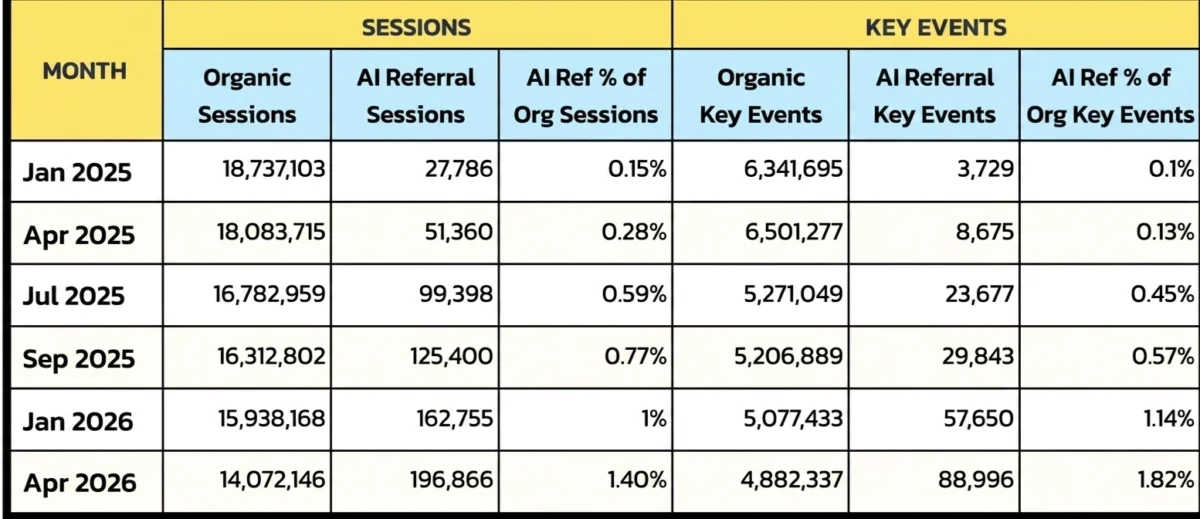
The current discourse surrounding AI’s impact on search often simplifies the complex reality. While AI referral traffic is experiencing exponential growth, it is not yet a direct replacement for traditional organic search volume. Over the same comparative period, sessions originating from AI platforms surged by over 163%, while AI-driven key events saw an even more impressive increase of 335%.
Despite this dramatic percentage growth, AI referral traffic, in absolute terms, remains relatively modest. The decline in organic traffic across the dataset amounted to nearly 14.7 million sessions. In contrast, AI referrals increased by just under 800,000 sessions during the same timeframe. This means AI referrals have only offset approximately 5% of the lost organic traffic.
This distinction is critical for strategic planning. AI platforms are not simply absorbing Google search traffic on a one-to-one basis. Instead, they are integrating themselves as an additional, distinct layer within the user’s discovery journey. For marketers, this necessitates a rejection of two equally misleading narratives: the first, that SEO is obsolete due to declining traffic; and the second, that AI referrals will seamlessly fill the void left by lost clicks. The data supports neither conclusion. Search is evolving into a more fragmented ecosystem, compelling brands to cultivate visibility across both traditional search results and within AI-generated answers.
A New Breed of Visitor: The AI-Referred User
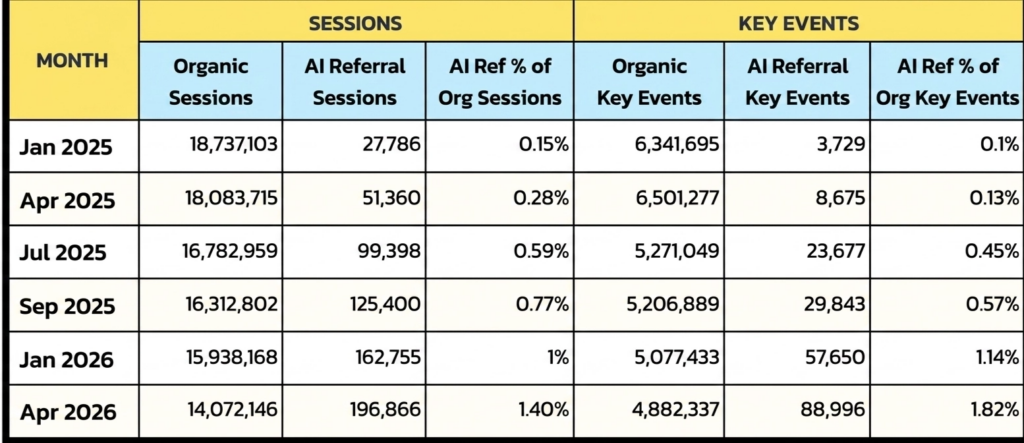
Perhaps the most compelling finding of the analysis lies not in the volume of AI referral traffic, but in the quality of its visitors. Throughout the post-AI Overview period, users arriving via AI platforms consistently demonstrated higher key event rates compared to those from organic search. AI referral traffic achieved a key event rate of 13.4%, significantly outperforming organic search’s 10.4%. By April 2026, this disparity widened further, with AI referrals converting at approximately 1.5 times the rate of traditional organic visitors.
This elevated conversion rate should not be interpreted as AI traffic being inherently "superior." Instead, it suggests that these users may be arriving at websites having already completed a more substantial portion of their research and decision-making process. AI-powered answers appear to be effectively assisting users in comparing products, evaluating options, and building confidence before they commit to clicking through to a brand’s website.
In essence, AI seems to be reshaping not only how users discover brands but also the timing of their engagement. The click is increasingly occurring later in the customer journey, after considerable exploratory work has already been undertaken. Consequently, for marketers, relying solely on traffic volume provides an increasingly incomplete measure of search performance.
The Shifting Tides of AI Platforms
The growth in AI referrals is not monolithic; it is being shaped by an evolving mix of contributing platforms. ChatGPT continues to be the dominant source of AI referral traffic within the analyzed dataset, accounting for the vast majority of AI-driven sessions and demonstrating consistent improvement in its key event performance over time. While other platforms, including Claude, Gemini, and Microsoft Copilot, are also experiencing growth, they are doing so from significantly smaller initial bases.
This fragmentation reinforces a critical understanding: AI search is not a singular entity or channel. Discovery is becoming distributed across a multitude of AI experiences, each with its own unique audience behaviors, citation patterns, and referral dynamics. Therefore, optimizing for AI cannot be a singular focus on one platform. Brands must increasingly prioritize understanding their consistent representation across the broader AI ecosystem.
The Imperative for a New SEO Measurement Framework
Perhaps the most profound conclusion drawn from this extensive analysis transcends the specifics of declining sessions or burgeoning AI referrals. It is the recognition that the traditional SEO measurement framework, in isolation, is no longer adequate. Standard SEO metrics can still indicate whether traffic is increasing or decreasing. However, they fail to reveal whether a brand is gaining or losing ground within the AI-generated answers themselves – the citations, summaries, and recommendations that never culminate in a click. This represents a significant measurement gap, underscoring why an analysis based solely on GA4 session data offers only half of the complete picture.
The other essential component of this evolving measurement strategy is AI visibility. This encompasses where a brand is mentioned, cited, or recommended across various AI platforms. It also involves understanding how third-party coverage, reviews, video content, and creator endorsements feed into this AI perception. A brand could be experiencing a decline in organic sessions while simultaneously enhancing its standing in how AI platforms describe and recommend it, or vice versa. Traffic data alone cannot differentiate these scenarios.
The practical implication for brands and their SEO teams is a fundamental shift in perspective: AI referral traffic should no longer be treated as a mere footnote in search reports. Instead, it must be tracked with the same rigor applied to any other established marketing channel. This includes monitoring its distinct sessions, conversion rates, platform mix, and observing trends over time, alongside crucial AI visibility signals. Many teams are already capturing elements of this data. The next critical step is to integrate these efforts consistently. This will enable investment decisions, content strategy development, entity data enhancement, and the identification of areas where third-party authority is paramount, to be grounded in where AI platforms are actively directing attention, rather than solely on historical patterns of Google search traffic. The future of SEO measurement lies in embracing this holistic view, acknowledging the distributed nature of discovery in the age of AI.

 Basiran
 Lina Irawan