Basiran

The landscape of holiday retail is undergoing a fundamental transformation as the creator economy becomes the primary engine for consumer discovery and conversion. With Black Friday 2026 set for November 27, new data derived from an analysis of 508,000 posts by United States creators—and a broader study of 1.2 million posts worldwide—reveals a shift in how brands must approach influencer partnerships to remain competitive. The findings suggest that the traditional "one-size-fits-all" approach to holiday marketing is obsolete, replaced by platform-specific behaviors and a significant emphasis on early planning and micro-influencer engagement.
Industry experts and marketing analysts suggest that the window for capturing consumer attention is widening, yet the peak remains intensely concentrated. According to the data, 26% of all creator posts during Black Friday week are published on the Friday itself, despite a month-long buildup of promotional content. This concentration of noise presents a dual challenge for brands: the need to establish a presence early in the season while ensuring their message cuts through the saturated digital environment on the day of the sale.
The Strategic Chronology of a 2026 Black Friday Campaign
Success in the creator economy requires a disciplined, multi-phase approach that begins months before the first discount code is generated. For 2026, the planning cycle follows a rigorous seven-phase timeline designed to mitigate risk and maximize return on investment (ROI).
Phase 1: Strategic Planning and Goal Setting (Late August to September)
The foundation of a successful campaign is laid three months in advance. During this phase, brands must define their key performance indicators (KPIs). Unlike general brand awareness campaigns, Black Friday initiatives are increasingly performance-driven, focusing on discount code redemptions, cost per acquisition (CPA), and new customer acquisition.
Data indicates that brands should split their holiday budgets into four distinct categories: creator fees, product seeding, paid social boosts for high-performing content, and a contingency reserve for late-season adjustments. A critical takeaway from the 2025 season is the effectiveness of product seeding; posts where creators had a physical product in hand earned significantly higher engagement. On Instagram, gifted product posts saw a 4.73% engagement rate per view, more than double the platform average of 2.10%.

Phase 2: Creator Selection and Demographic Alignment (Late September to October)
The selection process has shifted from a focus on follower counts to a focus on audience alignment. Brands are encouraged to analyze a creator’s last 20 posts to gauge audience sentiment. Comments regarding specific product details—such as shipping times, color shades, or sizing—are high-intent indicators that a creator’s audience is in a purchasing mindset.
Phase 3: Outreach and Relationship Management (Mid to Late October)
The "holiday rush" for creators begins in October. Analysis shows that 46% of Instagram and 64% of TikTok Black Friday content is actually published before Cyber Week officially begins. Brands that delay outreach until November often find that top-tier creators have already filled their content calendars or have signed exclusivity agreements with competitors.
Phase 4: Contracting and Creative Briefing (Late October to Mid-November)
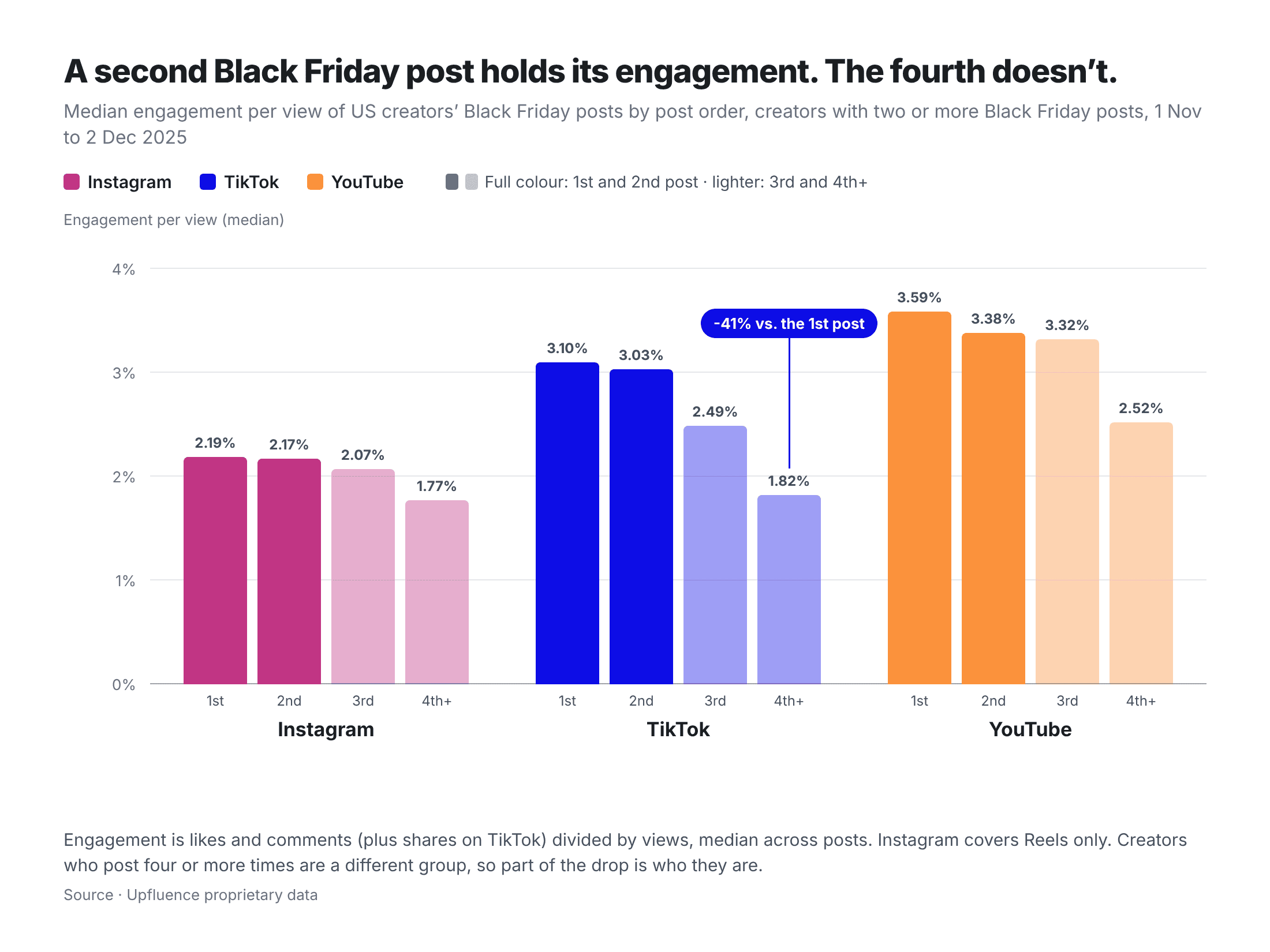
A common pitfall identified in the 2025 data is the "one-and-done" posting strategy. Approximately 60% of Instagram creators posted about Black Friday only once. However, engagement data shows that a second post maintains nearly the same engagement levels (2.2% on Instagram and 3.1% on TikTok) as the first. Performance only begins to significantly degrade after the fourth post. Consequently, 2026 contracts should mandate a minimum of two to three posts to maximize reach.
Phase 5: Content Approvals and Compliance (Mid-November)
The final two weeks before the sale are dedicated to quality control. This includes verifying tracking links, ensuring discount codes are active, and confirming that legal disclosures are prominently placed.
Phase 6: Campaign Launch (Black Friday Week)
Execution during the final week requires real-time monitoring. While TikTok posting remains relatively flat and consistent throughout the week, Instagram experiences a massive spike on Black Friday itself, with post volume doubling from the Wednesday prior.
Phase 7: Post-Mortem and Retention (Early December)
The campaign does not end on Cyber Monday. A comprehensive analysis of ROI, creator-specific sales performance, and audience feedback is essential. Brands are advised to identify their top 5% of performers and transition them into long-term brand ambassadors for the following year.
Platform Dynamics: Where Size and Engagement Diverge
One of the most significant findings of the recent data study is the inverse relationship between creator size and engagement across different platforms. The 2026 strategy must account for these platform-specific nuances to ensure budget efficiency.
Instagram: The Power of the Micro-Influencer
On Instagram, smaller creators (1,000 to 10,000 followers) consistently outperformed their larger counterparts in engagement per view. In the fashion category, micro-influencers saw a 3.37% engagement rate, compared to just 2.43% for "mega" influencers (100,000 to 1 million followers). This trend held true across beauty, home, and tech categories. The data suggests that for Instagram, a "pod" of ten micro-influencers may provide a better ROI than a single celebrity-tier creator.
YouTube: The Domain of Authority and Reach
Conversely, YouTube flips this dynamic. In the 2025 analysis, channels with 100,000 to 1 million subscribers led the pack in fashion, beauty, and tech. The smallest channels trailed in every category on this platform. This is likely due to the search-centric nature of YouTube; larger channels have better SEO authority and are more likely to appear in "Best Black Friday Deals" or "Product Review" search results.
TikTok: The Consistency Play
TikTok presents a unique environment where the volume of posts stays consistent from Monday to Saturday of Black Friday week. This suggests that the TikTok algorithm rewards consistent daily output rather than a single "big bang" post on Friday morning. Furthermore, TikTok has seen a massive adoption of shoppable links, with nearly 70% of Black Friday posts featuring direct commerce integration, compared to just 11% on Instagram.
The Disclosure Gap and Regulatory Risks
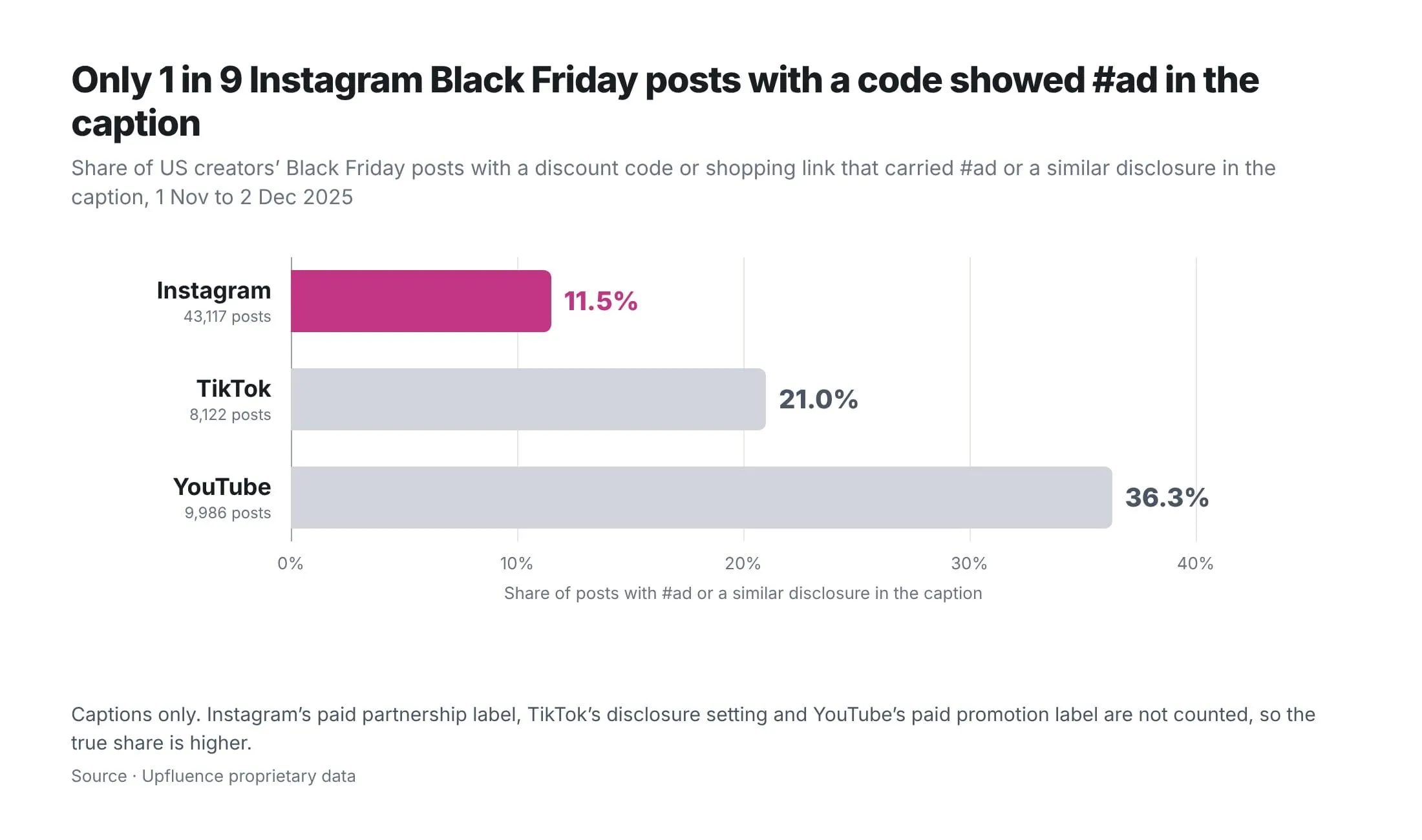
A concerning trend identified in the data is the lack of proper advertising disclosure. Despite strict FTC guidelines, only 11.5% of Instagram Black Friday posts with a discount code or shopping link included a clear caption disclosure like #ad or #sponsored. TikTok performed slightly better at 21%, while YouTube led the way at 36%.
As regulatory bodies increase their scrutiny of the creator economy, brands face significant legal and reputational risks if their partners fail to disclose paid relationships. For 2026, industry experts recommend making "#ad in the first line of the caption" a non-negotiable requirement for content approval. Failure to do so not only invites regulatory fines but can also erode consumer trust—a vital currency during the high-stakes holiday shopping season.
Economic Implications and the Shift Toward "Value-Based" Content
The broader economic context of 2026 suggests that consumers are becoming more discerning. With inflation and cost-of-living concerns influencing spending habits, creators who provide genuine "value-based" content—such as budget comparisons, "dupe" alerts, or long-term durability reviews—are seeing higher conversion rates than those who simply post aesthetic product shots.
This shift is reflected in the engagement metrics for unboxing and "gifted" content. When a creator shows the physical reality of a product, the engagement rate increases. This "tangibility factor" helps bridge the gap between digital discovery and physical purchase, providing the social proof necessary for consumers to commit to a purchase during a high-volume sale period.
Conclusion: The Future of Holiday Marketing
The data from the 1.2 million posts analyzed confirms that the creator economy is no longer a secondary channel for Black Friday; it is the primary battlefield. The 2026 season will reward brands that prioritize early planning, platform-specific creator selection, and rigorous compliance.
By shifting focus toward micro-influencers on Instagram for engagement, larger channels on YouTube for authority, and consistent posting schedules on TikTok for reach, brands can navigate the noise of the busiest shopping day of the year. Ultimately, the successful 2026 campaign will be one that treats creators not as mere advertising billboards, but as strategic partners who provide the authenticity and data-driven reach necessary to drive measurable sales in an increasingly crowded marketplace.

 Neng Nana
 rifanmuazin