Nana Wu

The landscape of digital commerce underwent a significant transformation during the 2025 holiday season, as record-breaking consumer spending coincided with a fundamental shift in how creator-led marketing drives engagement. According to recent market data and an extensive analysis of over 508,000 social media posts by U.S.-based creators, the traditional reliance on steep percentage-based discounts is losing its efficacy. Instead, value-added incentives, specifically the inclusion of a free gift with purchase, have emerged as the primary driver of audience interaction across major social platforms, including Instagram, TikTok, and YouTube.
In a year where U.S. online shoppers spent a record $11.8 billion on Black Friday alone—marking a substantial increase from $10.8 billion in 2024—the role of the influencer has evolved from a mere promotional vessel to a critical strategic partner. Adobe Analytics and Shopify have confirmed these upward trends, with Shopify merchants reporting a staggering $14.6 billion in sales over the Black Friday through Cyber Monday (BFCM) weekend. However, as the volume of promotional content reaches a saturation point, the data suggests that consumers are becoming increasingly selective, favoring authentic engagement over aggressive price-based urgency.
The Psychology of the Value-Add: Why Free Gifts Outperform Discounts
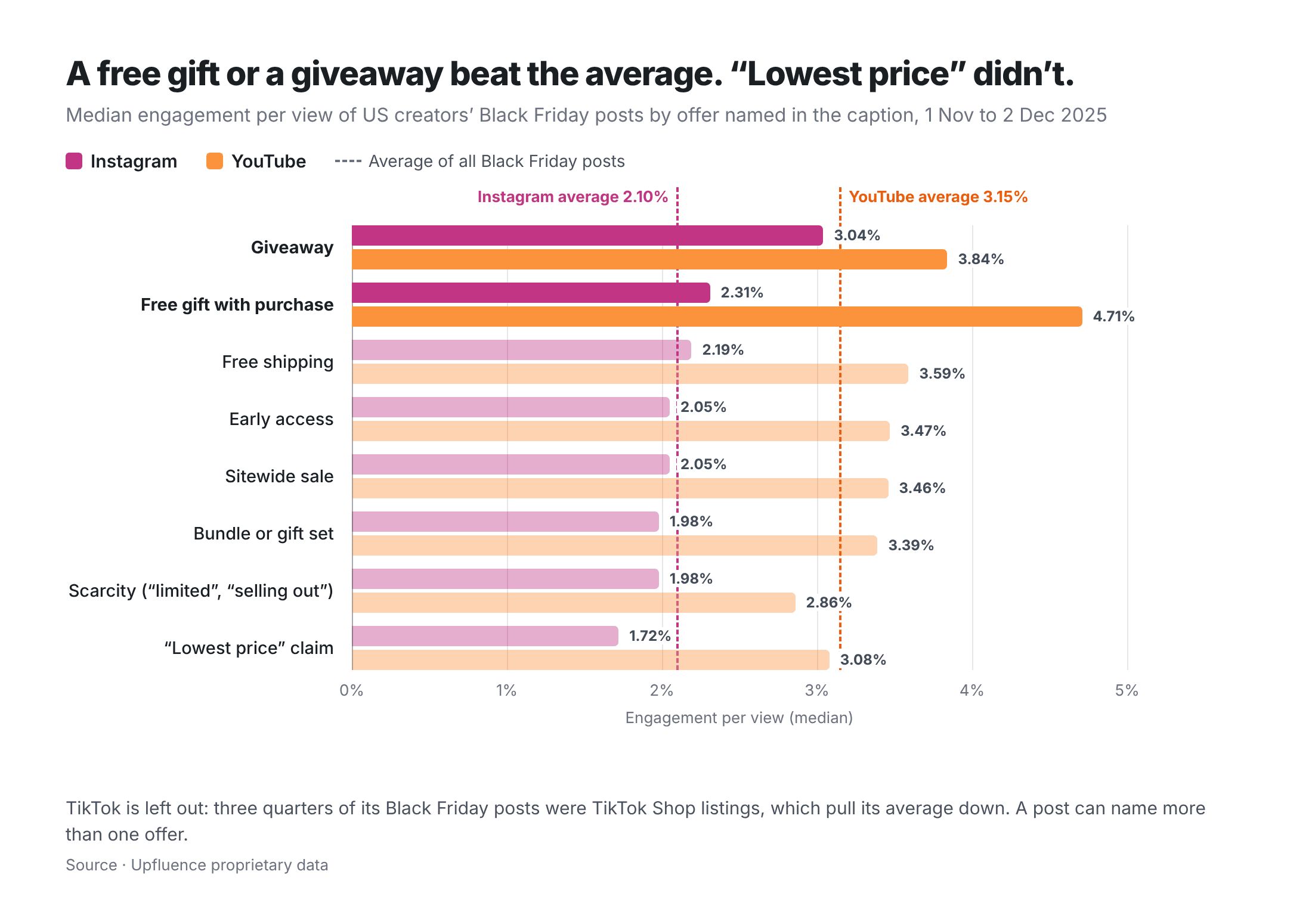
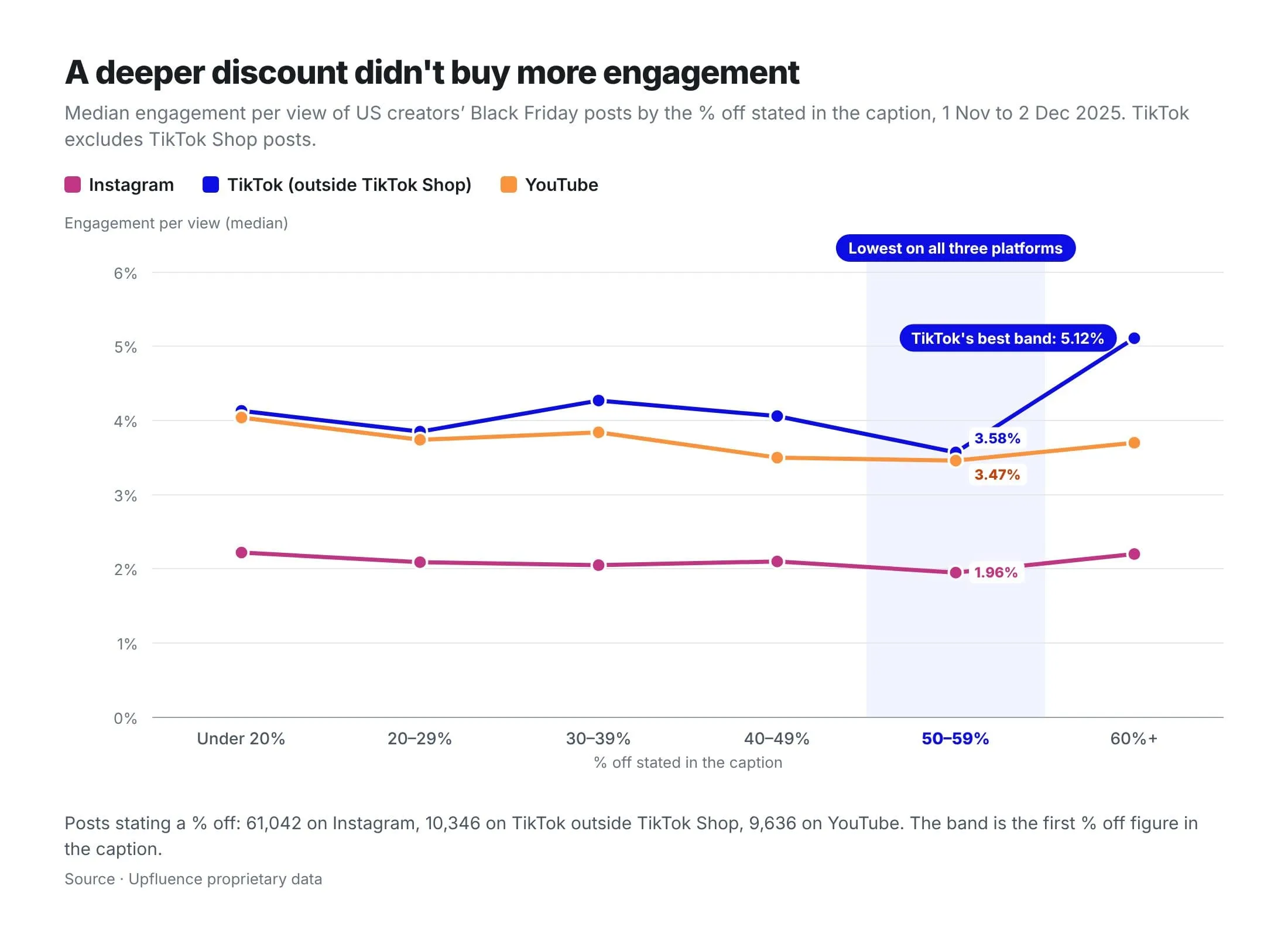
The most striking revelation from the 2025 data study is the "Discount Paradox." While 32% of Instagram posts prominently featured a percentage-off discount, these posts often failed to reach the engagement levels of more creative offers. Specifically, the "free gift with purchase" incentive outperformed average engagement metrics on every studied platform. On YouTube, posts offering a free gift achieved a 4.71% engagement-per-view rate, significantly higher than the 3.15% average for all Black Friday-related content.
Marketing analysts suggest this trend points to a growing "discount fatigue" among modern consumers. When every brand offers 50% or 60% off, the numbers begin to lose their psychological impact. Interestingly, the 50% to 59% discount band was identified as the weakest performing category across Instagram, TikTok, and YouTube. In contrast, lower discounts—those under 20%—often maintained higher engagement rates when paired with a strong creator narrative. This suggests that the perceived value of a tangible gift or an exclusive "creator code" provides a more compelling reason for a follower to stop scrolling than a standard price reduction.

Chronology of a Modern Campaign: The Shift to "Black November"
The timeline for Black Friday success has moved significantly earlier in the calendar year. Analysis of creator activity shows that the shopping conversation no longer begins in the week of Thanksgiving. Instead, 58% of U.S. creator posts regarding Black Friday were published before the actual Black Friday week even commenced.
Market observations indicate that worldwide mentions of Black Friday on platforms like Instagram began to double as early as October 20. By November 3, the volume of content had reached ten times its early-October levels. This shift suggests a strategic move toward "Black November," where creators spend the first three weeks of the month building anticipation, seeding product reviews, and establishing "early access" lists. For brands, this necessitates a planning cycle that begins in August and September, with creator contracts finalized by early October to capture the initial wave of consumer research.
Platform-Specific Dynamics and Category Performance
The effectiveness of a creator campaign is heavily dependent on matching the product category to the specific architectural strengths of the social media platform. The 2025 data highlights clear winners in various sectors:
1. Fashion on Instagram: Fashion remains the dominant category on Instagram, generating an engagement-per-view rate of 2.68%, which is 28% higher than the platform’s general Black Friday average. The visual nature of Instagram Reels lends itself to "try-on hauls" and "outfit of the day" (OOTD) content, which continues to resonate with consumers looking for aesthetic inspiration.
2. Technology and Research on YouTube: Unlike the impulse-driven nature of TikTok, YouTube has solidified its position as a research hub. Tech-related posts accounted for approximately 16% of all Black Friday content on the platform. These posts earned a 3.43% engagement rate, outperforming tech content on both Instagram and TikTok. Analysts attribute this to the long-form nature of YouTube, where a 10-minute deep-dive review provides the technical reassurance necessary for high-ticket purchases like laptops, cameras, and home appliances.
3. Beauty and Wellness on TikTok: While beauty content is prolific on TikTok, it faced stiff competition in 2025. Beauty posts on TikTok saw engagement rates of 3.40%, slightly below the platform’s non-TikTok Shop average of 3.75%. However, beauty remains a powerhouse on YouTube (4.35% engagement), where detailed makeup tutorials and skincare routine breakdowns allow for more nuanced product storytelling.
The Decline of Urgency and Price-Based Claims
A significant finding for brand copywriting teams is the diminishing return on "urgency" language. Traditional Black Friday tropes, such as "lowest price ever," "selling fast," or "limited stock," actually performed worse than the median engagement rates across all three platforms.
On Instagram, posts utilizing "lowest price" captions saw an engagement rate of only 1.72%, compared to the 2.10% average. On TikTok, the disparity was even wider, with urgency-focused content trailing significantly behind lifestyle-focused creator posts. This data indicates that the modern consumer is skeptical of manufactured scarcity. When a creator focuses on the utility and personal experience of the product—rather than the ticking clock—the audience is more likely to engage through comments and shares.
Strategic Integration: Turning Organic Content into Paid Media
As organic reach becomes more difficult to sustain during the crowded holiday period, the most successful brands have begun treating creator content as the "creative engine" for their paid advertising. This strategy, often referred to as Whitelisting or Creator Licensing, involves running the best-performing organic creator videos as targeted ads.
The rationale for this is supported by consumer behavior data showing that approximately 66% of mobile app users skip traditional in-app video ads as soon as they are able. However, content that looks and feels like a native creator post—User-Generated Content (UGC) or Influencer-Generated Content (IGC)—tends to bypass this psychological barrier. By securing usage rights in the initial contract, brands can take a high-performing video from early November and amplify it via paid retargeting during the high-conversion window of Black Friday through Cyber Monday.
Industry Implications and Future Outlook
The results of the 2025 season provide a blueprint for the 2026 marketing cycle. The data suggests that the "arms race" of deeper discounts is a race to the bottom that may erode brand equity without necessarily increasing engagement. The focus is shifting toward "Creator Commerce," where the creator acts as a trusted filter for the consumer.
Industry experts anticipate that the integration of TikTok Shop and Instagram Shopping features will continue to bifurcate the market. On TikTok, nearly three-quarters of Black Friday posts were linked to TikTok Shop listings, which currently show a lower median engagement (1.70%) than traditional creator content. This suggests a friction point between "social" and "commerce" that brands must navigate carefully.
In conclusion, the successful Black Friday marketing strategy of the mid-2020s is defined by three pillars: early engagement starting in October, a focus on value-add offers like free gifts over deep discounts, and a platform-specific approach to content creation. As the digital marketplace becomes increasingly crowded, the brands that win will be those that empower creators to tell authentic stories rather than those that simply demand the loudest price-based shouting. The shift from "selling" to "sharing" is no longer a theoretical preference; it is a data-backed necessity for survival in the most competitive retail window of the year.


 Basiran
 Neng Nana