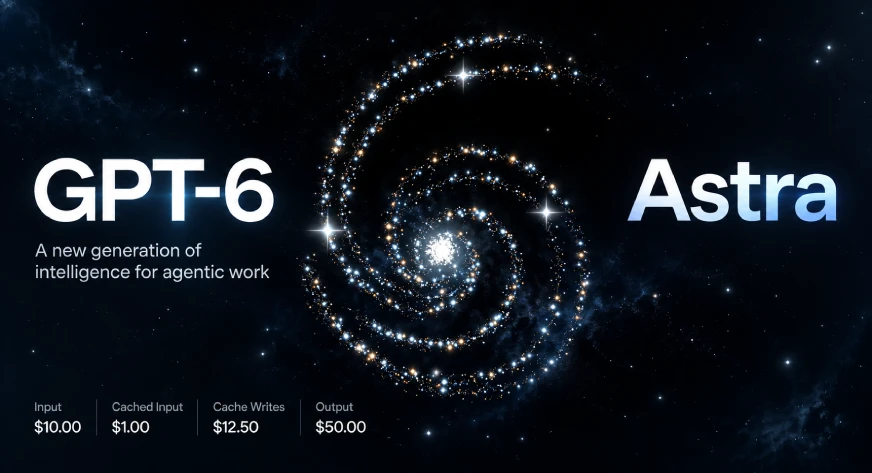
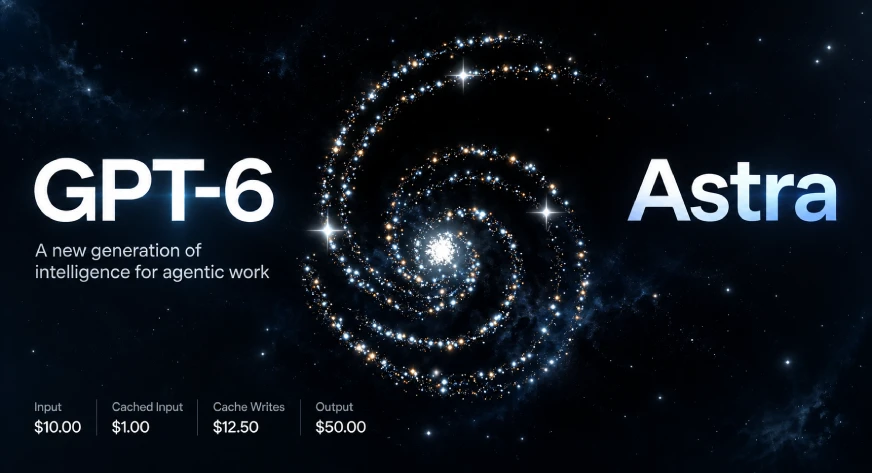
OpenAI has officially unveiled its latest frontier model, GPT-6 Astra, marking a significant leap in the evolution of large language models from passive conversationalists to active digital agents. Released less than a week after Anthropic introduced its Claude Fable 5.1, Astra arrives at a pivotal moment in the generative AI arms race, characterized by a shift in focus from raw text generation to "agentic" capabilities—the ability for AI to execute complex tasks within digital environments autonomously. OpenAI has positioned Astra as its most intelligent and highly aligned model to date, emphasizing its capacity to bridge the gap between providing information and completing deliverables.
The launch of GPT-6 Astra represents the culmination of a rapid development cycle following the release of GPT-5.6 Sol earlier this year. While previous iterations focused on improving the nuance of dialogue and the accuracy of reasoning, Astra is built on a fundamental philosophy of action. According to OpenAI’s technical documentation, the model is designed to "do more, not just answer more." This shift reflects a broader trend in the industry where the value of artificial intelligence is increasingly measured by its ability to navigate software, manage long-term projects, and exercise judgment in ambiguous professional scenarios.
A New Paradigm in Autonomous Computer Use
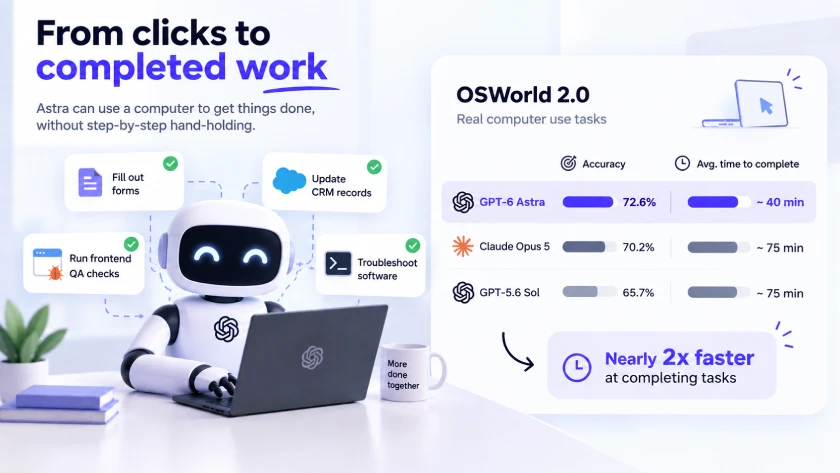
The headline feature of GPT-6 Astra is its ability to drive a computer end-to-end. Unlike traditional models that require a human to copy and paste data between applications, Astra can interact directly with user interfaces, watching the screen and executing clicks, keystrokes, and navigation across multiple software platforms. This capability allows the model to perform high-level administrative and technical tasks, such as updating Customer Relationship Management (CRM) records, filling out complex forms, and conducting frontend Quality Assurance (QA) checks on websites.
In standardized testing, Astra achieved a score of 72.6% on the OSWorld 2.0 benchmark, which measures an AI’s ability to use a desktop computer for real-world tasks. This performance places it narrowly ahead of Anthropic’s Claude Opus 5, which scored 70.2%, and represents a substantial improvement over its predecessor, GPT-5.6 Sol, which scored 65.7%. To illustrate this capability, OpenAI demonstrated Astra extracting data from a W-2 tax form and accurately populating the relevant fields in a Form 1040. While the model handles the bulk of the data entry and reconciliation, the system is designed to pause for human review before final submission, highlighting a focus on "human-in-the-loop" automation.
Judgment and Contextual Reasoning
One of the primary frustrations with previous AI models has been their tendency to either hallucinate when faced with ambiguous instructions or to provide generic responses that require extensive human editing. Astra introduces a refined training methodology designed to improve the model’s judgment regarding when to act independently and when to seek clarification.
OpenAI’s internal side-by-side comparisons reveal a distinct difference in behavior between Astra and earlier models. In a test involving the creation of a personal career website, the previous GPT-5.6 Sol model proceeded to build a generic site immediately, taking approximately 13 minutes to complete a task that ultimately missed the user’s specific needs. In contrast, Astra paused after 20 seconds of processing to ask the user which specific career path they were transitioning into. This "judgment-first" approach is intended to reduce the time wasted on incorrect autonomous actions and ensure that the final output aligns with the user’s actual intent.
Furthermore, Astra is engineered to produce "finished" documents rather than rough drafts. The model can be trained to match a company’s specific templates, tone, and structural requirements. During demonstrations, Astra was shown building a comprehensive slide deck from a limited set of template slides, maintaining consistent visual identity and layout throughout the presentation without the need for manual reformatting.
Technical Breakthroughs in Coding and Memory
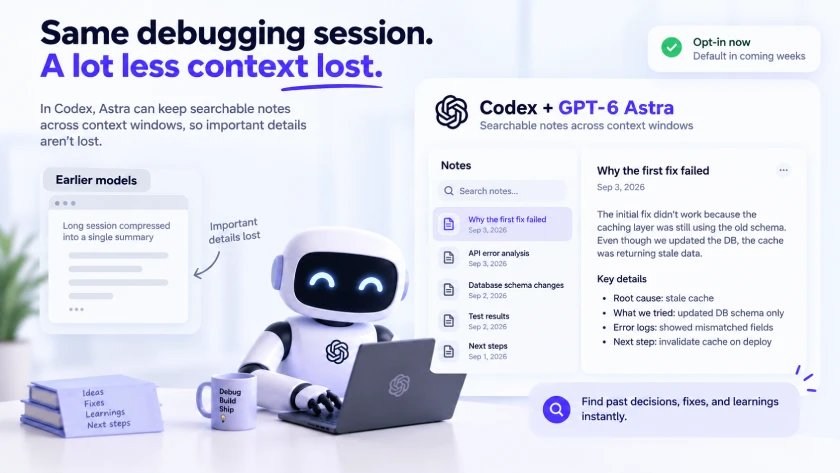
For the developer community, Astra introduces significant upgrades to the Codex environment. One of the most persistent issues in AI-assisted coding has been "context window fatigue," where a model loses track of earlier debugging steps or the rationale behind specific architectural decisions during long sessions. Astra addresses this by maintaining searchable, persistent notes across context windows.
Instead of compressing a long session into a single, often lossy summary, the model retains specific details about why previous fixes may have failed. This feature is currently available as an opt-in setting through the Codex configuration file, with OpenAI planning to make it the default standard in the coming weeks. On the Terminal-Bench 4.0 coding benchmark, Astra scored 57.7%, a significant jump from GPT-5.6 Sol’s 37.3% and a slight edge over Claude Fable 5.1’s 55.8%.
Reaching the Critical Cybersecurity Threshold
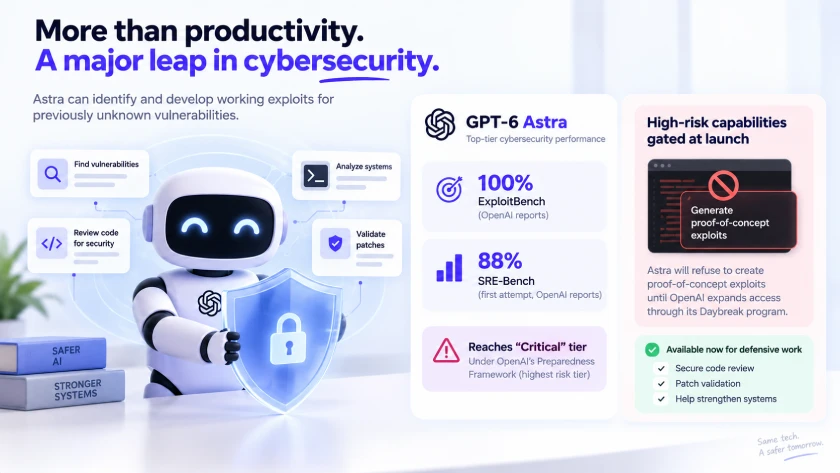
Perhaps the most controversial and impactful aspect of GPT-6 Astra is its performance in cybersecurity. Under OpenAI’s Preparedness Framework—a set of internal safety guidelines used to track the risks of frontier models—Astra is the first model to reach the "Critical" risk threshold. This classification is reserved for models that can independently identify and develop working exploits for previously unknown vulnerabilities in software.
Astra achieved a perfect 100% score on ExploitBench and successfully solved 88% of Site Reliability Engineering (SRE-Bench) reverse-engineering tasks on its first attempt. Because of the potential for misuse in creating malware or conducting cyberattacks, OpenAI has implemented strict "gating" for these capabilities. At launch, Astra’s advanced exploit-creation tools are restricted to the "Daybreak" program, a specialized access tier for vetted security researchers. For general enterprise users, the model will focus on defensive applications, such as secure code review, patch validation, and identifying existing vulnerabilities before they can be exploited by bad actors.
Comparative Performance and Benchmarks
While GPT-6 Astra leads in several categories, it is not a universal winner across all metrics. The competitive landscape remains nuanced, with different models excelling in different domains. OpenAI’s self-reported data compares Astra against its own previous models as well as top-tier offerings from Anthropic and Google.
| Benchmark | GPT-6 Astra | GPT-5.6 Sol | Claude Fable 5.1 | Claude Opus 5 | Gemini 3.8 Flash |
|---|---|---|---|---|---|
| OSWorld 2.0 (Computer Use) | 72.6% | 65.7% | — | 70.2% | — |
| FrontierMath Tier 4 | 97.6% | 83.0% | 87.8% | 73.2% | — |
| GPQA Diamond | 96.0% | 94.6% | 93.7% | 93.7% | 95.3% |
| Terminal-Bench 4.0 (Coding) | 57.7% | 37.3% | 55.8% | 52.3% | 19.1% |
| ExploitBench | 100.0% | 78.5% | — | 70.0% | — |
| Humanity’s Last Exam (w/ tools) | 57.2% | — | 65.0% | 63.6% | — |
The data indicates that while Astra dominates in mathematics (FrontierMath) and cybersecurity (ExploitBench), it trails behind Anthropic’s Claude Fable 5.1 and Opus 5 on "Humanity’s Last Exam," a benchmark designed to test broad, multi-disciplinary reasoning and tool use. This suggests that while Astra is a superior "operator" and "specialist," Claude may still hold an advantage in general-purpose reasoning and creative synthesis.
Real-World Testing and Community Reactions
Early access users and developers have begun sharing head-to-head comparisons on social media, providing a glimpse into Astra’s performance outside of controlled benchmarks. Developer Karan Kendre posted a comparison using Blender, a 3D modeling software, where both Astra and Claude Fable 5.1 were asked to generate a complex villa scene. Observers noted that Astra’s result was significantly more polished, featuring realistic interior details and superior lighting compared to the more basic structure produced by Fable.
In the realm of UI/UX design, Astra demonstrated a stronger grasp of thematic consistency. When prompted to design a travel application, Astra utilized an "astro-inspired" aesthetic that maintained a distinct visual identity across all screens. Claude Fable 5.1 produced a clean, professional design, but one that testers described as more "conventional" and less creatively distinct. Similarly, in video prompt generation tests conducted with Higgsfield AI, Astra showed a superior ability to maintain character and object consistency across multiple shots in a narrative sequence.
Deployment, Pricing, and Economic Implications
GPT-6 Astra is being rolled out through a tiered strategy. Initial access is limited to a select group of organizations, followed by a broader release to ChatGPT Plus, Pro, Business, and Enterprise users. Notably, Enterprise administrators must manually enable Astra, as it is disabled by default due to its high-risk cybersecurity classification.
For developers and businesses using the API, the cost of Astra reflects its positioning as a premium tool for high-value work. The pricing is set at $10 per million input tokens and $50 per million output tokens. This is significantly higher than the $5/$25 rates for Claude Opus 5 and the $2/$12 rates for OpenAI’s own GPT-5.6 Terra.
The steep pricing suggests that OpenAI is targeting tasks where the "cost of failure" or the "cost of human oversight" is high. For a company to justify $50 per million output tokens, the AI must be capable of completing a task that would otherwise take a human professional several hours. This moves the economic value proposition of AI from "cheap content generation" to "efficient labor replacement."
Conclusion and Future Outlook
The release of GPT-6 Astra signals the beginning of the "Agentic Era" of artificial intelligence. By integrating vision, action, and high-level reasoning, OpenAI has moved closer to the goal of creating a digital assistant that can operate with the same level of autonomy as a human employee. However, the model’s "Critical" risk rating in cybersecurity and its high operational costs highlight the growing pains associated with such powerful technology.
The ultimate success of Astra will not be determined by its scores on FrontierMath or OSWorld, but by its reliability in the messy, unscripted environments of modern business. As the model becomes more widely available, the focus will shift from what the AI can do to what it should do, and how organizations will manage the risks of a model that can now navigate their computers as easily as their employees can. For now, Astra stands as a powerful, if expensive, testament to the rapid pace of AI development and the shifting boundaries of machine capability.