A marketing team’s internal assessment of its operational effectiveness can reveal a stark reality: instead of a single, cohesive operational model, many organizations are unknowingly running two distinct systems in parallel. This disconnect, often masked by averaged scores, leads to common, yet often counterproductive, attempts to fix systemic issues, such as implementing more rigid intake forms. The key to unlocking true efficiency, experts argue, lies not in procedural fixes, but in a deep understanding of how work actually flows before any process changes are implemented.
The consequences of this underlying disconnect can be severe, as illustrated by a hypothetical product launch faltering due to a late-stage executive objection. The launch unravels not because of the objection itself, but because no single team member can readily access the complete plan, asset list, or ownership details. Despite prior visibility in meetings, the critical information resides solely with one individual, who is unavailable. This scenario, while anecdotal, reflects a pervasive challenge within marketing departments, where the perceived efficiency of a unified operation can mask a fragmented reality.
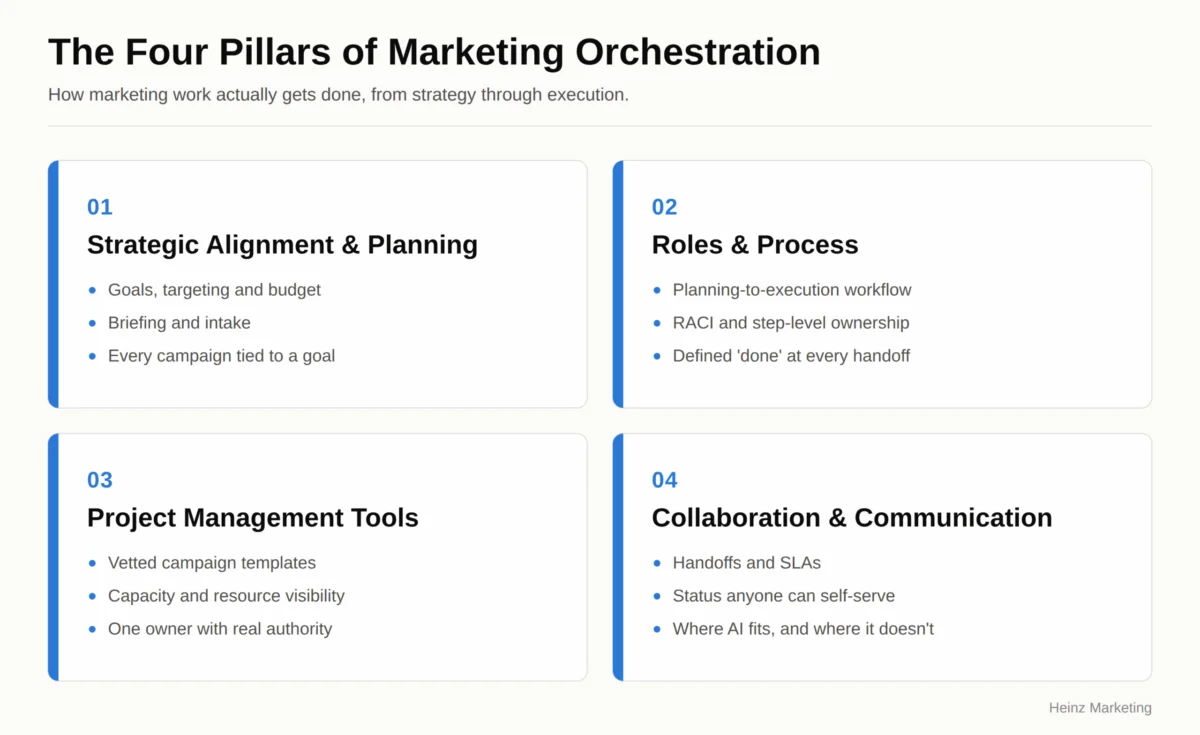
This issue was highlighted through the recent launch of a marketing orchestration self-assessment tool by Heinz Marketing. The tool, designed to gauge operational maturity, has yielded fascinating insights when completed by entire marketing leadership teams. A consistent observation across these assessments is the significant divergence in scores, even among leaders within the same company and operational sphere. For instance, scores related to strategic alignment and planning can differ by more than two points on a five-point scale. While a composite score might present a seemingly reasonable average, this figure often fails to represent the actual lived experience of team members, effectively averaging away the most critical findings.
The Illusion of Averages: Masking Divergent Realities
The natural inclination when faced with such assessment data is to report the composite score and move forward, as it offers a clean benchmark for improvement. However, this approach inadvertently obscures the nuanced realities of how work is executed. The data reveals two distinct operational models often coexisting within a single marketing department.
One segment of leaders may describe an organization with robust planning mechanisms, characterized by a defined intake process, clear protocols for handling unplanned requests, and established procedures for adapting to shifting priorities. In contrast, another segment might depict a far more reactive environment where a senior leader’s ad-hoc request can instantly supersede existing priorities, triggering a scramble to comply. Both descriptions, coming from leaders within the same marketing organization, accurately reflect their respective vantage points. When these responses are aggregated, they don’t show a gradual gradient of improvement but rather cluster into two distinct groups: one operating under a relatively mature model, and another functioning in a more chaotic, reactive state. This creates a situation where leadership operates under the assumption of a singular, unified model, while in reality, two fundamentally different systems are in play.
The "Pessimist" as a Strategic Indicator
A striking correlation emerges from these assessments: leaders who perceive the widest scope of the operation tend to assign lower scores, while those accountable for narrower, more contained areas report higher levels of satisfaction. This suggests that pessimism, or lower scores, is often directly proportional to the breadth of the leader’s operational oversight.
This finding offers a critical diagnostic tool for organizations using similar assessment exercises. The individual often perceived as overly negative or a constant naysayer may, in fact, possess the most comprehensive view of the organization’s shortcomings. Their critical perspective may stem from a higher vantage point, from which the seams and fractures in the operational fabric are more readily apparent. Before dismissing such feedback, leaders are encouraged to consider the scope of the operation that individual leader oversees.
High Collaboration Scores: A Red Flag in Disguise
Perhaps one of the most concerning findings is the consistently high scores in collaboration and communication, often reported with minimal disagreement among leadership. This generally reflects a positive sentiment: teams are perceived as good, genuinely trying their best, subject matter experts are engaged, and peer-to-peer communication is not seen as fundamentally broken.
However, this widespread agreement on collaboration can mask deeper systemic inefficiencies. In many organizations, leaders report having to painstakingly reconstruct campaign status by piecing together information from Slack threads, meeting notes, and personal recollections, followed by a final confirmation with the responsible individual. While the information exists, it lacks a reliable, centralized repository, leading to a time-consuming and often error-prone reconstruction process. The fact that teams can reliably perform this manual reconstruction leads to the illusion of smooth collaboration, even though the underlying infrastructure and processes are absent.
This "collaboration drag," as identified by Gartner, affects 84% of marketers, particularly as cross-functional work becomes more complex. When teams are consistently expending significant effort to gather and synthesize basic information, this "drag" becomes normalized, perceived as an inherent part of the job. The cost is paid in attention – a resource that does not scale with increased headcount. In fact, each new hire can potentially exacerbate this attention tax if foundational processes are not in place.
The Flawed Fix: Why Better Intake Forms Aren’t Enough
When marketing organizations grapple with collaboration drag and operational inefficiencies, the most common proposed solution is the implementation of a more robust intake process. The logic is sound: a structured intake system can ensure that new requests are properly evaluated against existing commitments, rather than being decided impulsively in meetings.
Despite its intuitive appeal, this fix frequently fails because teams often begin at the wrong stage. An effective intake process is predicated on the ability to answer the crucial question: "What would need to move to accommodate this new request?" This, in turn, requires a clear understanding of current team capacity and ongoing project statuses. Such knowledge is impossible without consistency in how work is structured and tracked, which necessitates clear ownership at the individual or sub-team level.
Many leaders report that accountability rests primarily at the team level, allowing individuals to claim they completed their part, even as work stalls in the inter-team gaps. Furthermore, campaigns are often built from scratch or heavily adapted from existing templates, indicating a lack of standardized workflows. Consequently, when intake forms are prioritized without addressing these foundational issues, they quickly become ineffective, with forms going unfilled within a quarter.
This pattern is particularly evident in large marketing organizations that have attempted workflow improvements multiple times. By that stage, the process gap is no longer the primary obstacle; instead, change fatigue becomes a significant impediment. Successful transformations have been observed to eschew the immediate implementation of new tools or intake forms. Instead, they commence with a thorough understanding of the actual workflow. This involves documenting the end-to-end planning-to-execution process, identifying critical communication touchpoints, clarifying ownership, and mapping individual responsibilities. Only after this foundational work is completed is the project management platform configured to align with the established workflow. Centralized intake, the initial objective for many, emerges as a later enhancement, not the starting point.
These organizations typically pilot new approaches with small teams and limited work types, engaging in regular feedback loops to identify and rectify issues before broader implementation. The impact, while potentially modest on paper, proves significant in practice. Capacity becomes a visible metric rather than a guessing game, requests are routed more consistently, service levels become measurable, and new teams can adopt the process with ease. This leads to improved time-to-market, and crucially, a boost in morale – an often-overlooked but profoundly impactful outcome.
Unlocking Internal Best Practices
A remarkable observation from these assessments is that the solutions to the gaps identified by lower-scoring teams often already exist within the higher-scoring segments of the same organization. One team might have immediate access to campaign status information without needing to contact a colleague, while another may possess a mature project management system with robust governance. Similarly, some teams exhibit clear stage-gate expectations and have integrated AI strategically into their workflows, rather than leaving its application to individual habit.
The best practices required to address nearly every identified gap are frequently present internally. The challenge lies not in a lack of capability but in the absence of a mandate or a mechanism to elevate one team’s successful pattern into a company-wide standard. This becomes a problem of organizational alignment and change management rather than a deficiency in skill or process.
This issue often persists because the work in question spans multiple teams, thereby falling outside the purview of any single leader. The imperative to address it diminishes the moment a more immediate crisis emerges. The path to resolution is less about introducing complex new systems and more about fostering collaboration and knowledge sharing.
Practical Application: Three Diagnostic Questions
The effectiveness of these assessments stems from their scenario-based nature. Rather than soliciting opinions, the questions present scenarios, with each answer option representing a distinct level of operational maturity. This allows individuals to select the option that most accurately reflects their daily reality, leading to honest and data-driven scores. Three representative questions illustrate this approach:
-
Campaign Status Inquiry: When you need the current status of a campaign, what is your immediate course of action? Options range from reconstructing the information from disparate sources like Slack threads and memory, to directly asking the responsible individuals, to accessing a shared system and retrieving the information within a minute.
-
Mid-Quarter Urgent Request: A senior leader submits a request mid-quarter that was not part of the original plan. How is this request handled? Potential outcomes vary from the decision being made impulsively during a meeting, to the request being systematically scoped against existing commitments, with explicit acknowledgment of any trade-offs.
-
Messaging Updates for In-Flight Campaigns: If your core messaging shifts mid-quarter, how long does it typically take for ongoing campaigns to reflect this new messaging? The timeframe can range from days, to weeks, or even never, with existing campaigns continuing to deploy the outdated messaging.
Leveraging Assessment for Clarity and Consensus
The ungated marketing orchestration self-audit tool is publicly available, and organizations are encouraged to have multiple leaders complete the assessment independently. The subsequent comparison of these individual scores, particularly focusing on areas of disagreement, can offer a more profound understanding of the marketing organization’s true operational dynamics than any averaged composite score. The divergence between the most and least optimistic leader’s perceptions often provides a more accurate and actionable insight into how the marketing department functions in practice.