Target is significantly expanding its integration of artificial intelligence (AI) across its digital shopping platforms, aiming to streamline customer experiences and unlock new efficiencies. The retail giant has recently rolled out a suite of AI-powered features, including an innovative Photo Search function, AI-driven customer review summaries, and enhanced tools for reordering past purchases and continuing unfinished online sessions. This strategic push into AI is further underscored by the appointment of Target’s first Chief AI Officer, signaling a deep commitment to leveraging advanced technology to redefine the modern retail journey.
The company’s proactive approach to AI integration was detailed in a blog post on September 8th, highlighting several key advancements introduced since 2025. Among these is Photo Search, a feature that allows shoppers to upload or capture an image to discover similar products within Target’s extensive catalog, eliminating the need for descriptive text searches. Complementing this is AI Review Insights, designed to distill the essence of hundreds of customer reviews into easily digestible summaries, helping shoppers make more informed purchasing decisions by focusing on attributes that truly matter. Furthermore, Target is leveraging AI to simplify the repurchase process with its "Buy Again" tool, which surfaces past purchases for effortless reordering, and to re-engage customers with unfinished shopping journeys through its "Continue Shopping" feature.
This intensified focus on AI comes at a critical juncture for Target, as it strategically bolsters its leadership in this domain. Chandhu Nair was appointed as the company’s inaugural Chief AI Officer, effective August 24th. During Target’s quarterly earnings call last month, CEO Michael Fiddelke emphasized Nair’s pivotal role in accelerating the company’s ability to harness AI. "Chandhu will help us accelerate how we harness the power of AI to create better guest experiences and unlock new capabilities across our business," Fiddelke stated, underscoring the strategic importance of AI in driving both customer satisfaction and operational innovation.
Target’s commitment to AI is reflected in its prominent industry rankings. The company holds the fifth position in the Digital Commerce 360 Top 1000 Database, a comprehensive market research tool that ranks North America’s largest online retailers based on annual e-commerce sales and other key metrics. In addition to its e-commerce prowess, Target also ranks 54th in Digital Commerce 360’s newly established AI Rankings, a testament to its growing leadership in the application of artificial intelligence within the retail sector.
AI-Powered Innovations Enhancing the Shopping Experience
The introduction of Photo Search, the latest AI-driven tool, marks a significant step forward in visual discovery for Target shoppers. Launched in August within the Target app, this feature empowers users to simply tap a camera icon in the search bar, then upload or take a picture to find visually similar products. This intuitive approach bypasses the need for verbal descriptions, making product discovery more natural and efficient, especially when a shopper has a visual idea of what they are looking for but lacks the precise terminology.
Complementing Photo Search, AI Review Insights addresses the challenge of sifting through vast quantities of customer feedback. Deployed in June, this AI tool meticulously analyzes product reviews to identify commonly discussed attributes and organizes customer sentiments into coherent themes. This allows shoppers to quickly grasp the key aspects of a product that resonate most with other buyers, thereby reducing the time and cognitive load associated with making purchase decisions. For instance, in the activewear category, Review Insights could aggregate feedback around comfort, fit, material stretch, and breathability, providing a concise overview of user experiences. Target reports that early data indicates Review Insights is positively impacting conversion rates and add-to-cart activity, while simultaneously mitigating "decision fatigue" – a common consumer challenge in today’s saturated market. While specific figures were not disclosed, the observed improvements suggest a tangible benefit for both shoppers and the retailer.
It is important to note that while innovative, these AI-driven features are not entirely novel in the broader retail landscape. Competitors like Amazon have been offering similar capabilities for some time. Amazon Lens, for example, has provided photo-based product search, and the e-commerce giant has also been utilizing AI to generate summaries of customer reviews for several years, indicating an ongoing arms race in leveraging AI for enhanced e-commerce experiences.
Streamlining Repeat Purchases and Unfinished Shopping Journeys with AI
Beyond discovery and evaluation, Target is strategically employing AI to foster customer loyalty and encourage repeat business. The "Buy Again" tool, accessible through the app’s main navigation, leverages AI to present users with their past purchases, frequently ordered items, and relevant deals tailored to their shopping history. This feature significantly simplifies the process of replenishing essential items. A shopper can effortlessly pull up a previous grocery order and quickly add staples like milk, bread, or paper products to a new cart, transforming a potentially time-consuming task into a few quick taps.
Since its launch last year, Target has continuously refined the "Buy Again" tool, enhancing its recommendation algorithms and deal selection capabilities. The retailer reports that this feature has driven "double-digit conversion growth year-over-year, while driving demand in categories like food and beverage." This suggests a strong correlation between AI-powered personalization for repeat purchases and increased sales in key consumer goods segments.
Similarly, the "Continue Shopping" feature utilizes AI-powered personalization to re-engage customers with unfinished online sessions. This tool intelligently brings shoppers back to products they have recently viewed, while also proactively suggesting alternatives and relevant offers across Target’s homepage, "My Target" section, and search results. Since its introduction last fall, Target has observed that this feature is "driving double-digit conversion rates and incremental add-to-carts," indicating its effectiveness in recapturing lost sales opportunities and encouraging further engagement.
Target’s Broader AI Expansion and Future Horizons
These recent AI enhancements are integral to Target’s wider strategy of embedding AI into its commerce operations. During the company’s Q2 earnings call on August 19th, Chief Merchandising Officer Cara Sylvester highlighted the successful integration of AI-powered teacher and college wish lists, along with more personalized content on the app’s home screen. Sylvester reported a significant uptick in wish-list creations, with total creations increasing by over 50% compared to the previous year, and the number of items added to these lists more than doubling. Furthermore, conversion rates across Target’s key back-to-school landing pages saw an increase of nearly 20%, demonstrating the tangible impact of AI-driven personalization on seasonal sales initiatives.
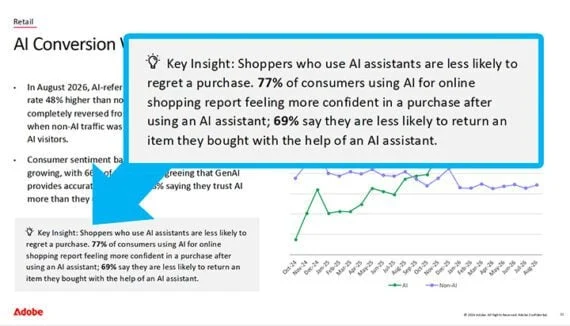
Looking beyond its proprietary platforms, Target is actively exploring how customers might interact with the retailer through external AI platforms. CEO Michael Fiddelke revealed that Target is collaborating with leading AI developers such as OpenAI and Google Gemini as it investigates the potential of "agentic commerce." While traffic generated from these external AI platforms currently represents a small fraction of Target’s overall digital traffic, its growth rate is notable, exceeding the industry average by more than 3.5 times year-over-year. This suggests a forward-thinking approach to meeting customers where they are, even as AI technology continues to evolve and integrate into various digital ecosystems.
Shipt Leverages AI with "Ask Shipt" Assistant
Adding another dimension to Target’s conversational commerce strategy, Shipt, the same-day delivery service owned by Target, has launched its own AI-powered shopping assistant. On September 9th, Shipt introduced "Ask Shipt" within its app and on Shipt.com. This new feature aims to transform conversational shopping by enabling users to convert prompts, recipes, and even meal photos directly into a shopping cart.
Shipt, acquired by Target in 2017, describes "Ask Shipt" as an intelligent assistant capable of understanding natural language requests and translating them into actionable shopping lists. Customers can articulate their needs, and the assistant will identify relevant products and populate a cart. Users then have the opportunity to review, modify, or swap suggested items before proceeding to checkout. Katie Stratton, Shipt’s Chief Growth and Strategy Officer, emphasized the people-centric nature of this AI integration. "Ask Shipt brings people-centric AI directly into the shopping journey, helping members move from inspiration to a personalized cart in moments," Stratton stated. She further highlighted that the tool’s capabilities extend across Shipt’s extensive marketplace, which comprises over 100 retail partners.
The launch of "Ask Shipt" coincides with Shipt’s ongoing experimentation with various conversational interfaces. The company has recently enabled shopping functionalities through platforms like ChatGPT and Anthropic’s Claude, further broadening its accessibility and integration into emerging AI ecosystems. Additionally, Shipt is preparing to roll out "Shared Lists," a feature designed to facilitate real-time collaboration on shopping lists among multiple users. This functionality will allow for seamless conversion of a collaboratively built list into a shopping cart with a single click, enhancing convenience for households and groups.
Analysis and Implications
Target’s aggressive integration of AI across its digital touchpoints signifies a clear strategic imperative to enhance customer experience, drive operational efficiency, and maintain a competitive edge in the rapidly evolving retail landscape. By introducing features like Photo Search and AI Review Insights, Target is not only simplifying product discovery and evaluation but also addressing common pain points that can lead to cart abandonment or customer frustration. The emphasis on "Buy Again" and "Continue Shopping" underscores a data-driven approach to customer retention and lifetime value, leveraging AI to personalize interactions and encourage loyalty.
The appointment of a dedicated Chief AI Officer and the exploration of agentic commerce with partners like OpenAI and Google Gemini signal Target’s long-term vision for AI. This suggests a future where AI plays an even more pervasive role, potentially enabling highly personalized shopping agents that can manage complex tasks on behalf of the consumer.
While some of these AI functionalities are mirrored by competitors, Target’s consistent deployment and refinement across its owned properties and its subsidiary Shipt demonstrate a cohesive and ambitious AI strategy. The positive early results reported for features like Review Insights and Buy Again, particularly the "double-digit" growth metrics, suggest that these investments are yielding tangible business benefits.
The success of these initiatives will likely hinge on Target’s ability to continuously innovate, ensure data privacy and security, and seamlessly integrate AI into the overall customer journey without creating friction. As AI technology continues its rapid advancement, Target’s proactive stance positions it as a key player in shaping the future of AI-driven retail, aiming to make shopping more intuitive, personalized, and ultimately, more rewarding for its customers.