


Dropshipping continues to be a robust and dynamic sector within e-commerce, projected to reach a staggering market value of approximately $543.53 billion by 2026. This significant growth, however, fuels an increasingly competitive environment. For businesses aiming to carve out a distinct presence, the strategic selection of a dropshipping partner is paramount. Among the prominent platforms catering to this demand, Spocket and Doba have emerged as leading contenders, particularly for merchants building their operations on platforms like Shopify. While both offer comprehensive solutions, they cater to distinct operational needs and business scales, with Doba positioning itself as a more integrated operational hub and Spocket emphasizing curated product selection and supplier proximity.
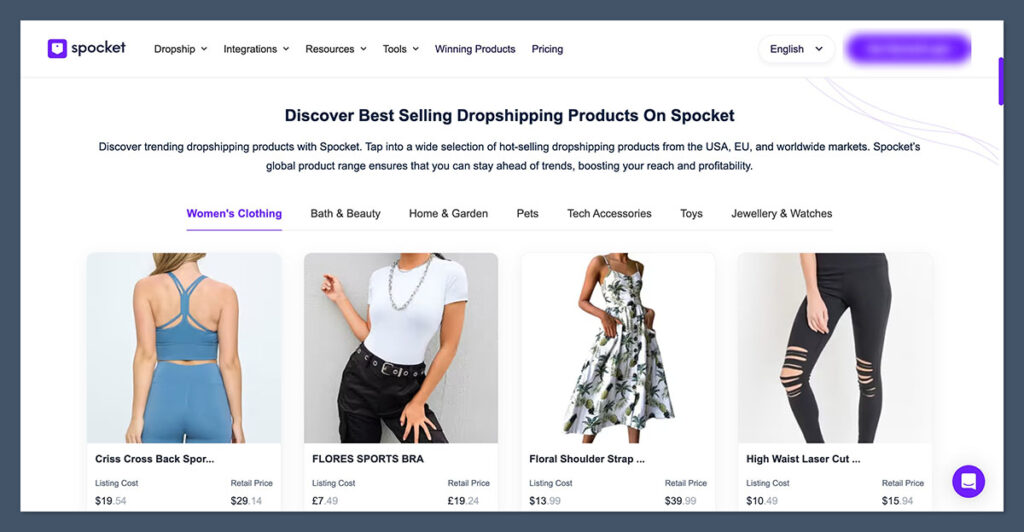
The core differentiation lies in their operational philosophy. Spocket champions selectivity, presenting a curated catalog that prioritizes trending items, often sourced from suppliers located in the United States and Europe. This approach aims to simplify the product discovery process and often translates to quicker domestic shipping. Conversely, Doba boasts a substantially larger inventory, with a pronounced emphasis on U.S.-based suppliers and products stored in U.S. warehouses, making it an attractive option for businesses targeting the American market. Furthermore, Doba distinguishes itself with a broader array of marketplace integration options and a sophisticated AI agent, Doba Pilot, which has significantly expanded its capabilities to automate a wider spectrum of daily operational tasks.
Doba vs. Spocket: A Strategic Overview for 2026
In the current e-commerce climate of 2026, the choice between Doba and Spocket hinges on a business’s growth trajectory and market focus. Doba is strongly recommended for established or rapidly expanding dropshipping enterprises that aim to serve a diverse customer base across multiple sales channels, including major platforms like Amazon, TikTok Shop, and established e-commerce storefronts. Its strength lies in its capacity to significantly reduce administrative overhead through advanced automation tools. These tools manage critical functions such as real-time price and inventory synchronization, seamless product listing migration between channels, the implementation of complex pricing rules, and the efficient management of extensive product catalogs.
The recent enhancements to Doba Pilot represent a significant leap forward, transforming it from a product sourcing assistant into a comprehensive AI-driven operational command center. Its expanded functionality now encompasses the entire dropshipping lifecycle, from initial market research and product sourcing through to listing management, order fulfillment, and even post-sales support. For businesses concentrating their efforts on the U.S. market, Doba’s robust network of U.S.-based suppliers and warehouse-fulfilled products offers a distinct advantage, potentially leading to faster shipping times and a more streamlined customer experience.
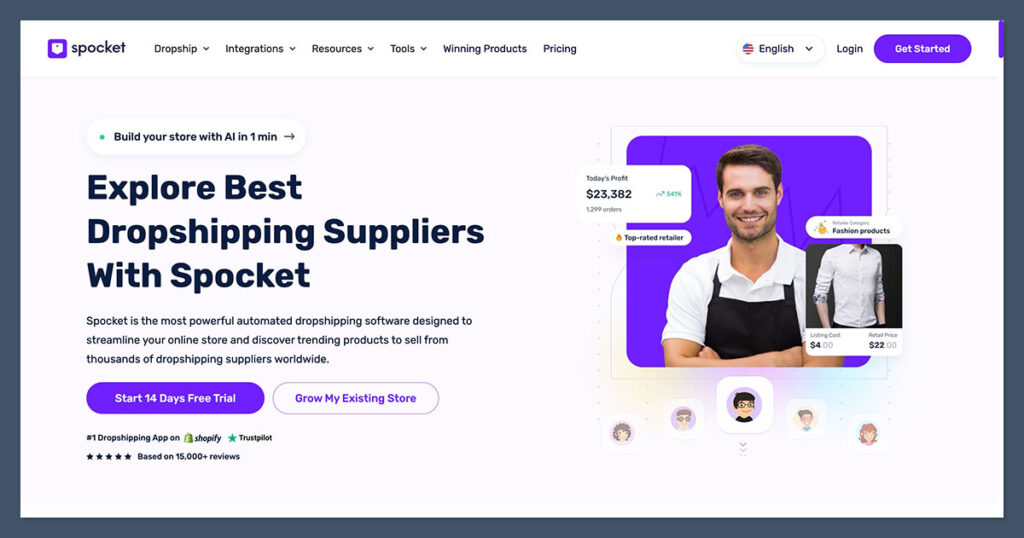
Spocket, on the other hand, presents a more streamlined solution, ideal for dropshippers who prioritize a curated selection of products and direct access to local suppliers. Its user interface is generally less complex, making it an accessible choice for those new to dropshipping. While it offers robust control over pricing and listings, including the option for branded invoices, a notable drawback for scaling businesses is its subscription model: each newly connected store requires a separate paid subscription, which can quickly escalate costs for multi-store operations.
Core Operational Philosophies: Efficiency vs. Curation
At their heart, both platforms provide essential dropshipping infrastructure and a wide array of product choices. However, their strategic focus diverges. Doba appears to be shifting its emphasis beyond initial product discovery, aiming to optimize the ongoing operational demands of a growing business. While its vast catalog is a key feature, its true value proposition in 2026 lies in its ability to automate and centralize the intricate processes required to keep a dropshipping business running smoothly. This includes the management of product imports, real-time stock level changes, order processing, shipment tracking, and the complex task of product movement across various sales channels.
Doba has evolved into what can be accurately described as a central operations hub. It consolidates critical functions such as product sourcing, supplier relationship management, e-commerce platform integrations, inventory control, listing management, order processing, and fulfillment into a unified ecosystem. The platform’s strong alignment with the U.S. market is evident in its catalog, which features over a million products, many of which are available from U.S. warehouses. This domestic fulfillment capability can be a significant differentiator for businesses where rapid delivery is a key component of their competitive strategy.
Spocket, in contrast, places a greater emphasis on the initial stages of the dropshipping journey. Its curated selection of U.S. and EU suppliers is designed to help retailers make informed choices early on. The process of selecting and importing products is intentionally straightforward: users identify desirable products, add them to an import list, make necessary edits, and then publish them to their stores. This simplicity makes Spocket particularly well-suited for smaller operations and individuals just beginning their dropshipping ventures.
| Comparison Point | Doba | Spocket |
|---|---|---|
| Best Fit | Growing dropshippers or marketplace sellers, especially US-focused ones | Beginners focused on finding the right supplier |
| Monthly Starting Price | $29.99 | $39.99 |
| Catalog Size | Over 1 million SKUs, including US warehouse options | Approximately 1 million products |
| Store Connections | Up to 15, depending on the plan | Multiple stores possible on one account, but each requires a separate subscription |
| Samples | Test orders can be placed | Dedicated "order samples" button |
| Branding | Varies by supplier; blind shipping for marketplace orders | Supports branded invoices on higher tiers |
| Main Channels | Shopify, Amazon, Walmart, eBay, TikTok Shop, WooCommerce, and more | Shopify, Wix, WooCommerce, BigCommerce, Squarespace, Amazon, eBay |
| Advanced Controls | Doba Pilot AI agent (research, sourcing, listing, fulfillment), automation, API, FTP, bulk downloads, listing migration | Supplier chat, premium products, bulk checkout (on select tiers) |
| Biggest Drawback | Potential learning curve, though Doba Pilot mitigates initial complexity | Costly for managing multiple stores due to per-store subscriptions |
Doba vs. Spocket: Pricing Structures and Overall Investment
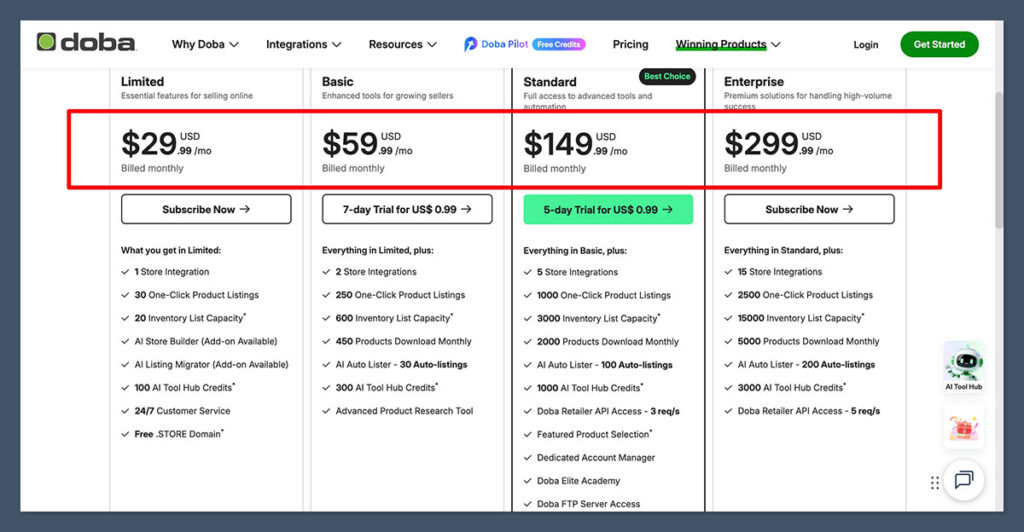
When evaluating the financial commitment, Doba generally presents a more accessible entry point for its foundational plans. The "Limited" plan, priced at $29.99 per month (with discounts for quarterly or annual payments), includes integration for one store, 30 one-click product listings, 20 inventory list slots, and 100 AI Tool Hub credits, with optional add-ons like AI Store Builder and AI Listing Migrator. The "Basic" plan, at $59.99 per month, expands these allowances and offers more credits. The "Standard" plan, costing $149.99 per month, significantly increases capacity, features, and store integrations, also granting access to API, dedicated account management, FTP server access, and the Doba Elite Academy.
Spocket’s plans begin at $39.99 per month, with an incentive of eight months free on the first annual subscription. This initial tier provides full catalog access, the ability to feature 25 unique products, AliExpress dropshipping capabilities, and multi-store management functionality. However, it’s crucial to reiterate that each individual store requires its own paid subscription, a factor that can significantly impact the total cost for businesses operating across multiple storefronts.
Both platforms offer considerable value, but the per-store subscription model of Spocket can become a considerable expense as a business scales its online presence across numerous channels. It is important to note that neither platform’s subscription fees cover the actual cost of the products themselves; these are separate expenses incurred at the time of sale.
Ease of Use and Onboarding: Navigating the Learning Curve
For individuals new to the dropshipping world, Spocket often presents a gentler initial learning curve. Its interface is designed for straightforward navigation: users browse the curated catalog, select products for import, make desired modifications, and then publish them to their chosen sales channel. While this process is intuitive, it’s worth noting that shipping costs are typically handled separately from the product pricing. A minor inconvenience can be the need to import products individually, although bulk publishing of import lists is available post-initial setup.
Doba, on the other hand, is a significantly more feature-rich platform. It even includes an AI-powered store builder, indicating a more comprehensive suite of tools. Setting up dropshipping operations on Doba involves a slightly steeper learning curve, but the platform offers robust features designed to accelerate manual tasks. The Doba Pilot AI agent, for instance, can assist in product research tailored to specific niches or shipping preferences, thereby reducing the time spent on manual filtering.
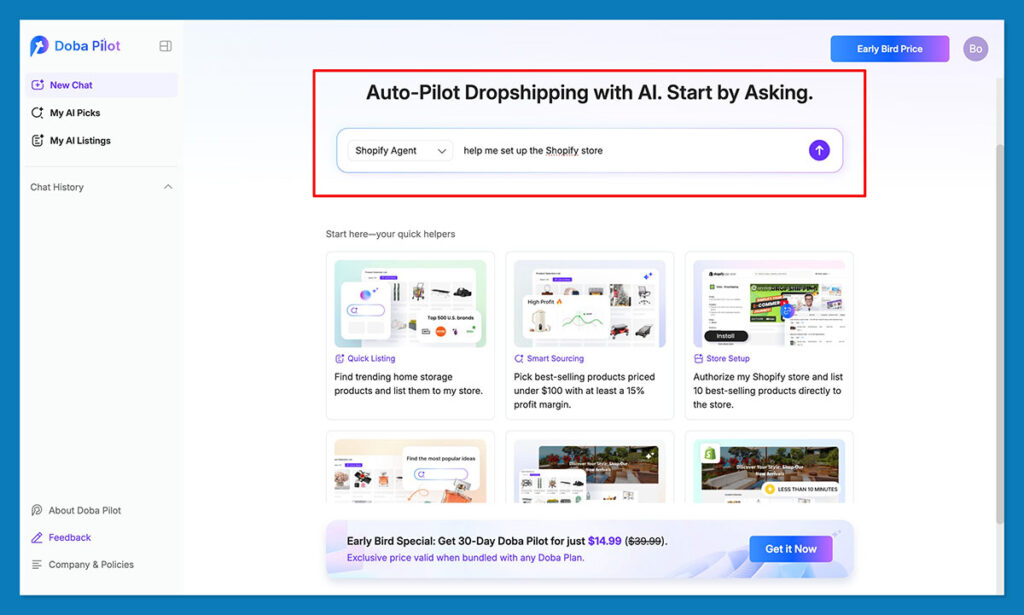
The recent advancements in Doba Pilot have notably smoothed the initial onboarding experience. The AI agent can now guide users through product discovery, store connection, and the initial listing process in a conversational manner, making the platform more accessible to beginners. While Doba remains a more complex system compared to Spocket, this enhanced AI guidance lowers the barrier to entry for getting a functional store operational. Furthermore, Doba provides an extensive library of online resources, including a dedicated "Academy" accessible with higher-tier plans, which is invaluable for entrepreneurs seeking to optimize their business strategies and achieve growth.

AI, Automation, and Product Research Capabilities
The integration of Artificial Intelligence and automation is a key differentiator in the current dropshipping landscape, and Doba has made substantial investments in this area. Doba Pilot, which initially functioned primarily as a conversational catalog search tool, has undergone a significant upgrade. It now operates as an all-encompassing AI dropshipping agent, covering the entire workflow from market research and sourcing to listing and fulfillment.
Market Scout, a component of Pilot, analyzes demand, competition, pricing trends, and seasonality to help businesses assess market viability before committing resources. Smart Sourcing allows users to input basic product descriptions, category preferences, price ranges, and shipping locations, and the AI then curates relevant product suggestions for review, drastically reducing manual product discovery efforts.
Pilot also streamlines the process of connecting stores and can assist in building Shopify stores, including theme and banner selection. Its store and listing workflows now extend across Shopify, BigCommerce, Wix, eBay, Walmart, and TikTok. The latest update enhances multi-channel listing capabilities for Walmart and TikTok by offering AI-assisted product attribute completion, UPC uploads, listing previews, and bulk publishing. Once stores are connected, Pilot aids in setting prices, optimizing titles and descriptions, and managing the publishing process.
Order and fulfillment management are also integrated within the Pilot interface, allowing users to monitor logistics status, review exceptions, track shipments, and initiate refund processes without switching between multiple tools. Pilot’s expanded fulfillment capabilities include proactive monitoring for logistics exceptions and the ability to intercept unshipped purchase orders if a corresponding store order is canceled, offering a distinct operational advantage over standard AI assistants. While Pilot cannot autonomously resolve every issue, it significantly reduces the need for extensive tab-switching and manual data handling. Users can also schedule recurring tasks such as sourcing, auto-listing, or market report generation, and query Pilot for information regarding Doba’s policies and suppliers. Additional AI-powered tools within Doba include AI Pickr, image editing capabilities, and automated listing and migration tools.
It is important to note that Doba’s AI features are tied to credit allowances within different subscription plans. Tools like AI Store Builder and AI Auto Lister operate under their own quotas or pricing structures, distinct from standard AI Credits. New Doba users are typically provided with 30 free Doba Pilot Credits upon signup.
Spocket, while not as extensively focused on broad AI applications as Doba, incorporates intelligent features for product filtering. Users can sort products by origin, destination, price, supplier, premium status, or best-seller ranking. Spocket also offers shipping time and cost estimations, though these features are currently limited to U.S. sellers. Both platforms automate fundamental order processing workflows. Doba additionally provides automated inventory and pricing updates, listing management tools, and AI-assisted operational tasks, with functionality varying based on the specific sales channel.
Product Range, Quality, and Supplier Vetting
Both Doba and Spocket offer a substantial number of products, with Doba generally presenting a broader spectrum of categories. Its catalog encompasses diverse areas such as homeware, beauty products, automotive accessories, and niche items often overlooked by other dropshipping platforms. With over a million SKUs, Doba is particularly beneficial for businesses experimenting with various product angles across multiple stores rather than focusing on a single niche. However, it’s important to acknowledge that Doba partners with a large number of suppliers, and while vetting processes are in place, product quality can exhibit variability.
Spocket maintains a more stringent approach to supplier selection. Suppliers must either manufacture their own inventory or physically hold it, and they are required to offer retailers a minimum discount of 25% off their public pricing. The vast majority of Spocket’s suppliers are located in the U.S. and EU. While Doba also allows filtering by location, Spocket’s curated network aims to ensure a higher baseline of supplier reliability and product origin transparency.
Shipping, Fulfillment, and Returns: Ensuring Customer Satisfaction
Spocket highlights its network of U.S. and EU suppliers, which facilitates relatively swift local delivery. Doba similarly provides a strong U.S. shipping infrastructure, with approximately 90% of its products originating from the U.S. This domestic focus can result in comparable delivery times for U.S.-based retailers, though actual transit times remain dependent on the specific product, supplier, destination, and chosen shipping method.
Doba specifically flags products that ship from U.S. warehouses, which are advantageous for businesses prioritizing fast domestic delivery. These products can mitigate common fulfillment challenges, including extended transit times, stockouts, and customer complaints related to late deliveries. It is crucial to remember that not all products in Doba’s catalog are U.S.-warehoused, and neither platform can guarantee specific delivery windows.
Both platforms enforce clear supplier guidelines. Doba mandates that suppliers refund any order not dispatched within their stated processing times. Damaged items are eligible for a prepaid return label upon submission of evidence. Orders with invalid tracking information that cannot be rectified by the supplier also result in a refund. Doba further offers optional After-Sales Protection Services to help retailers mitigate losses from issues such as non-defective returns or orders marked as delivered but not received.
Spocket requires its suppliers to maintain a 95% order success rate, provide tracking details, and adhere to stated delivery windows. Suppliers are also obligated to respond to inquiries within 24-47 hours. However, individual suppliers retain the autonomy to define their own return policies, and some may not accept returns at all.
Both companies provide automated tools to expedite fulfillment processes, though retailers may still need to manage certain complexities, such as split-basket orders, on their own.
Integrations, Storefronts, and Scalability
Doba and Spocket offer integrations with a wide array of popular e-commerce platforms, including Shopify, WooCommerce, Wix, BigCommerce, and Square, among others. However, Doba demonstrates a more extensive capability when it comes to connecting with external marketplaces. Its robust multi-channel listing features simplify expansion into platforms like Temu, TikTok Shop, Amazon, and eBay. While Spocket also offers integrations with Amazon and eBay, Doba’s architecture is more geared towards centralized management of diverse sales channels.
Doba centralizes data management across connected sales channels, offering a unified dashboard for product, inventory, store, and order information. This automatic synchronization of inventory levels and orders across platforms is a critical advantage for multi-channel sellers, helping to prevent stock discrepancies and errors associated with manual order processing. It’s important to note that while Doba integrates with a broad range of platforms, Doba Pilot’s direct store and listing workflows are currently optimized for Shopify, BigCommerce, Wix, Walmart, TikTok Shop, and eBay.
Both platforms provide API integrations. Spocket’s API is primarily focused on streamlining storefront integration, including automated checkout processing and inventory tracking. Doba’s API, conversely, is designed for bulk data streaming, multi-channel marketplace synchronization, fulfillment routing, and comprehensive inventory updates, reflecting its broader operational scope.
Samples, Branding, and Packaging: Enhancing the Customer Experience
Ordering product samples is a recommended practice for both dropshipping and print-on-demand ventures, and both Doba and Spocket facilitate this. Spocket features a clear "order samples" option on each listing, allowing users to purchase up to five units per item. Bulk sampling is not available. For Doba, the process of ordering samples can be more involved, often requiring direct coordination with individual suppliers or through specific supplier listings.
Spocket offers branded invoicing capabilities on its higher-tier plans. Doba enforces blind shipping for marketplace orders, with additional branding or packaging options being supplier-dependent. Spocket generally excels in this area due to its more streamlined sample ordering and branded invoicing features, requiring less direct seller effort.
Doba vs. Spocket: A Conclusive Verdict for 2026
Both Doba and Spocket are valuable tools in the dropshipping ecosystem, each catering to different business needs. Spocket stands out as an excellent choice for entrepreneurs seeking local suppliers, a user-friendly setup, convenient access to samples, and the ability to implement branded invoicing. It is particularly well-suited for beginners and those managing a single online store.
However, Doba emerges as the more comprehensive solution for a broader range of businesses, particularly those focused on growth and scalability. Its competitive starting price, coupled with its extensive control over listings, orders, inventory, marketplace integrations, and multi-store management, positions it as a superior choice for expanding operations. The advanced AI and automation tools offered by Doba are invaluable assets for businesses as they scale.
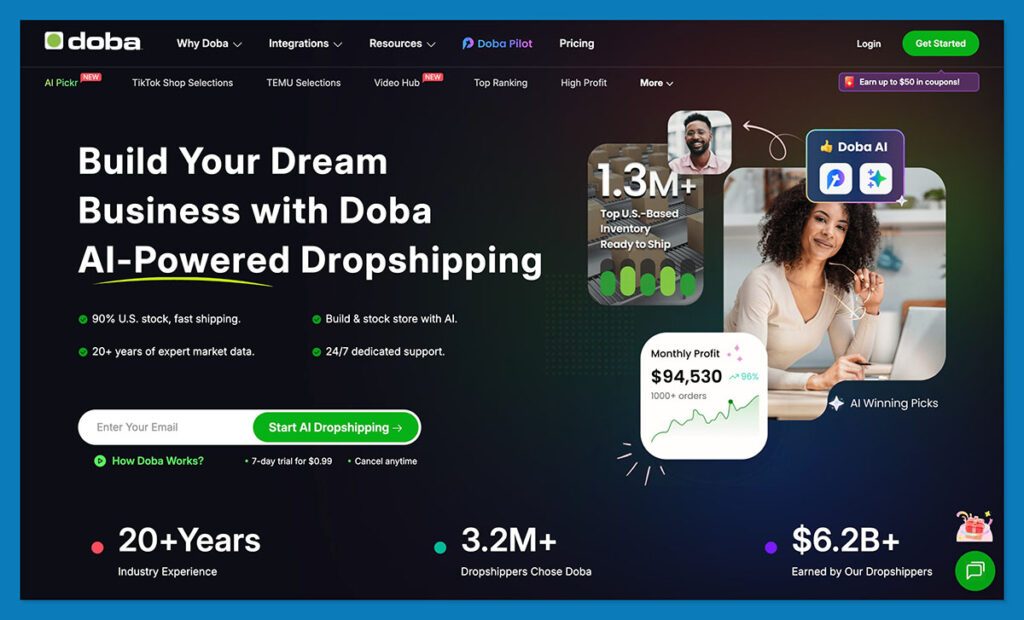
The recent enhancements to Doba Pilot have significantly addressed past criticisms regarding its learning curve. By providing conversational guidance through research, sourcing, store setup, and listing processes, Doba Pilot makes the platform more accessible to new users. While Doba may offer more functionality than a very small startup might immediately require, its integrated ecosystem and robust automation make it the more practical platform for businesses aiming for sustained growth and operational efficiency. As the dropshipping market continues to evolve, Doba’s all-encompassing approach to operational management provides a clear advantage for businesses looking to scale effectively.








