Dwi Wanna
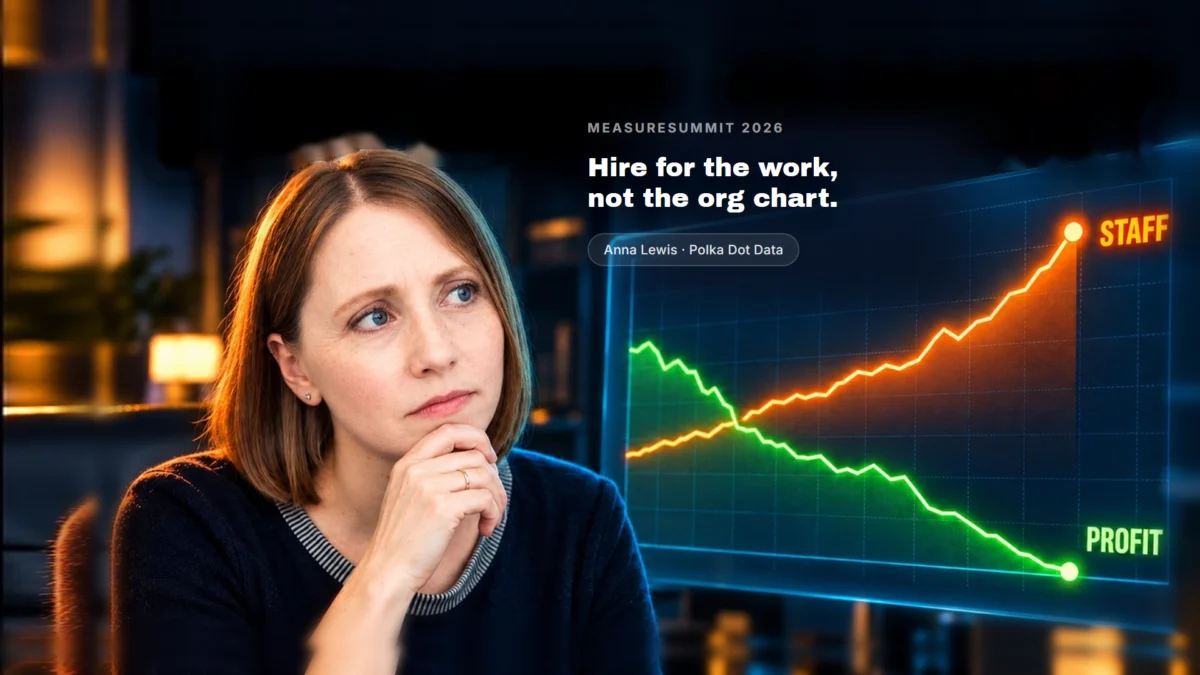
In an era where data-driven decision-making is championed as the ultimate competitive advantage, many analytics agencies paradoxically struggle to manage their own internal growth and profitability. During the recent MeasureSummit 2026, Anna Lewis, the founder of the analytics consultancy Polka Dot Data, provided a candid retrospective on a decade of leadership, detailing the systemic hiring errors that frequently erode agency margins. Lewis, who established her firm ten years ago, shared a data-backed narrative of the pitfalls encountered when scaling an analytics team, specifically highlighting how a peak headcount of eight employees nearly compromised the firm’s financial stability when the workload could not sustain the overhead.
The core of the presentation focused on the "pinball effect" visible in many service-based businesses: a scenario where revenue and profit fluctuate wildly while fixed costs, primarily salaries, remain high and inflexible. Lewis’s historical data showed periods where the margin between revenue and operational costs was so thin that the business essentially functioned without profit. To counter this, she developed a framework of six critical hiring mistakes that agency leaders and in-house analytics managers must avoid to ensure long-term sustainability.

A Chronology of Scaling Challenges
The journey of Polka Dot Data serves as a microcosm for the broader analytics industry. Between its founding and its tenth anniversary, the firm navigated the transition from a solo consultancy to a multi-person agency. The most significant inflection point occurred when the firm reached a headcount of eight. Lewis noted that this expansion was driven more by the desire to build a traditional corporate hierarchy than by the immediate demands of the client pipeline.
This "ego-driven" scaling led to a period where the firm was "hanging by a thread," according to Lewis. The misalignment between labor capacity and billable hours resulted in a chart where headcount remained a flat, high line, while revenue dipped and peaked unpredictably. The resolution of this crisis required a fundamental shift in how the firm evaluated talent, structured its teams, and tracked its financial health.
Mistake 1: Prioritizing the Curriculum Vitae Over Environmental Fit
One of the most common errors identified in the session was the tendency to hire based on the "Rose Analogy." Lewis explained that a candidate might possess a "perfect" CV—replete with prestigious degrees and technical certifications—yet fail to thrive because the "soil" of the agency environment is unsuitable for them.

In a professional services context, technical proficiency is a baseline requirement, but it is rarely the primary driver of long-term success. Lewis argued that resilience often outweighs academic credentials. The high-pressure nature of client-facing analytics work, which involves navigating shifting deadlines and technical troubleshooting, requires a temperament that can handle ambiguity.
"Resilience probably matters more than academics," Lewis stated. "You can have all the academics in the world, but unless you’ve got the resilience to keep working at it in the real world, it’s not going to count for anything." Consequently, modern hiring processes must incorporate behavioral interviewing techniques that probe for how a candidate has overcome past professional failures rather than just listing their technical stack.
Mistake 2: The Perils of Team Cloning and the Need for Cognitive Diversity
Lewis identified the "Sunflower Field Problem," a phenomenon where founders unconsciously hire individuals who mirror their own personality types, communication styles, and problem-solving approaches. While this creates initial harmony, it leads to blind spots in project execution and strategic planning.

To combat this, Polka Dot Data implemented the DISC personality profiling system, which categorizes individuals into four primary quadrants:
- Dominance (Red): Results-oriented, forceful, and direct.
- Influence (Yellow): Outgoing, enthusiastic, and persuasive.
- Steadiness (Green): Patient, diplomatic, and consistent.
- Conscientiousness (Blue): Analytical, systematic, and precise.
Lewis, who identifies within the "Red" (Dominant) zone, noted that her firm’s stability improved significantly when she hired a "Blue" (Conscientious) analytics developer. While the founder focused on growth and client acquisition, the developer focused on systems, documentation, and project completion. The session emphasized that a high-performing analytics team requires a balance; a team of only "Red" profiles will lack attention to detail, while a team of only "Blue" profiles may struggle with client communication and business development.
Mistake 3: Neglecting the Context of Agency vs. In-House Roles
A significant portion of the MeasureSummit talk addressed the fundamental differences between working for an external consultancy and working as part of an internal corporate data team. Hiring an elite in-house analyst for an agency role—or vice versa—often results in turnover because the environmental demands are diametrically opposed.

Agency roles demand "context switching," where an analyst must move between multiple clients, industries, and technical environments within a single day. This requires high adaptability and a tolerance for the "chaos" of external service work. Conversely, in-house roles require deep "institutional knowledge," long-term project ownership, and the ability to navigate internal corporate politics.
Lewis cautioned that failing to recognize these distinctions leads to "filling a gap with the wrong plant." A candidate who excels at deep-diving into a single company’s data for two years might find the rapid-fire nature of agency work exhausting, leading to burnout and decreased margins due to the high cost of replacement.
Mistake 4: Premature Structural Complexity
The fourth mistake involves building a "dream hierarchy" before the revenue supports it. Lewis admitted to the "ego trap" of designing a structure that included Heads of Analytics, BI Developers, and Client Success Managers while the firm was still at a size where such specialization was inefficient.

She proposed a tiered approach to team size:
- Small (1–3 people): High versatility is required. Every member must be a "generalist" capable of handling everything from data ingestion to client presentation.
- Mid-sized (4–10 people): This is the "danger zone" where overhead increases. Some specialization (e.g., a dedicated developer) is necessary, but the founder often remains the primary salesperson.
- Large (11+ people): Formal departments and middle management become essential for scalability.
The primary takeaway for agency owners is to ensure that the structure evolves in response to sustained revenue rather than in anticipation of it.
Mistake 5: The Stagnation of Job Specifications
In the rapidly evolving field of data analytics, a job description written two years ago is likely obsolete. Lewis argued that treating a job spec as a static document is a "work of fiction."

At Polka Dot Data, job specifications are integrated into the one-on-one management process. During regular reviews, employees are asked to audit their own job descriptions. This practice identifies "scope creep"—where an employee has taken on responsibilities outside their original remit—and highlights gaps where the business may need a new hire. Lewis recommended mapping the entire customer journey and listing every task involved; if a specific task has no owner, or if one person owns 80% of the tasks, the need for a revised job spec or a new hire becomes empirically evident.
Mistake 6: Failure to Track Granular Profitability Metrics
The final and perhaps most critical mistake is the lack of financial transparency regarding team performance. Many agencies track total revenue but fail to calculate the profitability of individual staff members. Following a framework inspired by industry veteran Fred Pike, Lewis now reviews a "stats pack" monthly.
The three essential metrics identified are:

- Staff-Profit Ratio: Total revenue generated by a person divided by their salary. This reveals who is truly driving the agency’s bottom line.
- Salary Percentage of Turnover: Total staff costs divided by total revenue. Lewis noted that her firm has seen this figure range from 20% to 70%. When this percentage exceeds 60%, the agency’s ability to weather a market downturn is severely compromised.
- Revenue Per Person: A simple but effective metric to ensure that as headcount grows, the business becomes more efficient rather than more bloated.
Beyond the numbers, Lewis emphasized the "Morale Feedback" loop. She used the metaphor of "Dementors"—individuals who drain the energy and positivity of a team. In a small agency, one negative personality can decrease the productivity of the entire group, leading to the departure of high-performing employees.
Broader Industry Implications and Conclusion
The insights shared by Lewis reflect a broader trend in the professional services industry: a move away from "growth at all costs" toward "sustainable profitability." As the cost of acquiring talent in the data sector remains high, the financial impact of a bad hire is magnified. Industry estimates suggest that the cost of replacing a specialized data analyst can be as high as 1.5 to 2 times their annual salary when accounting for recruitment fees, onboarding, and lost productivity.
The "hire slowly, fire quickly" mantra, while difficult to implement, was presented as a necessity for agency survival. Lewis’s retrospective serves as a checklist for the modern analytics leader: trust must be the foundation of the team, metrics must drive hiring decisions, and cognitive diversity must be prioritized over cultural homogeneity.

For the wider analytics community, the Polka Dot Data case study underscores that the most important data an agency can analyze is often its own internal operational metrics. By avoiding these six common pitfalls, agencies can transition from "pinballing" profits to a stable, scalable model that rewards both the founders and the team members.


 Ali Ikhwan