Muslim
As the calendar year winds down, a familiar question surfaces within the B2B SaaS landscape: should marketing teams intensify their paid media efforts during the holiday season? While the allure of year-end budget approvals and seemingly robust lead generation numbers can be tempting, a deeper analysis reveals that a direct correlation between increased holiday ad spend and sustainable pipeline growth is often illusory. This article delves into a more nuanced strategy, advocating for a buyer-centric approach that prioritizes genuine business needs over retail-driven timelines, ultimately aiming to build a more robust and defensible pipeline for the upcoming year.
The common misconception is that the holiday season presents a prime opportunity to capture eager buyers. However, the B2B SaaS purchasing cycle operates on a fundamentally different rhythm than consumer holiday shopping. The intricate processes of security reviews, internal buying committee approvals, and detailed implementation planning typically span weeks, if not months, regardless of budget availability. This disconnect was starkly illustrated last December for a SaaS client whose LinkedIn campaign, while generating a healthy volume of raw leads, yielded minimal engagement from sales outreach. The subsequent introduction of a qualification step and a shift in focus to tracking Sales Qualified Leads (SQLs) instead of mere lead volume highlighted a critical problem: a potentially lower Cost Per Lead (CPL) in December could easily translate into an empty pipeline in January.
Prioritizing Buyer Deadlines Over Retail Calendars
The core of a successful holiday paid media strategy for B2B SaaS lies in understanding and aligning with the buyer’s genuine deadlines, not the artificial cadence of retail promotions. A Black Friday sale or a Cyber Monday countdown does not inherently create a procurement requirement for a B2B solution. Instead, genuine triggers for year-end action include contract renewals, security reviews due before the fiscal year closes, financial close dates necessitating budget utilization, or pre-approved migration projects. These are the pivotal moments around which a targeted December campaign should be architected.
For accounts exhibiting such year-end imperatives, the remaining holiday period can be strategically segmented. Early December might focus on generating awareness and initial interest among those with a clear need for immediate action. Mid-December could shift towards nurturing those who have shown initial engagement, providing further information and addressing potential objections as the decision-making process intensifies. The period immediately following Christmas and extending into the new year, often characterized by reduced buyer availability, should be approached with caution, focusing on re-engagement and facilitating the transition into the next phase of the sales cycle.
It is crucial to acknowledge that this timeline is not universal. For organizations operating across diverse global markets, cultural and regional holidays significantly influence buyer availability. Events like Diwali, Lunar New Year, and Australia’s summer shutdown necessitate adjustments to campaign windows to align with periods of genuine business activity.
Before significantly increasing conversion spend, a critical step involves direct consultation with sales teams. Understanding who will be responsible for following up on inbound leads, the expected response time, and their availability during the holiday period is paramount. If a landing page promises immediate consultation, but the earliest available slot is post-holiday, an honest "book a January call" button will serve prospects far better than a form that leads to a lengthy period of unanswered inquiries.

While the temptation to pause campaigns entirely during periods of reduced buyer activity is understandable, a more effective approach involves reducing budgets to a minimum rather than halting campaigns altogether. Paused campaigns require a significant ramp-up period in January, potentially causing a delay in lead generation momentum. Maintaining a minimal presence ensures that campaigns remain active and can be scaled up more efficiently as the new year begins. For accounts lacking a clear year-end trigger, fabricating urgency can be counterproductive, as artificial deadlines are quickly dismantled during procurement processes. The focus should instead be on helping these buyers build a compelling business case for the new year.
Channel Specialization: Assigning Distinct Objectives
A common pitfall in holiday budget allocation is the reflexive reliance on last year’s percentage splits. A more strategic approach begins by defining the specific role each advertising channel is expected to fulfill. For a typical sales-led B2B SaaS client, LinkedIn can be instrumental in reaching key buying committee members who may not yet be actively searching for solutions. Google Search, conversely, is designed to capture existing demand from those actively seeking answers. Meta platforms, meanwhile, can effectively manage retargeting efforts and support founder-led educational content initiatives. A dedicated testing reserve is also essential, allowing for experimentation without cannibalizing budgets allocated to proven channels.
As a starting point, a planning guide might suggest a media mix such as 45% LinkedIn, 30% Search, 15% Meta, and 10% for testing. However, this serves as an illustration, not a rigid benchmark. If a particular industry exhibits low search demand, the allocation would naturally need to be adjusted. The principle remains consistent: each channel should have a clearly defined primary objective.
Crafting Content That Resonates and Travels
By the time a prospect completes a form, the vendor shortlist is often already established. The 2025 Buyer Experience Report by 6sense, which surveyed over 4,000 buyers, revealed that 94% of buying groups had ranked their preferred vendors prior to initial contact. Therefore, holiday creative must be designed to earn an early spot on that esteemed list.
Consider a security SaaS vendor targeting IT leaders planning their 2027 budgets. Instead of generic "Holiday savings end Friday" messaging, testing a document ad offering a "tool-consolidation worksheet" can be significantly more effective. Such a tool provides a straightforward method for comparing current software, implementation efforts, and associated costs. This offers an internal champion tangible value that can be shared without requiring colleagues to endure a lengthy demonstration.
Following this initial engagement, a short video from a technical leader addressing migration risks, or a customer testimonial detailing a successful implementation, can further build confidence. Each piece of content is designed to address specific objections and appeal to different stakeholders within the buying group. Procurement professionals will value a defensible cost comparison, while engineers will seek detailed integration information.

For SaaS clients, valuable reports and practical offers have consistently outperformed direct demo requests. Offers, in particular, can drive increased product usage and reduce the cost per SQL. The key lies in framing these offers not as year-end deals, but as strategic tools to help clients "start 2027 strong."
Crucially, landing pages must meticulously align with the promise of the advertisement. A migration-focused ad should direct users to implementation details, not a generic homepage. Furthermore, worksheet downloads should be tracked as a distinct conversion event, separate from sales-ready demand.
Defining Qualification: Beyond a Simple Download
Before any ad platform is instructed to optimize more aggressively, a clear and mutually agreed-upon definition of a qualified inquiry must be established with the sales team. For the security vendor example, this might include specific account criteria, documented project plans, and a realistic implementation timeline. A worksheet download signifies interest, but it does not inherently indicate a purchase is imminent.
Once this definition is in place, it can be directly communicated to advertising platforms. On LinkedIn, this translates to utilizing "qualified lead optimization" for Lead Generation campaigns. This involves setting up a qualified-lead conversion event via the Conversions API or a supported CRM integration and designating it as the optimization goal. Considerations for this process include the time lag between initial interest and qualification, the necessity of sales feedback loops to refine the definition, and the potential for excluding unqualified leads from optimization algorithms.
This approach is applicable to both LinkedIn and Google advertising, often facilitated through CRM platforms like HubSpot. Setting this up two to three months prior to campaign launch allows for sufficient data accumulation and refinement. The payoff is demonstrably better targeting and a higher quality of leads.
A vital pre-launch step is a comprehensive 48-hour rehearsal before any Q4 campaign goes live. This rehearsal should test the entire user journey: from the ad click to the landing page, form submission, CRM integration, sales development representative (SDR) follow-up, automation workflows, suppression rules, buyer readiness checks, and the protocol for pausing spend if critical issues arise. Resources like OneMetrik’s Festive Marketing Guide provide detailed step-by-step plans for such rehearsals.
Google Ads: Resisting the Urge to Over-Tinker

On Google, the holiday season often triggers an urge to react to perceived market shifts. Rising competition can lead to increased Cost Per Click (CPC) prices, and conversion rates might experience minor fluctuations. In such scenarios, the most effective strategy is often to maintain the stability of well-performing campaigns rather than making impulsive adjustments.
Seasonality adjustments, while seemingly intuitive, represent a classic form of overreaction. Google’s own guidance suggests their use only for significant, short-term (one to seven days) changes in conversion rates. Smart Bidding strategies already account for normal seasonal trends, rendering manual adjustments redundant for campaigns utilizing these automated bidding methods. A higher December CPC is not inherently indicative of a conversion rate shock; a genuine, short-term flash offer to an existing pipeline, however, might warrant a strategic response.
Establishing Spending Ceilings and Cohort Measurement
A fundamental safeguard for holiday spending is to establish a clear ceiling on the Cost Per Qualified Opportunity (CPQ). This ceiling should be calculated backward from the expected gross profit per customer and the acceptable payback window stipulated by finance departments. For instance, if finance permits $3,000 in media cost per new customer and 20% of qualified opportunities convert into customers, the CPQ ceiling would be $600. Any lead exceeding this cost is, in effect, a drain on resources, regardless of its perceived "cheapness" in December. This calculation should be re-evaluated whenever win rates or contract values change.
The critical step following campaign execution is reconciling ad platform data with CRM metrics. This involves tracking sales acceptance rates, the number of qualified opportunities generated, pipeline value per advertising dollar spent, and ultimately, Customer Acquisition Cost (CAC) by cohort. Unless a holdout or lift test has been rigorously conducted, it is more accurate to refer to reported results as "attributed" rather than "incremental."
Two common timing traps to avoid during this period are the premature assessment of campaign success and the conflation of lead volume with pipeline value. A rush to judge performance based solely on early December metrics can lead to misguided strategic decisions. Similarly, focusing solely on the sheer number of leads generated, without considering their quality and progression through the sales funnel, can create a false sense of accomplishment.
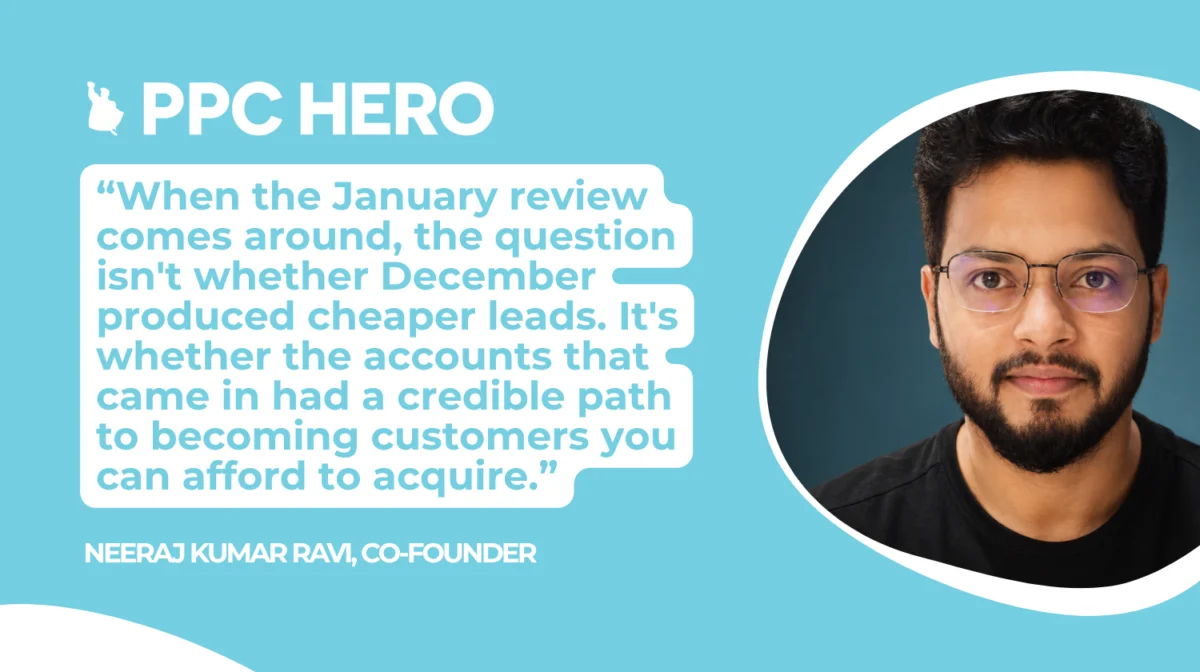
When the annual review commences in January, the pertinent question will not be about which campaigns produced the cheapest leads. Instead, the focus will be on whether the accounts acquired during the holiday period possessed a credible pathway to becoming valuable customers at an affordable acquisition cost. Answering this question requires a longer-term perspective but provides the essential evidence to inform next year’s strategic planning. Resources such as readiness scorecards and 30-day plans can offer a structured starting point for evaluating preparedness for the holiday season and the subsequent analysis of campaign outcomes.


 Layla Zulfa