

The digital commerce sphere is continually evolving, and with it, the strategies and tools businesses employ to connect with their customers. For many e-commerce brands, Klaviyo has long been a go-to platform for email and SMS marketing automation, renowned for its sophisticated segmentation, predictive analytics, and robust flow-building capabilities. However, a significant shift in Klaviyo’s pricing model in February 2025, moving from “emailed profiles” to “active profiles,” has prompted many businesses to re-evaluate their marketing technology stack. This change, which bases billing on all contacts a business can market to rather than just those they do email, has led to climbing monthly costs for a growing number of users, irrespective of their actual sending volume. Consequently, the search for more cost-effective yet equally powerful Klaviyo alternatives has intensified, with businesses seeking platforms that offer comparable or superior features without the escalating expenditure.
Klaviyo’s Strategic Pricing Shift and Its Impact
Klaviyo’s decision to pivot its billing structure to active profiles marked a pivotal moment for its user base. Prior to February 2025, businesses benefited from a model that only charged for the number of contacts they actively sent emails to. This allowed for greater flexibility, where a large list could be maintained, but only a targeted segment would incur costs, enabling strategic list management to control expenses. The transition to active profiles, however, fundamentally altered this dynamic. Now, any profile deemed “marketable”—including those who subscribe via forms or are collected during checkout, even if they haven’t yet received a marketing message—contributes to the monthly billable count. The only exclusions are suppressed or unsubscribed contacts.
This change, while strategically beneficial for Klaviyo in ensuring revenue aligns with the potential reach a business has, came as a surprise to many. For businesses with rapidly growing lists or those that had previously optimized their costs by selectively emailing segments, the immediate impact was often a noticeable hike in their monthly invoices. Klaviyo did implement a cap, limiting the initial price increase for legacy customers (those active before February 2025) to 25% of their previous bill, applied as an ongoing discount. However, this measure serves as a temporary buffer, as continued list growth will inevitably push businesses into higher, more expensive tiers. Industry analysts suggest this move was designed to encourage more thorough list hygiene and to capture value from the entire addressable market within a client’s database, aligning Klaviyo’s revenue more closely with the inherent value of a customer’s total marketing potential.
Understanding Klaviyo’s Current Cost Structure
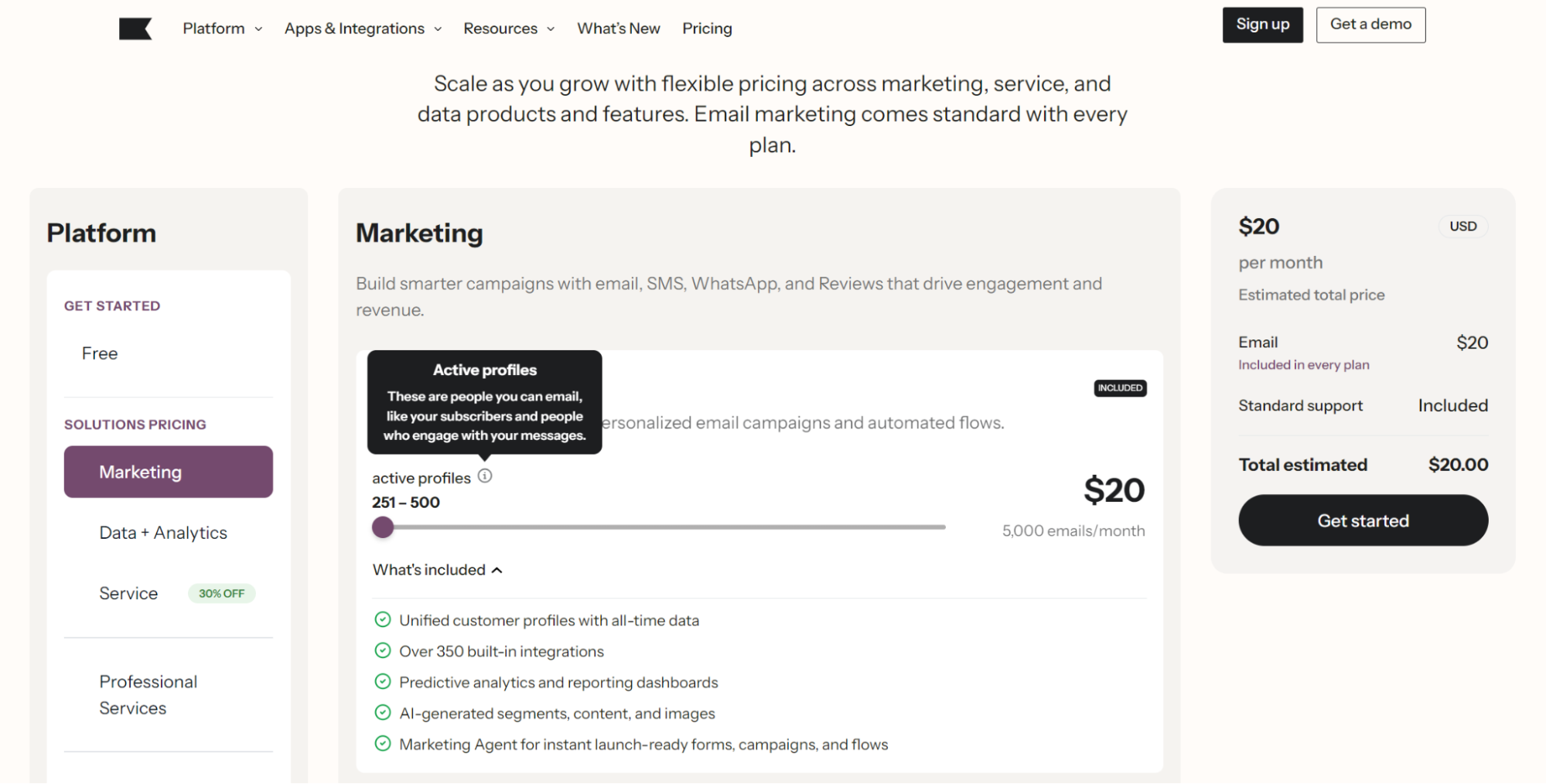
As of June 2026, Klaviyo’s pricing structure for email marketing is tiered based on the number of active profiles. While the free plan allows for up to 250 contacts and 500 emails, paid tiers start from $20/month for 500 contacts, which includes a 10x active profile multiplier for the email quota (e.g., 500 contacts get 5,000 emails). This structure means that as a business’s marketable list expands, even without an equivalent increase in marketing sends, its costs will rise. For example, a business with 1,000 contacts pays $30/month for 10,000 emails, while one with 25,000 contacts faces a $400/month charge for 250,000 emails.
Beyond email, Klaviyo offers an SMS add-on, starting with 150 free credits across all plans. Additional SMS credits are purchased in batches, with 1,250 credits costing $15/month. This means a business utilizing both email and SMS must factor in a minimum combined spend of $35/month ($20 for email + $15 for SMS). Bulk purchases offer slight discounts, but the added cost can quickly accumulate, especially for businesses with high SMS engagement or those targeting a large mobile audience. For instance, matching the 5,000 email quota with 5,000 SMS credits would incur an additional $45/month, bringing the total to $65/month for both channels. This integrated, yet separately billed, approach to multichannel marketing necessitates careful budget planning.
Exploring Cost-Effective and Feature-Rich Alternatives
The market for e-commerce marketing automation is diverse, offering several platforms that present compelling alternatives to Klaviyo, often at a better value proposition. The key is to find a tool that aligns with a business’s specific needs regarding pricing model, feature set, and scalability.
1. Omnisend: The Multichannel Powerhouse for E-commerce ROI
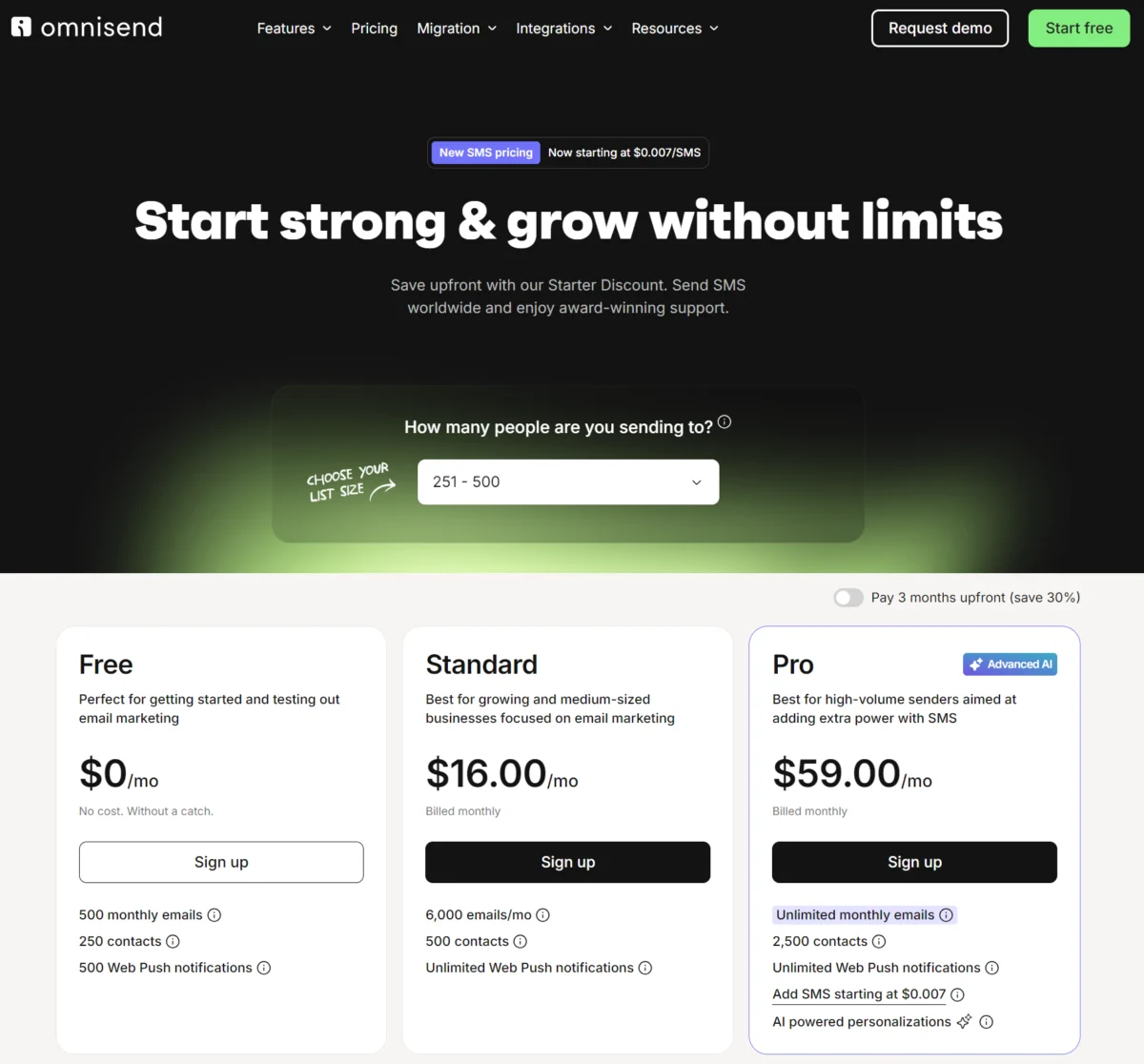
Omnisend consistently emerges as a strong contender, offering comparable enterprise email marketing capabilities to Klaviyo, often at a better value across various plan tiers. Its focus on multichannel marketing (email, SMS, web push) and high return on investment (ROI) makes it particularly attractive for growing e-commerce stores. Omnisend proudly reports that its customers achieved a $79 ROI for every $1 spent in 2025 across its integrated channels.
- Pricing Model: Omnisend offers a Free plan, a Standard plan for email marketing, and a Pro plan that integrates SMS and advanced features. Unlike Klaviyo, Omnisend’s Pro plan often includes unlimited email sends, a significant advantage for high-volume communicators. Its pricing model generally undercuts Klaviyo across popular contact tiers.
- Feature Comparison: Omnisend provides pre-built multichannel workflows, extensive AI features (segment builder, forms, copywriting, subject lines, product recommendations, churn prediction), and over 250 email templates. Crucially, features like Lifecycle/RFM maps, which are a paid add-on in Klaviyo (starting from $100/month), are included in all Omnisend plans. Support is another area of distinction, with Omnisend offering 24/7 chat and email support on all plans, whereas Klaviyo restricts 24/7 chat to its $300/month package and provides email-only support (60 days on the free plan). Omnisend also boasts global SMS coverage compared to Klaviyo’s 24 countries.
- Cost Savings Scenarios: For 1,000 contacts, Omnisend’s Standard plan is $20/month compared to Klaviyo’s $30, saving $120 annually. At 15,000 contacts, the saving can be substantial, with Omnisend Standard at $207/month versus Klaviyo’s $350, resulting in an annual saving of $1,716. Even the Pro plan, which starts from $59/month for 2,500 contacts, is a dollar less than Klaviyo’s email-only plan for the same count, while offering unlimited emails and SMS capabilities. Omnisend’s SMS credits are also more cost-effective, offering 1,111 credits for $10/month (US rate $0.009/credit) compared to Klaviyo’s 1,250 credits for $15/month (US rate $0.012/credit).
2. Brevo (formerly Sendinblue): The Send-Based Solution for Large, Infrequent Lists
Brevo offers a distinct send-based pricing model, which can be highly advantageous for businesses with large contact lists but who send marketing communications infrequently.
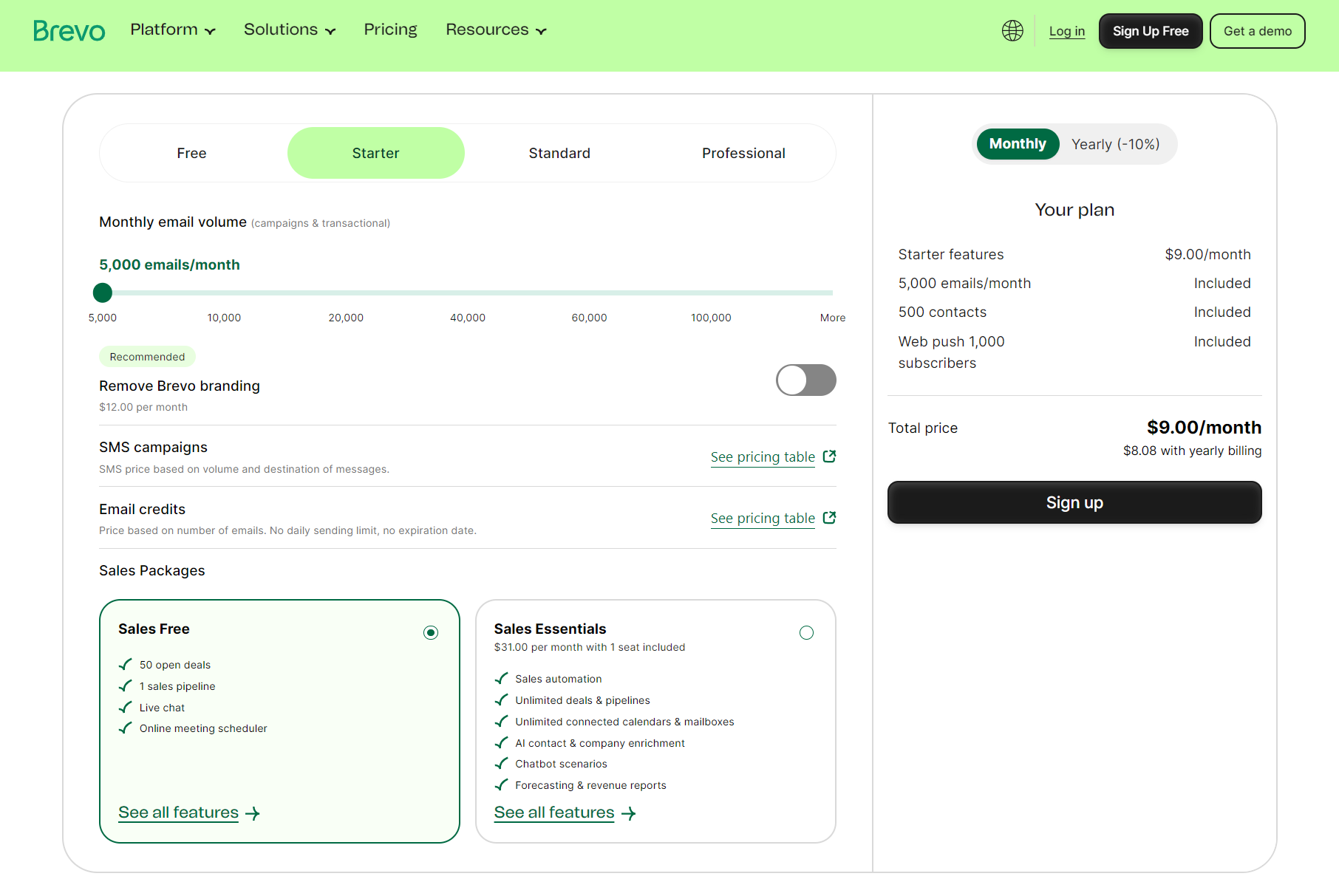
- Pricing Model: Brevo charges based on the number of emails sent per month, rather than active profiles. Its plans (Starter, Standard, Professional) provide a set contact allowance tied to the email tier. For example, a Starter plan at $29/month allows for 20,000 emails and up to 500,000 contacts.
- Feature Comparison: While Brevo’s entry points are cheaper, its lower-cost plans come with significant feature restrictions. A/B testing, reusable content sections, click heatmaps, and landing pages are absent in the Starter plan. Even the Standard plan lacks features like back-in-stock alerts, dynamic coupons, AI segmentation, and popups—all of which Omnisend includes for free. Brevo also offers add-ons for SMS, transactional emails, and dedicated IP addresses, which can inflate costs.
- Cost Scenarios: Assuming a weekly sending cadence (4 emails/contact/month), Brevo can be cheaper for larger lists. For 5,000 contacts sending 20,000 emails/month, Brevo Standard is $69 compared to Klaviyo’s $100, a saving of $31/month. At 10,000 contacts sending 40,000 emails/month, Brevo is $84 versus Klaviyo’s $150, saving $66/month. However, frequent sending can quickly push a business into higher Brevo tiers, narrowing the cost gap.
- Best For: E-commerce businesses with extensive contact lists that engage in low-frequency email campaigns. Its ability to store up to 500,000 contacts for a relatively low monthly send volume makes it a cost-effective choice for specific use cases.
3. MailerLite: Budget-Friendly for Mass Campaigns and Basic Journeys
MailerLite positions itself as a highly affordable alternative, often undercutting Klaviyo, Omnisend, and Brevo, particularly for businesses focused on mass email campaigns.
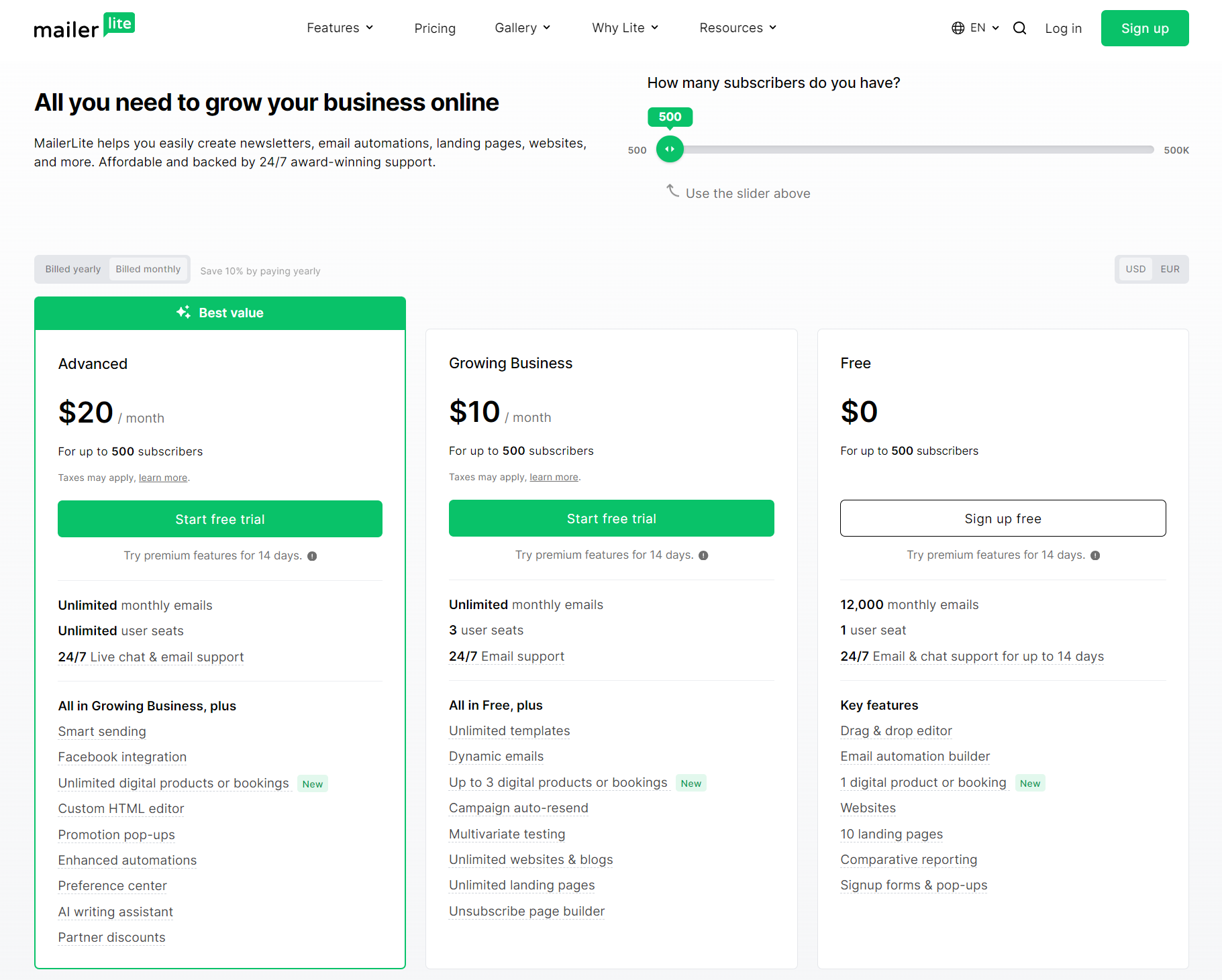
- Pricing Model: MailerLite offers a Free plan and two paid tiers: Growing Business and Advanced. Its pricing is based on subscriber count, with unlimited monthly emails in paid plans. The Growing Business plan starts at $10/month for 500 subscribers, which is half the price of Klaviyo and $4 less than Omnisend for the same contact count.
- Feature Comparison: MailerLite provides product-selling features like paid newsletters, recurring subscriptions, and digital product sales across all plans, along with a website builder. However, advanced features like custom HTML editors, promotion popups, advanced automations, and AI writing assistants are restricted to the Advanced plan ($20/month for 500 contacts). Its automation depth is more basic, with multi-trigger automations capped at three triggers and limited multichannel capabilities (no native SMS or web push).
- Cost Scenarios: MailerLite’s Growing Business plan is consistently cheaper than Klaviyo at every tier. For 25,000 contacts, MailerLite is $159/month versus Klaviyo’s $400, a significant saving. Even the Advanced plan is cheaper than Klaviyo beyond 1,000 contacts.
- Best For: Businesses prioritizing mass email sends, predictable customer journeys, and additional revenue streams through selling digital products or paid newsletters, especially those with tight budgets. It offers a generous free plan (500 subscribers, 12,000 emails/month) making it ideal for small operations.
Other Notable Platforms for Consideration
Beyond the primary alternatives, several other platforms cater to specific e-commerce needs, offering further options for businesses looking to optimize their marketing spend.
4. Privy (and the Sendlane Ecosystem): List-Building and Basic Automation
Privy, which acquired Sendlane in February 2026, is well-regarded for its robust list-building tools, including popups, banners, and forms. It offers email and SMS marketing capabilities, making it a unified solution for customer acquisition and basic engagement.
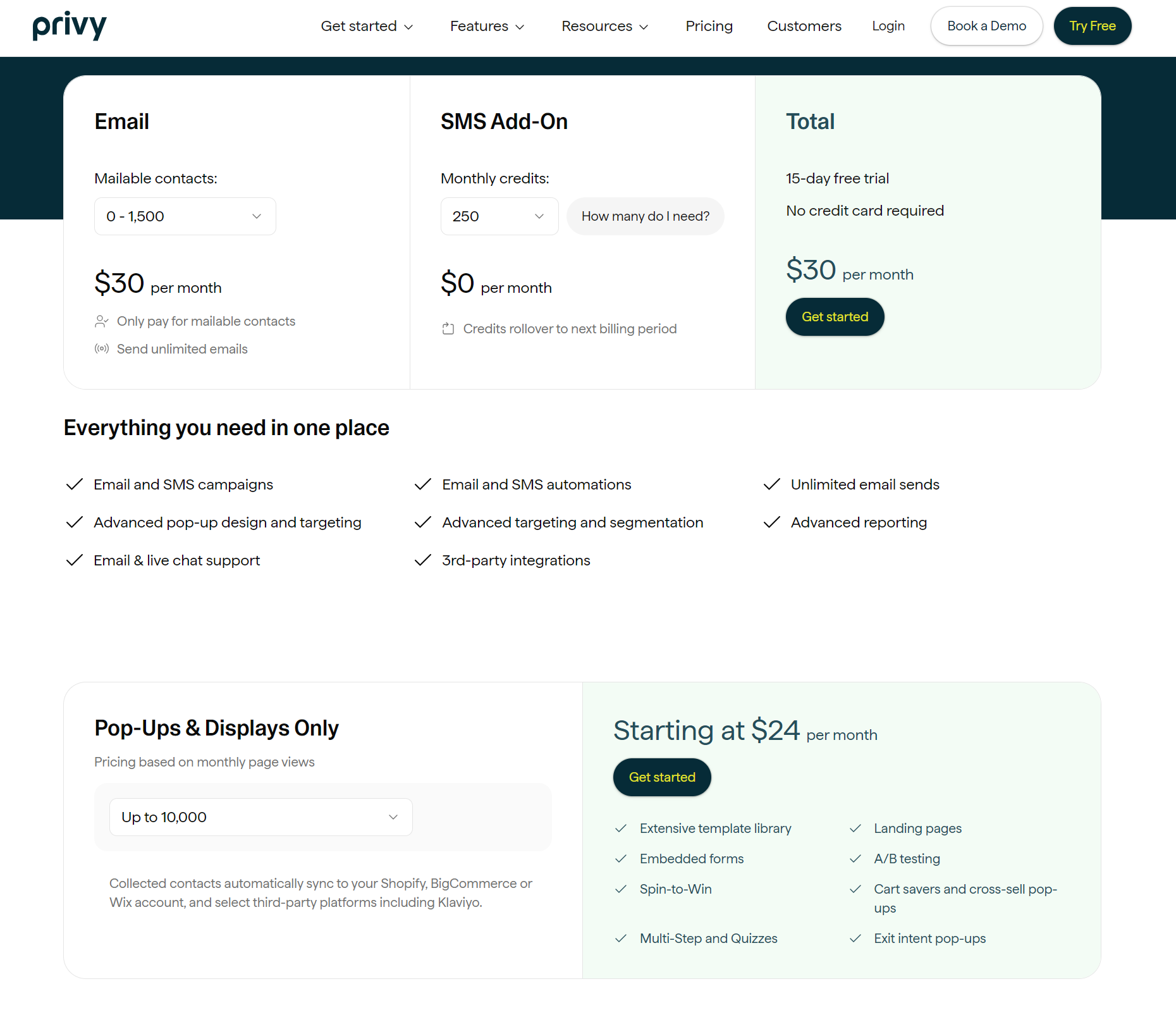
- Pricing Model: Privy offers an Email plan that includes popups and displays, or a standalone Pop-Ups & Displays Only plan. Its email plan starts at $30/month for 1,500 contacts, which is often cheaper than Klaviyo at most tiers.
- Feature Comparison: Privy excels in lead capture and conversion optimization through its diverse range of display options. However, its automation and reporting depth are more limited compared to Klaviyo or Omnisend. It may not function as a full B2C CRM and has less extensive global SMS coverage.
- Cost Scenarios: Privy is generally cheaper than Klaviyo, saving $15/month at 1,500 contacts and $110/month at 15,000 contacts. Interestingly, it becomes slightly more expensive at the 10,000 contact tier (+$15/month).
- Best For: Small to mid-sized Shopify stores primarily focused on building their email lists effectively through high-converting forms and popups, seeking a low-cost solution for basic email and SMS journeys.
5. Drip: Unlimited Emails for Mid-Sized E-commerce
Drip is an e-commerce email and SMS marketing tool that stands out for its unlimited email sends across all paid plans, a feature highly valued by businesses with frequent communication needs.
- Pricing Model: Drip’s plans start at $39/month for 2,500 contacts, significantly undercutting Klaviyo’s $60 for the same count by $21/month. This unlimited email send policy is a direct contrast to Klaviyo’s 10x contact send limit.
- Feature Comparison: Drip is often praised for being a simpler, more intuitive e-commerce email tool than Klaviyo. However, it trades some of Klaviyo’s advanced capabilities, such as predictive analytics, highly sophisticated triggers, and deeper e-commerce integration, for ease of use. Drip also lacks a free plan.
- Cost Scenarios: Drip is cheaper than Klaviyo at most tiers, with notable savings at 2,500 contacts (-$21/month) and 25,000 contacts (-$31/month). Similar to Privy, it crosses above Klaviyo at the 10,000 contact mark (+$4/month).
- Best For: Small to mid-size e-commerce stores that require unlimited email sends and prioritize a straightforward, user-friendly interface for managing basic to moderately complex automations, without the need for Klaviyo’s most advanced analytical tools.
6. Shopify Messaging: The Native Solution for Shopify Stores
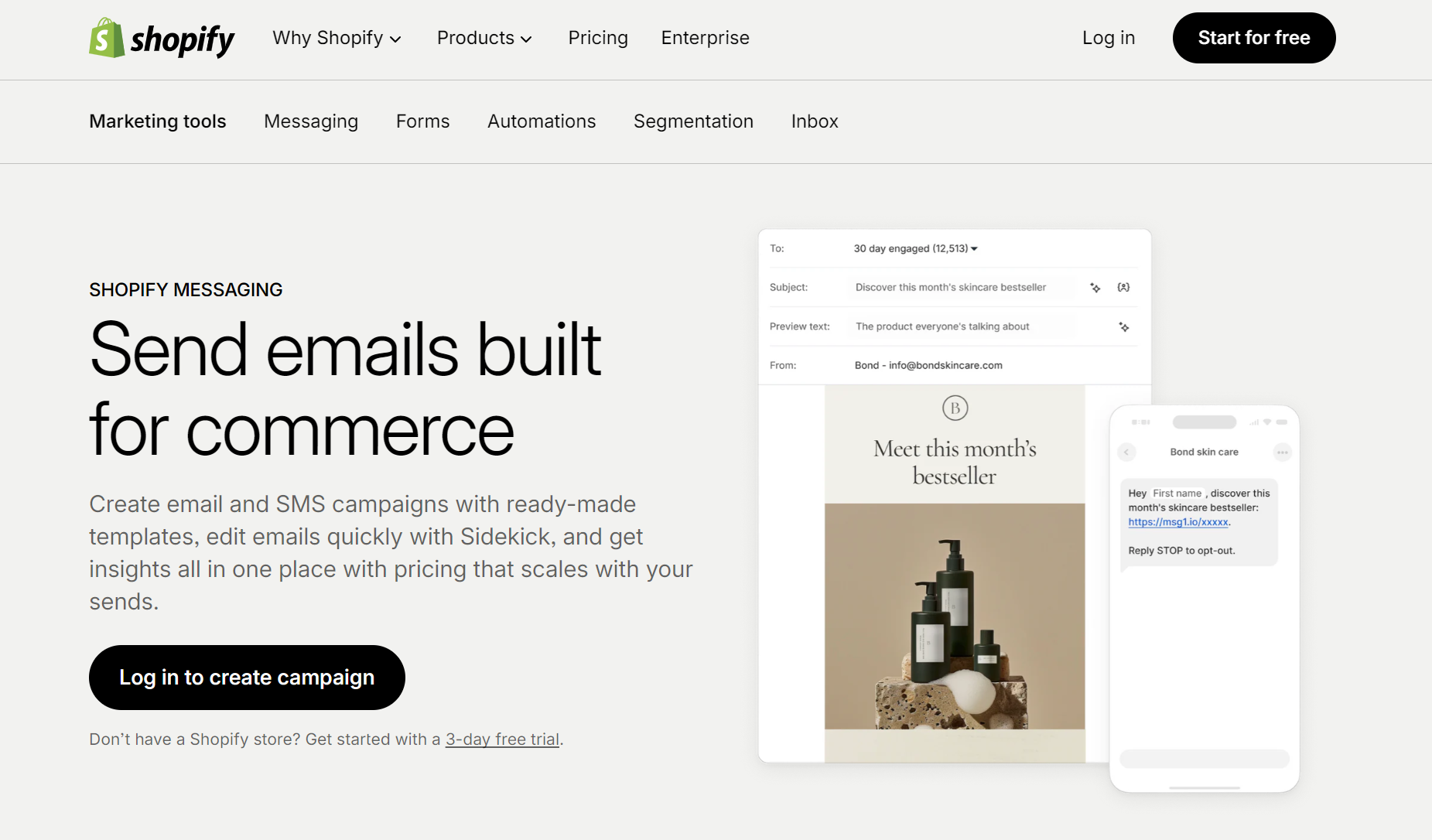
Shopify Messaging is Shopify’s native marketing app, working in conjunction with Shopify Flows for automation. Its primary appeal lies in its seamless integration within the Shopify ecosystem and its highly competitive pricing.
- Pricing Model: Shopify Messaging is free for up to 10,000 emails per month. Beyond this, the cost is $1 USD per 1,000 emails, dropping to $0.65 per 1,000 emails after 300,000 sends. SMS messaging was also integrated in December 2025, with a standard price of $0.012/send to US numbers.
- Feature Comparison: Shopify Messaging offers basic automation templates for common e-commerce scenarios like welcome series, abandoned cart recovery, and post-purchase follow-ups. Its main strength is its native integration, allowing merchants to manage marketing directly from their Shopify dashboard. However, it requires additional apps for advanced functionalities like forms, popups, and sophisticated segmentation, which are typically bundled into platforms like Klaviyo or Omnisend.
- Cost Scenarios: It is exceptionally cheap, or even free for many small businesses, making it a highly attractive option for budget-conscious Shopify merchants.
- Best For: Small Shopify stores that are comfortable with basic email and SMS marketing capabilities, prefer a native solution within their Shopify dashboard, and want to minimize their marketing software expenditure. It’s ideal for those without the appetite for learning a new, feature-rich tool or managing separate platforms.
Strategic Migration from Klaviyo to a New Platform
Switching marketing automation platforms, while potentially daunting, can lead to significant cost savings and better feature alignment. Omnisend, recognizing this need, has streamlined the migration process for Klaviyo users.
The general steps for migration typically involve:
- Exporting Data: Extract contact lists, segments, and any relevant historical data (e.g., purchase history, engagement metrics) from Klaviyo. Klaviyo allows data export into spreadsheets.
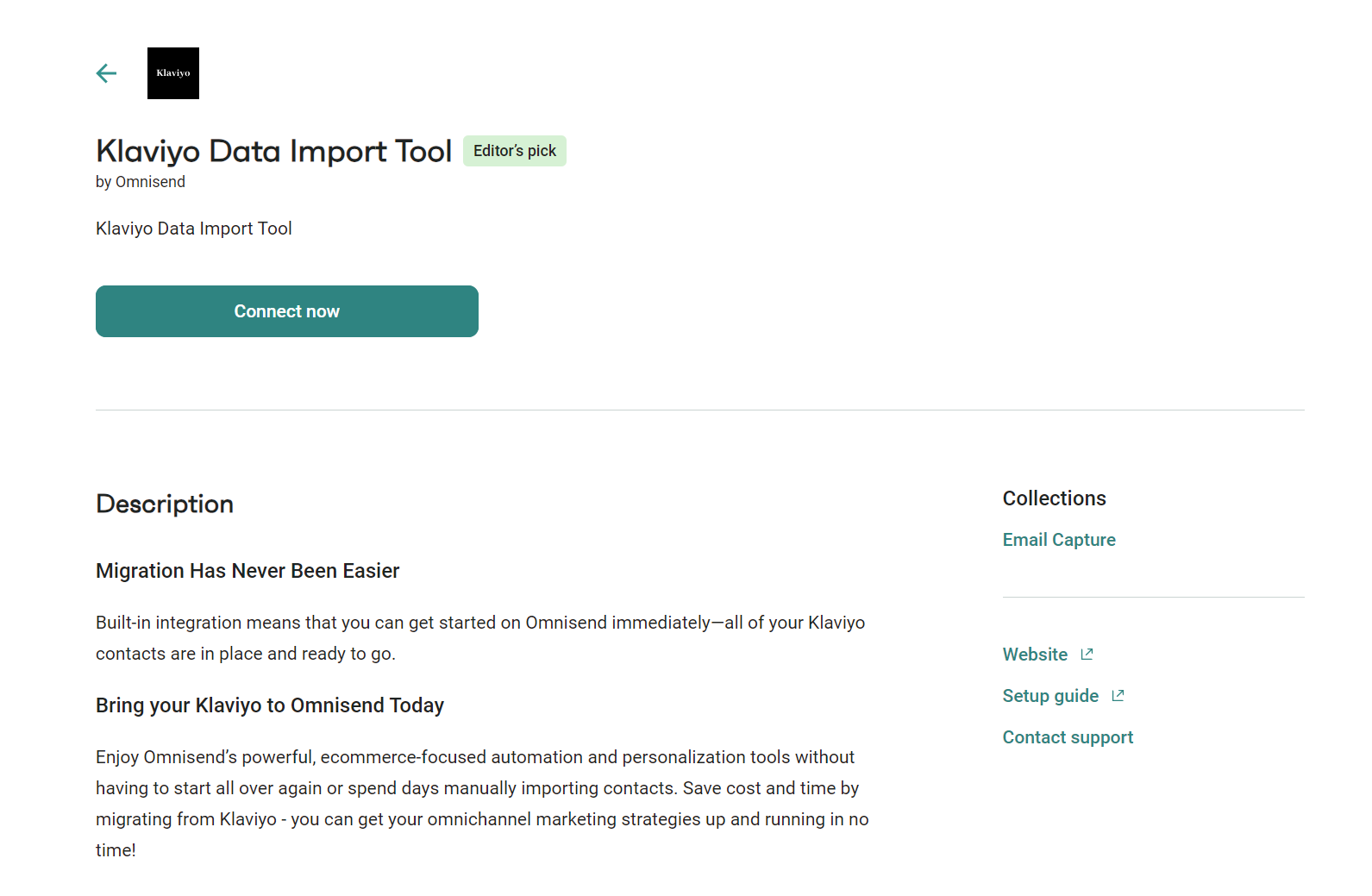
- Importing Data: Transfer the exported data to the new platform. This is where tools like Omnisend’s Klaviyo Data Import Tool simplify the process.
- Rebuilding Assets: Recreate email templates, forms, popups, and automation flows on the new platform. While data can be imported, the visual and logical structure of these elements usually needs manual reconstruction.
- Testing: Thoroughly test all new automations and campaigns before going live to ensure data flows correctly and messages are delivered as intended.
For Omnisend, the process is facilitated by specific tools and support:
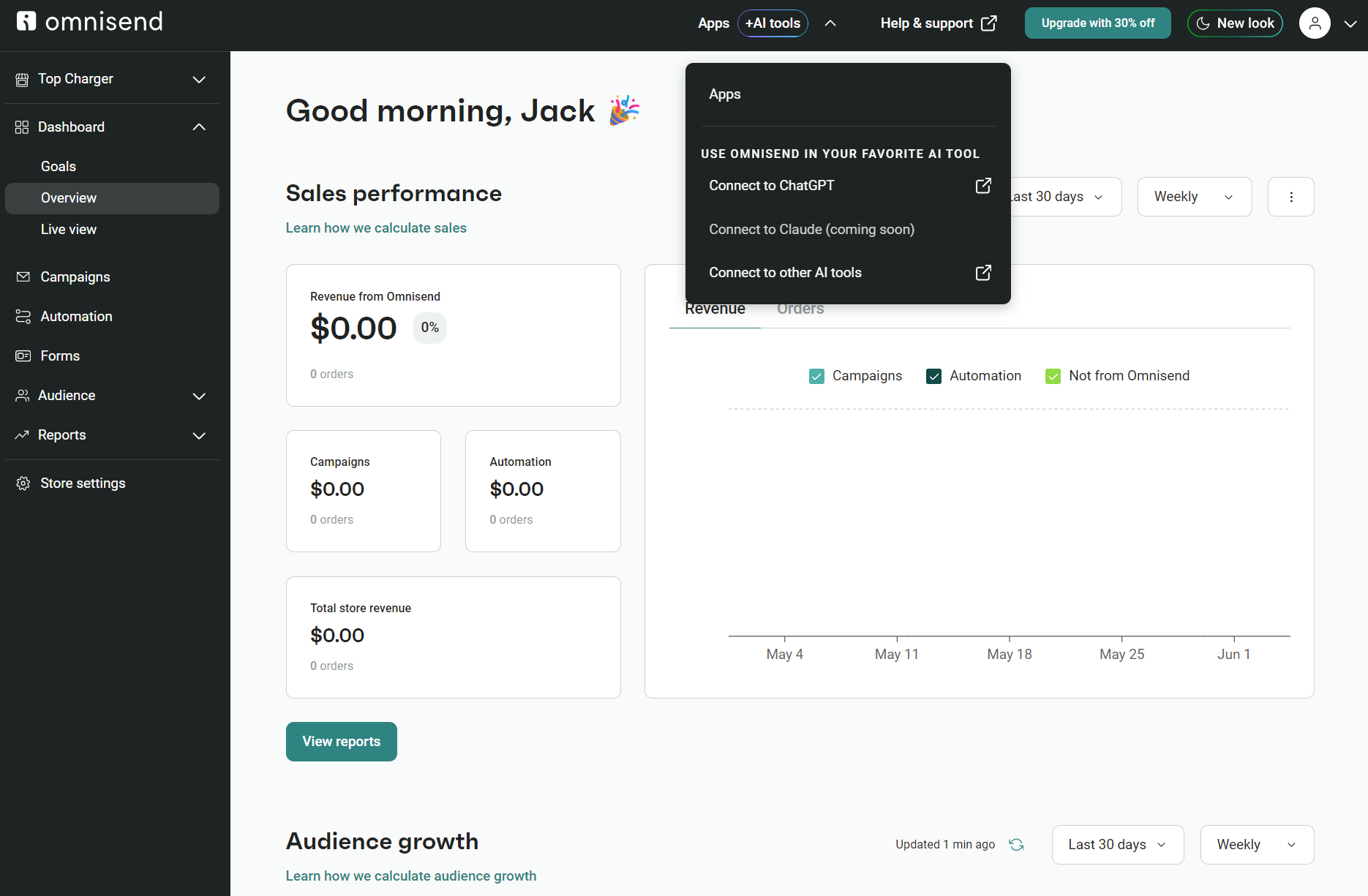
- Navigate to Apps in your Omnisend dashboard.
- Select Connect a new app.
- Search for the Klaviyo Data Import Tool and click to open the app.
- Click Connect now.
- Log in to your Klaviyo account, locate and copy your private API key.
- Paste the API key into the designated field in Omnisend and click Connect.
- Click Sync contacts & segments to initiate the data transfer.
It’s important to note that the sync is a manual action, not real-time. Therefore, a final manual sync before fully closing the Klaviyo account is recommended to capture the latest data. While complex segments with AND/OR combinations or unsupported fields might not migrate perfectly and may require rebuilding using Omnisend’s pre-built segments or its AI segment builder, the core contact data and basic segments transfer seamlessly. Omnisend also offers 28 pre-built flows to help recreate automations and supports HTML import for email templates, allowing businesses to mimic their Klaviyo designs quickly. For businesses with a monthly spend of $250+ on Omnisend, a free kickstart service, valued at $1,000, is available to assist with the migration, ensuring a smooth transition without data loss.
When Klaviyo Remains the Optimal Choice
Despite the rising costs, Klaviyo’s advanced capabilities still make it the preferred platform for certain e-commerce businesses. Its strength lies in its ability to build incredibly complex customer journeys with multiple steps, conditional splits, predictive triggers, and entry/exit points. For businesses with sophisticated customer segmentation needs, deep data integration, and a reliance on predictive analytics (like churn risk, next purchase date, or likely purchase amount), Klaviyo’s B2C CRM functionalities and AI features (Generative AI for emails/segments/flows, K:AI agents) offer unparalleled depth.
Furthermore, businesses deeply integrated into the Klaviyo ecosystem, with intricate automations, custom reports, and a history of optimized performance within the platform, might find the cost and effort of migration outweigh the potential savings. The investment in learning, customizing, and integrating Klaviyo often creates a “sticky” environment where switching platforms, and potentially losing some nuanced functionality or historical data context, becomes a significant deterrent. Therefore, Klaviyo makes sense for:
- Growing e-commerce stores whose primary channels are email and SMS, and who leverage a rich dataset to feed into predictive analytics and a comprehensive B2C CRM.
- Businesses requiring highly complex, multi-branching customer journeys and sophisticated behavioral segmentation that other platforms may not replicate with the same depth.
- Organizations already deeply embedded in the Klaviyo ecosystem, where the switching costs (time, resources, potential feature loss) are prohibitive.
Conclusion
Klaviyo’s shift to active profile pricing has undeniably driven up costs for many e-commerce businesses, prompting a critical re-evaluation of their marketing technology investments. While Klaviyo continues to offer enterprise-level features and deep analytical capabilities, its pricing structure and add-on costs often place it at a higher premium compared to its competitors.
The market, however, is rich with robust alternatives. Omnisend stands out as a strong all-rounder, offering comparable enterprise features, superior multichannel capabilities (including web push), and a more competitive pricing model with potentially unlimited email sends in its Pro plan, making it an excellent value proposition for most e-commerce stores. Brevo’s send-based pricing presents a viable option for businesses with large, infrequently messaged lists, while MailerLite offers a highly affordable solution for mass campaigns and basic customer journeys. Privy excels in list-building, and Drip provides unlimited emails for mid-sized operations. For Shopify-native businesses prioritizing extreme cost-efficiency and dashboard integration, Shopify Messaging offers a compelling free tier.
Ultimately, the choice of a Klaviyo alternative hinges on a business’s specific needs, budget, and the complexity of its marketing automation strategy. While Klaviyo excels in its niche of highly sophisticated, data-driven automation, many businesses can achieve their marketing goals with more cost-effective platforms that offer a better balance of features and value. By actively managing contact lists and thoroughly comparing the pricing models and feature sets of these alternatives, businesses can make informed decisions that optimize their marketing spend and drive sustainable growth.








