

The rapid proliferation of generative artificial intelligence (AI) has fundamentally reshaped the digital search landscape, compelling marketing professionals to recalibrate their strategies for brand visibility and audience engagement. As consumers increasingly turn to AI answer engines like ChatGPT, Gemini, and Perplexity for information, synthesized recommendations, and product evaluations, the traditional metrics of search engine optimization (SEO)—keyword rankings, organic traffic, and click-through rates—are proving insufficient. This paradigm shift has given rise to a new discipline: Answer Engine Optimization (AEO) and Generative Engine Optimization (GEO), focusing on how brands appear within AI-generated responses. In this evolving environment, platforms designed to monitor and optimize AI visibility have become indispensable. Peec AI has emerged as a notable player in this space, yet a robust ecosystem of alternatives is rapidly developing, offering specialized functionalities to meet diverse marketing needs in 2026.
The Dawn of AI Search: A New Frontier for Marketers
The transition away from traditional web search began subtly but has accelerated dramatically. Buyers no longer solely "Google" their queries; instead, they engage in conversational AI interfaces, seeking direct answers, comparisons, and expert recommendations. This shift means that a brand’s presence in an AI-generated summary can precede any direct interaction with its website, making AI visibility a critical top-of-funnel concern. Marketers, who in 2021 relied on established SEO frameworks, now face the challenge of adapting to a world where AI models synthesize information from countless sources to provide a single, authoritative answer. The imperative is clear: understand how AI "sees" and "cites" your brand, and actively shape that perception.
AI visibility monitoring, often interchangeably referred to as AI brand monitoring, is the systematic practice of tracking a brand’s mentions, sentiment, and citation frequency within responses generated by various AI answer engines. Unlike classic rank tracking, which measures a webpage’s position on a Google Search Engine Results Page (SERP), AI visibility tools measure "presence"—how often a brand is included in an AI answer, its placement within that answer, and the overall sentiment (favorable, neutral, or negative). Peec AI excels in this monitoring function, providing insights across multiple AI models. However, mere monitoring, while foundational, is only one piece of the puzzle. Effective AEO demands actionable insights, integration with CRM systems for attribution, and scalable solutions for multi-regional and complex content workflows.
Peec AI: Strengths and Strategic Gaps in a Dynamic Market
Peec AI has established itself as a strong contender in the AI visibility monitoring space. Its core strengths lie in its comprehensive tracking capabilities, measuring brand presence, sentiment, and placement across up to ten AI models simultaneously. A particularly commendable feature is its nuanced distinction between Google AI Overviews and Google AI Mode, providing more precise reporting than many competitors who conflate these distinct metrics. For global brands and multilingual content teams, Peec AI offers robust per-country and per-language tracking, making it a direct fit for international strategies. Furthermore, its "Actions" layer provides prioritized recommendations, helping teams interpret raw data into actionable opportunities.
Despite these strengths, Peec AI exhibits certain limitations that have paved the way for a diverse array of alternatives. Firstly, its remediation capabilities are limited; while it identifies citation gaps, it does not offer integrated tools for content generation, brief drafting, or automated publishing. This necessitates manual workarounds for teams with constrained content bandwidth. Secondly, a significant gap for RevOps-minded organizations is the lack of native CRM integration. AI visibility data remains siloed within Peec AI’s dashboard, requiring manual export and separate attribution modeling to connect to pipeline and revenue metrics. Thirdly, Peec AI lacks historical data backfill, meaning tracking commences only upon subscription, hindering baseline comparisons against prior performance. Lastly, while its platform coverage is strong, it may not include all emerging answer surfaces, and its reliance on AI-generated queries rather than real user prompts can sometimes affect accuracy. These limitations highlight the market demand for more integrated, action-oriented, and attribution-focused AEO solutions.
-1.png)
Essential Buyer Criteria for AEO Platforms in 2026
The evaluation of Peec AI alternatives in 2026 requires a refined framework that extends beyond basic monitoring. Marketers must assess tools based on their ability to deliver actionable insights and integrate into broader marketing and sales ecosystems. Key criteria include:
- Remediation and Content Generation: Does the tool help fix identified gaps by generating content briefs, drafting copy, or integrating with content management systems (CMS)?
- CRM Attribution: Can AI visibility data be directly linked to CRM records, pipeline stages, and revenue metrics? Native integration or robust API access is crucial.
- Scalability for Multi-regional Workflows: For global brands, does the platform offer seamless tracking and reporting across multiple languages, regions, and content workflows?
- Prompt Methodology: Does the tool use real user prompts for its tracking, or synthetic queries? Real user prompts offer greater accuracy and relevance.
- Historical Data: Does the platform offer historical data backfill to establish benchmarks and track trends over time?
- Engine Coverage: How many and which AI answer engines does the tool monitor? Is it limited to popular ones or does it include emerging platforms?
- Diagnostic Depth: Does it merely show what AI says, or also why (e.g., citation pathway analysis, AI crawler analytics)?
- Pricing Model and TCO: Is the pricing transparent, scalable, and reflective of the total cost of ownership, considering seat limits, prompt volumes, and feature tiers?
- Integration Ecosystem: How well does it integrate with existing marketing tech stacks (e.g., analytics, CRM, CMS)?
Before committing to a paid trial, organizations are advised to benchmark their current AI visibility using tools like HubSpot’s AI Grader to establish a baseline for performance evaluation.
Leading Peec AI Alternatives: A Detailed Comparison for 2026
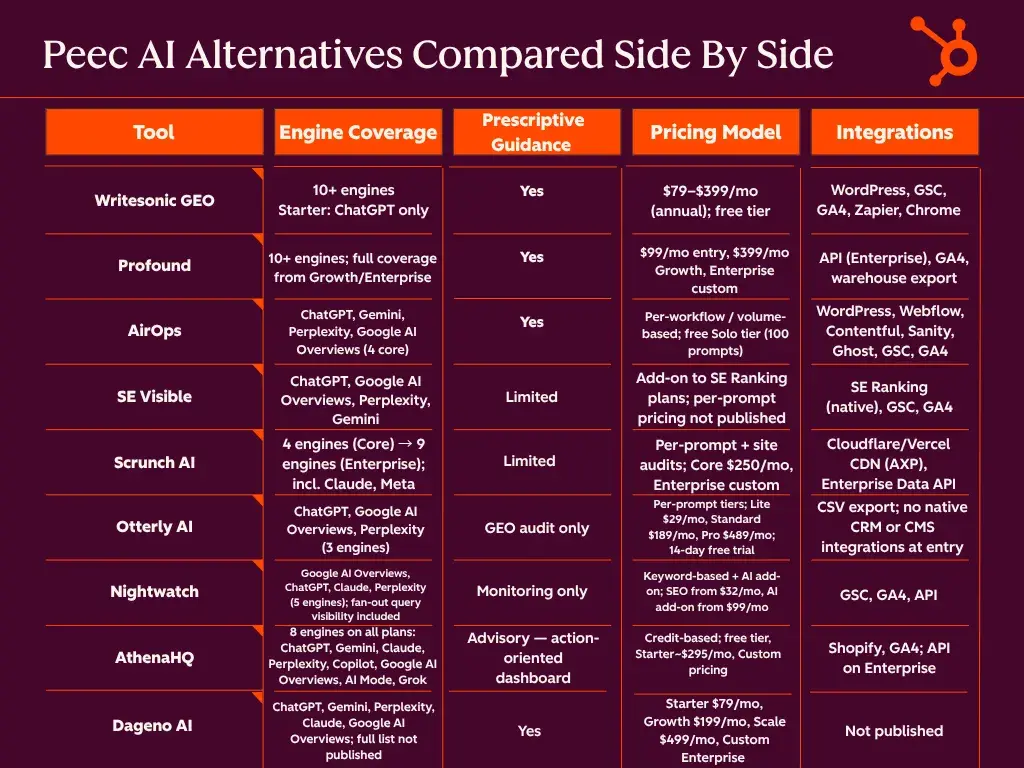
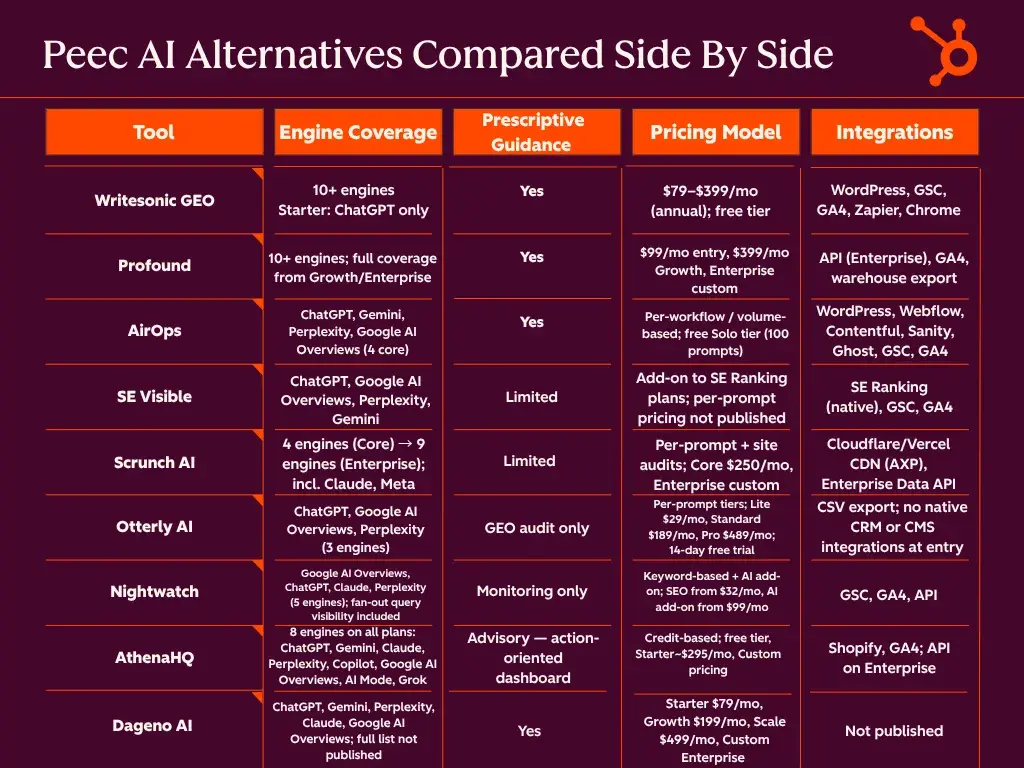
The market for AEO platforms is dynamic, with several strong contenders emerging to address the diverse needs of marketing teams. Here’s a detailed look at nine prominent alternatives to Peec AI in 2026, ranked by their capacity to go "beyond the dashboard":
1. Writesonic GEO – Best For Prescriptive Optimization and Content Creation
Writesonic GEO stands out as an end-to-end AEO platform. It not only tracks AI visibility but also integrates directly with content generation capabilities. When a citation gap is identified, teams can immediately leverage Writesonic’s AI writing tools to create or brief content, streamlining the remediation process. This combination of monitoring and creation is a significant advantage for teams with active content operations. While its monitoring layer is newer than some dedicated trackers, its seamless integration between data and execution creates a compounding advantage. Pricing starts affordably at approximately $79/month, making it a budget-friendly option that includes both writing and monitoring. For optimal workflow, pairing Writesonic’s output with a content hub like HubSpot’s allows for robust publishing and performance tracking.
2. Profound – Best For Enterprise Security and Advanced Analytics
Profound caters to enterprise-level marketing teams, large agencies, and organizations where AI recommendations directly impact revenue. It offers a comprehensive suite for tracking brand mentions, citations, sentiment, and prompt volume across over 10 AI platforms. Its "Agents" feature facilitates AEO-optimized content creation at scale, incorporating human-in-the-loop review. Profound boasts an industry-leading prompt dataset, with over 1.5 billion real user prompts in its research reports and 400 million+ anonymized conversations, providing unparalleled measurement credibility. Its enterprise-grade security features (SSO, role-based access, data residency) make it a secure choice for highly regulated environments. The Growth plan, at $399/month, unlocks significant functionality, making it ideal for large-scale operations willing to invest.
3. AirOps – Best For Agencies and Multi-Site Content Operations
AirOps is a content operations platform that integrates AEO research and visibility analysis. Its Insights feature tracks citation rate, mention rate, and sentiment across popular answer engines. Page360 connects this visibility data to Google Search Console and GA4, while "Quill" (AirOps’ Playbooks feature) can research, draft, and publish content directly to various CMS platforms like Webflow, WordPress, and Contentful. This integrated publishing layer is a game-changer for agencies managing multiple client sites or brands, enabling templated workflows and significant operational leverage. While tracking depth is newer, its focus on connecting insights to publishing within a single workflow is a distinct advantage. AirOps offers a free entry tier, with paid plans scaling by volume and complexity.

4. SE Visible (by SE Ranking) – Best For Unified SEO and AEO
For teams already utilizing SE Ranking for traditional SEO, SE Visible offers a seamless integration of AI overview tracking intelligence into their existing ecosystem. This provides over 13 years of historical SEO context alongside new AI-tracking capabilities, eliminating the need for a separate subscription. The ability to view both traditional keyword rankings and AI visibility within a single platform is highly efficient. Unlimited seats across all plans make it accessible to entire marketing teams without escalating costs. While its AI visibility data is newer than SE Ranking’s core SEO functionality, it presents the most straightforward path for unified SEO + AEO management.
5. Scrunch AI – Best For Enterprise AI Crawler Intelligence
Scrunch AI targets the enterprise market, offering beyond standard brand visibility tracking. It incorporates AI crawler analytics, providing insights into how AI bots and agents interact with a site before constructing their answers. Its Agent Experience Platform (AXP) automatically serves AI-optimized content to AI agents without affecting the human-facing site. This diagnostic capability, showing AI’s inputs rather than just outputs, is invaluable for technical SEO teams. The Core plan covers four answer engines at $250/month, with custom Enterprise tiers offering up to nine. While its content generation layer is less developed than Writesonic or AirOps, its deep crawler analytics are a unique selling point.
6. Otterly AI – Best For Budget-Conscious Teams and Low-Cost Entry
Otterly AI provides a credible entry point for startups, SMBs, solo founders, and teams exploring AEO without a substantial budget commitment. Starting at $29/month, it tracks brand mentions and citations across multiple answer engines, holding a strong 4.9/5 rating on G2. Its GEO audit feature evaluates over 25 on-page factors and provides fix-it checklists, offering a thin optimization layer uncommon at this price point. While engine coverage is narrower (3 engines vs. 10+ for top-tier tools) and CRM integrations are absent at lower tiers, Otterly AI allows small teams to establish a reliable monitoring baseline before scaling up.
7. Nightwatch – Best For Diagnostic Citation Pathway Analysis
Nightwatch is ideal for teams seeking to understand why their brand isn’t appearing in AI answers, rather than just that it isn’t. It offers fan-out query visibility, revealing the real-time web searches AI systems conduct before generating responses. Starting at $32/month for base SEO monitoring and an additional $99/month for the AI tracking add-on, it covers Google AI Overviews, ChatGPT, Claude, and Perplexity. This diagnostic capability allows content and SEO teams to identify precisely which sources AI is fetching and which content gaps to prioritize, making it a powerful tool for understanding the citation pathway.
8. AthenaHQ – Best For No-Cost Entry and Proof of Concept
AthenaHQ offers a free entry tier, providing a meaningful advantage for teams needing to demonstrate value before securing budget for AEO tools. Positioned as a brand intelligence tool, it covers mentions, citations, and competitive share of voice. This low-friction entry point allows organizations to build a business case with real data, document early wins, and then either upgrade or migrate to a more comprehensive platform. While it lacks advanced auditing, optimization, and enterprise-grade security features, it serves as an excellent starting point for initial AEO evaluations.
9. Dageno AI – Best For Full-Workflow GEO Execution without Enterprise Contracts
Dageno AI, though newer and less established, presents an ambitious scope for its price point: a full workflow encompassing data monitoring, strategy, content generation, and result attribution. It aims to be a direct upgrade path from monitoring-only tools like Peec AI, helping teams close identified gaps without requiring an enterprise contract. Its focus on connecting content actions to visibility outcomes and ultimately to ROI is a significant draw for teams seeking measurable results beyond mere reach. Pricing tiers range from Starter ($79/month) to Scale ($499/month), offering various levels of functionality.
Strategic Implications for Marketing Teams
The shift to AI search necessitates a fundamental re-evaluation of marketing strategies. AEO tools are not merely replacements for SEO platforms but represent a new category addressing distinct challenges. Marketing teams must:
- Prioritize Answer-First Content: Content must be structured to provide immediate, direct answers to queries, optimizing for AI’s preference for utility over long preambles.
- Embrace Entity and Schema Hygiene: Consistent, structured data about brands, products, and personnel is crucial for AI systems to accurately disambiguate and cite information.
- Focus on Comparison and Alternative Content: Pages that compare products or offer alternatives consistently generate higher AI citation rates, addressing commercial investigation queries directly.
- Integrate AEO with CRM for Attribution: The ultimate goal is to connect AI visibility to revenue. This requires robust attribution models that track AI-sourced traffic, contacts, and deals.
Connecting AI Visibility to Revenue in Your CRM
The most critical step in transforming AI visibility into a revenue-generating investment is integrating AEO data into your attribution model. Since many AI answer engines do not consistently pass standard referrer data, AI-referred sessions often appear as "direct" traffic in analytics platforms. Marketers must proactively address this:
- Tag AI-sourced Traffic: Work with analytics teams to create dedicated UTM parameters for AI-sourced campaigns. Configure channel groupings in GA4 to capture known AI referrer patterns (e.g., perplexity.ai, chatgpt.com, gemini.google.com). HubSpot’s Smart CRM can be configured to capture the source at contact creation.
- Standardize UTM Taxonomy: Implement a consistent UTM taxonomy across all AEO and GEO content. Every piece of content published to address an AI visibility gap should include campaign parameters that map back to the specific initiative. This creates a clear lineage from "Peec AI alternative X identified a citation gap for [query Y]" to "content Z was published and generated N pipeline-influenced contacts."
- CRM Integration for ROI: Utilize CRM custom properties (e.g., "AI Visibility Initiative") populated via workflow automation when UTM parameters match AEO campaign taxonomy. This allows every deal in the pipeline to carry a signal about whether AI visibility work contributed. Building a Smart CRM dashboard that surfaces AI-sourced contacts by lifecycle stage, deal stage, and revenue provides leadership with a direct view of AEO’s financial impact.
Implementing an Effective AEO Program: A Six-Step Playbook
Successful AEO programs follow a repeatable, structured cycle:
- Query Clustering: Group tracked prompts into thematic clusters (product comparisons, use cases, category definitions) to identify high-value opportunities.
- Citation Gap Analysis: For underperforming clusters, identify the sources AI currently cites (third-party reviews, competitor documentation, industry publications) to inform content strategy.
- Entity and Schema Hygiene: Ensure brand, product, and personnel information is consistently represented in structured data, as AI systems rely heavily on entity disambiguation.
- Answer-First Content Creation: Develop content that directly answers the query, followed by context, as AI systems prioritize immediate utility.
- Comparison and Alternative Formats: Strategically create content comparing products or offering alternatives, as these formats consistently outperform single-entity content for AI citations.
- Measurement and Refresh: Continuously track citation rate changes post-publication. Content that earns its first AI citation within 37 days (the median for ChatGPT and Claude, per Profound’s research) is performing well; uncited content warrants investigation for technical issues or content gaps.
Market Trends and Future Outlook
The AEO market is expected to continue its rapid evolution. Key trends include:
- Deepening Integration: A greater emphasis on native integrations with CRM, CMS, and analytics platforms to create seamless, closed-loop marketing workflows.
- Advanced Personalization: Tools will likely incorporate more sophisticated AI models to personalize content recommendations and optimize for individual user intent within AI search.
- Ethical AI and Transparency: As AI’s influence grows, there will be increasing demand for tools that offer transparency into AI’s sourcing methodology and ethical content generation practices.
- Voice Search and Multimodal AI: AEO will expand to encompass optimization for voice-based queries and multimodal AI interactions, requiring new tracking and content formats.
Conclusion
The shift to AI-powered search engines represents a fundamental reorientation of digital marketing. While Peec AI offers robust monitoring capabilities, the market for AI visibility platforms is expanding to provide more integrated, action-oriented, and attribution-focused solutions. From Writesonic GEO’s prescriptive optimization to Profound’s enterprise-grade analytics and AirOps’ agency-focused workflows, marketers in 2026 have a diverse array of tools to choose from. The key to success lies not merely in selecting a tool, but in building a comprehensive AEO program that connects AI visibility to measurable revenue, integrates seamlessly with existing tech stacks, and continuously adapts to the dynamic landscape of generative AI. This strategic approach will ensure that brands remain visible, relevant, and profitable in the era of AI search.








