
The relentless demand for fresh, engaging content in the digital ecosystem presents a universal challenge for creators: maintaining a consistent flow of inspiration while avoiding the dreaded writer’s block. In an era where content is king and search engine algorithms prioritize regularity and relevance, the ability to generate compelling blog post ideas is not merely a creative pursuit but a strategic imperative. This article explores a comprehensive suite of methodologies, from leveraging internal data and advanced digital tools to embracing personal experiences, designed to empower content creators in their quest for sustained ideation.
The Modern Content Imperative: A Digital Landscape Demanding Freshness
In the contemporary digital landscape, content marketing has transcended mere trend to become a cornerstone of effective online presence. According to recent industry reports, companies that consistently blog generate an average of 67% more leads than those that do not, underscoring the tangible return on investment. Furthermore, maintaining a regular publishing schedule is crucial for search engine optimization (SEO), as search engines like Google favor websites that demonstrate authority and freshness through new content. This pressure to publish, however, often leads to the “content treadmill” phenomenon, where creators struggle to conceive unique and valuable topics that resonate with their target audience. The evolution of content creation has seen a significant shift from purely intuitive brainstorming to a more data-driven and technologically assisted approach, integrating sophisticated analytics and artificial intelligence to inform ideation.
Leveraging Internal Data for Strategic Insights
One of the most potent sources of new blog post ideas lies within a creator’s existing digital footprint and direct audience interactions. This internal data offers unparalleled insights into what an audience truly seeks, moving beyond guesswork to precise, user-driven content development.
Audience-Centric Ideation: The Voice of Your Readers
Direct feedback from an audience is an invaluable, often underutilized, resource for content generation. Blogs equipped with comment sections or contact forms frequently receive inquiries that, while sometimes off-topic, can highlight significant knowledge gaps or areas of interest for the readership. These questions, ranging from simple clarifications to requests for elaborate explanations, are prime candidates for dedicated blog posts. For instance, a persistent query about a nuanced aspect of a product or service, or a commonly misunderstood concept within a niche, signals an unmet need.
Beyond passive feedback, proactive engagement through questionnaires or polls distributed to subscribers can yield a wealth of topic suggestions. A travel blogger might poll their audience on their biggest fears about solo travel, leading to a series of posts on safety tips, budget travel, or destination guides. By systematically cataloging these questions and insights, content creators can build a robust repository of ideas directly informed by their community, ensuring high relevance and engagement. This approach not only provides inspiration but also strengthens audience loyalty by directly addressing their concerns.
Google Search Console: Unlocking User Intent
Google Search Console (GSC) stands as a foundational tool for any content strategist aiming for data-driven ideation. It provides direct, unfiltered data on the exact search queries users employ to discover a website. The Performance Report within GSC is particularly insightful, listing search terms alongside crucial metrics such as clicks, impressions, and average ranking positions. This data allows creators to identify existing content that performs well and, more importantly, to spot topics where their site appears in search results but may not fully address the user’s intent.
For example, if a parenting blog ranks for “how to keep toddlers busy without screens” but lacks a comprehensive article on that specific subject, it indicates a clear content gap and an opportunity to capture more relevant organic traffic. This method transcends basic keyword research by revealing actual user behavior on one’s own site. The integration of GSC data directly into WordPress dashboards via tools like Yoast SEO with Google Site Kit further streamlines this process, allowing creators to monitor top search queries and performance metrics without navigating multiple platforms. While commercial tools like Ahrefs and Semrush offer broader competitive analysis, GSC provides proprietary first-party data, making it an indispensable, free, and reliable source for understanding audience search behavior and informing content strategy.
AI-Powered Content Planning: The Yoast AI Content Planner
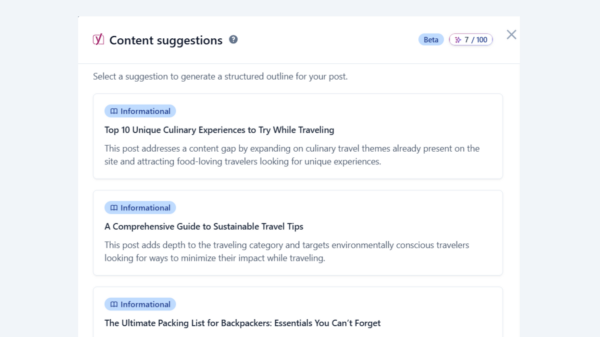
The advent of artificial intelligence has introduced a new paradigm in content ideation, exemplified by tools like the Yoast AI Content Planner. This innovative feature addresses the common predicament of knowing that content needs to be published but struggling with what to write. By analyzing a site’s existing content, the Yoast AI Content Planner identifies thematic gaps and suggests five highly relevant blog ideas.
Unlike generic AI prompts, this planner generates suggestions tailored to the specific niche and content ecosystem of the user’s blog. For instance, a food blog that has extensively covered meal prep but has not delved into quick vegetarian lunches might receive a suggestion for the latter, based on identified semantic connections and missing topics. Once an idea is selected, the tool goes a step further, generating a structured draft complete with a suggested title, key headings, and even a meta description. This immediate outline significantly reduces the initial hurdle of structuring an article, enabling writers to commence content creation without delay. The ability to generate new batches of ideas with a single click ensures a continuous stream of tailored suggestions, making the Yoast AI Content Planner a strategic asset for maintaining publishing consistency and filling real content gaps.
Advanced Keyword Research: Beyond the Obvious
Keyword research has long been the backbone of SEO-driven content strategy, yet its potential for ideation often remains underexplored. A comprehensive keyword research document contains a treasure trove of potential blog ideas; the key lies in digging deeper to uncover the underlying search intent and the best angle for a given topic.

Understanding search intent—whether users are looking for informational guides, transactional pages, or navigational assistance—is paramount. Tools like Yoast SEO’s Semrush integration and Google’s autocomplete feature can illuminate this intent. Furthermore, observing Google’s AI Overviews or AI Mode answers for specific keywords provides insight into the kind of comprehensive answers users are seeking.
Consider the keyword “best running shoes for flat feet.” Instead of a single article, a deeper dive can reveal a spectrum of related queries: “What causes flat feet and how do shoes help?” (informational), “What are the top brands for flat feet running shoes?” (review/comparison), “How to choose running shoes for flat feet based on arch support?” (how-to guide). Each of these questions can form the basis of a distinct, highly targeted blog post. This approach ensures content directly addresses user needs, thereby maximizing its relevance and search performance. The integration with tools like Wincher within Yoast SEO allows for continuous tracking of how these keyword-targeted posts perform over time, enabling further refinement of content strategy.
Exploring External Digital Frontiers for Inspiration
While internal data provides a focused lens, the broader internet offers a vast landscape for discovering new trends, topics, and creative angles.
Visual Discovery with Pinterest
Pinterest, primarily a visual discovery engine, remains a powerful platform for content inspiration, particularly for visually oriented niches such as food, DIY, fashion, travel, and home decor. Beyond its aesthetic appeal, Pinterest serves as an excellent tool for spotting emerging trends and identifying content gaps within specific niches. Searching for broad terms like “[blog post ideas]” or “[what to blog about]” can yield general inspiration, but adding niche-specific modifiers—e.g., “[blog post ideas for parents]” or “[blog post ideas for lifestyle bloggers]”—narrows the focus and accelerates the ideation process. Analyzing top-pinned posts within these searches can reveal popular topics and content formats that resonate with a target audience.
However, caution is advised, as Pinterest can be a “clickbait heaven.” The platform’s emphasis on visually appealing titles and images can sometimes lead to a focus on quantity over quality. Content creators must maintain a clear strategic focus to avoid being sidetracked by fleeting trends and ensure any inspiration gathered aligns with their blog’s core mission and editorial standards.
Creative Catalysts: Content Idea Generators
Online content idea generators, such as Portent’s Title Maker, serve as creative catalysts rather than definitive solution providers. While they may not deliver ready-to-publish article ideas, their strength lies in sparking lateral thinking and offering humorous or unexpected perspectives that can break through mental blocks. For instance, entering “house plant” might yield “The 15 Biggest House Plant Blunders,” which can be expanded into a practical guide. Similarly, “wine” could generate “17 Unexpected Uses for Wine,” prompting ideas for lifestyle or DIY content.
The value of these tools is in their ability to generate outlandish or unconventional suggestions, forcing creators to think outside their usual patterns. From “20 Ideas You Can Steal From Babies” (for a parenting or psychology blog) to “How to Keep Your Towels Soft” (for a home decor or lifestyle blog inspired by “Towel Day”), these prompts can be refined and developed into genuinely engaging and unique content pieces. They are best utilized as a warm-up exercise for creativity, designed to get the “creative juices flowing” rather than to provide final headlines.
AI Chatbots: Intelligent Brainstorming Partners
The evolution of AI and large language models (LLMs) like ChatGPT, Claude, and Gemini has transformed them into sophisticated brainstorming partners for content creators. The key to maximizing their utility lies in providing specific context and strategic prompts, moving beyond generic queries.
Instead of a broad request like “Give me blog ideas about parenting,” a more effective prompt would be “Generate five unique blog post angles about sustainable parenting for a blog targeting eco-conscious millennial parents, focusing on practical tips.” This level of specificity guides the AI to produce more relevant and actionable ideas. Similarly, refining vague concepts by asking “Narrow down the topic ‘home organization’ into three distinct blog post ideas for small apartment dwellers” can transform a general idea into targeted content.
AI can also be used for competitive analysis. Feeding an AI a competitor’s blog URL and asking “Analyze the content themes on this blog and suggest three underserved topics that my blog could cover to differentiate itself” can provide strategic insights. However, a critical caveat is to avoid producing “commodity content.” AI often generates ideas that are generic or overdone. To truly stand out, creators must infuse AI-generated ideas with their unique perspective, personal experiences, proprietary data, or expert insights. For example, if AI suggests “10 tips for better sleep,” a human creator can transform it into “My 30-day experiment: How integrating ancient sleep rituals transformed my insomnia,” making the content distinctive and authoritative.
Calendar-Driven Content: Days Of The Year
Websites like Days Of The Year offer an unconventional yet fertile ground for blog inspiration, collecting a vast array of fun, bizarre, and niche holidays. This resource allows content creators to tie their content to specific, often quirky, dates, providing a timely and engaging hook. For a blog focused on mythical creatures, “Unicorn Day” (April 9th) or “Leprechaun Day” could inspire posts on folklore, creature origins, or even themed crafts. A travel or lifestyle blogger could leverage “Towel Day” (May 25th) to discuss travel essentials, sustainable towel choices, or tips for maintaining towel softness, creating relevant content from an unexpected prompt. This method encourages creative thematic linking, allowing blogs to connect with cultural moments, no matter how niche, and generate fresh content angles.
Community and Peer Insights
The internet is a vast repository of human thought and creativity. Engaging with other bloggers, following industry leaders, and participating in niche-specific Facebook groups or forums can be a powerful catalyst for new ideas. Observing discussions, popular posts, and emerging trends within these communities can reveal topics that resonate with a shared audience. Collaborative brainstorming with fellow bloggers can also unlock new perspectives and stimulate creative thinking. However, it is paramount to adhere to ethical guidelines: inspiration should never cross the line into plagiarism. Acknowledging sources and giving credit where due maintains journalistic integrity and fosters a respectful community.
Personal and Experiential Avenues for Unique Content
Beyond external tools and data, a content creator’s own life, experiences, and environment offer a unique and authentic wellspring of ideas.
Tapping into Current Events
Connecting current events to a blog’s niche can generate timely and highly relevant content. The strategy involves identifying news stories and then framing them through the specific lens of the blog’s audience. For a parenting blog, a new study on the impact of screen time could inspire an article titled “What the Latest Research Says: Navigating Screen Time for Children in the Digital Age.” A personal finance blog could analyze changes in tax laws, offering “Three Ways New Tax Rules Affect Your Savings: Strategies for Adaptation.” The core principle is to move beyond simply reporting the news and instead provide analytical value and actionable insights for the readership. Setting up Google Alerts for industry-specific keywords ensures creators stay abreast of relevant developments. While current events offer significant potential, it is crucial to approach sensitive topics with thoughtfulness and a focus on providing helpful context rather than exploiting trends.
Drawing from Daily Life and Professional Experience
Personal experiences, challenges faced in daily life, or solutions developed in a professional context can serve as rich narratives for blog posts. A therapist with a blog offering mental health tips might draw inspiration from common client struggles, illustrating therapeutic concepts with anonymized case studies. A chef running a food blog could share kitchen hacks discovered through years of practice or recount humorous culinary mishaps. The authenticity of personal stories often resonates deeply with readers, fostering a stronger connection. When incorporating real-life situations, it is ethically imperative to prioritize privacy. All identifying details, names, and specific circumstances must be altered or omitted to protect the individuals involved and maintain professional confidentiality.
The Power of Disconnection and Deliberate Brainstorming
The act of prolonged staring at a blank screen is counterproductive to creativity. When inspiration wanes, stepping away from the desk and engaging in a completely different activity can reset the mind. A short walk, listening to music, or even mundane household chores can provide the mental space needed for ideas to surface organically. The brain often makes unexpected connections when not actively focused on a problem.
For a more structured break, timed brainstorming sprints can be highly effective. Setting a timer for ten minutes and rapidly jotting down twenty blog ideas related to a specific topic—categorizing five as “weird,” five as “practical,” and ten as “in-between”—forces divergent thinking. This exercise encourages the suspension of self-criticism, allowing a free flow of ideas. Following this, dedicating another five minutes to freewrite about the most intriguing idea can often unlock an unexpected angle or a coherent narrative. Such deliberate breaks and structured ideation techniques can significantly enhance focus and rekindle inspiration.
The Idea Repository: Maintaining a Content Bank
A deceptively simple yet profoundly effective strategy is to maintain a running list of blog post ideas. Inspiration is cyclical; some days bring an abundance of concepts, while others are barren. By consistently documenting every fleeting idea, observation, or question that arises—whether on a mobile app, a digital document, or a physical notebook—creators build a personal content bank. This repository becomes an invaluable resource for those days when inspiration is low, providing a ready supply of topics to kickstart the writing process without the pressure of immediate ideation.
The Evolving Role of the Content Creator
The journey from a blank screen to a published article in the modern digital age requires a multifaceted approach, synthesizing analytical rigor, technological proficiency, and creative flair. The content creator’s role has evolved to become that of a strategist, analyst, and storyteller, adept at navigating data, leveraging AI, and connecting with an audience on a deeply human level. The ability to combine the precision of tools like Google Search Console and AI Content Planners with the authenticity of personal experience and the broad perspective gained from external exploration defines success in this dynamic environment.
The blend of technical SEO understanding with journalistic integrity and a responsive mindset ensures that content is not only discoverable but also genuinely valuable and engaging. As digital platforms continue to evolve, the adaptability of content creators in integrating new tools and refining their strategies will be paramount.
In conclusion, a lack of inspiration need not derail a publishing schedule. Whether through deep dives into keyword research, harnessing the power of AI-driven planning tools, engaging directly with an audience, or simply stepping away for a reflective break, myriad pathways exist to discover and develop compelling content. The most effective approach integrates structure with creativity, transforming the challenge of ideation into an ongoing opportunity for innovation and connection. The next time writer’s block looms, selecting and implementing one of these strategies can be the crucial step to reinvigorating the creative process and ensuring a consistent flow of high-quality content.