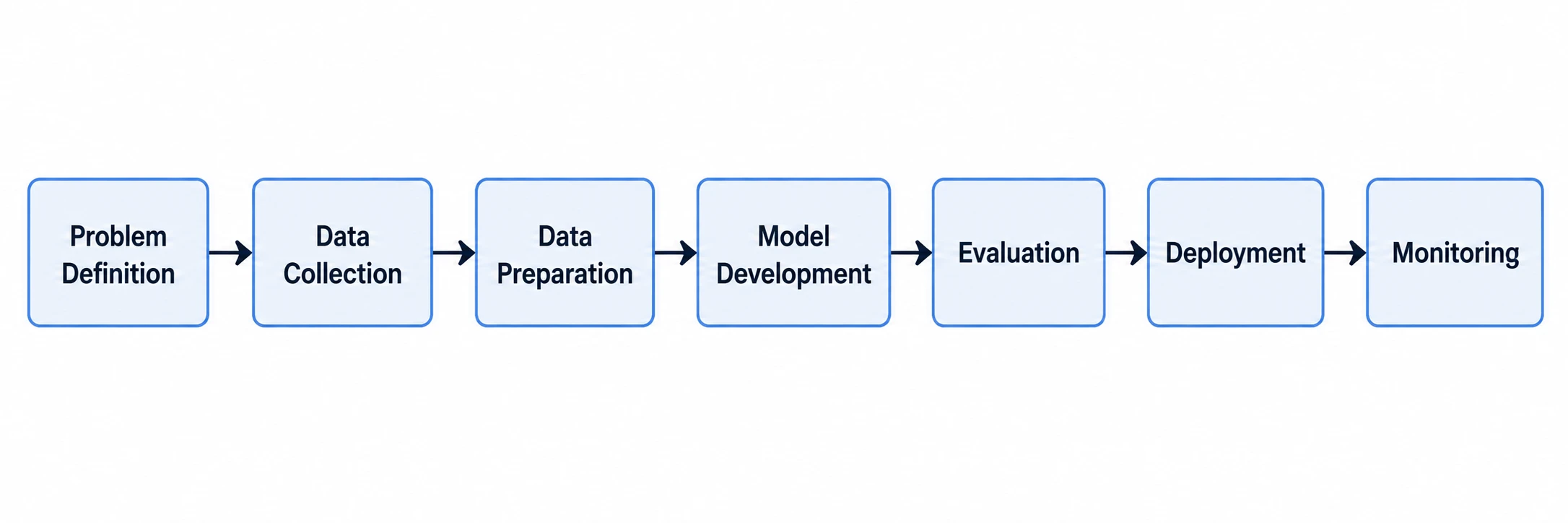
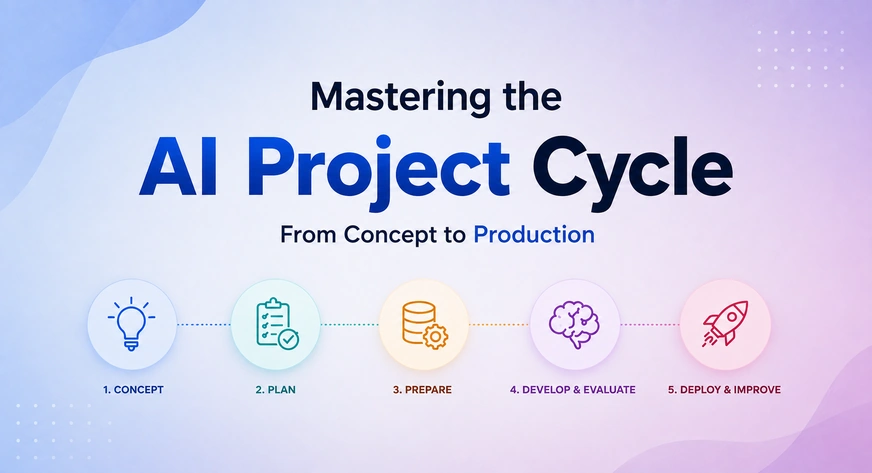
The rapid proliferation of artificial intelligence across global industries has shifted the focus from experimental curiosity to operational necessity. As organizations transition from testing simple chatbots to deploying complex, multi-agent systems, the requirement for a standardized, repeatable framework has never been more critical. Building a successful AI system is not a linear task of feeding data into a pre-selected model; rather, it is an intricate, multi-stage journey known as the AI Project Cycle. This structured process ensures that AI solutions are not only technically sound but also economically viable, ethically responsible, and capable of evolving alongside shifting market demands.
The Strategic Foundation: Defining the Problem Space
The genesis of any high-impact AI project lies in the Problem Definition stage. Industry data suggests that a significant percentage of AI initiatives fail not due to technical limitations, but because of a misalignment between the technology and the business objective. In a professional environment, vague goals such as "improving efficiency" are insufficient. Instead, stakeholders must define specific, measurable outcomes.
For instance, a financial institution seeking to implement AI for fraud detection must move beyond the general concept of "security" to a concrete objective: "Reducing false-positive transaction flags by 15% within the first six months while maintaining a 99% detection rate for unauthorized cross-border transfers." This level of specificity dictates the type of data required, the choice of model architecture, and the metrics used for evaluation. During this phase, project leads must identify the target audience, the available budget, and the technical constraints of the existing infrastructure.
Data Acquisition and the Ethics of Sourcing
Once the problem is framed, the focus shifts to Data Collection. In the modern AI landscape, data is often categorized as the "new oil," yet its value is entirely dependent on its refinement. Teams must identify diverse sources, ranging from internal proprietary databases and application logs to external APIs and public datasets.
In the context of Generative AI (GenAI) and Retrieval-Augmented Generation (RAG), data collection extends to unstructured formats such as PDFs, internal knowledge bases, and customer interaction histories. A growing trend in this stage is the use of synthetic data—artificially generated information that mimics real-world patterns—to train models where sensitive privacy concerns or data scarcity exist. Analysts note that ethical data sourcing has become a primary concern for legal departments, as the use of copyrighted or biased data can lead to significant regulatory penalties and reputational damage.
Data Engineering and Exploratory Analysis
Raw data is rarely suitable for immediate consumption by an AI model. The Data Preparation and Exploration stage is frequently cited by data scientists as the most time-consuming portion of the cycle, often accounting for up to 80% of the total project timeline. This phase involves cleaning the data by removing duplicates, handling missing values, and normalizing formats.
Exploratory Data Analysis (EDA) is conducted concurrently to uncover underlying patterns and potential biases. For example, if a recruitment AI is trained on historical data that reflects past hiring biases, the model will likely perpetuate those same prejudices. By identifying these skews during the preparation stage, engineers can apply techniques like oversampling or re-weighting to ensure a more equitable outcome. For Generative AI applications, this stage also involves "chunking" documents and generating vector embeddings to facilitate efficient information retrieval.
Model Development and Technical Selection
With a clean dataset in hand, the project moves to Model Development. This is the stage where the theoretical meets the practical. Engineers must decide between traditional machine learning (ML) algorithms—such as Random Forests or Gradient Boosting—and more modern approaches involving Large Language Models (LLMs) or neural networks.
A common pitfall in this stage is "over-engineering," where teams select the most complex model available when a simpler, more interpretable solution would suffice. Modern best practices advocate for starting with a baseline model to establish a performance floor. In GenAI projects, this stage might not involve training a model from scratch but rather fine-tuning an existing foundation model or designing sophisticated "agentic" workflows where multiple AI agents collaborate to solve a task.
Rigorous Evaluation and Benchmarking
Before an AI system can be integrated into a live environment, it must undergo Stage 5: Evaluation. This is not a mere "pass/fail" test but a multi-dimensional assessment of performance. For traditional ML, metrics like Accuracy, Precision, Recall, and the F1-score provide a mathematical view of the model’s reliability.
However, the rise of Generative AI has necessitated new evaluation frameworks. Since LLMs can produce varied outputs for the same prompt, teams use metrics like BLEU or ROUGE for text similarity, alongside "LLM-as-a-judge" techniques where a more powerful model evaluates the outputs of a smaller one. Beyond accuracy, evaluation must also account for latency (how fast the system responds) and cost (the computational expense per query). For high-stakes industries like healthcare or aerospace, this stage includes "red-teaming" to ensure the model cannot be manipulated into providing harmful or incorrect information.
Deployment and the Transition to Production
Deployment marks the transition of the AI system from a controlled lab environment to the real world. This stage involves significant collaboration between data scientists and DevOps engineers—a discipline now commonly referred to as MLOps. The system must be integrated with existing APIs, databases, and user interfaces while ensuring security protocols are met.
Professional deployment strategies often utilize "Canary Releases" or "A/B Testing." In a Canary Release, the new AI system is rolled out to a small percentage of users (e.g., 5%) to monitor for any unforeseen bugs before a full-scale launch. This incremental approach mitigates the risk of a total system failure and allows for real-time adjustments based on initial user feedback.
Monitoring, Maintenance, and the Iterative Feedback Loop
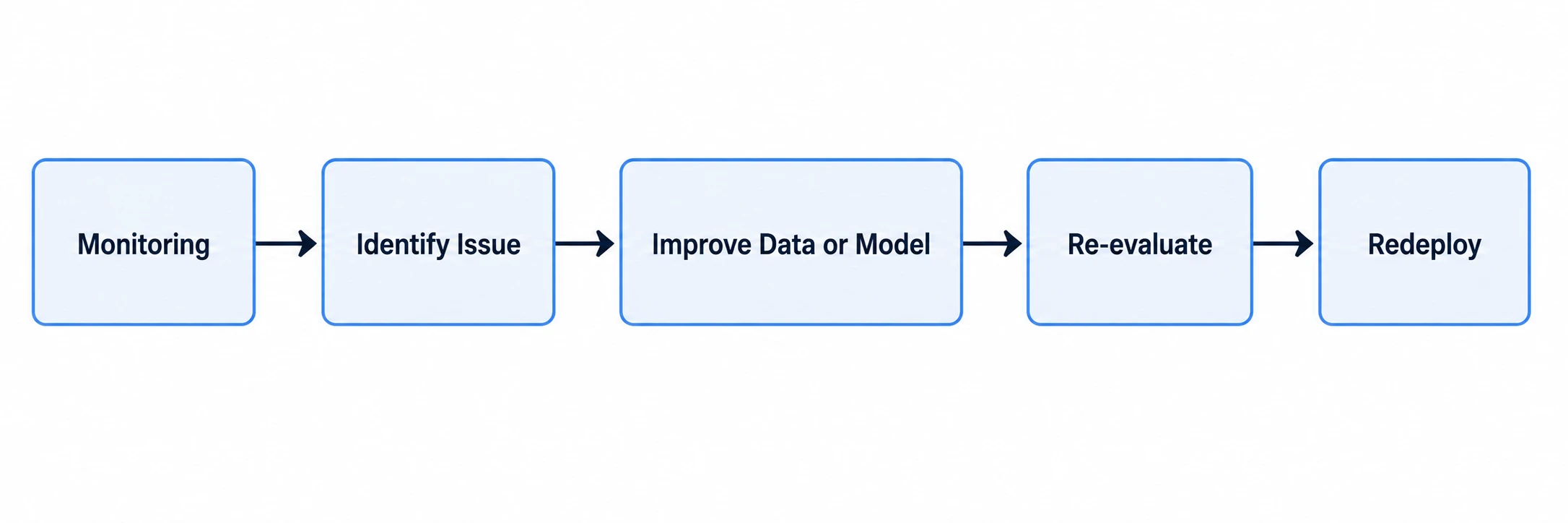
Contrary to traditional software development, the "completion" of an AI project is a misnomer. Stage 7, Monitoring and Continuous Improvement, is an ongoing necessity. AI models are subject to "Model Drift," a phenomenon where the model’s performance degrades over time as real-world data evolves away from the training set.
Monitoring tools track key performance indicators (KPIs) and alert teams to anomalies. If a customer service AI begins to see a spike in "hallucinations" (generating false information) or if its response accuracy drops below a certain threshold, the cycle restarts. Insights gained from production are fed back into the Problem Definition or Data Collection stages, leading to a refined version of the system. This iterative nature ensures that the AI remains an asset rather than a liability.
A Chronology of the AI Lifecycle
To visualize the progression, a typical enterprise-grade AI project often follows this timeline:
- Month 1: Problem Definition and Stakeholder Alignment.
- Month 2: Data Sourcing and Legal/Compliance Review.
- Month 3: Data Cleaning, EDA, and Feature Engineering.
- Month 4: Model Selection, Training, and Initial Prototyping.
- Month 5: Extensive Evaluation, Safety Testing, and UI Integration.
- Month 6: Pilot Deployment and Real-time Monitoring.
- Ongoing: Monthly performance audits and quarterly retraining cycles.
Broader Impact and Industry Implications
The formalization of the AI Project Cycle has profound implications for the global economy. By moving away from "black box" development and toward a transparent, staged process, companies can more accurately calculate Return on Investment (ROI). Furthermore, as regulatory bodies like the European Union implement the AI Act, having a documented project cycle becomes a legal requirement for demonstrating "trustworthy AI."
Industry experts suggest that the next frontier of the AI Project Cycle will involve "Autonomous MLOps," where AI systems themselves monitor, evaluate, and suggest improvements to other AI systems. While this increases efficiency, it also underscores the need for human-in-the-loop oversight at every stage of the cycle.
In conclusion, the AI Project Cycle is the essential roadmap for navigating the complexities of modern machine learning. By treating AI development as a continuous, iterative journey rather than a one-time technical hurdle, organizations can build systems that are resilient, scalable, and genuinely transformative. The success of an AI initiative is ultimately measured not by the complexity of its code, but by the rigor of the process that brought it to life.