

In the intricate landscape of modern digital communication, the email sign-off stands as a critical element, shaping the recipient’s final impression and subtly guiding their next action. Far from being a mere formality, the closing phrase chosen for an email serves as a powerful non-verbal cue, reflecting the sender’s tone, context, and the overarching purpose of the message. This comprehensive guide delves into the nuanced world of email sign-offs, exploring their significance, dissecting their various forms, and offering strategic insights for their effective deployment across diverse professional and personal scenarios.
The Evolving Significance of Email Etiquette
The advent of email revolutionized communication, offering unparalleled speed and reach. However, with this efficiency came a new set of unwritten rules and expectations regarding digital etiquette. In an era where a significant portion of professional and commercial interactions occur through electronic mail, every component of an email, from the subject line to the signature, contributes to the sender’s professional image and the message’s efficacy. The sign-off, positioned immediately before the sender’s name and contact details, often serves as the last point of direct textual engagement, making its impact disproportionately significant. It acts as a bridge between the core message and the call to action, or simply as a polite conclusion, underscoring the sender’s respect and professionalism.
Historically, formal letter closings like "Yours faithfully" or "Sincerely" carried specific weight, dictated by established social hierarchies and communication norms. While email has largely democratized communication, the underlying principle of tailoring one’s closing to the recipient and context remains paramount. Early email usage often mimicked these formal conventions, but as digital interactions became more frequent and informal, a broader spectrum of sign-offs emerged, necessitating a more deliberate approach to selection.
Deconstructing the Email Closing: Sign-Offs, Closing Lines, and Signatures
It is important to differentiate between an email sign-off, a closing line, and an email signature, as these distinct components collectively form the conclusion of a message. The email sign-off is the concise phrase directly preceding the sender’s name—examples include "Best regards," "Cheers," or "Thanks." It sets an immediate tone. The closing line, conversely, is a full sentence or phrase that often precedes the sign-off, such as "Let me know what works for you" or "I look forward to your response." This line frequently incorporates a soft call to action or a statement of expectation. Finally, the email signature is the block of information situated below the sender’s name, typically including their job title, company, contact details, and sometimes legal disclaimers or marketing links. While these elements are distinct, their combined effect is what crafts the complete closing impression.
The Psychological Impact of a Well-Chosen Sign-Off
Beyond mere politeness, the right email sign-off leverages psychological principles to reinforce the message and influence the recipient’s perception. A study by Boomerang, an email productivity tool, analyzing millions of emails, indicated that certain sign-offs correlated with higher response rates. While "Thanks" and "Thank you" were consistently among the most effective, suggesting the power of expressing gratitude, even seemingly minor choices can subtly affect how a message is received.
A formal closing can instill a sense of trust and seriousness, crucial for initial contacts or high-stakes communications. A friendly sign-off can foster rapport and warmth, essential for nurturing ongoing relationships. Conversely, an inappropriate sign-off—too casual for a formal context, or too formal for a casual one—can create dissonance, undermine credibility, or even leave a negative lasting impression. This final textual interaction can either reinforce the sender’s professionalism and clarity or introduce an element of awkwardness or misinterpretation, directly impacting future interactions and the overall effectiveness of the communication.
Categorizing Sign-Offs: A Strategic Framework
The optimal email sign-off is not universal; it is highly dependent on three critical factors: the desired tone of the message, the existing relationship with the reader, and the specific purpose of the email. To navigate this complexity, sign-offs can be broadly categorized, moving from the most formal to the most informal, each serving distinct communication objectives.
1. Professional and Formal Email Sign-Offs
These closings are indispensable when establishing new professional relationships, communicating in high-stakes environments, or addressing individuals with whom a respectful distance is maintained. They convey deference, seriousness, and adherence to professional norms.
- Use Cases: Job applications, formal proposals, initial client communications, official announcements, legal correspondence.
- Examples: Sincerely, Regards, Best regards, Respectfully, Yours faithfully (for unknown recipients), Yours truly, Cordially, Kind regards, Warm regards, All the best, Best wishes, With appreciation, With respect, In good faith, Thank you for your consideration, Respectfully submitted.
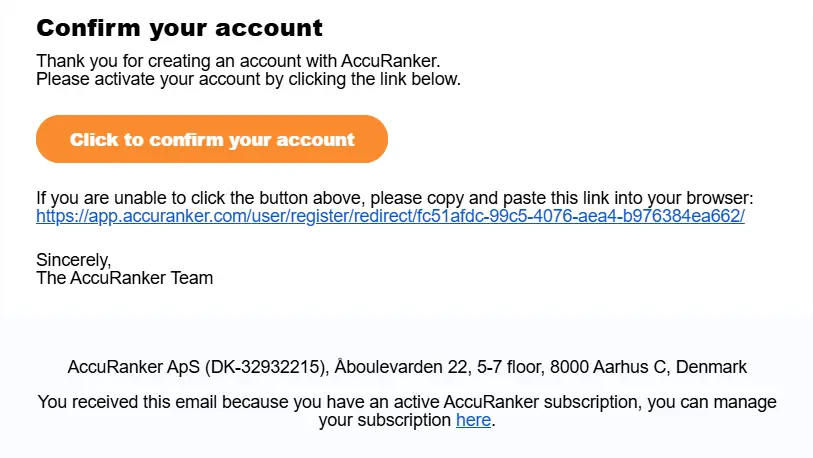
- Analysis: An example from AccuRanker, where an account confirmation email concludes with "Sincerely, The AccuRanker Team," exemplifies the utility of a formal sign-off for transactional messages. Its formality signals trustworthiness and official capacity, aligning perfectly with the objective of a confirmation email.
2. Friendly and Casual Email Sign-Offs
Reserved for colleagues, established clients, or individuals with whom a comfortable rapport has been built, these sign-offs inject warmth and approachability without sacrificing professionalism.
- Use Cases: Internal team communications, follow-ups with familiar clients, informal updates, newsletters to engaged audiences.
- Examples: Cheers, Best, Thanks, Talk soon, See you, Take care, Have a great day/week, Wishing you well, Yours, Warmly, Regards (standalone), Many thanks, Looking forward, Keep in touch, Until next time, Enjoy.
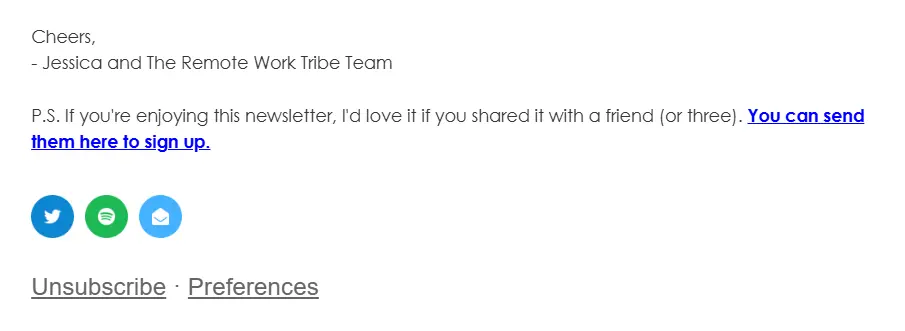
- Analysis: The Remote Work Tribe’s newsletter using "Cheers" followed by sender names illustrates how a casual sign-off reinforces an established, relaxed community tone. It builds camaraderie, contrasting sharply with the stiff formality that would feel out of place in such a context.
3. Thank-You and Appreciation Email Sign-Offs
These closings are specifically designed to convey gratitude, whether for an interview, a favor, a purchase, or any instance where someone has dedicated their time or resources. The intensity of the gratitude should mirror the significance of the act.
- Use Cases: Post-interview thank-yous, acknowledging support, confirming purchases, expressing appreciation for feedback.
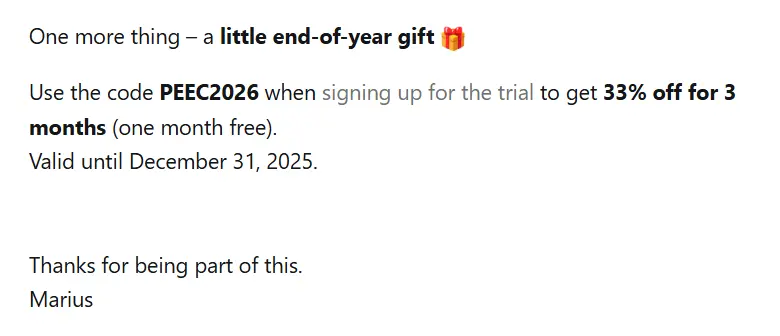
- Examples: Thank you, Many thanks, Thanks again, With gratitude, Appreciatively, Gratefully, Much appreciated, Thanks so much, Thanks a bunch, Your help is appreciated, I appreciate your time, With deepest thanks, Grateful for your support, Thanks for your continued business, Thank you for your patronage, We appreciate you, Thanks for being part of this, Thank you for everything, Truly grateful, Best thanks.
- Analysis: Peec AI’s end-of-year email, closing with "Thanks for being part of this" alongside a discount, effectively combines gratitude with a subtle call to action. The sign-off authenticates the discount as a genuine token of appreciation, fostering customer loyalty.
4. Sales and Follow-Up Email Sign-Offs
These sign-offs are inherently action-oriented, designed to steer the recipient towards a specific next step, such as making a purchase, clicking a link, or providing a reply. They are a crucial component in driving conversions and maintaining engagement.
- Use Cases: Promotional emails, order confirmations (with next steps), sales follow-ups, customer support replies requiring further action.
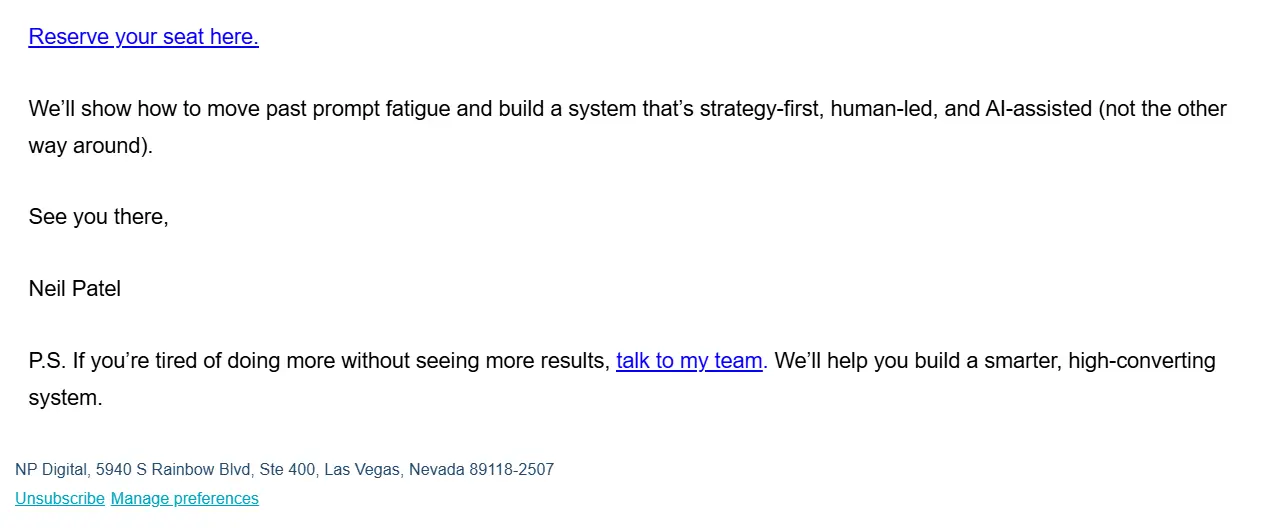
- Examples: Looking forward to hearing from you, Hoping to connect soon, Let me know if you have any questions, Feel free to reach out, Ready to assist, Awaiting your response, Hope to collaborate, See you there, Shop now, Click here, Visit our site, Explore more, Don’t miss out, Get started today, Your next step, Call us.
- Analysis: Neil Patel’s event invitation ending with "See you there" after urging seat reservations exemplifies a sales-oriented sign-off. It re-emphasizes the desired outcome and creates a sense of anticipation for the event, directly supporting the email’s primary goal.
5. Creative and Modern Email Sign-Offs
For brands or individuals with a distinct voice and an audience that appreciates personality, creative sign-offs add character without resorting to overt humor. Consistency in brand voice is key for these to land effectively.
- Use Cases: Brand newsletters, creative industry communications, personal blogs, internal team messages in a casual corporate culture.
- Examples: Happy [activity related to business], Stay awesome, Keep shining, Wishing you success, Your partner in [industry], Onwards and upwards, Make it a great day, To your success, Stay curious, The [Your Company] Team.
- Analysis: AmeraLabs, a 3D-printing brand, uses "Happy printing." This specific, industry-relevant sign-off resonates deeply with its audience, injecting personality while remaining on-topic and reinforcing brand identity.
6. Funny Email Sign-Offs
Humorous sign-offs require a keen understanding of the audience and context. They are best reserved for internal communications, lighthearted newsletters, or exchanges with recipients who share a similar sense of humor. Misapplication can lead to confusion or offense.
- Use Cases: Internal team banter, highly informal newsletters, communications within niche communities with shared inside jokes.
- Examples: May the force be with you, Catch you on the flip side, Later, alligator, Keep calm and carry on, Stay golden, Don’t get lost, Sent from my potato, Over and out, To infinity and beyond, Live long and prosper, May your coffee be strong, Your friendly neighborhood [Your Role], Until next time, stay quirky, Signing off for now, Sending good vibes, Stay sassy, Keep it real, Farewell, human, Adios, amigos, May your inbox be empty.
- Analysis: The Dragon Trappers Lodge’s sign-off, "May your blades stay sharp and your flesh on your bones," is a prime example of a funny sign-off working within a specific niche (fantasy gamers). The shared context makes the humor land perfectly, fostering community engagement.
Sign-Offs in the Customer Journey: An E-commerce Perspective
For e-commerce brands, the strategic deployment of email sign-offs is integral to nurturing the customer journey, transforming final words into action primers. Each stage of the customer lifecycle demands a tailored approach to closing phrases, ensuring clarity of call to action and minimizing friction in the decision-making process.
| Journey Stage | Goal | Recommended Closing Line | Recommended Sign-Off | Implications |
|---|---|---|---|---|
| Welcome Emails | Build warmth and engagement | "We are thrilled to share our story with you." | "Excited to have you here," | Sets a friendly, inviting tone, fostering immediate connection and trust. |
| Cart Recovery | Balance urgency with support | "Don’t leave your favorites behind." | "Your items are waiting," | Creates gentle urgency while reminding the customer of their potential purchase. |
| Promotional | Drive immediate action | "This offer expires at midnight." | "Shop the sale now," | Reinforces scarcity and prompts instant conversion. |
| Customer Service | Emphasize availability and trust | "Reply directly to this email if you need anything else." | "We’re always here to help," | Assures ongoing support and builds confidence in the brand. |
| Post-Purchase | Focus on loyalty and retention | "We hope you love your new items." | "Thanks for your order," | Expresses gratitude, reinforcing a positive customer experience and encouraging repeat business. |
These examples illustrate how the sign-off, when aligned with the email’s objective within the customer journey, can significantly enhance its effectiveness. For instance, a cart recovery email might conclude with, "Don’t let these slip away. Complete your purchase today before your size sells out. Your cart is waiting, John." This clear, concise, and action-oriented closing directly addresses the customer’s intent. Similarly, a post-purchase thank-you might state, "Thank you for shopping with us. We hope you’ll come to love your new items. Till next time, John," fostering goodwill and encouraging future engagement.
Common Pitfalls: Sign-Offs to Avoid
Just as there are effective sign-offs, there are also those that can undermine an otherwise strong message. Many people fall into the trap of using default or habitual closings without considering their impact.
- Sign-offs that clash with your message: Using "Best" after delivering bad news can seem flippant. The sign-off must harmonize with the email’s content.
- Sign-offs that turn off your audience: An overly casual "xoxo" in a professional setting or a hyper-formal "Respectfully" to a close colleague can create an immediate disconnect and signal a lack of awareness.
- Sign-offs that read as lazy: Generic one-word closings like "Regards" (without "Best" or "Kind") can sometimes be perceived as abrupt or lacking effort, particularly in initial communications.
- Sign-offs that bury your contact details: While not a sign-off itself, neglecting a comprehensive email signature below the sign-off can make it difficult for recipients to contact you, especially on mobile devices.
- Passive-aggressive sign-offs: Phrases like "Thanks in advance" for a request that hasn’t been agreed upon can imply an expectation that may breed resentment. Similarly, "Per my last email" can escalate tension rather than resolving it. Such closings reflect frustration and are best avoided in favor of direct and neutral communication.
Strategic Selection and Implementation
Choosing the right email sign-off is a strategic decision that requires careful consideration. Prioritize the recipient, the message’s tone, and cultural norms.
- Consider your relationship: Is it formal, casual, new, or established?
- Assess the email’s purpose: Is it to inform, request, thank, sell, or follow up?
- Match the tone: Ensure the sign-off aligns with the overall sentiment of your email.
- Be consistent: While adapting is key, maintain a consistent professional persona across your communications.
- Consider cultural nuances: Different cultures may interpret formality and familiarity differently.
- When in doubt, default to "Best regards": This phrase is widely accepted as polite, professional, and versatile across most business contexts.
Once a sign-off is chosen, ensure the mechanics are sound:
- Punctuation: A comma usually follows the sign-off (e.g., "Best regards, John").
- White space: Leave a line break between the closing line, the sign-off, and your name/signature for readability.
- Consistency: For automated campaigns or team communications, ensure all members use approved, consistent sign-offs. Tools like Omnisend allow for A/B testing different sign-offs on segments of an audience to gauge their effectiveness and conversion rates, while AI writers can help rephrase closing lines to achieve the desired tone.
Conclusion: The Art of the Final Impression
The email sign-off, though seemingly minor, holds considerable power in professional communication. It is the final brushstroke on your message, capable of reinforcing your professionalism, building rapport, or subtly guiding your recipient toward a desired action. A well-chosen sign-off demonstrates attention to detail, emotional intelligence, and respect for the recipient, all of which are vital in fostering strong relationships and achieving communication objectives.
In an increasingly digitized world where first and last impressions are often made through screens, mastering the art of the email sign-off is not just good etiquette; it is a strategic imperative for individuals and organizations alike. By understanding the nuances of tone, context, and purpose, and by thoughtfully selecting the appropriate closing, communicators can ensure their emails consistently leave a positive, professional, and impactful final impression. For businesses, especially in e-commerce, this translates directly into enhanced customer engagement, stronger brand loyalty, and ultimately, improved conversion rates.








