rifanmuazin
The affiliate marketing landscape experienced a seismic shift in mid-January 2026 as two of the industry’s most prominent networks, Rakuten Advertising and impact.com, took the unprecedented step of removing PayPal Honey from their platforms. This move follows a series of high-profile investigations into the browser extension’s technical practices, specifically regarding "stand-down" violations and attribution manipulation. PayPal Honey, which was acquired by the global payments giant PayPal for approximately $4 billion in 2020, now faces significant hurdles in maintaining its status as a leading player in the performance marketing sector.
The controversy centers on allegations that the Honey browser extension systematically bypassed industry-standard protocols designed to ensure fair commission attribution. These protocols, known as "stand-down" rules, are intended to prevent browser extensions from overwriting the cookies of other affiliates who may have introduced the customer to the brand earlier in the clickstream. By allegedly failing to stand down and concealing these actions, Honey is accused of siphoning commissions away from content creators, influencers, and other top-of-funnel partners.
A Chronology of Disruption: From Investigation to Expulsion
The events leading to the removal of PayPal Honey were precipitated by independent investigations that gained significant traction within the digital marketing community. The timeline of the fallout is as follows:
- Late 2025 – Early 2026: Investigative reports by digital transparency advocate MegaLag and cybersecurity researcher Ben Edelman surfaced, detailing specific instances where Honey’s software appeared to engage in "cookie-stuffing" and the intentional circumvention of stand-down rules. Edelman’s investigation specifically highlighted "detecting testers," suggesting the software could identify when it was being monitored and alter its behavior to appear compliant.
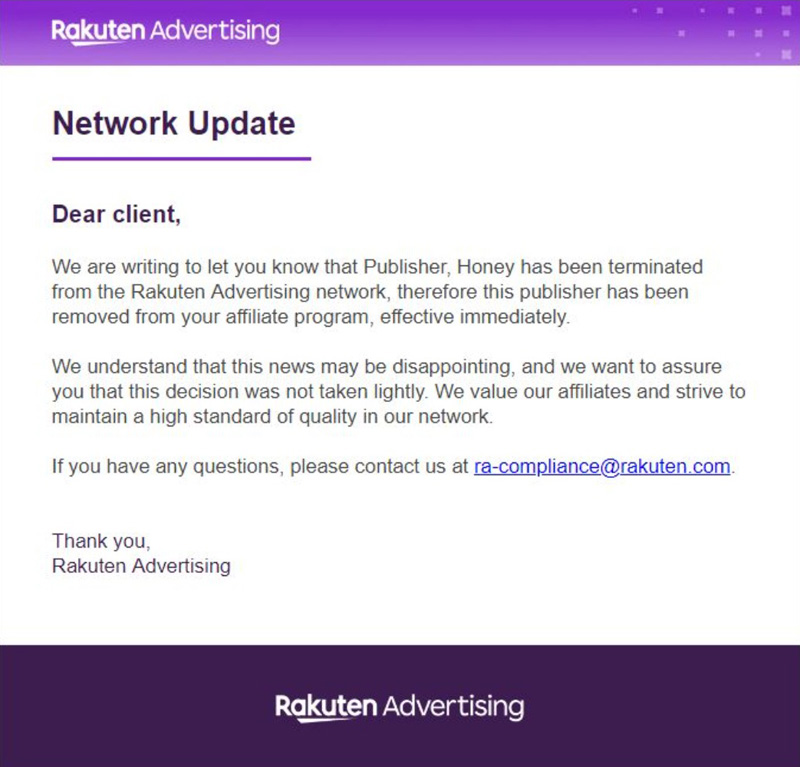
- Monday, January 12, 2026: On the opening day of Affiliate Summit West, the largest affiliate marketing conference in the United States, Rakuten Advertising officially announced the termination of Honey from its network. The network cited the need to "maintain a high standard of quality" and protect the integrity of its ecosystem.
- January 12–15, 2026: The news dominated discussions at Affiliate Summit West in Las Vegas, with industry professionals expressing concerns over the impact of attribution fraud on smaller publishers and the general trust in the "partnership economy."
- Friday, January 16, 2026: impact.com followed suit, announcing that Honey had been found "out of compliance" with platform policies. While impact.com characterized its move as a suspension from its "Discovery Marketplace" rather than a permanent network-wide ban, the message was clear: the extension’s behavior undermined the fundamental principles of the platform.
The Mechanics of Non-Compliance: Stand-Down Rules and Attribution Manipulation
To understand the gravity of these removals, one must examine the technical mechanisms of affiliate attribution. Most modern affiliate programs operate on a "last-click-wins" model. Under this system, the last affiliate to provide a referral link that the customer clicks before making a purchase receives the full commission for that sale.
Browser extensions like Honey provide value to consumers by automatically finding and applying coupon codes at checkout. However, because they operate at the very end of the consumer journey, they have a natural advantage in the "last-click" race. To protect content-driven affiliates—such as bloggers or review sites—who do the heavy lifting of product discovery, networks implement "stand-down" rules. These rules dictate that if an affiliate cookie is already present in the user’s browser, the extension must not fire its own affiliate link, thereby allowing the original referrer to claim the commission.
The investigations into Honey alleged that the extension utilized sophisticated methods to bypass these rules. By overwriting existing cookies even when it was supposed to remain inactive, Honey effectively "hijacked" the attribution. Furthermore, the concealment of these practices made it difficult for brand managers and networks to detect the violations through standard auditing tools.

Official Responses and Industry Reactions
The leadership of the major networks has been vocal about the necessity of these enforcement actions. David Yovanno, CEO of impact.com, explicitly cited "attribution manipulation" as the core reason for the suspension, emphasizing that such behavior threatens the transparency and trust required for the partnership economy to function.
Rakuten Advertising’s statement was equally firm, framing the termination as a quality control measure. The timing of the announcement—coinciding with the industry’s largest annual gathering—was viewed by many analysts as a strategic "PR play" intended to signal to the market that networks are becoming more aggressive in policing high-volume publishers who do not play by the rules.
The Performance Marketing Association (PMA) and the Affiliate & Partner Marketing Association (APMA) in the UK have also weighed in, highlighting the complexity of Downloadable Software Publisher (DSP) policies. A recent APMA audit of thirty brands across ten networks underscored the ongoing struggle to balance the utility of browser extensions with the need for fair attribution, offering recommendations for more robust auditing processes.
Broader Implications for PayPal and the Affiliate Ecosystem
The fallout for PayPal is potentially significant. Having invested $4 billion in Honey to bolster its e-commerce presence and data collection capabilities, the loss of access to major affiliate networks limits the extension’s revenue-generating potential and its utility to merchants. If more networks follow the lead of Rakuten and impact.com, PayPal may be forced to radically restructure how Honey interacts with merchant sites and third-party tracking technologies.
For the broader affiliate industry, this event serves as a "watershed moment." It highlights the risks of over-reliance on a small number of high-volume affiliates and the dangers of the "last-click" model when it is not strictly policed. The removal of a "bad apple" of this magnitude is expected to encourage more brands to conduct their own independent audits rather than relying solely on network-level compliance teams.
Strategic Lessons for Affiliate Program Management
The Honey incident provides five critical lessons for affiliate managers and brand owners looking to safeguard their marketing budgets and maintain healthy partner ecosystems:
1. The Proximity of Risk
A single non-compliant affiliate can jeopardize the health of an entire program. High-quality content publishers often refuse to join programs where they know they will be "vulture-ed" by extensions that hijack their commissions. Protecting the "good apples" requires the removal of those who manipulate the system.
2. The Necessity of Internal Policing
Brands cannot outsource their ethics or their compliance entirely to networks. While networks have compliance departments, they often focus on network-wide policy rather than brand-specific terms and conditions. Furthermore, networks may face a conflict of interest when dealing with publishers that generate massive transaction volumes. Brands must enforce their own Terms and Conditions (Ts & Cs) and use third-party monitoring tools to verify affiliate behavior.
3. Deep Technical Understanding
Managing an affiliate program in 2026 requires more than just relationship management; it requires technical literacy. Managers must understand the difference between "soft clicks," "forced clicks," and "stand-down" protocols to intelligently police their programs and identify sophisticated fraud.
4. Avoiding Generalization
While the Honey case is a significant example of extension-based non-compliance, it should not lead to a blanket ban on all browser extensions or software publishers. Many extensions provide legitimate value and operate within the rules. Each partner should be evaluated on their individual behavior and technical implementation.
5. The Mandate for Diversification
The most resilient affiliate programs are those that do not put all their eggs in one basket. A program that sees a massive revenue drop after the removal of one partner is, by definition, poorly diversified. To mitigate risk, brands should aim for a balanced mix of at least 28 different affiliate types, including:
- Content & Influence: Content producers, social media influencers, podcasters, and video marketers.
- Niche & Professional: Educators, consultants, service providers, and affinity groups.
- Technological & Loyalty: Card-linked offers, post-checkout solutions, and CUG (closed user group) loyalty solutions.
- Traditional Performance: Paid search affiliates (with strict trademark rules), email marketers, and coupon/deal sites.
- Emerging Channels: Connected TV (CTV) and mobile-oriented publishers.
Conclusion: A Move Toward Greater Transparency
The removal of PayPal Honey from Rakuten Advertising and impact.com marks a turning point in the maturation of the affiliate marketing industry. As attribution technology becomes more sophisticated, the tolerance for manipulation is shrinking. For merchants, the path forward involves a more rigorous approach to partner selection, a commitment to multi-touch attribution models where possible, and a relentless focus on diversifying their affiliate base to ensure that no single partner—no matter how large—can dictate the terms of their success. The industry’s response to the Honey controversy suggests that in 2026 and beyond, the "standard of quality" will be enforced with renewed vigor.