
In a move that has sent shockwaves through the digital marketing industry, two of the largest affiliate networks in the United States, Rakuten Advertising and impact.com, have taken decisive action against PayPal Honey. The browser extension and shopping tool, which was acquired by PayPal for $4 billion in 2020, has been removed or suspended from these platforms following allegations of noncompliance with network policies and "attribution manipulation." The enforcement actions, which occurred during the third week of January 2026, highlight a growing industry-wide crackdown on practices that undermine the integrity of the partnership economy.
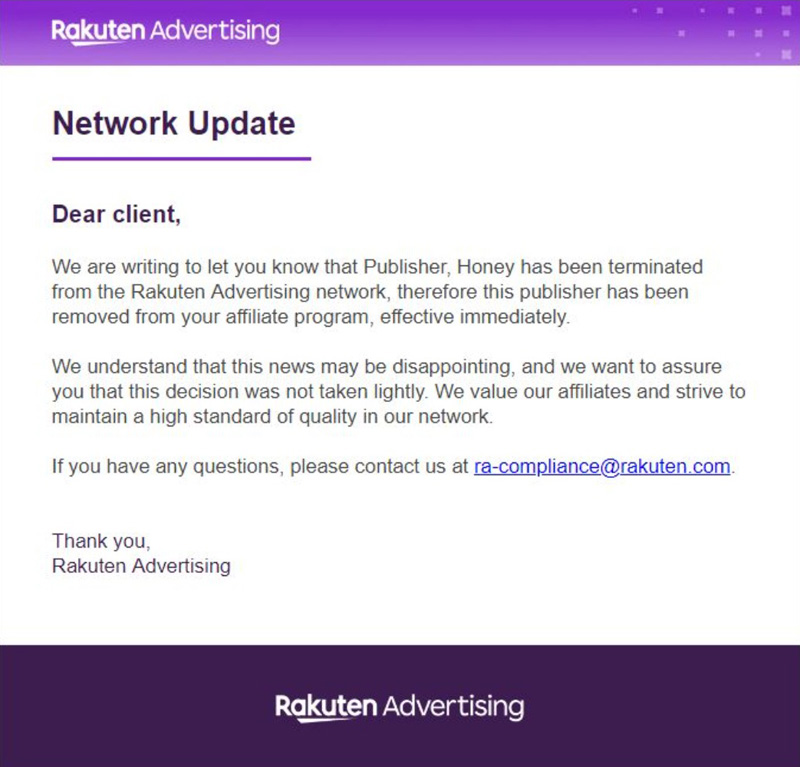
The fallout began on Monday, January 12, when Rakuten Advertising officially announced that Honey had been "terminated from the network." In a statement directed at its partners, Rakuten framed the decision as a necessary step to "maintain a high standard of quality" within its ecosystem. Just days later, on Friday, January 16, the platform impact.com followed suit, declaring that Honey was "out of compliance" with its platform policies. While impact.com described its action as a "removal" from its Discovery Marketplace, industry observers noted that the platform categorized it as a suspension, suggesting a potential, albeit difficult, path toward reinstatement should compliance issues be resolved.
Chronology of the Disruption
The timeline of Honey’s removal suggests a coordinated or rapidly cascading response to recent investigative findings. The catalysts for these network actions appear to be two-fold: a detailed video exposé by the creator known as MegaLag and an exhaustive technical investigation by Ben Edelman, a well-known expert in online advertising fraud and consumer protection.
On January 12, the same day the affiliate industry gathered for the Affiliate Summit West conference, Rakuten Advertising issued its termination notice. The timing was particularly notable, as the conference is the largest of its kind in the United States, ensuring that the news of Honey’s removal was the primary topic of discussion among thousands of marketing professionals and brand managers.
By January 16, impact.com’s CEO addressed the situation directly, citing "attribution manipulation" as the core reason for the suspension. The CEO emphasized that such behavior undermines trust in the partnership economy, where brands rely on accurate data to compensate partners for genuine customer acquisitions.
Understanding the Technical Violations: Stand-Down and Hijacking
At the heart of the controversy are "stand-down" violations. In the affiliate marketing world, browser extensions are often classified as Downloadable Software Publishers (DSPs). To ensure fair competition, these extensions are typically required to follow "stand-down" rules. These rules mandate that an extension must not fire its affiliate link or drop a cookie if another affiliate—such as a content creator, blogger, or review site—has already influenced the customer’s journey and is present in the clickstream.

The primary goal of stand-down rules is to prevent "last-touch" hijacking. Most affiliate programs operate on a last-click attribution model, meaning the last affiliate to "touch" the customer before the purchase receives the full commission. Investigations into Honey’s behavior suggested that the extension was intentionally violating these rules, concealing its activity to overwrite the cookies of previous affiliates. By doing so, Honey would claim credit for sales that were already in progress, effectively diverting commissions away from other hard-working partners and into its own coffers.
Ben Edelman’s investigation provided technical evidence of these violations, showing how the software could detect when it was being tested and alter its behavior to avoid detection by compliance officers. This "concealment" was cited by industry leaders as a particularly egregious breach of trust, moving the issue from accidental technical error to intentional manipulation.
Industry Data and the Cost of Noncompliance
The implications of these removals are significant, given Honey’s massive footprint. At the time of its acquisition by PayPal, Honey boasted over 17 million monthly active users and partnerships with 30,000 retailers. For many brands, Honey was a top-tier revenue generator. However, the recent actions by Rakuten and impact.com suggest that the quality of that revenue is now being questioned.
A recent study by The Affiliate & Partner Marketing Association (APMA) in the United Kingdom shed light on the complexity of these attribution issues. The APMA conducted an independent audit of 30 brands across 10 affiliate networks, examining the behavior of different affiliate types. While the data was anonymized, the study highlighted a recurring tension between "early-funnel" affiliates (like content creators) and "bottom-funnel" extensions (like Honey). The audit provided seven recommendations for the industry, emphasizing the need for more robust "soft click" technologies and stricter enforcement of stand-down protocols to protect the integrity of the channel.
For brand managers, the cost of Honey’s removal is not just the potential loss in referred sales volume, but the realization that a significant portion of those sales may have been misattributed. If an extension is simply "winning" the last click from a customer who was already going to buy—or who was referred by another affiliate—the brand is essentially paying a commission for a sale it would have had anyway, or worse, paying the wrong person.
Implications for Affiliate Program Management
The removal of a $4 billion entity from major networks serves as a stark reminder for affiliate managers. Experts from AM Navigator and other consultancy firms have identified several critical lessons that brands must take away from this event.
The Danger of the "Bad Apple"
In an affiliate ecosystem, the presence of a rule-violating publisher can deter high-quality affiliates from joining a program. Content creators and influencers, who invest significant time in building trust with their audiences, are often hesitant to promote brands that allow "cookie-stuffing" extensions to operate unchecked. If a blogger knows their commission will likely be hijacked at the checkout screen by a browser extension, they will simply stop promoting that merchant.
The Limits of Network Policing
One of the most vital takeaways for brands is that they cannot rely solely on affiliate networks to police their programs. While networks like Rakuten and impact.com have compliance departments, their primary focus is on violations of network-wide policies. Individual brand terms and conditions are often left to the brand’s own management team to enforce. Furthermore, networks have historically been slow to act against high-volume publishers who generate significant fees for the network itself. Brands are encouraged to conduct their own audits and use third-party policing tools to ensure compliance.
The Necessity of Diversification
The Honey incident has exposed the vulnerability of affiliate programs that rely too heavily on a single type of publisher. Many programs find that upwards of 50% of their revenue comes from just one or two large coupon or loyalty extensions. When such a publisher is removed, the program’s revenue craters.
To mitigate this risk, industry experts suggest a diversification strategy that includes a wide array of affiliate types. A healthy program should ideally incorporate:
- Content Producers and Mass Media: High-authority sites and journalists.
- Social Media Influencers: Creators who drive brand awareness and intent.
- Card-Linked Offers: Rewards tied directly to consumer credit cards.
- Niche Educators and Consultants: Partners who provide deep expertise in specific product categories.
- Affinity Groups and Charities: Organizations that drive loyalty through shared values.
- Podcasters and Video Marketers: Partners who leverage long-form engagement.
By spreading recruitment across 20 or more different affiliate categories, brands can ensure that the loss of any single partner—no matter how large—does not result in a catastrophic failure of the channel.
Future Outlook for the Partnership Economy
The suspension of PayPal Honey is likely to lead to a period of intense scrutiny for all browser-based shopping tools. Analysts expect other major networks and independent platforms to conduct their own reviews of DSP behavior in the coming months. There is also an increasing call for "multi-touch attribution" models, which would move the industry away from the "last-click-wins" standard and toward a system that rewards every affiliate who contributed to the customer’s journey.
For PayPal and Honey, the path forward remains unclear. While the company has the resources to challenge these findings or overhaul its technology, the damage to its reputation within the affiliate community is substantial. For the broader industry, the events of January 2026 mark a turning point where transparency and technical compliance have become non-negotiable requirements for participation in the global affiliate marketplace.
As the digital landscape evolves, the focus is shifting from raw volume to "incremental" value. Brands are no longer satisfied with high sales numbers if those numbers are the result of attribution manipulation. The removal of Honey signals that the industry’s gatekeepers are finally prioritizing the long-term health of the partnership economy over short-term transaction fees.