
 rifanmuazin
In the rapidly evolving landscape of digital commerce, the discipline of Conversion Rate Optimization (CRO) has shifted from a niche marketing tactic to a fundamental pillar of business strategy. At the center of this transformation is the integration of data science, behavioral psychology, and, increasingly, artificial intelligence. Simbar Dube, a Conversion Research Specialist at Enavi, recently provided an in-depth look into the methodologies that drive modern experimentation and how the advent of AI is reshaping the way brands understand and interact with their customers. Dube’s perspective is shaped by a unique professional trajectory, moving from the investigative world of journalism into the data-heavy environment of CRO, a transition that highlights the enduring importance of inquiry-based research in a digital-first world.
The Evolution of a Conversion Specialist: From Journalism to Data
The path to becoming a CRO expert is rarely linear. For Simbar Dube, the journey began in 2019 when he joined Invesp, a pioneering firm in the conversion optimization space. Initially serving as a Content Editor, Dube ascended to the role of Head of Marketing before specializing in conversion research at Enavi. His background in journalism provided a critical foundation for his current work. In journalism, the objective is to uncover the "who, what, where, when, and why" of a story; in CRO, the objective is strikingly similar, though the "story" is the customer journey and the "plot holes" are the points of friction that prevent a sale.
Dube defines the discipline of optimization through a concise four-pillar philosophy: "Curiosity. Tested. Proven. Repeat." This framework suggests that while technology changes, the core requirement for success remains a relentless curiosity about human behavior. The transition from reporting news to reporting on data signals represents a broader trend in the industry where qualitative communication skills are increasingly paired with quantitative analytical rigor.

The Strategic Shift: How AI is Accelerating Research Synthesis
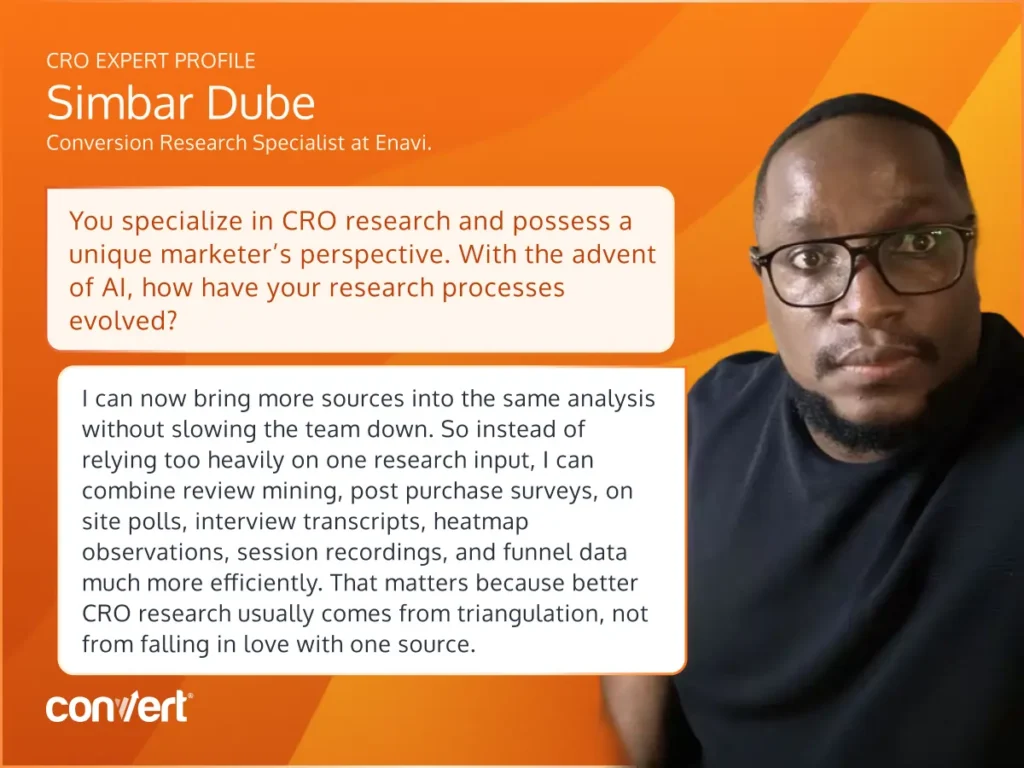
The integration of artificial intelligence into marketing workflows has been met with both enthusiasm and skepticism. However, in the field of CRO research, the impact is measurable in terms of efficiency and scale. According to Dube, the fundamental objectives of research remain unchanged: identifying where customer intent collapses and understanding the hesitations that lead to abandonment. What has changed is the velocity at which these insights can be gathered.
Before the widespread adoption of AI, a comprehensive research phase was often a bottleneck in the experimentation cycle. A specialist might spend dozens of hours manually reviewing hundreds of customer survey responses, mining thousands of product reviews for sentiment, and watching hours of session recordings to identify patterns. Dube notes that while a researcher could previously go "deep" into a single data source, it was difficult to go "wide" across multiple sources simultaneously without significant time investment.
Today, AI models allow researchers to process vast volumes of qualitative feedback in a fraction of the time. This includes:
- Clustering Recurring Objections: Identifying common themes in customer complaints or questions across disparate channels.
- Language Pattern Comparison: Analyzing how different customer segments describe their problems versus how a brand describes its solutions.
- Multi-Source Triangulation: Simultaneously synthesizing data from post-purchase surveys, on-site polls, interview transcripts, and heatmaps.
This "triangulation" is vital because it prevents researchers from "falling in love with one source," a common bias that can lead to flawed hypotheses. By using AI to widen the field of evidence, specialists can ensure their conclusions are supported by a broader spectrum of user behavior.

The Human Element: Diagnosis vs. Signal Detection
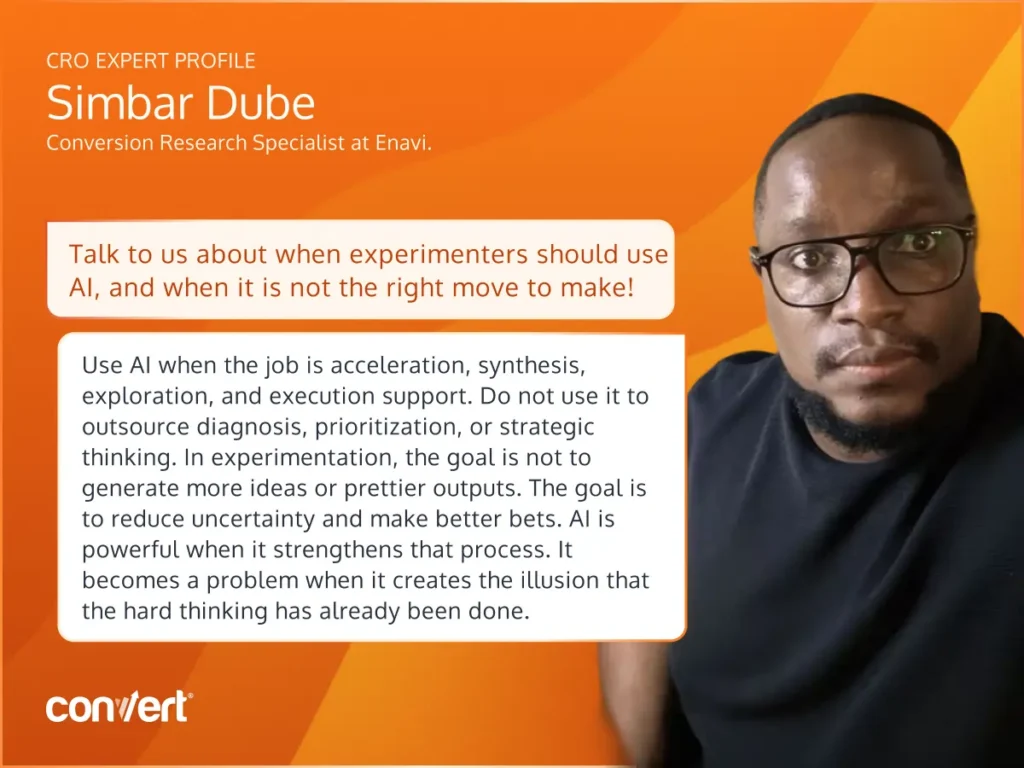
Despite the efficiency gains provided by AI, a critical distinction remains between "signal detection" and "diagnosis." Dube argues that while AI is excellent at surfacing signals—such as a recurring complaint about shipping costs—it cannot inherently understand the commercial context or the strategic priority of that signal.
In a professional journalistic tone, the analysis of Dube’s methodology reveals a "human-in-the-loop" requirement for effective CRO. A machine can identify that 20% of users mention a specific friction point, but it cannot determine if those users represent the highest-value segment or if the friction point is a "necessary" hurdle in a high-intent funnel. Business judgment, funnel context, and an understanding of the brand’s unique value proposition remain human-led activities.
Dube cautions against "outsourcing diagnosis" to AI. The risk lies in treating an AI-generated summary as a final truth rather than a starting point for deeper investigation. In the hierarchy of experimentation, AI serves the roles of acceleration, synthesis, and execution support, but the higher-order functions of prioritization and strategic thinking remain firmly in the domain of the human specialist.
Case Study: Bridging the Digital and Physical Gap
The practical application of CRO thinking often extends beyond the digital interface. Dube highlighted a significant experiment involving a retail client that illustrates the "offline" potential of conversion research. The client, having recently opened a new physical store, faced a dual challenge: online customers were hesitant to purchase due to uncertainty regarding the fit and feel of the products, yet the brand knew that in-store customers yielded a higher Average Order Value (AOV).
The experimentation team utilized a "Buy Online, Pick Up In Store" (BOPIS) strategy to address this. By making the pickup option more prominent for shoppers in the geographic vicinity of the new store, they positioned the physical location as the "fastest and most reassuring path to purchase."
The experiment was measured through three primary metrics:
- Increase in pickup orders for the specific branch.
- Comparative foot traffic during the test window versus a baseline.
- The overall order value of the local cohort.
This case study serves as an example of "experimentation in its purest sense," moving beyond simple A/B testing of button colors to solving a fundamental business problem through behavioral intervention. It addresses the psychological barrier of "purchase anxiety" by leveraging physical assets to bolster digital confidence.
Re-Engineering the B2B Sales Pipeline through Experimentation
Another area where CRO methodologies are being applied is in B2B sales motion, particularly in "stalled pipeline recovery." Dube treats stalled deals not merely as a follow-up task for sales representatives but as an experimentation problem.
At the agency level, Dube tested different re-entry approaches for prospects who had stopped responding. These included:
- Generic Nurture: Standard brand-led updates.
- Case Study Proof: Providing evidence of success with similar clients.
- Diagnostic Outreach: A highly specific, pointed analysis of what was likely constraining growth in the prospect’s specific funnel.
The results indicated that diagnostic outreach—providing the buyer with a reason to think rather than just a reason to click—consistently outperformed broader nurture strategies. This reinforces the idea that specificity and perceived value are the primary drivers of engagement in high-stakes environments.
The Future of Experimentation: Integrated AI and Market Impact
The broader implications of these shifts are significant for the marketing industry. AI is no longer a peripheral tool; it is being "baked into" the infrastructure of the web. Platforms like Shopify are already deploying AI-driven tools for simulation and rollout, signaling a future where experimentation is a continuous, automated background process.
However, the "acceleration" described by Dube suggests a potential labor shift. As the "grunt work" of data synthesis becomes automated, the value of a CRO professional will shift toward their ability to ask the right questions and interpret complex results within a commercial framework. This evolution mirrors the history of many technical fields where automation of the "how" places a higher premium on the "why."
Chronology of the CRO Evolution (2019-2024)
- 2019: Simbar Dube enters the CRO field at Invesp. At this time, AI tools for research are largely experimental or limited to basic sentiment analysis.
- 2020-2021: The global pandemic accelerates e-commerce adoption, making CRO a critical survival tool for brands. BOPIS becomes a standard industry practice.
- 2022: Large Language Models (LLMs) begin to emerge, allowing for more sophisticated qualitative data processing.
- 2023: AI becomes integrated into mainstream testing platforms. The focus shifts from "if" to use AI to "how" to use it without losing human oversight.
- 2024: Specialists like Dube advocate for a balanced approach, using AI for speed while maintaining human control over diagnosis and strategic bets.
Supporting Data and Market Context
The trends identified by Dube are reflected in broader market data. According to recent industry reports:
- BOPIS Growth: The BOPIS market is projected to reach over $700 billion by 2027, as consumers increasingly seek the convenience of online browsing paired with the immediacy of physical pickup.
- AI Adoption: A 2023 survey of digital marketers found that over 70% are already using AI to assist with content creation or data analysis, though only 25% trust it to make autonomous strategic decisions.
- The Cost of Acquisition: As Customer Acquisition Costs (CAC) continue to rise due to privacy changes and increased competition, the ROI of CRO becomes more attractive, as it focuses on extracting more value from existing traffic.
Conclusion: The Enduring Power of the Investigative Mindset
The insights provided by Simbar Dube underscore a fundamental truth in the digital age: technology may change the speed of work, but it does not change the nature of human behavior. The most successful experimenters are those who can bridge the gap between high-velocity data processing and deep, empathetic understanding of the customer journey.
As AI continues to become more embedded in the experimentation environment, the discipline of optimization will likely continue to move away from "best practices"—which are often just averages—and toward highly specific, diagnostic-led interventions. For professionals in the field, the goal remains the reduction of uncertainty and the making of better bets, a process that requires a delicate balance of machine-led efficiency and human-led wisdom.








