The integration of Artificial Intelligence (AI) into B2B marketing is no longer a distant prospect but a present reality, with organizations actively exploring and implementing new solutions to address long-standing challenges. As AI technologies mature and become more accessible, marketers are increasingly tasked with understanding their practical applications and deriving tangible value. This article delves into several real-world use cases, drawing from observed implementations and expert insights to illuminate the evolving landscape of AI in B2B marketing. The focus will be on practical applications such as data enrichment, knowledge base optimization, and the strategic balance between quantity and quality in marketing efforts.
Tom Swanson, Senior Engagement Manager at Heinz Marketing, highlights that while abundant resources exist detailing AI use cases and implementation strategies—ranging from AI agents and Retrieval Augmented Generation (RAG) tools to pure generative models and data analysis—practical, field-tested insights are invaluable. “As a B2B agency professional, I witness a diverse array of AI implementations across various companies, teams, and organizations,” Swanson notes. “Today, I aim to share some hard-won lessons and real-world stories from these experiences, some of which I was directly involved in, while others I observed from a distance.” The agency environment, he explains, provides a unique vantage point for observing a broad spectrum of projects and their resultant outcomes, offering a wealth of practical wisdom.
Custom AI Solutions for Niche Targeting: Beyond Enterprise Tools
A significant challenge for many B2B marketers, particularly those targeting local or small and medium-sized businesses (SMBs), is the diminishing return on investment from traditional, enterprise-focused data platforms. Tools like ZoomInfo, while powerful for large corporations, often fall short when the target audience comprises smaller entities that are not extensively profiled. This gap in data accessibility directly impacts a company’s ability to reach and engage with potential clients, a fundamental hurdle in any business development strategy.
One compelling solution observed involves leveraging AI for custom data acquisition in these niche markets. In a notable case, a company developed a bespoke script utilizing Claude’s coding capabilities to overcome the limitations of existing platforms. This AI-driven workflow initiates weekly searches of public records for businesses meeting specific criteria. Subsequently, it scours the web for additional information about these identified businesses, meticulously filling in a predefined template. The script is deployed on a cloud server, ensuring automated execution on a recurring basis. This AI agent proved capable of gathering twice the amount of actionable data compared to traditional methods like ZoomInfo, specifically within its targeted local SMB segment. While ZoomInfo remained a valuable asset for the company’s broader, strategic outreach, the AI-powered solution provided a critical, cost-effective alternative for its localized sales efforts.
This instance underscores a key trend: AI is enabling the creation of highly specialized tools tailored to unique market segments, offering a level of granularity and efficiency that off-the-shelf solutions cannot match. The ability to programmatically access and synthesize information from disparate public sources represents a significant advancement in data procurement for businesses operating in less data-rich environments.
Streamlining Demand Generation with AI-Powered Intake
The efficiency of demand generation teams is often hampered by inconsistent request formats and incomplete information from various internal stakeholders. This can lead to significant delays, inaccurate project scoping, and ultimately, a suboptimal user experience for both the marketing team and the business units they serve. Addressing this bottleneck is crucial for any organization aiming to optimize its marketing operations.

A particularly insightful application of AI was observed within a demand generation team managing requests from multiple business units. The core challenge was standardizing the intake process without imposing an onerous burden on requestors. The team implemented an AI solution designed to ingest unstructured request data, process it, and then structure it into a consistent format. This approach leverages AI’s inherent ability to interpret and organize varied inputs.
The AI system was configured with a small context window to minimize the likelihood of errors. Requests, regardless of their initial format, are fed into the AI, which then standardizes the information and facilitates confirmation with both the requestor and the actioning team. This automated validation process effectively removes a significant hurdle at the beginning of the workflow. The benefits are multifaceted: projects can be queued more efficiently, the required time and effort can be accurately assessed, and realistic timelines can be provided to stakeholders. Furthermore, by eliminating “garbage in, garbage out” scenarios, the team gained clearer visibility into other potential workflow inefficiencies, allowing for more targeted process improvements. This application of AI demonstrates a strategic shift from manual data validation to an automated, intelligent intake system, freeing up valuable human resources for more strategic tasks.
The Art and Science of Chunking: Optimizing Knowledge Bases for AI
The efficacy of AI models, particularly in Retrieval Augmented Generation (RAG) systems, is heavily dependent on the quality and accessibility of the knowledge base they reference. RAG involves providing a large language model (LLM) with specific, proprietary data to enhance its responses beyond general internet knowledge. However, a common pitfall is the creation of overly large or poorly structured knowledge bases, which can lead to increased processing times, higher token usage (and thus, costs when using API-based models), and a degradation in response speed and accuracy.
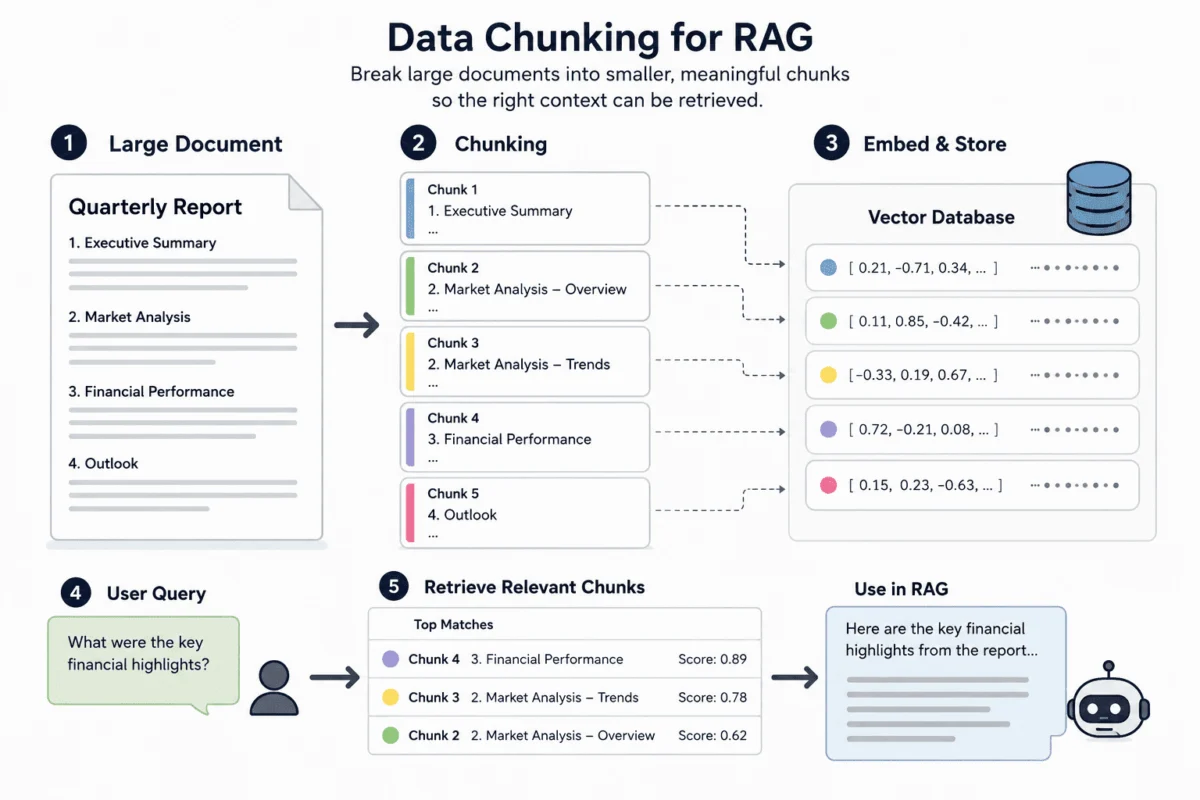
Tom Swanson shares a personal learning experience in this domain: “I started a project and built out a robust knowledge base, only to find my execution times and token usage far higher than expected.” The critical insight gained was the necessity of “chunking.” This process involves breaking down large documents within the knowledge base into smaller, manageable segments, or “chunks.” These chunks are then vectorized, meaning they are converted into numerical representations that capture their semantic meaning. This vectorization allows the AI to efficiently search for and retrieve the most relevant chunks of information when a query is made, rather than processing entire documents.
For organizations looking to build RAG tools, understanding and implementing effective chunking strategies is paramount. The process typically involves:
- Document Segmentation: Breaking down large text files into smaller, logical units.
- Vector Embedding: Converting these segments into numerical vectors using embedding models.
- Indexing: Storing these vectors in a specialized database (vector database) for rapid searching.
- Retrieval: When a query is received, the system converts the query into a vector and searches the index for the most semantically similar document chunks.
- Contextualization: The retrieved chunks are then fed to the LLM along with the original query to generate a contextually relevant response.
This meticulous approach ensures that AI models have access to precisely the information they need, when they need it, significantly improving performance and cost-efficiency. The underlying principle is that by organizing and indexing information granularly, AI can navigate vast datasets with unprecedented speed and precision.
Balancing Speed and Quality: The Human Element in AI-Driven Campaigns
While AI excels at accelerating processes and generating content at scale, the pursuit of sheer volume can sometimes come at the expense of strategic nuance and creative originality. In B2B marketing, where customer acquisition costs (CAC) are often high and sales cycles are longer, a focus on quality and differentiation is critical.
Many clients have sought to use AI to drastically reduce the time from campaign ideation to execution, achieving success in standardizing briefs, shortening service-level agreements (SLAs), and ensuring output consistency. However, a common observation is that while the speed of campaign deployment increases, the actual marketing performance does not necessarily improve. AI-generated content, when produced without sufficient human oversight, can begin to sound homogenous, failing to resonate with human buyers who are seeking trust, connection, and a clear value proposition.
“AI writes great stuff for AI, but it all starts to look the same to a human,” observes Swanson. “Right now, AI does a lot of the research for buyers, but the buyer is still a person. They still have to decide they want to book a meeting. They still have to like and trust the brand.” This realization has led some organizations to recalibrate their AI integration strategies, opting for a hybrid approach. This involves retaining AI for its speed and efficiency in tasks like initial drafting, research compilation, and data analysis, while strategically integrating human marketers at critical junctures. These junctures often involve areas requiring strategic creativity, nuanced understanding of buyer psychology, and the ability to take calculated risks—elements that AI, in its current state, still struggles to replicate.
The implication is that AI should not be viewed as a replacement for human strategic thinking but rather as a powerful augmentation tool. An effective AI workflow should harness the unique strengths of the entire operational system, including people, processes, and technology. This means identifying where AI can deliver the most value in terms of efficiency and scale, and where human intuition, creativity, and strategic judgment are indispensable for achieving superior business outcomes. The objective is to achieve a symbiotic relationship where AI accelerates execution, while human expertise guides strategy and ensures authentic brand connection.
Conclusion: The Evolving AI Landscape in B2B Marketing
The integration of AI into B2B marketing is a dynamic and rapidly evolving field. While AI is continuously improving its capabilities, including the potential for more nuanced and engaging content generation for human audiences, the current reality necessitates a thoughtful and strategic approach. The lessons learned from real-world implementations highlight the importance of custom solutions for niche markets, the power of AI in streamlining operational workflows, the critical need for optimized data management through techniques like chunking, and the enduring value of human oversight in balancing speed with strategic quality.
As organizations continue to navigate this AI-enhanced marketing world, a holistic perspective that leverages the best aspects of human intelligence and artificial intelligence will likely yield the most impactful results. The journey is ongoing, and continuous learning and adaptation will be key to unlocking the full potential of AI in achieving marketing objectives. For those seeking to delve deeper into these strategies and explore further insights, engaging with experts in the field offers a valuable pathway to understanding and implementing AI effectively.