

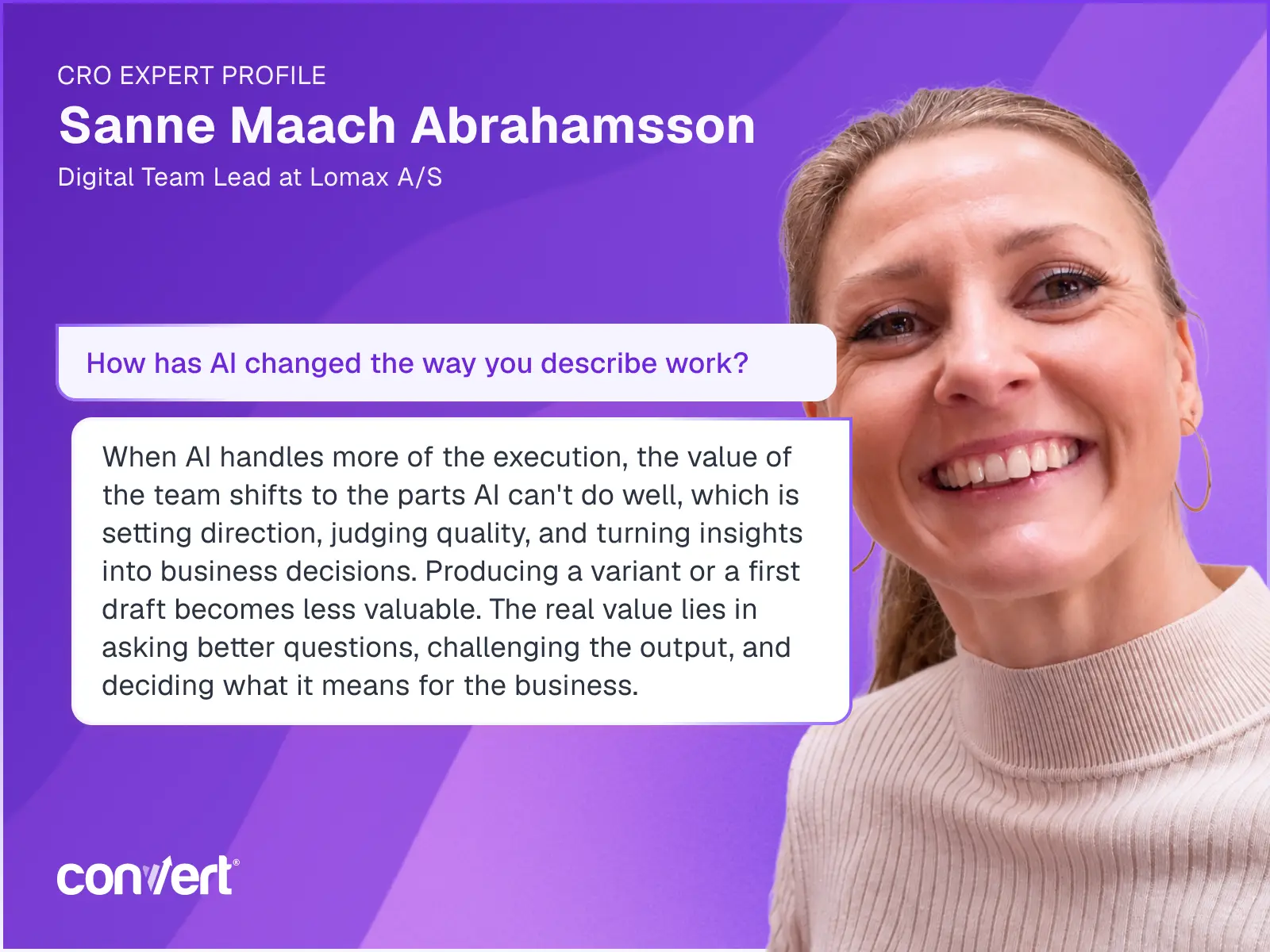
Sanne Maach Abrahamsson, the Digital Team Lead at Lomax A/S, recently shared insights into the evolving landscape of digital experimentation, the integration of artificial intelligence into conversion rate optimization (CRO) workflows, and the strategic importance of building a "shared organizational memory." As a prominent figure in the Danish B2B e-commerce sector, Abrahamsson’s journey from the finance industry to leading digital experimentation at one of Denmark’s largest office supply retailers offers a unique perspective on how evidence-based decision-making is reshaping corporate strategy. In a professional landscape often crowded with "noise" regarding digital transformation, Abrahamsson emphasizes that the true value of experimentation lies not just in increasing conversion rates, but in preventing costly business errors and fostering a culture of continuous, documented learning.
The Evolution of Experimentation at Lomax A/S
Lomax A/S, established in 1962, has grown into a dominant force in the Nordic B2B market, providing everything from office furniture to electronics and kitchen supplies. For a company of this scale, the transition to a data-driven experimentation model was a significant cultural shift. Abrahamsson joined the company with a background in finance and interaction design, admitting that the concept of Conversion Rate Optimization was initially foreign to her. However, the intersection of user-centered design and rigorous data analysis quickly became the cornerstone of her methodology.

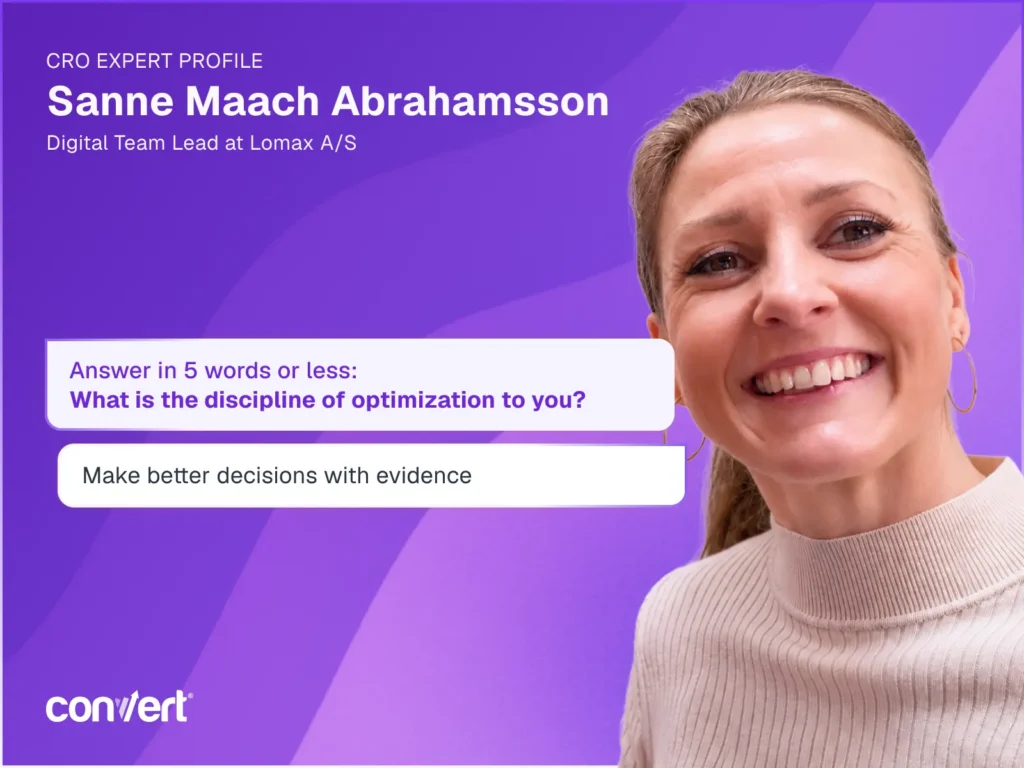
Under her leadership, experimentation at Lomax has moved beyond simple A/B testing of button colors. It has become a comprehensive system for validating business hypotheses before they are scaled. Abrahamsson defines the discipline of optimization as the ability to "make better decisions with evidence." This philosophy is particularly critical in the B2B sector, where purchasing cycles are longer and customer relationships are often built on long-term trust and functional efficiency rather than impulsive consumer behavior.
Chronology of Digital Transformation and AI Integration
The timeline of experimentation at Lomax A/S reflects a broader industry trend: the shift from manual testing to AI-enhanced learning.
- The Foundation Phase: Initially, the focus was on introducing the CRO discipline to the organization. This involved establishing basic testing protocols and proving the commercial impact of minor user interface changes.
- The Infrastructure Phase: Recognizing that individual test results were often lost in "old slide decks or tickets," the team invested in a centralized learning infrastructure. Airtable was implemented as the "single source of truth," documenting research, roadmaps, and results.
- The AI Pivot (2023-Present): Within the last year, the team began exploring how Generative AI could support the experimentation process. Rather than using AI simply for speed, Lomax focused on using it to synthesize vast amounts of qualitative and quantitative data.
- The "Knowledge Memory" Era: The current phase involves connecting AI agents, specifically Anthropic’s Claude, to their Airtable database. This allows the team to search and synthesize learnings across years of data, turning individual test results into recognizable patterns of customer behavior.
Supporting Data: The Economics of Experimentation
The push for a more robust experimentation framework is supported by global market data. According to industry benchmarks, companies that adopt a "test-and-learn" culture see a significantly higher return on investment (ROI) compared to those that rely on "HIPPO" (Highest Paid Person’s Opinion) decision-making.

In the B2B e-commerce space, where Lomax operates, the stakes are particularly high. A 2023 McKinsey report highlighted that B2B companies using advanced analytics and experimentation to personalize the customer journey can see a revenue uplift of 10% to 15%. However, the report also noted that the primary barrier to success is not the lack of data, but the inability to translate that data into actionable organizational knowledge—a challenge Abrahamsson has addressed through her "shared organizational memory" initiative.
Furthermore, the integration of AI into these workflows is a response to the "productivity paradox." While AI can generate thousands of test variants, the human capacity to analyze them remains a bottleneck. By using AI to synthesize past learnings, Lomax aims to ensure that their testing volume does not outpace their institutional understanding.
Case Studies: Preventing Expensive Business Mistakes
Abrahamsson highlights two specific experiments that illustrate the dual role of CRO: identifying growth opportunities and, perhaps more importantly, mitigating risk.

The Automated Video Tool Experiment
Management was initially enthusiastic about a third-party tool designed to automatically scrape YouTube for product videos and embed them on Lomax’s product pages. The business case seemed solid: video engagement is generally high, and the tool promised to automate a labor-intensive manual process.
However, controlled experimentation revealed a different reality. The automated matching led to quality issues—videos with subtitles in the wrong language, influencer content that didn’t align with the brand, and poor-quality productions. The result was a measurable drop in both conversion rates and average order value (AOV). By testing the tool before committing to a long-term contract, Lomax avoided a significant financial mistake and protected its brand reputation.
AI-Generated Product Descriptions
In another study, the team tested AI-generated copy against human-written descriptions across various funnel stages. The results provided a nuanced view of AI’s capabilities. On individual product pages, the AI excelled at providing clear, concise overviews that helped customers find technical information quickly, leading to positive performance.
Conversely, on category-level pages, the AI-generated copy felt generic and lacked the "human creativity" necessary to engage users at the discovery stage. This experiment prevented a blanket implementation of AI copy and instead guided the team toward a hybrid model where AI handles technical summaries while humans focus on high-level creative strategy.
Official Responses and Internal Implications
The reaction within Lomax A/S has been one of cautious optimism followed by strategic alignment. Abrahamsson notes that top management’s initial excitement for "magic bullet" AI solutions has evolved into a deeper appreciation for the experimentation process. The organization now views "failed" tests not as losses, but as valuable data points that prevent incorrect strategic pivots.
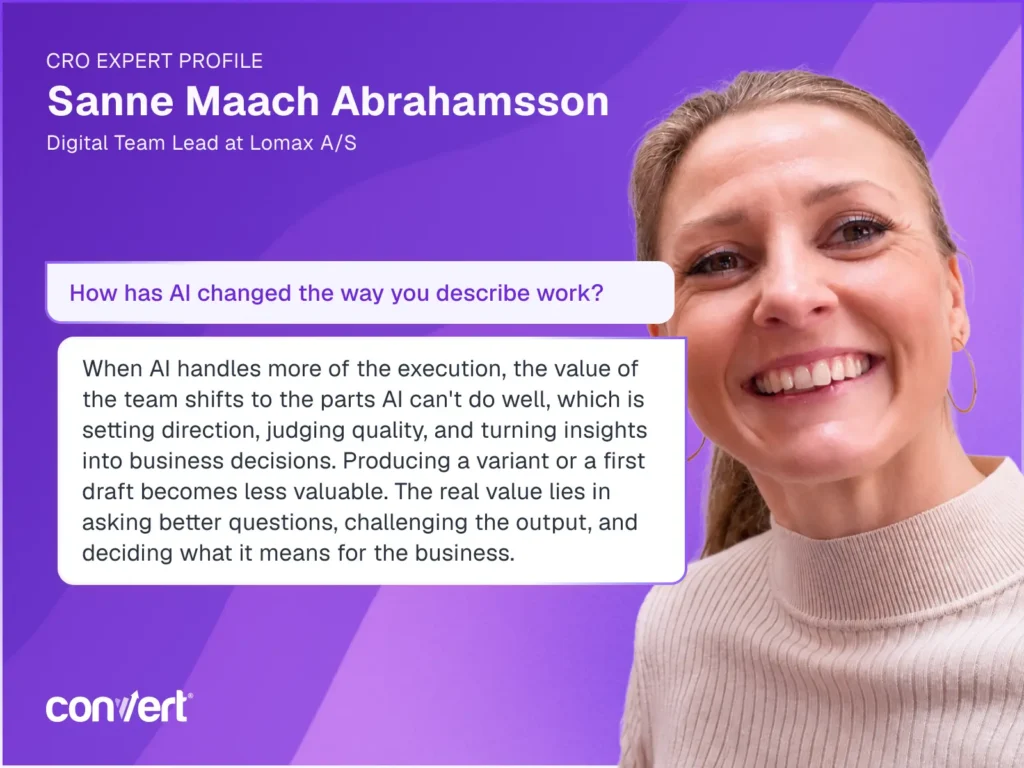
Internally, the role of the digital team is shifting. Abrahamsson expects her team to spend less time on "production"—such as writing basic copy or designing minor variants—and more time on "judgment." This involves setting the strategic direction, auditing the quality of AI-generated output, and determining the broader business implications of test results.
Broader Impact and Future Implications for the Industry
The methodology employed by Sanne Maach Abrahamsson at Lomax A/S serves as a blueprint for the future of digital marketing and e-commerce. As AI continues to commoditize the execution of digital tasks, the competitive advantage for firms will shift toward "Judgment and Synthesis."
- From Execution to Judgment: The value of a CRO practitioner will no longer be measured by how many tests they run, but by the quality of the questions they ask and their ability to connect disparate insights across the business.
- The Rise of Agentic Workflows: Abrahamsson’s vision of leading "not just people but agents" suggests a future where digital managers act as "conductors" of an AI-human orchestra. The focus remains on maintaining a high-quality bar and encouraging a culture of curiosity.
- Compound Learning: By treating every experiment as a building block in a permanent database, companies can achieve "compound learning." This prevents the common corporate cycle of repeating the same mistakes every few years as staff turnover occurs.
- B2B Personalization: For the broader B2B sector, the Lomax approach proves that high-tech experimentation is not reserved for B2C giants like Amazon or Netflix. Even traditional industries can benefit from a rigorous, evidence-based approach to the user experience.
In conclusion, the interview with Sanne Maach Abrahamsson underscores a critical transition in the digital economy. As organizations navigate the complexities of AI and data-driven growth, the most successful will be those that prioritize evidence over intuition and institutional memory over fleeting wins. At Lomax A/S, experimentation is no longer just a department; it is the fundamental framework through which the company understands its customers and secures its future in a rapidly changing market. The shift from a "production-heavy" team to a "judgment-heavy" team represents the next frontier in professional digital management, where the human element remains the ultimate arbiter of quality and strategy.







