

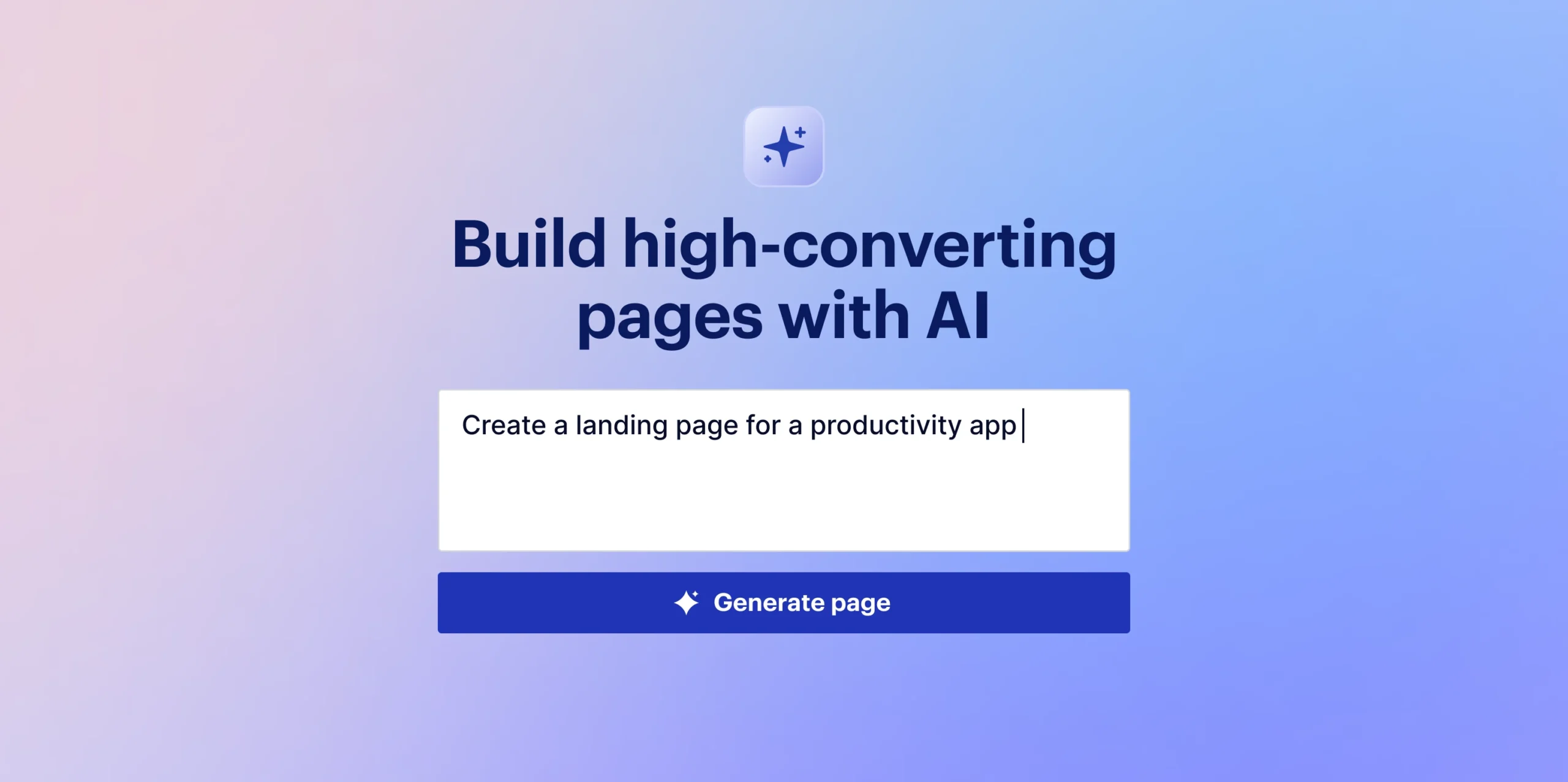
Instapage, a long-standing leader in landing page technology and conversion rate optimization (CRO), has officially announced a comprehensive transformation of its service architecture, evolving from a suite of marketing tools into a fully integrated, end-to-end AI-powered marketing platform. This strategic pivot, announced in early 2026, marks a significant milestone in the company’s fourteen-year history, aiming to address the increasing complexity of the modern marketing tech stack. By embedding generative and predictive artificial intelligence across every stage of the marketing funnel—from initial page design to automated lead nurturing—Instapage seeks to eliminate the friction typically associated with multi-tool workflows. The new release introduces several core pillars, most notably AI-driven page generation, automated email sequences, and "AI Collections," designed to help leaner marketing teams achieve high-scale results without the traditional overhead of manual design and coding.
The Evolution of Instapage: A Fourteen-Year Chronology
To understand the significance of this shift, it is necessary to examine the trajectory of Instapage within the broader context of the software-as-a-service (SaaS) industry. Founded in 2012, Instapage entered a market where building a functional, high-converting landing page required significant technical expertise or the use of rudimentary, inflexible templates. The company’s initial value proposition was centered on its "No-Code" drag-and-drop builder, which became a gold standard for marketers seeking independence from overstretched IT departments.
By 2018, the company had expanded its focus from mere page construction to Conversion Rate Optimization (CRO). This era saw the introduction of heatmaps, A/B testing modules, and personalization features that allowed users to serve different content to different audience segments based on geographic or behavioral data. However, as the digital advertising landscape became more saturated, the "stitching together" of disparate tools—such as separate builders, analytics platforms, and email service providers—began to create operational bottlenecks.
The 2023-2024 period served as the catalyst for the current AI integration. As generative AI moved from novelty to utility, Instapage began embedding specific AI capabilities, such as copy generation and basic experimentation prompts. The 2026 rollout represents the culmination of this evolution, moving away from "bolted-on" AI features toward a holistic ecosystem where AI serves as the foundational infrastructure of the entire platform.
Breaking the Blank Page Barrier: AI Page Generation and Pixel-Perfect Design
One of the most significant challenges cited by digital marketers is the "blank page syndrome"—the psychological and operational hurdle of initiating a new campaign from scratch. Instapage’s new AI page generation tool is engineered to bypass this stage entirely. Unlike first-generation AI builders that often produce rigid, uneditable outputs, the Instapage solution utilizes a text-to-layout engine. Users provide a descriptive prompt detailing their goal, audience, and brand voice, and the system generates a conversion-ready landing page with optimized layouts and tailored messaging in a matter of seconds.
Crucially, the platform maintains its commitment to "pixel-perfect" control. In the current market, many standalone AI generators require users to re-prompt the entire system to make minor adjustments, a process that is both time-consuming and costly in terms of API token consumption. Instapage’s integration allows for a hybrid approach: the AI provides the structural and creative foundation, while the user retains the ability to move, resize, or redesign any element via a visual drag-and-drop interface. This eliminates the "inefficient back-and-forth" often found in prompt-based design, ensuring that brand guidelines are met without sacrificing the speed of AI.
Closing the Loop: AI-Powered Email and Lead Nurturing
The expansion into AI-powered email management addresses a long-standing gap in the conversion funnel. Historically, once a lead was captured on a landing page, it would be exported to a third-party Email Service Provider (ESP), often resulting in data lag or broken automation triggers. Instapage’s new suite brings these leads and follow-up sequences into a single environment.
The AI email generator allows teams to select specific goals—such as lead qualification, webinar registration, or direct sales—and choose a tone and length suited to their brand. The system then generates tailored follow-up sequences that are contextually aware of the landing page the lead originated from. By housing the page, the lead data, and the communication history in one platform, Instapage claims to remove the "manual handoffs" that frequently lead to lead leakage. In a 2026 economic environment characterized by leaner teams and tighter budgets, this level of consolidation is positioned as a necessity rather than a luxury.
Supporting Data and Market Analysis: The Shift Toward Tool Consolidation
The shift toward an integrated AI platform is supported by broader industry data regarding marketing technology (MarTech) fatigue. According to industry reports from late 2025, the average enterprise marketing team utilizes between 12 and 20 different tools to manage their digital presence. This fragmentation leads to "data silos," where insights from a landing page do not inform the email strategy, and vice versa.

Furthermore, the cost of human capital has become a primary driver for AI adoption. Data indicates that since 2024, there has been a 35% increase in the demand for "full-stack" marketers who can manage design, copy, and analytics simultaneously. By automating the more labor-intensive aspects of these roles—such as layout creation and initial draft writing—Instapage’s AI suite allows smaller teams to compete with larger organizations that have traditionally relied on massive headcounts.
Market analysis suggests that the generative AI in marketing market is expected to grow at a CAGR of nearly 30% through 2030. Instapage’s decision to move beyond simple copy-writing AI into "AI Collections"—which involves the automated scaling of high-performing assets—aligns with the industry’s move toward "Autonomous Marketing Operations."
Official Perspectives and Industry Implications
While official statements from the Instapage executive team emphasize the "end-to-end" nature of the platform, industry analysts have noted the competitive implications of this move. By incorporating email and advanced experimentation, Instapage is moving into territory traditionally held by companies like HubSpot, Mailchimp, and Optimizely.
"The era of the ‘single-feature’ SaaS tool is rapidly drawing to a close," notes a senior analyst in the digital marketing space. "Platforms that can bridge the gap between creation and conversion—using AI as the connective tissue—are the ones that will survive the current wave of tool consolidation. Instapage is essentially betting that marketers are tired of being ‘integrators’ and want to get back to being ‘strategists.’"
From a developer’s perspective, the move toward AI-generated pages that remain editable via a visual builder is seen as a significant technical achievement. It solves the "black box" problem of AI design, where the user has no control over the underlying code or layout logic. By maintaining a pixel-perfect builder on top of an AI engine, Instapage provides a "safety net" for brand consistency.
Broader Impact and the Future of the Marketing Workflow
The broader implications of Instapage’s AI platform extend to the democratization of high-end digital marketing. Previously, sophisticated CRO and multi-step lead nurturing were the domain of companies with the budget for expensive agencies or specialized in-house teams. The introduction of AI page and email generation lowers the barrier to entry, allowing startups and mid-sized businesses to deploy "conversion-ready" infrastructure in minutes.
However, this shift also raises questions about the future of creative roles in marketing. As AI takes over the "heavy lifting" of design and copy, the value of the human marketer is expected to shift toward strategy, empathy, and high-level brand positioning. The Instapage platform is designed to facilitate this shift, encouraging users to "describe their dream" rather than "wrestle with a grid."
As of the current rollout, select AI features remain in a beta phase, with a gradual release schedule to existing customers and new trial users. The company has encouraged users to engage with the 14-day free trial to experience the workflow firsthand, signaling a high level of confidence in the platform’s stability and user experience.
In conclusion, Instapage’s transition into an AI-powered marketing platform is a response to a decade of increasing tool complexity and the rapid maturation of generative AI. By unifying page generation, email automation, and experimentation into a single, AI-driven workflow, the company is positioning itself as an essential partner for the next generation of digital marketers who must do more with less. The success of this pivot will likely be measured by the platform’s ability to deliver on its promise of "no gaps, no manual handoffs, and no switching between tools"—a vision that, if realized, could redefine the standard for marketing operations in the late 2020s.







