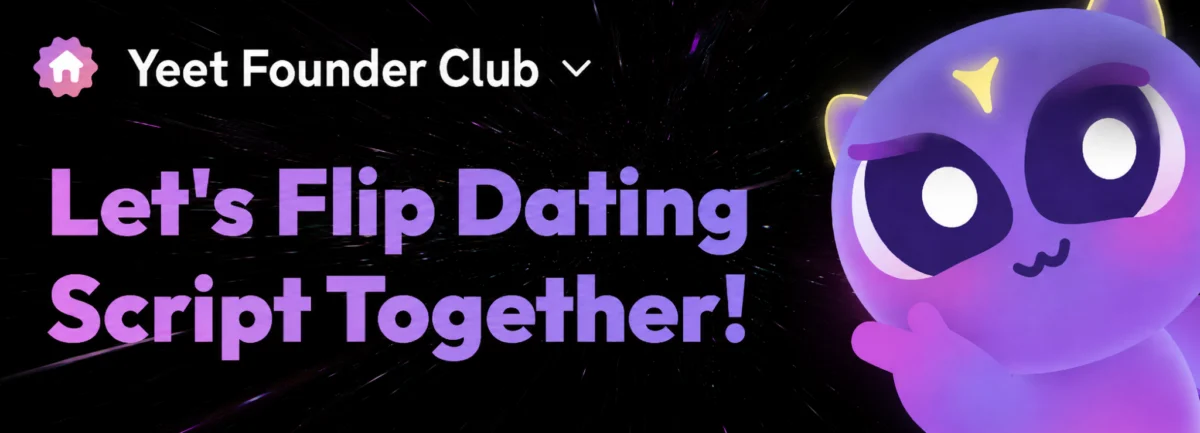
In an era where traditional market research often lags behind the rapid evolution of consumer sentiment, a burgeoning dating startup named Yeet has demonstrated a paradigm shift in product development. By prioritizing community engagement over proprietary secrecy, the company managed to design, refine, and launch a dating application built specifically for the nuances of Gen Z. The strategy was deceptively simple yet profoundly effective: before a single line of final code was written for the consumer-facing app, Yeet established a digital headquarters on Discord. This move allowed the founders to bypass the sterile environment of traditional focus groups in favor of a living, breathing laboratory of their target demographic.
The success of Yeet’s "Founder Club"—a Discord server that served as a direct pipeline between developers and users—offers a blueprint for modern brands seeking to capture the attention of a generation famously skeptical of traditional advertising. As the dating app market faces a period of stagnation and "swipe fatigue," Yeet’s community-centric approach highlights a broader trend in the tech industry: the transition from "product-led growth" to "community-led development."
The Genesis of the Founder Club: A Chronology of Community Building
The development of Yeet did not begin in a vacuum. The founders recognized early on that the dating app landscape was saturated with platforms that prioritized quantity of matches over quality of interaction. To disrupt this space, they needed more than just a clever algorithm; they needed a deep understanding of the daily frustrations experienced by young daters.
The chronology of Yeet’s development followed a non-traditional path:
- Initial Outreach (Early 2024): Instead of running high-budget "coming soon" ads, the Yeet team utilized short-form video platforms like TikTok and Instagram. These videos did not showcase features; they showcased "pain points." By highlighting the awkwardness, exhaustion, and futility often associated with modern dating, the brand established immediate relatability.
- The Discord Invitation: Viewers who resonated with these pain points were invited to join an exclusive Discord server named the "Founder Club." The pitch was not to test a product, but to "flip the dating script together."
- The Listening Phase: For several months, the Yeet team, led by co-founder and marketing head Penny Chen, acted as observers. They created channels for specific discussions ranging from "dating horror stories" to "AI ethics."
- Iterative Prototyping: As members shared their frustrations, the developers adjusted the app’s roadmap in real-time. Feedback regarding the anxiety of "first messages" led directly to the implementation of an AI-driven conversation starter.
- Validation and Launch: Before the official app store debut, the core features had already been "vetted" by the community that intended to use them.
This timeline illustrates a shift in power dynamics. Rather than a brand telling the consumer what they need, the consumer dictated the product’s utility before it even reached the market.
Addressing the "Swipe Fatigue" Crisis with Data-Driven Insights
The primary insight gleaned from the Discord community was a profound sense of "swipe fatigue." In the broader industry, data supports this sentiment. According to recent studies on digital wellness, nearly 80% of Gen Z users report feeling "burnt out" by the gamified nature of traditional dating apps like Tinder and Bumble. The endless loop of swiping on profiles often leads to a "paradox of choice," where the abundance of options results in lower satisfaction and higher anxiety.
Yeet’s internal surveys within their Discord community corroborated these national trends. Penny Chen noted that 84% of their community members explicitly stated a preference for real-time, live connections over the "blind swiping" model. This data point became the North Star for the development team.
In response, Yeet pivoted away from the static profile-browsing model. The resulting product utilizes an AI agent that facilitates live, synchronized conversations between two compatible users. The AI serves as a social lubricant, helping to bridge the gap between two strangers and ensuring the conversation remains fluid. This specific feature—the AI agent—was heavily scrutinized by the Discord community during its conceptual phase. Users expressed concerns about "AI overreach," prompting the developers to limit the AI’s role to facilitation rather than active matchmaking or ghostwriting responses.
The Architecture of Authentic Engagement
One of the most critical lessons for brands lies in who Yeet chose to represent the company within the Discord server. Traditional corporate moderation often feels sterile or defensive. Yeet avoided this by deploying Gen Z employees to interact with the community. These moderators did not use corporate jargon or scripted responses; they spoke as peers.
"The moderators just act more like their friends," Chen explained. "Or like college students interacting with each other."
This approach fostered a level of psychological safety that is rare in brand-customer relationships. When users felt they were speaking to "one of their own," they were more willing to provide honest, sometimes harsh, feedback. For an organization, this "unfiltered" data is far more valuable than the polite or curated responses often found in paid surveys.
Furthermore, Yeet incentivized participation through social currency rather than just monetary rewards. Users whose suggestions were implemented in the app were given special "badges" within the Discord forum. This gamification of the feedback loop created a sense of ownership among the users. They weren’t just customers; they were "founders" in their own right.
Broader Implications for the Marketing and PR Industry
The Yeet case study serves as a stark reminder that the "top-down" approach to brand building is increasingly obsolete for younger demographics. The implications for the broader industry are significant:
1. The Death of the Traditional Focus Group
Traditional focus groups are often criticized for "observer bias," where participants give the answers they think the moderator wants to hear. By embedding the research phase within a social community like Discord, brands can observe organic interactions. This provides a more accurate reflection of consumer behavior and desire.
2. Community as a Risk Mitigation Tool
Building a product in secret is a high-risk endeavor. A brand may spend millions on development only to find that the market has moved on or the "killer feature" is actually a deterrent. By building alongside a community, Yeet performed constant "micro-validations" of their ideas, significantly reducing the risk of a failed launch.

3. The Rise of "Niche-First" Scaling
Yeet’s strategy involves keeping the Discord community relatively small—between 1,000 and 2,000 members. This intimacy allows for deeper connections and more manageable data sets. As they look toward expansion, they plan to replicate this model on Reddit, joining existing conversations and building a reputation for listening before they begin active promotion. This "listen first, speak later" philosophy is the antithesis of traditional "disruptive" marketing.
Expert Analysis: The Challenges of Scaling Intimacy
While Yeet’s success is notable, industry analysts point out the challenges of maintaining this level of community intimacy as a brand grows. Scaling a 1,500-person Discord server to a million-user app requires a delicate balance. If the "Founder Club" becomes too large, the sense of exclusivity and direct access to founders may vanish.
Furthermore, there is the risk of "vocal minority" bias. The users who join a Discord server to discuss dating app mechanics are often more tech-savvy and opinionated than the "average" user. Brands must ensure that while they listen to their most active community members, they do not alienate the broader, more passive user base.
However, for a startup like Yeet, these are secondary concerns. Their immediate goal was to find "product-market fit," and Discord provided the most efficient path to that objective. By treating their audience as collaborators rather than targets, they have built a level of brand loyalty that traditional marketing cannot buy.
Future Outlook: Beyond the Swipe
As Yeet continues to iterate on its AI-driven, no-swipe model, the company remains committed to its community-first roots. Their planned move into subreddits suggests a strategy of "meeting the user where they are" rather than trying to force users into a branded ecosystem.
The takeaway for other organizations is clear: the most valuable asset a brand can have is not its intellectual property or its marketing budget, but a direct, honest line of communication with its audience. In an age of AI and automation, the human element—the simple act of listening—remains the most powerful tool in a brand’s arsenal.
For gaming companies, financial institutions, and educational organizations alike, the Yeet model proves that when you build with your community, you don’t just build a better product—you build a movement. The era of the "faceless brand" is ending; the era of the "community-collaborator" has begun. Organizations that fail to adopt this level of transparency and engagement may soon find themselves on the wrong side of the "swipe," discarded by a generation that values authenticity above all else.