The challenge of consistently producing compelling content is a universal hurdle for bloggers, marketers, and digital communicators in today’s demanding online landscape. In an era where content is king and search engine algorithms prioritize fresh, relevant information, the dreaded "writer’s block" can significantly impede publishing schedules and audience engagement. While the pressure to maintain a steady stream of original ideas can be overwhelming, a diverse array of strategies and sophisticated digital tools now exists to help content creators overcome this common obstacle and foster a continuous flow of inspiration.
The Persistent Challenge of Content Generation in the Digital Age
The digital ecosystem thrives on new content. Websites with active blogs consistently report higher organic traffic, increased lead generation, and stronger brand authority. For instance, studies by HubSpot indicate that companies that blog receive 55% more website visitors and 97% more inbound links than those that don’t. This pervasive demand places immense pressure on individuals and teams responsible for content creation, making writer’s block not merely a creative inconvenience but a potential business impediment. The shift from traditional print media to the fast-paced digital realm has also amplified this pressure, requiring a constant influx of topics that resonate with specific audiences and perform well in search engine rankings. A survey by Statista in 2022 revealed that approximately 60% of professional writers experience writer’s block at some point in their careers, underscoring its widespread nature. The evolution of content creation has moved from sporadic, passion-driven posts to a highly strategic, data-informed process crucial for digital visibility and business growth.
Leveraging Audience Insights: The Foundation of Relevance
One of the most potent, yet often overlooked, sources of blog post ideas lies directly within a creator’s existing audience. Engaging with readers provides direct insight into their interests, pain points, and questions, ensuring that new content is inherently relevant and valuable.
-
Direct Feedback Channels: Blogs equipped with comment sections or contact forms serve as invaluable conduits for audience feedback. Beyond simple positive or negative reactions, readers frequently pose questions that, while sometimes off-topic or requiring extensive elaboration, can be goldmines for new content. Maintaining a dedicated log of these inquiries ensures a ready reservoir of ideas when inspiration wanes. This practice not only provides immediate topic ideas but also strengthens community ties and demonstrates responsiveness to reader needs, fostering a loyal readership. Similarly, proactive engagement through online questionnaires or polls can directly solicit input, allowing content creators to pinpoint specific topics their audience wishes to explore, transforming passive feedback into actionable content strategy.
-
Google Search Console: Unearthing Reader Intent: For any website owner, Google Search Console (GSC) remains an indispensable, free tool for understanding how users discover their site. Its Performance Report is a treasure trove of data, detailing the exact search queries people use, alongside metrics like clicks, impressions, and average ranking positions. This data allows creators to identify existing content gaps—topics where their site ranks but doesn’t fully address the query, or areas where there’s high impression volume but low click-through rates, indicating a need for more targeted content. For example, if GSC reveals users are frequently searching for "how to keep toddlers busy without screens" and landing on a broader parenting post, it signals a clear demand for a dedicated, in-depth article on that specific topic, reflecting direct audience intent.

The integration of GSC data directly into content management systems, such as through Yoast SEO with Google Site Kit for WordPress users, streamlines this process. This allows creators to access critical performance metrics and top search queries without navigating multiple platforms, fostering a more efficient workflow. Yoast SEO’s developers emphasize that this integration aims to "democratize access to crucial SEO data, empowering creators to make informed decisions directly within their publishing environment." While advanced tools like Ahrefs and Semrush offer broader competitive analysis, GSC provides proprietary data directly from Google, making it uniquely authoritative for identifying audience search behavior and informing content strategy. Its consistent updates and direct connection to Google’s ranking signals underscore its continued relevance in the ever-evolving SEO landscape, with millions of websites relying on its insights daily.
The Rise of AI-Powered Ideation Tools
The advent of artificial intelligence (AI) has profoundly impacted content creation, offering innovative solutions for generating ideas and structuring content. AI tools are increasingly becoming integral to content strategies, moving beyond simple keyword generation to sophisticated content planning.
-
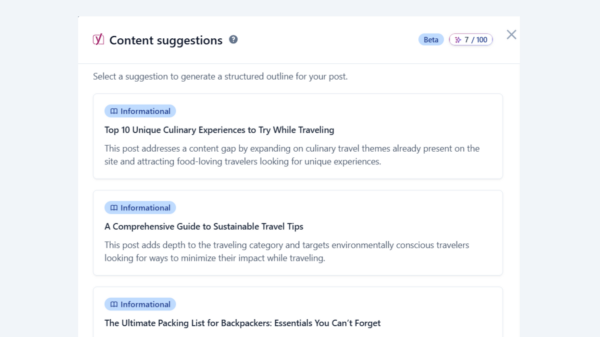
Introducing Yoast AI Content Planner: Recognizing the persistent challenge of ideation, Yoast SEO developed its AI Content Planner. This feature, available in Yoast SEO Premium products, exemplifies how AI can provide targeted, context-aware suggestions. The planner analyzes a user’s existing website content, identifies thematic gaps, and proposes five relevant blog post ideas tailored to the site’s niche. This isn’t generic brainstorming; it’s data-driven, based on what the audience is already consuming and what is missing. For instance, a food blog with extensive meal prep content but no specific posts on "quick vegetarian lunches" might receive that as a suggestion, directly addressing a potential content void.
Once an idea is selected, the Yoast AI Content Planner takes it a step further by generating a structured draft, complete with a suggested title, relevant headings, and even a meta description. This significantly reduces the initial friction of starting a new article, providing a clear outline for immediate development. A spokesperson for Yoast stated, "Our goal with the AI Content Planner is to empower creators to maintain consistency and relevance without the constant struggle of ideation. We want to bridge the gap between knowing you need to publish and knowing what to publish." This functionality was designed with content consistency in mind, aiming to empower creators to publish regularly without the bottleneck of ideation. The ability to generate new batches of ideas with a single click further enhances its utility, ensuring a continuous stream of fresh perspectives. This represents a significant leap from traditional brainstorming, offering a semi-automated, intelligent approach to content planning.
-
General AI and Chatbot Strategies: Large Language Models (LLMs) and chatbots like ChatGPT, Claude, and Gemini have become powerful, accessible tools for creative ideation. However, their effectiveness hinges on the specificity and context provided by the user. Generic prompts yield generic results. To maximize their potential, content creators should:
- Ask for Specific Angles: Instead of broad requests like "Give me blog ideas about parenting," refine the prompt to "Generate five blog post ideas for first-time parents struggling with sleep deprivation, focusing on practical, actionable tips, backed by child psychology principles."
- Refine Vague Ideas: If a broad topic is suggested, instruct the AI to narrow it down. For example, if "healthy eating" is a broad topic, ask, "Can you narrow down ‘healthy eating’ into five specific blog post topics for busy professionals, focusing on meal prep and time-saving strategies, incorporating plant-based options?"
- Reverse-Engineer Competitors: Provide the AI with a competitor’s blog URL and ask, "Analyze this blog’s content and suggest five topics they haven’t covered but would be relevant to their audience, or five ways I can offer a unique perspective on their existing popular posts, highlighting their weaknesses."
- Avoiding "Commodity Content": A critical consideration when using AI is to prevent the generation of generic, "commodity content" that lacks unique value. AI often produces ideas that are widely covered. The human element becomes crucial here: always infuse AI-generated ideas with personal experience, original data, expert interviews, or a unique perspective. For example, if AI suggests "10 tips for better sleep," transform it into "My 7-Day Experiment: How Biohacking My Sleep Transformed My Productivity (Backed by Personal Data and Expert Interviews)." This adds authenticity and differentiates the content. The ethical use of AI also dictates that content creators critically review and edit all AI-generated text to ensure accuracy, originality, and adherence to brand voice, a point echoed by industry analysts who warn against the proliferation of unoriginal content that could dilute the quality of the internet.
Strategic Keyword Research: Beyond the Surface
While often associated with SEO, in-depth keyword research is fundamentally an exercise in understanding audience needs and can unlock a wealth of blog post ideas. It moves beyond simply identifying popular search terms to deciphering the underlying search intent.
-
Understanding Search Intent: The core of effective keyword research is determining why someone is searching for a particular term. Are they looking for information (informational intent), trying to buy something (commercial intent), navigating to a specific site (navigational intent), or seeking a solution to a problem (transactional intent)? Tools like Yoast SEO’s Semrush integration, Google’s autocomplete suggestions, and critically, what appears in Google’s AI Overviews or AI Mode answers, can reveal this intent. For instance, a search for "best running shoes for flat feet" clearly indicates a commercial and informational intent—the user wants recommendations and understands the specific challenge of flat feet. This granular understanding is key to creating content that directly answers user queries, a core tenet of modern SEO.
-
Expanding Keywords into Comprehensive Content Clusters: A single keyword can often be expanded into an entire content cluster, ensuring thorough coverage and establishing expertise. Taking "best running shoes for flat feet" as an example, a creator might ask:
- What are the common biomechanical problems flat-footed runners face, and how do they impact performance?
- What specific shoe features (e.g., arch support, motion control, cushioning) should they prioritize?
- Are there specific strengthening exercises or stretches that can alleviate issues for flat feet?
- How do leading athletic shoe brands (e.g., Brooks, Saucony, Hoka) specifically cater to flat-footed athletes with their shoe lines?
- What are the prevalent myths about running with flat feet, and what does current sports science suggest?
Each of these questions can evolve into a distinct blog post:
- "Understanding Pronation: The Biomechanics of Running with Flat Feet and Injury Prevention" (Informational)
- "Top 7 Running Shoe Technologies for Optimal Flat Foot Support: A Deep Dive into Stability and Comfort" (Product-focused, informational)
- "Essential Foot Exercises for Runners with Flat Feet: Strengthening, Stability, and Injury Resilience" (How-to guide)
- "Brand Spotlight: A Comparative Review of Leading Running Shoe Brands for Flat-Footed Athletes" (Review/comparison)
- "Debunking Common Myths: What Sports Podiatrists Want You to Know About Running with Flat Feet" (Myth-busting)
This strategy ensures comprehensive topic coverage, establishes authority, and improves internal linking opportunities, all of which are beneficial for SEO. Furthermore, integrating tools like Wincher with Yoast SEO allows creators to track the performance of these posts for target keywords over time, providing valuable data for refining future content strategy. According to a 2023 survey by BrightEdge, 53% of all website traffic comes from organic search, underscoring the critical role of well-executed keyword research in content ideation.
Tapping into External Digital Inspiration
Beyond direct audience feedback and internal site analytics, the broader internet offers a boundless wellspring of inspiration.
-
Pinterest: Visual Trends and Niche Discovery: While primarily known as a visual discovery engine, Pinterest is a powerful platform for identifying trends and uncovering content gaps, especially for visually-driven niches like food, DIY, fashion, travel, and home decor. Searching for keywords such as "[your niche] blog post ideas" or "[your niche] inspiration" can reveal popular "pins" and emerging themes. Analyzing top-pinned content provides insight into what resonates visually and informationally with a specific demographic. However, content creators must exercise caution, as Pinterest can be a "clickbait" haven, with a focus on catchy headlines over substantive content. The focus should remain on quality, in-depth content rather than superficial engagement hooks, ensuring the inspiration translates into valuable material.
-
Content Idea Generators (e.g., Portent’s Title Maker): Online content idea generators, like Portent’s Title Maker, may not deliver ready-to-publish article concepts but excel at sparking lateral thinking. By inputting a core keyword (e.g., "house plant," "wine," "baby"), these tools generate humorous, bizarre, or unexpected titles. For instance, "The 15 biggest house plant blunders" or "17 unexpected uses for wine." While these might seem outlandish, they can serve as creative prompts that challenge conventional thinking:
- "House Plant Blunders: Common Mistakes New Plant Parents Make and How to Avoid Them for Thriving Indoor Gardens"
- "Beyond the Glass: Creative Culinary and Household Uses for Leftover Wine, From Marinades to Cleaning Solutions"
- "Life Lessons from Todd