The landscape of search engine optimization has undergone a profound transformation, moving far beyond the rudimentary keyword matching that characterized Google’s early algorithms. Today, content strategy must align with Google’s sophisticated understanding of search intent, context, and, critically, content quality, encapsulated in its E-E-A-T framework. Publishers clinging to outdated keyword-centric approaches risk being left behind in a search environment increasingly prioritizing human-centric, authoritative information.
From Keyword Matching to Semantic Understanding: A Paradigm Shift
In its nascent stages, Google’s primary function was elegantly simple: to index web documents and return results based on the presence and frequency of keywords matching a user’s search query. This era gave birth to the concept of "keyword research and optimization" as the cornerstone of SEO. Content creators focused on embedding relevant keywords, often leading to practices like "keyword stuffing" in an attempt to game the system. However, as the internet grew in complexity and the volume of information exploded, the limitations of this approach became glaringly obvious. A simple keyword match could not differentiate between high-quality, trustworthy information and misleading, superficial, or even harmful content.
Recognizing this fundamental flaw, Google embarked on a long and complex journey to teach its algorithms to understand content more like a human. This evolution saw the introduction of algorithms designed to decipher search intent – what a user really wants to know, do, buy, or go – and the broader context of their query. The challenge was immense, as "quality" itself is an inherently subjective concept, varying significantly based on the individual searcher’s needs and the nature of the information sought. This pursuit of programmatic quality assessment ultimately led to the development of E-E-A-T.
The Genesis and Evolution of E-E-A-T
E-E-A-T, an acronym for Experience, Expertise, Authoritativeness, and Trustworthiness, is not a new concept. Its roots trace back to the original E-A-T framework, first introduced in Google’s Quality Raters’ Guidelines years ago. These guidelines, an extensive document used by over 10,000 human quality raters globally, serve as a manual for assessing the quality of web pages and websites encountered through Google search. The raters’ evaluations provide critical feedback that helps train and refine Google’s machine learning algorithms, teaching them to identify what "high-quality" search results truly look like. The addition of the first "E" for "Experience" in late 2022 was a significant update, emphasizing the value of first-hand use or knowledge of a topic. This chronology highlights Google’s continuous refinement of its understanding of content quality, adapting to user needs and the evolving digital landscape.
Deconstructing E-E-A-T: More Than Just Acronyms
Each component of E-E-A-T plays a distinct yet interconnected role in Google’s assessment of content:
- Experience: This refers to the content creator’s direct, first-hand experience with the topic. For instance, someone reviewing a product should ideally have used it, or someone writing about a travel destination should have visited it. This adds a layer of authenticity and practical insight that theoretical knowledge often lacks.
- Expertise: This speaks to the knowledge and skill of the content creator in a particular field. While formal qualifications (like a medical degree for health content) are clear indicators, expertise can also be demonstrated through extensive practical experience, published works, or a deep understanding of a niche, even without traditional academic credentials.
- Authoritativeness: This relates to the recognition and reputation of the creator or website as a go-to source for information on a given topic. It’s about being known and respected within an industry or community. Authoritativeness is often built through consistent high-quality output, endorsements from other experts, and citations from reputable sources.
- Trustworthiness: This is arguably the most crucial element, encompassing the honesty, accuracy, safety, and reliability of the website and its content. Users must feel confident that the information provided is truthful, unbiased, and poses no harm. Factors contributing to trustworthiness include transparent sourcing, factual accuracy, secure website protocols (HTTPS), and a clear privacy policy.
It’s vital to note that E-E-A-T is evaluated for both the website as a whole and the individual content creator. A site might have high E-E-A-T for technology reviews but low E-E-A-T for medical advice, underscoring the topic-specific nature of these evaluations.
Elevated Standards for YMYL Topics
The importance of high E-E-A-T is not uniformly applied across all content. It is significantly amplified for "Your Money or Your Life" (YMYL) topics – subjects where inaccurate or misleading information could directly impact a person’s health, financial stability, safety, or well-being. These categories demand the highest standards of accuracy, expertise, and trustworthiness.
Examples of YMYL topics and their corresponding E-E-A-T requirements include:
- Medical, Health, and Science-Related Topics: Content must demonstrate expertise from qualified professionals (e.g., doctors, scientists) and be supported by scientific publications and research.
- Financial and Legal Advice: Requires professional sources such as certified accountants, lawyers, or official regulatory bodies to ensure accuracy and compliance.
- News Reporting: Demands accurate factual information, timely updates, and expertise from experienced, ethical journalists, with clear attribution.
- Voting, Legislation, and Public Policy: Should rely heavily on official government sources to ensure factual correctness and neutrality.
- Topics Related to Children: Content, especially advice, must come from highly reliable and responsible sources, prioritizing the safety and well-being of minors.
- Product Reviews: Benefits greatly from first-hand experience with the product, coupled with detailed methodology for how third-party reviews or research were incorporated.
It is important to acknowledge that Google’s guidelines also state that a lack of widespread reputation does not automatically equate to low E-E-A-T. Many small websites or individual creators, particularly in niche fields, may not have extensive public profiles but can still produce exceptionally high-quality content based on genuine first-hand experience and deep knowledge. In such cases, the demonstrability of experience can outweigh a missing author reputation.
Strategies for Building and Demonstrating E-E-A-T
The transition from keyword-focused SEO to an E-E-A-T-driven content strategy requires a fundamental shift in mindset and approach. The goal is no longer to "game" the algorithm but to genuinely serve the user with the most reliable, knowledgeable, and satisfying content possible.
1. Learn from Quality Content and User Engagement:
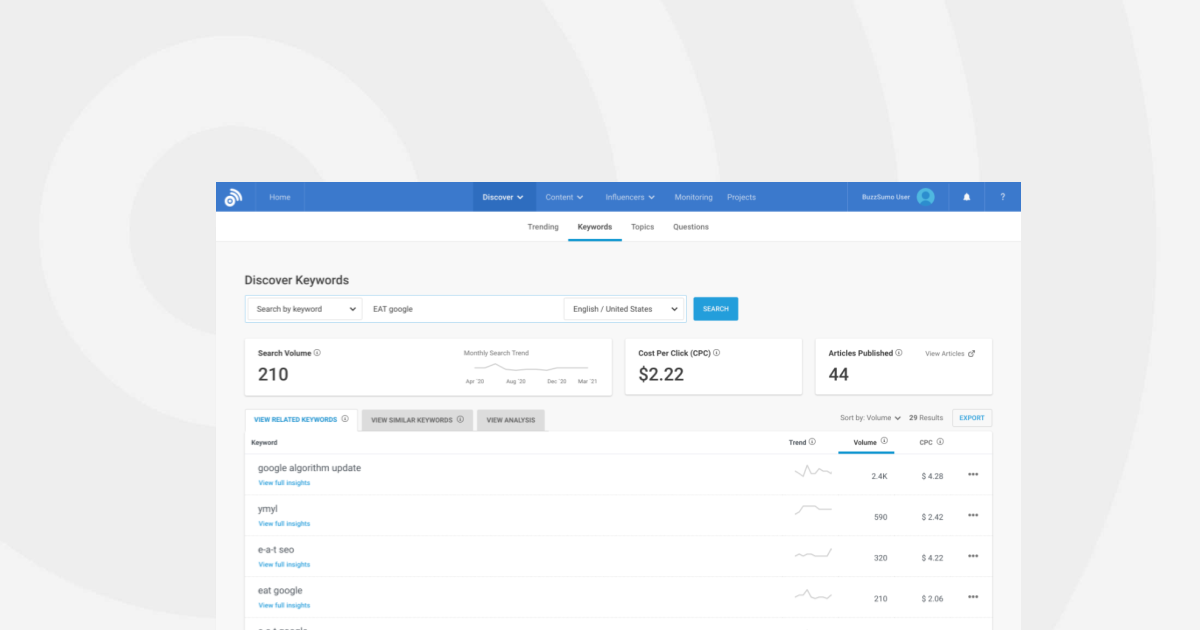
To understand what constitutes "quality" in your niche, analyze content that already performs well. Tools like BuzzSumo’s Content Analyzer offer valuable insights:
- Shares and Engagement: Identify content that garners significant social shares, comments, and other forms of engagement. High engagement often indicates that the content resonates deeply with the audience, fulfilling their needs and prompting interaction. For example, analyzing "Social Media Marketing" content might reveal that comprehensive guides or actionable tips generate the most buzz.
- Links: Examine top-linked articles. Backlinks from reputable sites are a strong signal of authoritativeness and trustworthiness, as other experts and publications are effectively endorsing the content.
- Evergreen Visibility: Prioritize content with a high "evergreen score," indicating sustained engagement and relevance over time. This suggests the content addresses fundamental, enduring questions within your topic.
- Rankings: Utilize keyword tools to see what content currently ranks highest for your target topics. Analyze the structure, depth, and quality of these top-performing pages to discern patterns and best practices.
By dissecting successful content, creators can reverse-engineer what makes it compelling and authoritative, integrating those learnings into their own strategy.
2. Cultivate and Display Authority:
Google actively encourages its quality raters to research the author and website to ascertain their topical authority. Building a strong personal and brand authority is a long-term investment with significant SEO benefits.
- Demonstrate Expertise: Actively participate in your niche. Seek opportunities for interviews, podcasts, webinars, and guest posts on reputable industry sites. This not only builds your profile but also creates a network of external validation.
- Monitor Niche Leaders: Keep track of established authorities in your field. Analyze their content, engagement, and external mentions to understand how they maintain their standing.
- Implement Schema Markup: Use Organization and Author schema markup to provide Google with structured data about your brand and content creators. This helps search engines connect your identity and credentials across the web.
- Consolidate Online Presence: Create a central hub (like a "Linktree" or "Beacons.ai" page) that lists all your professional profiles, publications, and channels.
- Transparent Author Bylines: Ensure all articles feature clear author bios that highlight relevant experience, qualifications, and any affiliations. This provides immediate credibility to the content.
3. Embrace a Topic-Centric Content Strategy:
Given Google’s move towards understanding entities and topics over isolated keywords, a topic-cluster approach is paramount.
- Pillar Content and Topic Clusters: Identify broad, foundational "pillar" topics within your niche. Create comprehensive, in-depth "pillar pages" for these topics. Then, develop numerous supporting "cluster content" articles that delve into specific sub-topics, linking them back to the main pillar page. This interconnected structure signals comprehensive coverage and deep authority on the overarching topic.
- Leverage Topic Research Tools: Tools like BuzzSumo’s Topics Explorer can help identify the most popular and relevant associated topics for a given keyword, guiding the development of effective pillar and cluster content. For instance, "Content Marketing" could be a pillar, with "Blogging," "SEO Writing," and "Email Marketing" as cluster topics.
- Proven Impact: SEO experts like Samuel Schmitt have demonstrated significant traffic boosts (e.g., 1,000% increase) by effectively implementing topic cluster models, underscoring their efficacy in modern SEO.
4. Craft a "Satisfying" Amount of Content:
The notion of an ideal content length is a persistent myth. Google’s guidance is to provide a "satisfying amount" of content, which is entirely dependent on user intent and the topic’s complexity.
- Intent-Driven Length: A quick answer to a simple question might require only a few hundred words, while a comprehensive guide on a complex subject could necessitate thousands. The goal is to fully address the user’s query without unnecessary fluff.
- Data-Backed Length Analysis: Use content analysis reports (e.g., BuzzSumo’s "Average engagement by content length") to understand the typical length of highly engaged content for your specific topic. For "Social Media Marketing," analysis might reveal an optimum range of 3,000-10,000 words for comprehensive guides, indicating that users expect depth for this subject.
5. Build Strategic Relationships, Not Just Links:
While backlinks remain important, Google’s semantic understanding means that genuine relationships and associations are increasingly influential.
- Cultivate Influencer Relationships: Identify credible authors, journalists, and publications in your niche using tools like BuzzSumo’s Journalist Database. Engage with them authentically, offer exclusive insights, and build rapport. The mantra "Mates First, Links Later" emphasizes building genuine connections over transactional link requests.
- Entity Recognition: Google’s algorithms can semantically understand when your brand or authorship is regularly referenced or associated with other influential "entities" (brands, experts) within a particular knowledge graph. Even without direct backlinks, these associations can significantly boost your perceived E-E-A-T.
- Outreach for Promotion and Collaboration: Focus on promoting your high-quality content to relevant journalists and influencers who might genuinely find it valuable for their audience or for their own research.
6. Provide Trusted and Diverse Sources:
Transparency and factual grounding are cornerstones of trustworthiness.
- Cite Credible Sources: Make it a standard practice to include a variety of reliable sources. This demonstrates thorough research, reduces bias, and allows users to verify information.
- Prioritize Official Sources: For data, statistics, or critical recommendations, always refer to official government bodies, academic institutions, and reputable research organizations. For example, when discussing vaccine-related news, utilizing Google’s advanced search
site:govcan help locate official government sources. - Embrace Outbound Links: Don’t fear linking out to authoritative external sources. While it might lead users away briefly, it signals that you prioritize providing comprehensive, well-researched information, enhancing your trustworthiness.
The Broader Implications for Content Marketing
The evolution of Google’s algorithms, driven by advancements in AI and machine learning, indicates a clear and irreversible trajectory: search engines are becoming increasingly adept at evaluating content with human-like discernment. This means that content creators and SEO professionals can no longer rely on superficial tactics. The future of content ranking lies in genuinely prioritizing the user experience by delivering content that demonstrates unparalleled Experience, Expertise, Authoritativeness, and Trustworthiness.
The shift towards E-E-A-T is not merely another SEO trend; it represents a fundamental reorientation of content strategy towards quality, integrity, and user satisfaction. Those who adapt swiftly, embracing the principles of E-E-A-T in their content planning, creation, and promotion, will not only secure higher rankings but also build stronger, more credible brands in the digital age. The imperative is clear: create content for your customers, not for a bygone era’s search engines.


 Nana
Nana
 Laily UPN