Google Search has officially commenced the integration of its newest large language model, Gemini 3.5 Flash-Lite, marking a significant step forward in the evolution of its search capabilities. The model is specifically being deployed to power "agentic search experiences," a concept Google introduced earlier this year, and is also widely anticipated to bolster the functionality of Google AI Overviews and the experimental AI Mode. Confirmation of this rollout came directly from Google, which stated on its official news blog, "3.5 Flash-Lite is also rolling out in Google Search."
The deployment of Gemini 3.5 Flash-Lite underscores Google’s commitment to advancing its generative AI initiatives within its core product. This model is engineered for scenarios demanding both low latency and high throughput, making it ideal for complex developer workflows, particularly in areas like agentic search and sophisticated document processing. Google explicitly highlighted "agentic search" as a prime example of its application.
Background: The Evolution of AI in Google Search
Google’s journey into integrating artificial intelligence into its search engine has been a progressive one, marked by several pivotal advancements over the past decade. Initially, AI was employed to enhance understanding of queries and relevance ranking, with breakthroughs like RankBrain in 2015, followed by BERT (Bidirectional Encoder Representations from Transformers) in 2019, which significantly improved the comprehension of nuanced language in search queries. The subsequent introduction of MUM (Multitask Unified Model) further extended Google’s ability to understand information across various modalities and languages, paving the way for more complex, multi-faceted search results.
The advent of generative AI models, particularly large language models (LLMs), has accelerated this trajectory. Google introduced its Gemini family of models in December 2023, positioning them as its "most capable and general models yet." The Gemini family, comprising Ultra, Pro, and Nano variants, was designed to be multimodal from the ground up, capable of understanding and operating across text, images, audio, and video. Gemini 1.5 Pro, launched in February 2024, notably expanded the context window to an unprecedented 1 million tokens, allowing for the processing of vast amounts of information simultaneously.
The concept of "agentic search" was formally unveiled at Google I/O in May 2024, alongside the announcement of Gemini 3.5 Flash and Gemini 3.5 Pro. Agentic search represents a paradigm shift from traditional keyword-based queries to a more interactive, goal-oriented experience. Instead of merely retrieving information, an agentic search system is designed to understand a user’s multi-step intent, break it down into sub-tasks, gather relevant information, process it, and even execute actions or provide synthesized, actionable insights. This capability is expected to be particularly transformative for complex planning, research, and problem-solving tasks. Information agents, a key component of this vision, were slated to launch first for Google AI Pro & Ultra subscribers in the summer of 2026, aligning with the current rollout timeline.
Alongside agentic search, Google has been actively developing "AI Overviews" and "AI Mode" within its search interface. AI Overviews provide AI-generated summaries at the top of search results, aiming to answer queries directly without requiring users to click through multiple links. AI Mode, an even more interactive experience, allows for conversational follow-ups and deeper exploration of topics. These features, while promising, have also faced scrutiny regarding accuracy and the potential for "hallucinations," prompting Google to continually refine their underlying models and deployment strategies. The integration of Gemini 3.5 Flash-Lite is a crucial step in enhancing the reliability and performance of these evolving AI-powered search components.

Gemini 3.5 Flash-Lite: Technical Specifications and Performance Benchmarks
Gemini 3.5 Flash-Lite stands out as Google’s "fastest, most cost-effective 3.5-class model." Engineered for efficiency, it boasts an impressive output rate of 350 tokens per second, as measured by the Artificial Analysis Index. This high throughput, combined with its low-latency design, makes it exceptionally well-suited for applications where rapid processing of large volumes of data is critical.
A key differentiator for 3.5 Flash-Lite is its significant performance improvement in agentic workflows compared to previous Flash-Lite generations. This is crucial for its role in agentic search, where the model needs to efficiently manage multi-step reasoning and task execution. Robby Stein, a prominent figure at Google, highlighted the model’s enhanced capabilities on X (formerly Twitter), stating, "It offers stronger instruction following and better understands user intent, so conversations flow much more seamlessly." This improved comprehension of user intent is paramount for agentic systems to accurately interpret complex requests and deliver relevant, coherent responses.
Google provided several compelling performance charts and benchmark results to illustrate the model’s advancements:
- Terminal-Bench 2.1: Gemini 3.5 Flash-Lite achieved a score of 54%, a substantial improvement over the prior generation’s 31%. This benchmark evaluates a model’s ability to perform tasks requiring interaction with a terminal or command-line interface, indicating a significant leap in its coding and operational capabilities.
- GDM-MRCR v2 (Google DeepMind – Multi-Round Conversational Reasoning): The model scored 72.2%, up from 60.1%. This metric assesses a model’s proficiency in long-context understanding and maintaining coherence over extended conversational interactions, a vital feature for seamless agentic dialogues.
- GDPval-AA v2 (Google DeepMind – Practical Agentic Evaluation): Gemini 3.5 Flash-Lite demonstrated a score of 1140, vastly outperforming the previous 642. This benchmark measures real-world task execution capabilities, showcasing the model’s practical efficacy in completing complex, multi-stage assignments.
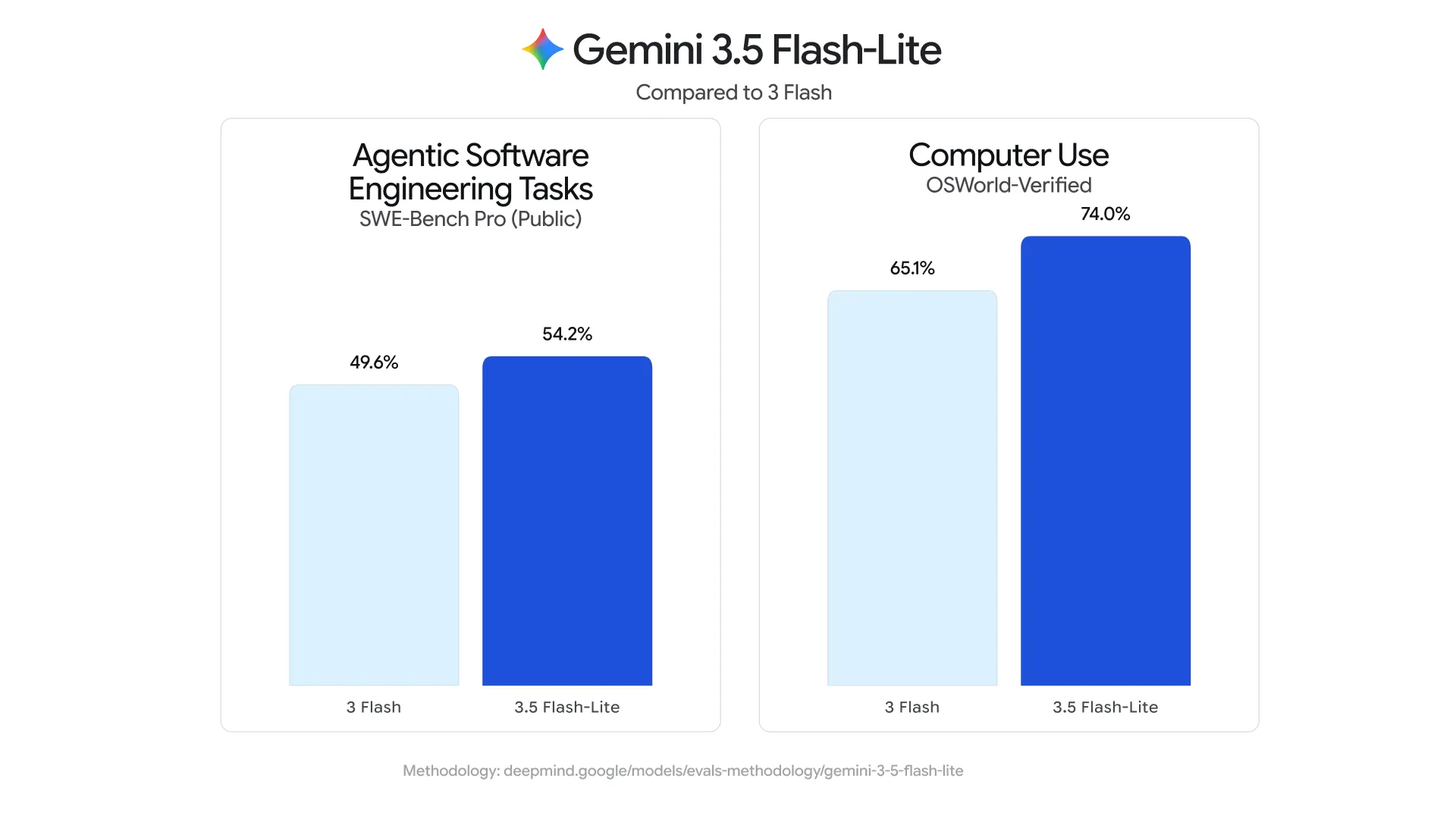
Remarkably, Gemini 3.5 Flash-Lite even surpasses its more robust counterpart, Gemini 3 Flash, in several critical agentic and coding evaluations:
- SWE-Bench Pro (Software Engineering Benchmark): Flash-Lite achieved 54.2% compared to Gemini 3 Flash’s 49.6%. This indicates superior performance in tasks related to software engineering, such as debugging or implementing code changes.
- OSWorld-Verified (Operating System World): The model scored 74.0% against Gemini 3 Flash’s 65.1%. This benchmark assesses a model’s ability to interact with and navigate operating system environments, further solidifying its prowess in agentic tasks that involve computer use.
These benchmarks collectively demonstrate that 3.5 Flash-Lite is not just a faster and more cost-effective option but also a significantly more capable model for a wide array of agentic and coding workloads, often outperforming even higher-tier predecessors.
Developer Implications and Configurable Intelligence
Beyond its direct impact on Google Search, Gemini 3.5 Flash-Lite offers substantial benefits for developers. Google emphasized that the model "enables efficient scaling for agentic systems." This is critical for developers looking to build sophisticated AI applications that can handle varying levels of complexity and user demand.
The model introduces configurable "thinking levels," allowing developers to optimize its behavior based on specific workload requirements. For high-volume tasks requiring minimal latency and cost, developers can configure the model to prioritize "minimal" or "low" thinking levels. Conversely, for more intricate, multi-step subagent workloads, developers can engage "higher thinking levels" to process complex logic and orchestrate multiple sub-tasks. This flexibility ensures that the model can be tailored to a broad spectrum of use cases, from simple, rapid queries to elaborate, multi-stage projects.
Furthermore, Google announced that 3.5 Flash-Lite now incorporates "computer use as a built-in tool." This integration allows the model to reliably support agentic tasks across various interfaces, effectively enabling it to interact with digital environments, retrieve information, and execute commands more autonomously. This feature is a game-changer for building truly intelligent agents that can extend their capabilities beyond mere text generation to actual task accomplishment within digital ecosystems.
Official Responses and Industry Reactions
The rollout has been met with positive commentary from Google officials and industry experts. Robby Stein’s aforementioned tweet underscored the model’s improved instruction following and user intent understanding, paving the way for "much more seamless" conversations. While the exact scope of this improvement (whether it applies broadly to AI Mode, AI Overviews, or exclusively agentic search) remained subject to some interpretation, the overall message was clear: a more intuitive and responsive AI is coming to Google Search.
Glenn Gabe, a well-known SEO expert and analyst, weighed in on the implications, connecting the 3.5 Flash-Lite deployment directly to the anticipated launch of search information agents. In a tweet, Gabe stated, "Search information agents are coming. This lays the foundation for that IMO. At I/O, Google said Search agents would launch this summer. Well, it’s summer. :)" He further cited Google’s I/O announcement: "Information agents will launch first for Google AI Pro & Ultra subscribers this summer." This contextualization highlights the strategic timing of the 3.5 Flash-Lite integration, positioning it as a foundational technology for Google’s next generation of AI-powered search features. Rajan Patel, another Google executive, amplified Stein’s message by referencing his tweet, further solidifying the company’s collective excitement and strategic alignment around this new model. These reactions collectively indicate that Google views 3.5 Flash-Lite as a critical enabler for its ambitious AI roadmap in search.
Broader Implications and Future Outlook
The integration of Gemini 3.5 Flash-Lite carries significant implications for the future of Google Search, the broader AI landscape, and user experience.
- Enhanced User Experience: For the average user, the most immediate benefit will likely be a faster, more accurate, and more conversational search experience. The model’s improved understanding of user intent and instruction following means queries will be interpreted more precisely, leading to more relevant and helpful results. Agentic search promises to transform how users tackle complex problems, allowing them to delegate multi-step tasks to the search engine itself, potentially reducing the time and effort required for research and planning.
- Acceleration of AI Overviews and AI Mode: While not explicitly confirmed for these features, the inherent capabilities of 3.5 Flash-Lite—its speed, cost-effectiveness, and enhanced reasoning—make it a strong candidate for powering or significantly improving AI Overviews and AI Mode. Faster processing means quicker AI-generated summaries and more fluid conversational interactions, addressing some of the performance concerns associated with these features.
- Competitive Edge: In the rapidly evolving AI space, continuous innovation is key. Google’s deployment of 3.5 Flash-Lite keeps it competitive with other tech giants like OpenAI and Microsoft, which are also heavily investing in generative AI for search and productivity tools. By offering a highly efficient and capable model, Google reinforces its position at the forefront of AI research and application.
- Democratization of Advanced AI: The "Lite" designation, coupled with its cost-effectiveness, suggests that advanced AI capabilities could become more widely accessible. This is not only beneficial for Google’s internal operations but also for developers leveraging Google’s AI platform, enabling them to build sophisticated AI-powered applications without incurring prohibitive costs or latency issues.
- Challenges and Responsible AI: As Google pushes the boundaries of AI in search, it must continue to address challenges related to accuracy, bias, and responsible deployment. Agentic systems, with their ability to perform actions, necessitate robust safeguards to prevent unintended consequences. Google’s ongoing efforts in responsible AI development will be crucial as these powerful models become more deeply embedded in everyday search interactions.
- Economic Impact: The efficiency of 3.5 Flash-Lite could lead to significant operational cost savings for Google, given the immense scale of its search infrastructure. These savings can then be reinvested in further research and development, creating a virtuous cycle of innovation.
In conclusion, the integration of Gemini 3.5 Flash-Lite into Google Search represents more than just an incremental update; it is a foundational shift towards a more intelligent, proactive, and agentic search experience. By leveraging this fast, cost-effective, and highly capable model, Google is laying the groundwork for a future where search engines not only answer questions but also assist users in accomplishing complex tasks, fundamentally reshaping how individuals interact with information and the digital world. The coming months, particularly as information agents become available to subscribers, will reveal the full extent of this transformation.